
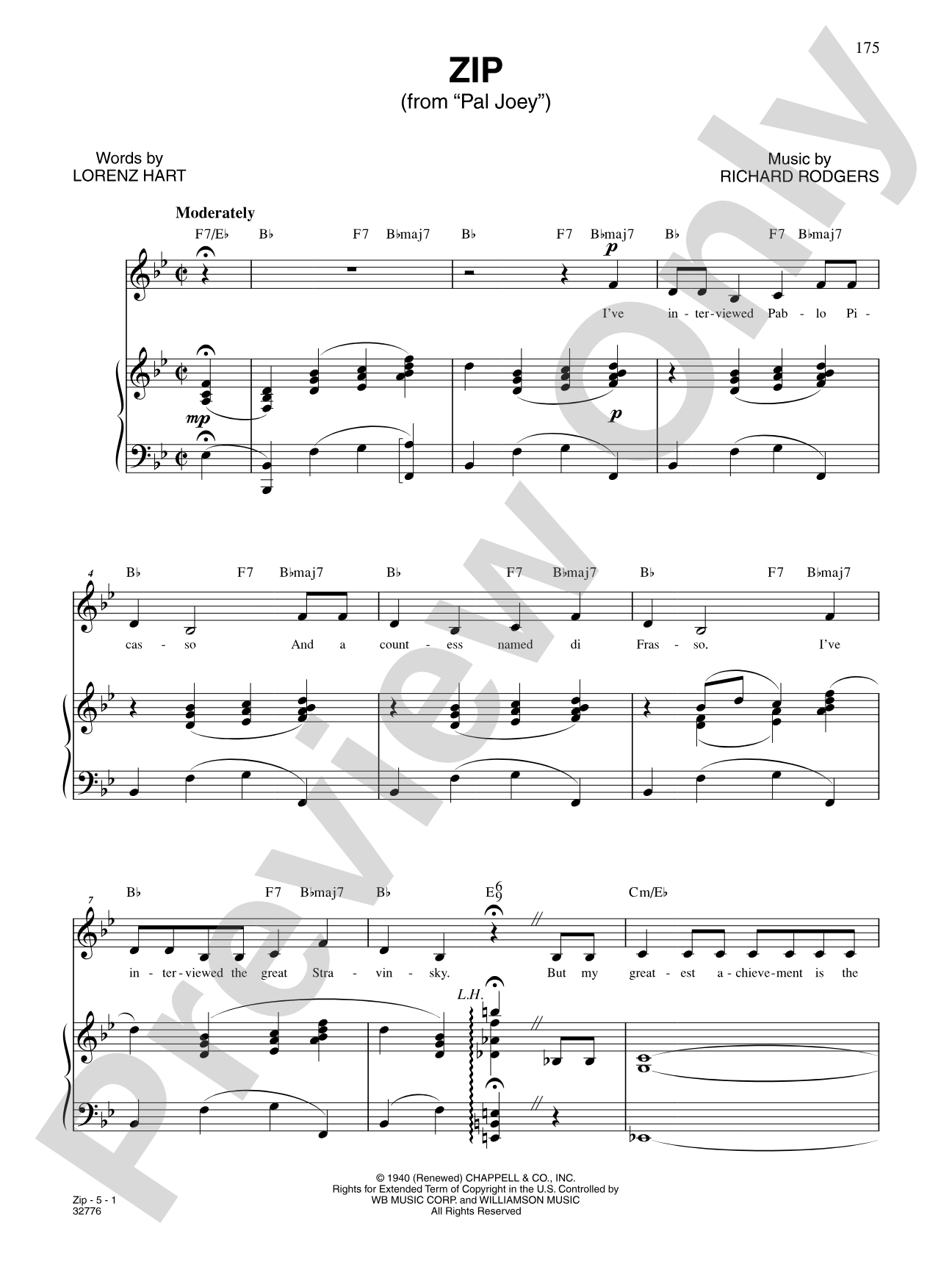

Zip (From "Pal Joey"): Piano/Vocal/Chords
Ed. Lisa DeSpain
Item: 00-PS-0010401
$4.99
One moment…
Related Items
Love in a Home (From "Li'l Abner"): Piano/Vocal/Chords |
$4.99
|
View | |
The Sailor of My Dreams: Piano/Vocal/Chords |
$4.99
|
View | |
Timid Frieda: Piano/Vocal/Chords |
$4.99
|
View | |
Goodbye, Little Dream, Goodbye (From "Red, Hot and Blue"): Piano/Vocal/Chords |
$4.99
|
View | |
A Little Bit of Good (From "Chicago"): Piano/Vocal/Chords |
$4.99
|
View | |
My Love Is on the Way (From "the Golden Apple"): Piano/Vocal/Chords |
$4.99
|
View | |
Just Imagine (From "Good News"): Piano/Vocal/Chords |
$4.99
|
View | |
A Little Bit in Love (From "Wonderful Town"): Piano/Vocal/Chords |
$5.99
|
View | |
Windflowers (From "the Golden Apple"): Piano/Vocal/Chords |
$4.99
|
View | |
Long Ago (From "Half a Sixpence"): Piano/Vocal/Chords |
$4.99
|
View | |
My Man's Gone Now (From "Porgy and Bess"): Piano/Vocal/Chords |
$5.99
|
View | |
This Is All Very New to Me: Piano/Vocal/Chords |
$5.99
|
View | |
Bring on Tomorrow (From "Fame-the Musical"): Piano/Vocal/Chords |
$5.99
|
View | |
All for You: Piano/Vocal/Chords |
$4.99
|
View | |
Only Love (From "the Scarlet Pimpernel"): Piano/Vocal/Chords |
$4.99
|
View | |
Mira (From "Carnival"): Piano/Vocal/Chords |
$4.99
|
View | |
I'm a Stranger Here Myself: Piano/Vocal/Chords |
$5.99
|
View | |
Tell Me (From "Marie Christine"): Piano/Vocal/Chords |
$4.99
|
View | |
Romance (From "the Desert Song"): Piano/Vocal/Chords |
$5.99
|
View | |
Why Shouldn't I? (From "Jubilee"): Piano/Vocal/Chords |
$4.99
|
View | |
The Sun, Whose Rays Are All Ablaze (From "The Mikado"): Piano/Vocal/Chords |
$4.99
|
View | |
Some Other Time (From "On the Town"): Piano/Vocal/Chords |
$5.99
|
View | |
Love Is Sweeping the Country (From "of Thee I Sing"): Piano/Vocal/Chords |
$5.99
|
View | |
Ballad of Dependency: Piano/Vocal/Chords |
$4.99
|
View | |
Patterns (From "Baby"): Piano/Vocal/Chords |
$5.99
|
View | |
The Boy Friend (From "the Boy Friend"): Piano/Vocal/Chords |
$4.99
|
View | |
I Speak Six Languages (From "the 25th Annual Putnam County Spelling Bee"): Piano/Vocal/Chords |
$5.99
|
View | |
Safety in Numbers: Piano/Vocal/Chords |
$4.99
|
View | |
Jilted: Piano/Vocal/Chords |
$4.99
|
View | |
Yes, My Heart: Piano/Vocal/Chords |
$9.99
|
View | |
Millwork (From "Working"): Piano/Vocal/Chords |
$5.99
|
View | |
Wonderful, Wonderful Day (From "Seven Brides for Seven Brothers"): Piano/Vocal/Chords |
$4.99
|
View | |
Over the Rainbow (From "the Wizard of Oz"): Piano/Vocal/Chords |
$4.99
|
View | |
My Own Best Friend (From "Chicago"): Piano/Vocal/Chords |
$4.99
|
View | |
How Can I Wait? (From "Paint Your Wagon"): Piano/Vocal/Chords |
$5.99
|
View | |
If You Hadn't but You Did (From "Two on the Aisle"): Piano/Vocal/Chords |
$5.99
|
View | |
Lazy Afternoon (From "The Golden Apple"): Piano/Vocal/Chords |
$4.99
|
View | |
What Is a Woman? (From "I Do, I Do"): Piano/Vocal/Chords |
$4.99
|
View | |
Ladies (From "Destry Rides Again"): Piano/Vocal/Chords |
$4.99
|
View | |
Think of Meryl Streep (From "Fame-the Musical"): Piano/Vocal/Chords |
$5.99
|
View | |
West End Avenue (From "The Magic Show"): Piano/Vocal/Chords |
$5.99
|
View | |
Notice Me, Horton (From "Seussical the Musical"): Piano/Vocal/Chords |
$5.99
|
View | |
My Cousin in Milwaukee (From "Pardon My English"): Piano/Vocal/Chords |
$5.99
|
View | |
Somewhere That's Green (From "Little Shop of Horrors"): Piano/Vocal/Chords |
$5.99
|
View | |
Old Friend (From "I'm Getting My Act Together and Taking It on the Road"): Piano/Vocal/Chords |
$5.99
|
View | |
Holding to the Ground (From "Falsettos"): Piano/Vocal/Chords |
$5.99
|
View | |
Back on Base (From "Closer than Ever"): Piano/Vocal/Chords |
$5.99
|
View | |
The Music Still Plays On (From "A New Brain"): Piano/Vocal/Chords |
$5.99
|
View | |
What a Nice Idea? (From "Two Gentlemen of Verona"): Piano/Vocal/Chords |
$4.99
|
View | |
Mad About the Boy (From "Words and Music"): Piano/Vocal/Chords |
$5.99
|
View |
Description
For aspiring and professional singers who love Broadway, Alfred's Singer's Library of Musical Theatre presents an elegant collection of the best-loved musical theatre songs in their original keys, authentically transcribed from their original vocal scores. Perfect for study, and equally suitable for the most important auditions and performances, each volume is dedicated to a specific vocal range, and contains dozens of songs from a variety of shows that span decades of theatre history. Multiple volumes are available for each of four vocal ranges: Soprano, Mezzo-Soprano/Alto, Tenor, and Baritone/Bass. Authoritative historical and contextual commentary, audition tips, and 16-bar cut suggestions for each song make it the most useful and relevant song library of its kind.
Titles: My Own Best Friend (Chicago) * Back on Base (Closer Than Ever) * That Mister Man of Mine (Dames At Sea) * A Little Brains, A Little Talent (Damn Yankees) * Something of My Own (Dessa Rose) * Ladies (Destry Rides Again) * I Know the Truth (Elton John and Tim Rice's "Aida") * Holding to the Ground (Falsettos) * Think of Meryl Streep (Fame: The Musical) * A Little Girl From Little Rock (Gentlemen Prefer Blondes) * Lazy Afternoon (The Golden Apple) * What Is a Woman? I Do, I Do) * Old Friend (I'm Getting My Act Together and Taking It on the Road) * Last Midnight (Into The Woods) * Moments in the Woods (Into The Woods) * Somewhere That's Green (Little hop of Horrors) * West End Avenue (The Magic Show) * Tell Me Why (A Man of No Importance) * Take It on the Chin (Me and My Girl) * Like It Was (Merrily We Roll Along) * The Music Still Plays On A New Brain) * Mad About the Boy (Oh! Coward) * It's a Fine Life (Oliver!) * How Can I Wait? (Paint Your Wagon) * Zip (Pal Joey) * My Cousin in Milwaukee (Pardon My English) * Notice Me Horton (Seussical the Musical) * Wonderful, Wonderful Day (Seven Brides For Seven Brothers) * What Nice Idea (Two Gentlemen of Verona) * If You Hadn't but You Did (Two on the Aisle ) * Over the Rainbow (The Wizard of Oz) * Millwork (Working).


Titles: My Own Best Friend (Chicago) * Back on Base (Closer Than Ever) * That Mister Man of Mine (Dames At Sea) * A Little Brains, A Little Talent (Damn Yankees) * Something of My Own (Dessa Rose) * Ladies (Destry Rides Again) * I Know the Truth (Elton John and Tim Rice's "Aida") * Holding to the Ground (Falsettos) * Think of Meryl Streep (Fame: The Musical) * A Little Girl From Little Rock (Gentlemen Prefer Blondes) * Lazy Afternoon (The Golden Apple) * What Is a Woman? I Do, I Do) * Old Friend (I'm Getting My Act Together and Taking It on the Road) * Last Midnight (Into The Woods) * Moments in the Woods (Into The Woods) * Somewhere That's Green (Little hop of Horrors) * West End Avenue (The Magic Show) * Tell Me Why (A Man of No Importance) * Take It on the Chin (Me and My Girl) * Like It Was (Merrily We Roll Along) * The Music Still Plays On A New Brain) * Mad About the Boy (Oh! Coward) * It's a Fine Life (Oliver!) * How Can I Wait? (Paint Your Wagon) * Zip (Pal Joey) * My Cousin in Milwaukee (Pardon My English) * Notice Me Horton (Seussical the Musical) * Wonderful, Wonderful Day (Seven Brides For Seven Brothers) * What Nice Idea (Two Gentlemen of Verona) * If You Hadn't but You Did (Two on the Aisle ) * Over the Rainbow (The Wizard of Oz) * Millwork (Working).
Discover MakeMusic Cloud: thousands of interactive titles your students can play along with today.
Sample Audio
1
Over The Rainbow from The Wizard Of Oz
--:--
Over The Rainbow from The Wizard Of Oz
0:00
0:00
Sample Video
No sample videos found.
Additional Details
Series:
Singer's Library of Musical Theatre
Publisher:
Alfred Music
Page Count:
224
SKU:
00-PS-0010401
More about this title
About the Composer: Richard Rodgers
Richard Rodgers revolutionized American musical theater by proving that sophisticated harmony and memorable melody could coexist in songs written for the stage. His partnership with lyricist Lorenz Hart produced some of Broadway's most enduring standards, while his later work with Oscar Hammerstein II established the modern musical as a cohesive dramatic form. For singers and musicians, Rodgers's output represents an unmatched study in vocal writing across multiple ranges and styles.
What makes Rodgers essential in music education is his economy of means. His melodies sit naturally in the voice, his harmonic progressions teach functional tonality without pretension, and his songs remain genuinely singable whether you're preparing for an audition or exploring the American songbook in a classroom setting.
Why we love this
Rodgers wrote for real singers with real ranges, which means every song in this collection sits where it should sit for your voice type. The contextual notes and 16-bar cut suggestions reflect decades of audition experience, saving you from the guesswork that typically comes with preparing these songs. You're not just getting sheet music; you're getting a master class wrapped around it.
What to expect
These songs carry the sophistication of mid-20th-century Broadway without ever becoming precious or dated. The melodies feel inevitable once you know them, the lyrics hit with genuine wit or warmth, and the harmonies support your voice in ways that feel both respectful and alive.
Who it's for
This collection serves singers preparing for auditions, whether you're building a book for musical theater callbacks or exploring the Broadway repertoire in a voice studio. It's equally valuable for choir directors seeking solo literature with real dramatic substance and for music students who want to understand how American songwriting actually works.
How to get the most out of it
- Study the harmonic progression underneath your melody line. Rodgers's chords often tell you where the emotional weight of a phrase lands, and singing with awareness of that structure gives your interpretation real foundation.
- Use the original key provided here as your starting point for auditions. These transcriptions preserve the arrangements singers hear on cast recordings, which matters more than you might think when casting directors are familiar with the material.
- Read through the contextual commentary before diving into the music. Understanding the character's situation and the song's dramatic purpose eliminates a lot of interpretive second-guessing.
How to use it
Feature one of these songs as a solo or small ensemble moment in a concert program where you need musical theater representation without overshadowing the rest of your selections. The variety of shows and song types means you can build a coherent program around a single volume by pairing selections that speak to each other dramatically or thematically.
Skills your students will build
- Singing in the original keys of Broadway standards with historical accuracy
- Reading piano-vocal scores with chord symbols
- Interpreting character context and dramatic intention from printed stage directions
- Preparing audition cuts using industry-standard conventions
- Recognizing and executing Rodgers's characteristic melodic shapes and harmonic progressions