
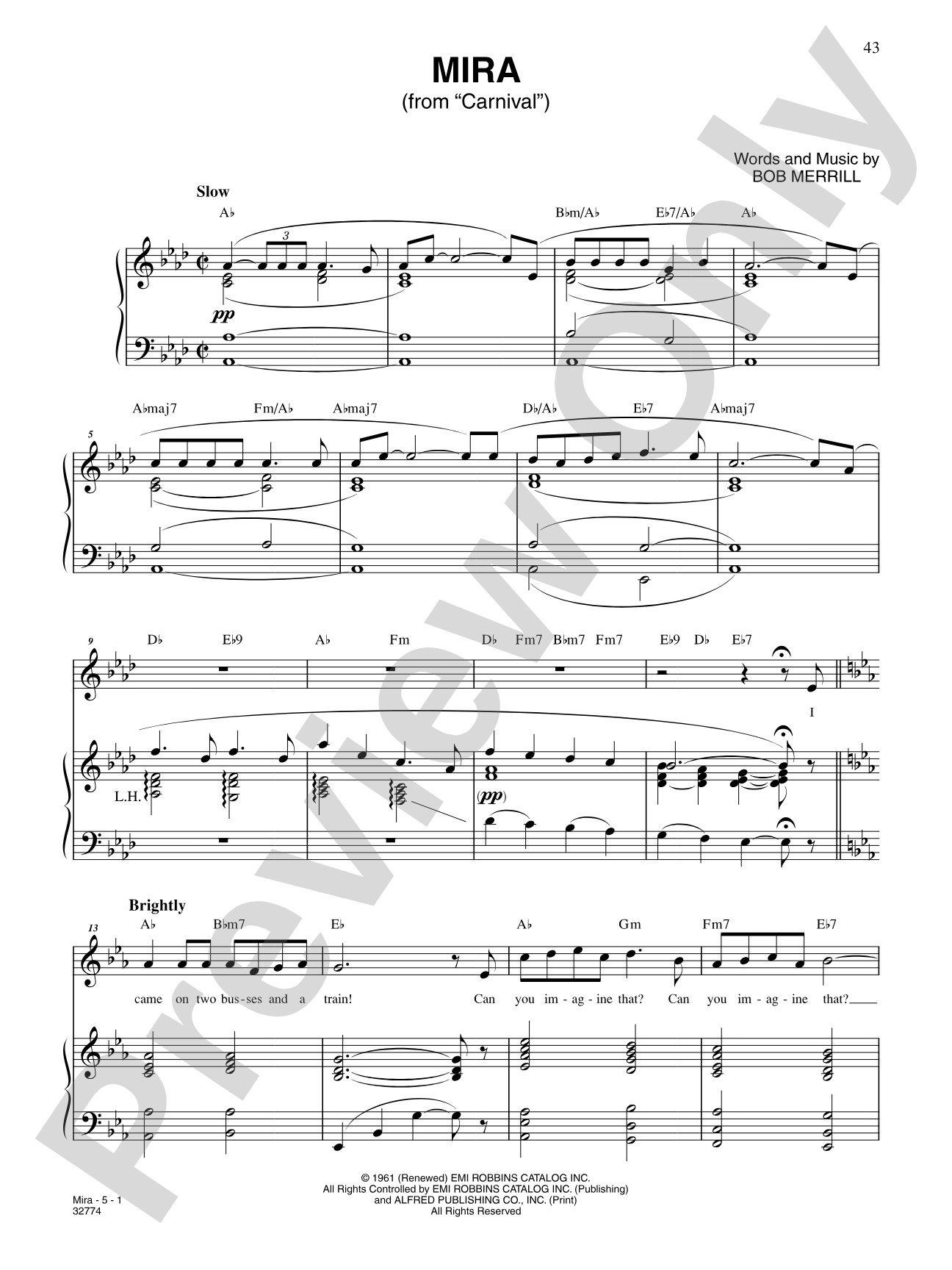

Mira (From "Carnival"): Piano/Vocal/Chords
Ed. Lisa DeSpain
Item: 00-PS-0010410
$4.99
One moment…
Related Items
Love in a Home (From "Li'l Abner"): Piano/Vocal/Chords |
$4.99
|
View | |
The Sailor of My Dreams: Piano/Vocal/Chords |
$4.99
|
View | |
Timid Frieda: Piano/Vocal/Chords |
$4.99
|
View | |
Goodbye, Little Dream, Goodbye (From "Red, Hot and Blue"): Piano/Vocal/Chords |
$4.99
|
View | |
A Little Bit of Good (From "Chicago"): Piano/Vocal/Chords |
$4.99
|
View | |
My Love Is on the Way (From "the Golden Apple"): Piano/Vocal/Chords |
$4.99
|
View | |
Just Imagine (From "Good News"): Piano/Vocal/Chords |
$4.99
|
View | |
A Little Bit in Love (From "Wonderful Town"): Piano/Vocal/Chords |
$5.99
|
View | |
Windflowers (From "the Golden Apple"): Piano/Vocal/Chords |
$4.99
|
View | |
Long Ago (From "Half a Sixpence"): Piano/Vocal/Chords |
$4.99
|
View | |
My Man's Gone Now (From "Porgy and Bess"): Piano/Vocal/Chords |
$5.99
|
View | |
This Is All Very New to Me: Piano/Vocal/Chords |
$5.99
|
View | |
Bring on Tomorrow (From "Fame-the Musical"): Piano/Vocal/Chords |
$5.99
|
View | |
All for You: Piano/Vocal/Chords |
$4.99
|
View | |
Only Love (From "the Scarlet Pimpernel"): Piano/Vocal/Chords |
$4.99
|
View | |
I'm a Stranger Here Myself: Piano/Vocal/Chords |
$5.99
|
View | |
Tell Me (From "Marie Christine"): Piano/Vocal/Chords |
$4.99
|
View | |
Romance (From "the Desert Song"): Piano/Vocal/Chords |
$5.99
|
View | |
Why Shouldn't I? (From "Jubilee"): Piano/Vocal/Chords |
$4.99
|
View | |
The Sun, Whose Rays Are All Ablaze (From "The Mikado"): Piano/Vocal/Chords |
$4.99
|
View | |
Some Other Time (From "On the Town"): Piano/Vocal/Chords |
$5.99
|
View | |
Love Is Sweeping the Country (From "of Thee I Sing"): Piano/Vocal/Chords |
$5.99
|
View | |
Ballad of Dependency: Piano/Vocal/Chords |
$4.99
|
View | |
Patterns (From "Baby"): Piano/Vocal/Chords |
$5.99
|
View | |
The Boy Friend (From "the Boy Friend"): Piano/Vocal/Chords |
$4.99
|
View | |
I Speak Six Languages (From "the 25th Annual Putnam County Spelling Bee"): Piano/Vocal/Chords |
$5.99
|
View | |
Safety in Numbers: Piano/Vocal/Chords |
$4.99
|
View | |
Jilted: Piano/Vocal/Chords |
$4.99
|
View | |
Yes, My Heart: Piano/Vocal/Chords |
$9.99
|
View | |
Millwork (From "Working"): Piano/Vocal/Chords |
$5.99
|
View | |
Wonderful, Wonderful Day (From "Seven Brides for Seven Brothers"): Piano/Vocal/Chords |
$4.99
|
View | |
Over the Rainbow (From "the Wizard of Oz"): Piano/Vocal/Chords |
$4.99
|
View | |
My Own Best Friend (From "Chicago"): Piano/Vocal/Chords |
$4.99
|
View | |
How Can I Wait? (From "Paint Your Wagon"): Piano/Vocal/Chords |
$5.99
|
View | |
If You Hadn't but You Did (From "Two on the Aisle"): Piano/Vocal/Chords |
$5.99
|
View | |
Lazy Afternoon (From "The Golden Apple"): Piano/Vocal/Chords |
$4.99
|
View | |
What Is a Woman? (From "I Do, I Do"): Piano/Vocal/Chords |
$4.99
|
View | |
Zip (From "Pal Joey"): Piano/Vocal/Chords |
$4.99
|
View | |
Ladies (From "Destry Rides Again"): Piano/Vocal/Chords |
$4.99
|
View | |
Think of Meryl Streep (From "Fame-the Musical"): Piano/Vocal/Chords |
$5.99
|
View | |
West End Avenue (From "The Magic Show"): Piano/Vocal/Chords |
$5.99
|
View | |
Notice Me, Horton (From "Seussical the Musical"): Piano/Vocal/Chords |
$5.99
|
View | |
My Cousin in Milwaukee (From "Pardon My English"): Piano/Vocal/Chords |
$5.99
|
View | |
Somewhere That's Green (From "Little Shop of Horrors"): Piano/Vocal/Chords |
$5.99
|
View | |
Old Friend (From "I'm Getting My Act Together and Taking It on the Road"): Piano/Vocal/Chords |
$5.99
|
View | |
Holding to the Ground (From "Falsettos"): Piano/Vocal/Chords |
$5.99
|
View | |
Back on Base (From "Closer than Ever"): Piano/Vocal/Chords |
$5.99
|
View | |
The Music Still Plays On (From "A New Brain"): Piano/Vocal/Chords |
$5.99
|
View | |
What a Nice Idea? (From "Two Gentlemen of Verona"): Piano/Vocal/Chords |
$4.99
|
View | |
Mad About the Boy (From "Words and Music"): Piano/Vocal/Chords |
$5.99
|
View |
Description
For aspiring and professional singers who love Broadway, Alfred's Singer's Library of Musical Theatre presents an elegant collection of the best-loved musical theatre songs in their original keys, authentically transcribed from their original vocal scores. Perfect for study, and equally suitable for the most important auditions and performances, each volume is dedicated to a specific vocal range, and contains dozens of songs from a variety of shows that span decades of theatre history. Multiple volumes are available for each of four vocal ranges: Soprano, Mezzo-Soprano/Alto, Tenor, and Baritone/Bass. Authoritative historical and contextual commentary, audition tips, and 16-bar cut suggestions for each song make it the most useful and relevant song library of its kind.
Titles: All for You (Saturday Night) * Autumn (Starting Here, Starting Now) * Ballad of Dependency (The Threepenny Opera) * The Boy Friend (The Boy Friend) * Bring on Tomorrow (Fame -- The Musical) * Goodbye, Little Dream, Goodbye (Anything Goes 1988 Revival) * I Speak Six Languages (The 25th Annual Putnam County Spelling Bee) * I'm a Stranger Here Myself (One Touch of Venus) * Jilted (Of Thee I Sing) * Just Imagine (Good News) * A Little Bit in Love (Wonderful Town) * A Little Bit of Good (Chicago) * Long Ago (Half a Sixpense) * Love in a Home (Lil' Abner) * Love Is Sweeping the Country (Of Thee I Sing) * Mira (Carnival) * My Love Is on the Way (The Golden Apple) * My Man's Gone Now (Porgy and Bess) * Once Upon a Dream (Jekyll & Hyde) * Only Love (Scarlet Pimpernel) * Patterns (Closer Than Ever) * Practically Perfect (Mary Poppins -- Stage Version) * Romance (The Desert Song) * Safety in Numbers (The Boy Friend) * The Sailor of My Dreams (Dames at Sea) * Some Other Time (On the Town)* The Sun Whose Rays Are All Ablaze (The Mikado) * Tell Me (Marie Christine) * This Is All Very New to Me (Plain and Fancy) * Timid Frieda (Les Timides) (Jacques Brel Is Alive & Well & Living in Paris) * Was She Prettier Than I? (High Spirits) * Why Shouldn't I? (Jubilee) * Windflowers (The Golden Apple) * Yes, My Heart (Carnival).


Titles: All for You (Saturday Night) * Autumn (Starting Here, Starting Now) * Ballad of Dependency (The Threepenny Opera) * The Boy Friend (The Boy Friend) * Bring on Tomorrow (Fame -- The Musical) * Goodbye, Little Dream, Goodbye (Anything Goes 1988 Revival) * I Speak Six Languages (The 25th Annual Putnam County Spelling Bee) * I'm a Stranger Here Myself (One Touch of Venus) * Jilted (Of Thee I Sing) * Just Imagine (Good News) * A Little Bit in Love (Wonderful Town) * A Little Bit of Good (Chicago) * Long Ago (Half a Sixpense) * Love in a Home (Lil' Abner) * Love Is Sweeping the Country (Of Thee I Sing) * Mira (Carnival) * My Love Is on the Way (The Golden Apple) * My Man's Gone Now (Porgy and Bess) * Once Upon a Dream (Jekyll & Hyde) * Only Love (Scarlet Pimpernel) * Patterns (Closer Than Ever) * Practically Perfect (Mary Poppins -- Stage Version) * Romance (The Desert Song) * Safety in Numbers (The Boy Friend) * The Sailor of My Dreams (Dames at Sea) * Some Other Time (On the Town)* The Sun Whose Rays Are All Ablaze (The Mikado) * Tell Me (Marie Christine) * This Is All Very New to Me (Plain and Fancy) * Timid Frieda (Les Timides) (Jacques Brel Is Alive & Well & Living in Paris) * Was She Prettier Than I? (High Spirits) * Why Shouldn't I? (Jubilee) * Windflowers (The Golden Apple) * Yes, My Heart (Carnival).
Discover MakeMusic Cloud: thousands of interactive titles your students can play along with today.
Sample Audio
1
Lucky To Be Me from On The Town
--:--
Lucky To Be Me from On The Town
0:00
0:00
Sample Video
No sample videos found.
Additional Details
Series:
Singer's Library of Musical Theatre
Publisher:
Alfred Music
Page Count:
196
SKU:
00-PS-0010410
More about this title
About the Composer: Bob Merrill
Bob Merrill (1921-1998) composed and wrote lyrics for some of Broadway's most enduring musical theatre scores. His gift for crafting singable melodies and emotionally direct lyrics shaped productions from the 1950s through the 1980s, including Carnival, Wonderfultown, and Lil' Abner. Merrill's work bridges the golden age of musical theatre with later developments in the form, making his catalogue essential study for singers navigating the full span of Broadway repertoire.
As both composer and lyricist, Merrill understood the intimate relationship between music and text in the theatre. His songs reward detailed attention to character, intention, and the specific dramatic moment each one occupies within its show. For singers and voice teachers, his work offers masterclasses in how melody and language work together to serve storytelling.
Why we love this
This collection gives singers access to Merrill's full range without having to hunt through multiple vocal collections or original cast recordings. The original keys preserve the dramatic and vocal choices Merrill made for each character, and the contextual notes help singers understand not just the song but its purpose within the show. For auditions and recitals alike, having these songs authentically transcribed and organized by vocal range removes a major preparation barrier.
What to expect
Merrill's songs carry warmth and directness. You'll find character-driven moments that ask you to embody a specific person in a specific circumstance, alongside songs with broader emotional appeal. The melodies are designed to sit comfortably in the voice while remaining dramatically expressive. Singing his work feels like having a conversation with the audience about something that genuinely matters to the character.
Who it's for
This collection serves singers preparing auditions, building their performance repertoire, or studying the craft of musical theatre song. Whether you're a high school singer exploring Broadway, a college vocal performance major, or a professional working toward your next role, having Merrill's songs in their original keys and with historical context makes preparation focused and efficient.
How to get the most out of it
- Read the historical and contextual commentary before you sing. Understanding which character sings this song, what they want in the moment, and how it fits the larger story shapes every interpretive choice you make.
- Study the original cast recording if available, but use it as a reference for phrasing and intention, not as a template to imitate. Your voice, your age, and your interpretation bring something new to the character.
- Experiment with the 16-bar cut suggestions if you're preparing for auditions, but sing the full song in rehearsal and performance. The cuts are tools for audition time constraints, not artistic statements.
- Pay attention to the lyrics and how they sit on the melody. Merrill's words were written to land on specific notes for a reason. Honor that relationship even as you find your own voice in the part.
How to use it
Pair these songs with other selections from the same shows to build a thematic audition set, or mix and match across Merrill's catalogue to showcase range and versatility. The collection works equally well for a senior recital focused on American musical theatre or for strategic audition preparation across multiple vocal ranges. Use the contextual notes to craft program notes that deepen audience connection to each song's theatrical origin.
Skills your students will build
- Singing character-driven narrative moments with emotional specificity
- Reading and interpreting musical theatre as dramatic text, not just melody
- Applying historical and contextual knowledge to interpretive choices
- Finding authentic expression within the constraints of a composed line
- Building a sustainable audition repertoire across multiple vocal ranges