
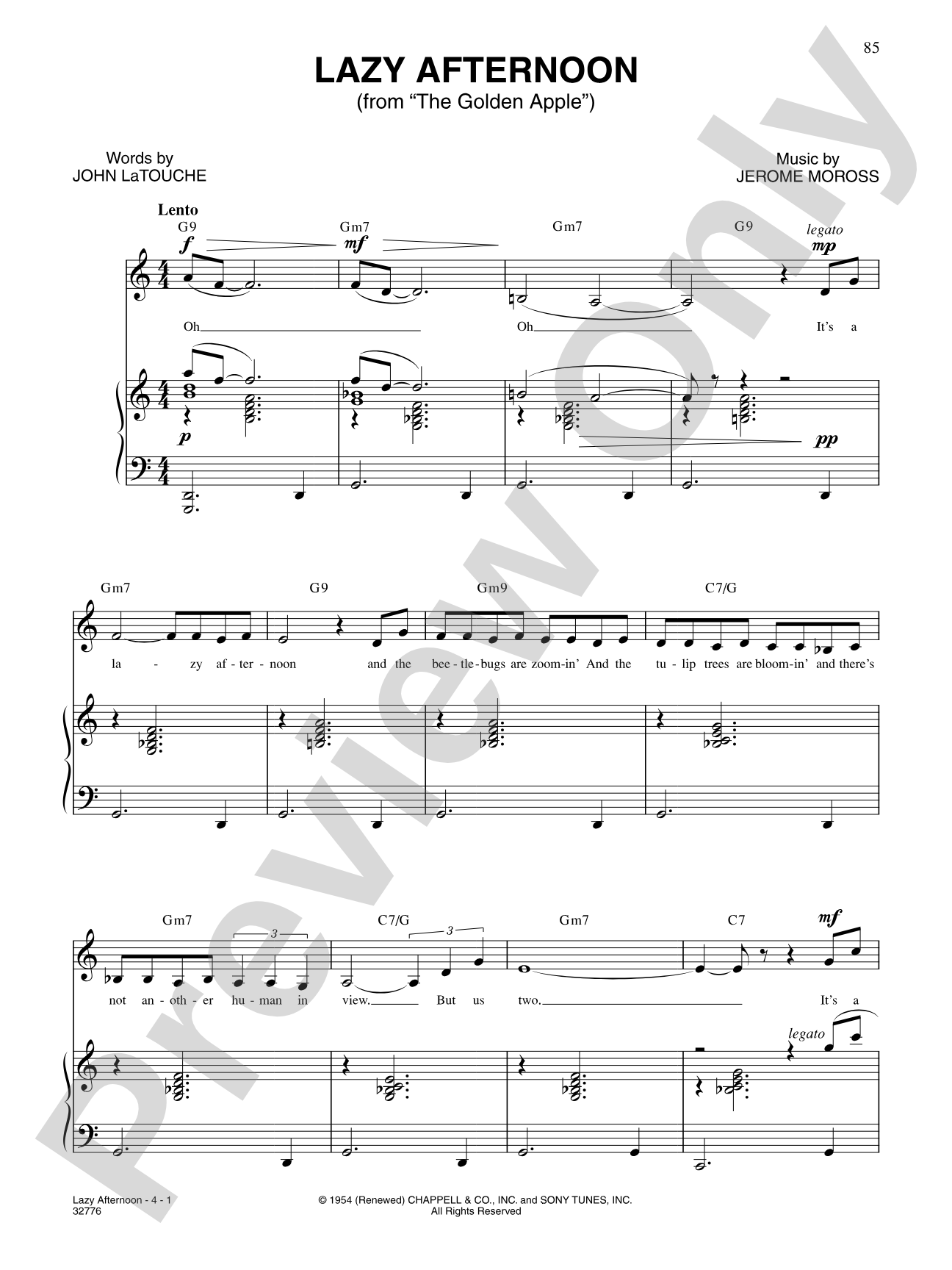

Lazy Afternoon (From "The Golden Apple"): Piano/Vocal/Chords
Ed. Lisa DeSpain
Item: 00-PS-0010385
$4.99
One moment…
Related Items
Love in a Home (From "Li'l Abner"): Piano/Vocal/Chords |
$4.99
|
View | |
The Sailor of My Dreams: Piano/Vocal/Chords |
$4.99
|
View | |
Timid Frieda: Piano/Vocal/Chords |
$4.99
|
View | |
Goodbye, Little Dream, Goodbye (From "Red, Hot and Blue"): Piano/Vocal/Chords |
$4.99
|
View | |
A Little Bit of Good (From "Chicago"): Piano/Vocal/Chords |
$4.99
|
View | |
My Love Is on the Way (From "the Golden Apple"): Piano/Vocal/Chords |
$4.99
|
View | |
Just Imagine (From "Good News"): Piano/Vocal/Chords |
$4.99
|
View | |
A Little Bit in Love (From "Wonderful Town"): Piano/Vocal/Chords |
$5.99
|
View | |
Windflowers (From "the Golden Apple"): Piano/Vocal/Chords |
$4.99
|
View | |
Long Ago (From "Half a Sixpence"): Piano/Vocal/Chords |
$4.99
|
View | |
My Man's Gone Now (From "Porgy and Bess"): Piano/Vocal/Chords |
$5.99
|
View | |
This Is All Very New to Me: Piano/Vocal/Chords |
$5.99
|
View | |
Bring on Tomorrow (From "Fame-the Musical"): Piano/Vocal/Chords |
$5.99
|
View | |
All for You: Piano/Vocal/Chords |
$4.99
|
View | |
Only Love (From "the Scarlet Pimpernel"): Piano/Vocal/Chords |
$4.99
|
View | |
Mira (From "Carnival"): Piano/Vocal/Chords |
$4.99
|
View | |
I'm a Stranger Here Myself: Piano/Vocal/Chords |
$5.99
|
View | |
Tell Me (From "Marie Christine"): Piano/Vocal/Chords |
$4.99
|
View | |
Romance (From "the Desert Song"): Piano/Vocal/Chords |
$5.99
|
View | |
Why Shouldn't I? (From "Jubilee"): Piano/Vocal/Chords |
$4.99
|
View | |
The Sun, Whose Rays Are All Ablaze (From "The Mikado"): Piano/Vocal/Chords |
$4.99
|
View | |
Some Other Time (From "On the Town"): Piano/Vocal/Chords |
$5.99
|
View | |
Love Is Sweeping the Country (From "of Thee I Sing"): Piano/Vocal/Chords |
$5.99
|
View | |
Ballad of Dependency: Piano/Vocal/Chords |
$4.99
|
View | |
Patterns (From "Baby"): Piano/Vocal/Chords |
$5.99
|
View | |
The Boy Friend (From "the Boy Friend"): Piano/Vocal/Chords |
$4.99
|
View | |
I Speak Six Languages (From "the 25th Annual Putnam County Spelling Bee"): Piano/Vocal/Chords |
$5.99
|
View | |
Safety in Numbers: Piano/Vocal/Chords |
$4.99
|
View | |
Jilted: Piano/Vocal/Chords |
$4.99
|
View | |
Yes, My Heart: Piano/Vocal/Chords |
$9.99
|
View | |
Millwork (From "Working"): Piano/Vocal/Chords |
$5.99
|
View | |
Wonderful, Wonderful Day (From "Seven Brides for Seven Brothers"): Piano/Vocal/Chords |
$4.99
|
View | |
Over the Rainbow (From "the Wizard of Oz"): Piano/Vocal/Chords |
$4.99
|
View | |
My Own Best Friend (From "Chicago"): Piano/Vocal/Chords |
$4.99
|
View | |
How Can I Wait? (From "Paint Your Wagon"): Piano/Vocal/Chords |
$5.99
|
View | |
If You Hadn't but You Did (From "Two on the Aisle"): Piano/Vocal/Chords |
$5.99
|
View | |
What Is a Woman? (From "I Do, I Do"): Piano/Vocal/Chords |
$4.99
|
View | |
Zip (From "Pal Joey"): Piano/Vocal/Chords |
$4.99
|
View | |
Ladies (From "Destry Rides Again"): Piano/Vocal/Chords |
$4.99
|
View | |
Think of Meryl Streep (From "Fame-the Musical"): Piano/Vocal/Chords |
$5.99
|
View | |
West End Avenue (From "The Magic Show"): Piano/Vocal/Chords |
$5.99
|
View | |
Notice Me, Horton (From "Seussical the Musical"): Piano/Vocal/Chords |
$5.99
|
View | |
My Cousin in Milwaukee (From "Pardon My English"): Piano/Vocal/Chords |
$5.99
|
View | |
Somewhere That's Green (From "Little Shop of Horrors"): Piano/Vocal/Chords |
$5.99
|
View | |
Old Friend (From "I'm Getting My Act Together and Taking It on the Road"): Piano/Vocal/Chords |
$5.99
|
View | |
Holding to the Ground (From "Falsettos"): Piano/Vocal/Chords |
$5.99
|
View | |
Back on Base (From "Closer than Ever"): Piano/Vocal/Chords |
$5.99
|
View | |
The Music Still Plays On (From "A New Brain"): Piano/Vocal/Chords |
$5.99
|
View | |
What a Nice Idea? (From "Two Gentlemen of Verona"): Piano/Vocal/Chords |
$4.99
|
View | |
Mad About the Boy (From "Words and Music"): Piano/Vocal/Chords |
$5.99
|
View |
Description
For aspiring and professional singers who love Broadway, Alfred's Singer's Library of Musical Theatre presents an elegant collection of the best-loved musical theatre songs in their original keys, authentically transcribed from their original vocal scores. Perfect for study, and equally suitable for the most important auditions and performances, each volume is dedicated to a specific vocal range, and contains dozens of songs from a variety of shows that span decades of theatre history. Multiple volumes are available for each of four vocal ranges: Soprano, Mezzo-Soprano/Alto, Tenor, and Baritone/Bass. Authoritative historical and contextual commentary, audition tips, and 16-bar cut suggestions for each song make it the most useful and relevant song library of its kind.
Titles: My Own Best Friend (Chicago) * Back on Base (Closer Than Ever) * That Mister Man of Mine (Dames At Sea) * A Little Brains, A Little Talent (Damn Yankees) * Something of My Own (Dessa Rose) * Ladies (Destry Rides Again) * I Know the Truth (Elton John and Tim Rice's "Aida") * Holding to the Ground (Falsettos) * Think of Meryl Streep (Fame: The Musical) * A Little Girl From Little Rock (Gentlemen Prefer Blondes) * Lazy Afternoon (The Golden Apple) * What Is a Woman? I Do, I Do) * Old Friend (I'm Getting My Act Together and Taking It on the Road) * Last Midnight (Into The Woods) * Moments in the Woods (Into The Woods) * Somewhere That's Green (Little hop of Horrors) * West End Avenue (The Magic Show) * Tell Me Why (A Man of No Importance) * Take It on the Chin (Me and My Girl) * Like It Was (Merrily We Roll Along) * The Music Still Plays On A New Brain) * Mad About the Boy (Oh! Coward) * It's a Fine Life (Oliver!) * How Can I Wait? (Paint Your Wagon) * Zip (Pal Joey) * My Cousin in Milwaukee (Pardon My English) * Notice Me Horton (Seussical the Musical) * Wonderful, Wonderful Day (Seven Brides For Seven Brothers) * What Nice Idea (Two Gentlemen of Verona) * If You Hadn't but You Did (Two on the Aisle ) * Over the Rainbow (The Wizard of Oz) * Millwork (Working).


Titles: My Own Best Friend (Chicago) * Back on Base (Closer Than Ever) * That Mister Man of Mine (Dames At Sea) * A Little Brains, A Little Talent (Damn Yankees) * Something of My Own (Dessa Rose) * Ladies (Destry Rides Again) * I Know the Truth (Elton John and Tim Rice's "Aida") * Holding to the Ground (Falsettos) * Think of Meryl Streep (Fame: The Musical) * A Little Girl From Little Rock (Gentlemen Prefer Blondes) * Lazy Afternoon (The Golden Apple) * What Is a Woman? I Do, I Do) * Old Friend (I'm Getting My Act Together and Taking It on the Road) * Last Midnight (Into The Woods) * Moments in the Woods (Into The Woods) * Somewhere That's Green (Little hop of Horrors) * West End Avenue (The Magic Show) * Tell Me Why (A Man of No Importance) * Take It on the Chin (Me and My Girl) * Like It Was (Merrily We Roll Along) * The Music Still Plays On A New Brain) * Mad About the Boy (Oh! Coward) * It's a Fine Life (Oliver!) * How Can I Wait? (Paint Your Wagon) * Zip (Pal Joey) * My Cousin in Milwaukee (Pardon My English) * Notice Me Horton (Seussical the Musical) * Wonderful, Wonderful Day (Seven Brides For Seven Brothers) * What Nice Idea (Two Gentlemen of Verona) * If You Hadn't but You Did (Two on the Aisle ) * Over the Rainbow (The Wizard of Oz) * Millwork (Working).
Discover MakeMusic Cloud: thousands of interactive titles your students can play along with today.
Sample Audio
1
Over The Rainbow from The Wizard Of Oz
--:--
Over The Rainbow from The Wizard Of Oz
0:00
0:00
Sample Video
No sample videos found.
Additional Details
Series:
Singer's Library of Musical Theatre
Publisher:
Alfred Music
Page Count:
224
SKU:
00-PS-0010385
More about this title
About the Composer: Jerome Moross
Jerome Moross (1913, 1983) composed for Broadway, film, and concert hall with equal facility, bringing orchestral sophistication to musical theatre. His score for 'The Golden Apple' (1954) stands as one of the most musically ambitious works of the Golden Age, drawing on classical forms and harmonic language that elevated the genre.
Why we love this
Alfred's Singer's Library captures these songs in their original keys with meticulous transcriptions from the vocal scores, which means you get exactly what the composers intended. The contextual notes and audition-specific cuts save rehearsal time and give singers concrete guidance for performance.
What to expect
These songs breathe with the elegance and harmonic richness of mid-century Broadway at its most sophisticated. The collection spans comedy, pathos, and introspection, offering singers textures ranging from wry and conversational to deeply lyrical.
Who it's for
Singers preparing auditions or performance pieces will find authentic, professionally edited scores that demand respect. Voice teachers and coaches benefit from having dozens of options in the correct keys within a single reference volume.
How to get the most out of it
- Study the harmonic language closely; Moross's writing is more chromatic and complex than typical musical theatre fare, so secure the chord changes before focusing on interpretation.
- Listen to recordings of the original production to absorb the style and phrasing conventions of the era, which differ from contemporary Broadway singing.
- Use the 16-bar cut suggestions as a starting point, but don't stop there. Work with your students to understand why those measures were chosen and what they reveal about the song's architecture.
How to use it
Pair songs from this collection with contemporary musical theatre selections to illustrate the evolution of vocal writing and harmonic practice. For a cabaret or concert of American musical theatre standards, this library ensures you're drawing from authoritative sources with historically informed context.
Skills your students will build
- Reading and interpreting chromatic harmony and extended chord progressions
- Executing the rhythmic and phrasing conventions of mid-century Broadway style
- Sustaining legit vocal technique through wide intervallic leaps and sustained lines
- Connecting song interpretation to historical and dramaturgical context
- Preparing audition-ready arrangements using professional cut suggestions