
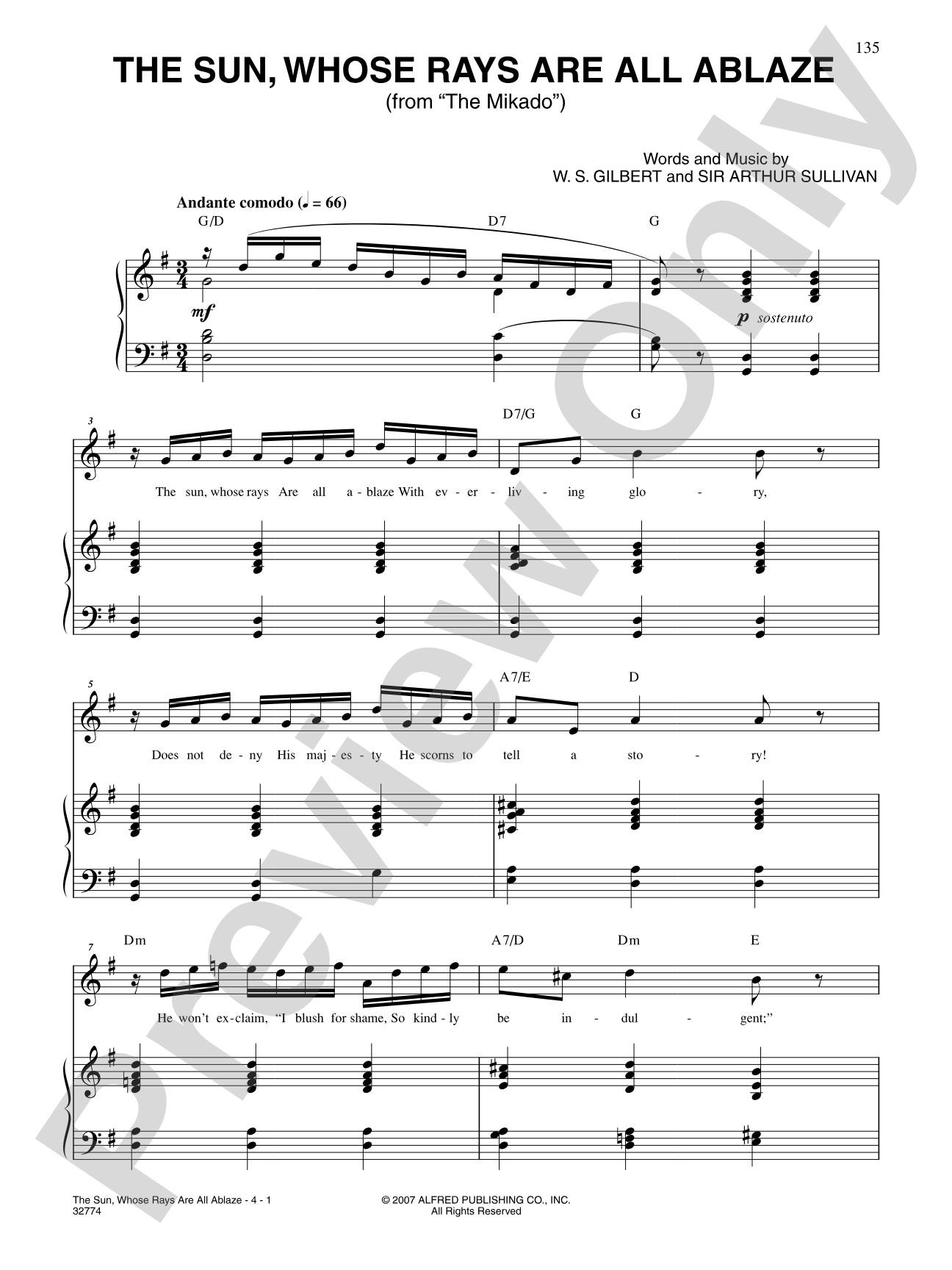

The Sun, Whose Rays Are All Ablaze (From "The Mikado"): Piano/Vocal/Chords
Ed. Lisa DeSpain
Item: 00-PS-0010434
$4.99
One moment…
Related Items
Love in a Home (From "Li'l Abner"): Piano/Vocal/Chords |
$4.99
|
View | |
The Sailor of My Dreams: Piano/Vocal/Chords |
$4.99
|
View | |
Timid Frieda: Piano/Vocal/Chords |
$4.99
|
View | |
Goodbye, Little Dream, Goodbye (From "Red, Hot and Blue"): Piano/Vocal/Chords |
$4.99
|
View | |
A Little Bit of Good (From "Chicago"): Piano/Vocal/Chords |
$4.99
|
View | |
My Love Is on the Way (From "the Golden Apple"): Piano/Vocal/Chords |
$4.99
|
View | |
Just Imagine (From "Good News"): Piano/Vocal/Chords |
$4.99
|
View | |
A Little Bit in Love (From "Wonderful Town"): Piano/Vocal/Chords |
$5.99
|
View | |
Windflowers (From "the Golden Apple"): Piano/Vocal/Chords |
$4.99
|
View | |
Long Ago (From "Half a Sixpence"): Piano/Vocal/Chords |
$4.99
|
View | |
My Man's Gone Now (From "Porgy and Bess"): Piano/Vocal/Chords |
$5.99
|
View | |
This Is All Very New to Me: Piano/Vocal/Chords |
$5.99
|
View | |
Bring on Tomorrow (From "Fame-the Musical"): Piano/Vocal/Chords |
$5.99
|
View | |
All for You: Piano/Vocal/Chords |
$4.99
|
View | |
Only Love (From "the Scarlet Pimpernel"): Piano/Vocal/Chords |
$4.99
|
View | |
Mira (From "Carnival"): Piano/Vocal/Chords |
$4.99
|
View | |
I'm a Stranger Here Myself: Piano/Vocal/Chords |
$5.99
|
View | |
Tell Me (From "Marie Christine"): Piano/Vocal/Chords |
$4.99
|
View | |
Romance (From "the Desert Song"): Piano/Vocal/Chords |
$5.99
|
View | |
Why Shouldn't I? (From "Jubilee"): Piano/Vocal/Chords |
$4.99
|
View | |
Some Other Time (From "On the Town"): Piano/Vocal/Chords |
$5.99
|
View | |
Love Is Sweeping the Country (From "of Thee I Sing"): Piano/Vocal/Chords |
$5.99
|
View | |
Ballad of Dependency: Piano/Vocal/Chords |
$4.99
|
View | |
Patterns (From "Baby"): Piano/Vocal/Chords |
$5.99
|
View | |
The Boy Friend (From "the Boy Friend"): Piano/Vocal/Chords |
$4.99
|
View | |
I Speak Six Languages (From "the 25th Annual Putnam County Spelling Bee"): Piano/Vocal/Chords |
$5.99
|
View | |
Safety in Numbers: Piano/Vocal/Chords |
$4.99
|
View | |
Jilted: Piano/Vocal/Chords |
$4.99
|
View | |
Yes, My Heart: Piano/Vocal/Chords |
$9.99
|
View | |
Millwork (From "Working"): Piano/Vocal/Chords |
$5.99
|
View | |
Wonderful, Wonderful Day (From "Seven Brides for Seven Brothers"): Piano/Vocal/Chords |
$4.99
|
View | |
Over the Rainbow (From "the Wizard of Oz"): Piano/Vocal/Chords |
$4.99
|
View | |
My Own Best Friend (From "Chicago"): Piano/Vocal/Chords |
$4.99
|
View | |
How Can I Wait? (From "Paint Your Wagon"): Piano/Vocal/Chords |
$5.99
|
View | |
If You Hadn't but You Did (From "Two on the Aisle"): Piano/Vocal/Chords |
$5.99
|
View | |
Lazy Afternoon (From "The Golden Apple"): Piano/Vocal/Chords |
$4.99
|
View | |
What Is a Woman? (From "I Do, I Do"): Piano/Vocal/Chords |
$4.99
|
View | |
Zip (From "Pal Joey"): Piano/Vocal/Chords |
$4.99
|
View | |
Ladies (From "Destry Rides Again"): Piano/Vocal/Chords |
$4.99
|
View | |
Think of Meryl Streep (From "Fame-the Musical"): Piano/Vocal/Chords |
$5.99
|
View | |
West End Avenue (From "The Magic Show"): Piano/Vocal/Chords |
$5.99
|
View | |
Notice Me, Horton (From "Seussical the Musical"): Piano/Vocal/Chords |
$5.99
|
View | |
My Cousin in Milwaukee (From "Pardon My English"): Piano/Vocal/Chords |
$5.99
|
View | |
Somewhere That's Green (From "Little Shop of Horrors"): Piano/Vocal/Chords |
$5.99
|
View | |
Old Friend (From "I'm Getting My Act Together and Taking It on the Road"): Piano/Vocal/Chords |
$5.99
|
View | |
Holding to the Ground (From "Falsettos"): Piano/Vocal/Chords |
$5.99
|
View | |
Back on Base (From "Closer than Ever"): Piano/Vocal/Chords |
$5.99
|
View | |
The Music Still Plays On (From "A New Brain"): Piano/Vocal/Chords |
$5.99
|
View | |
What a Nice Idea? (From "Two Gentlemen of Verona"): Piano/Vocal/Chords |
$4.99
|
View | |
Mad About the Boy (From "Words and Music"): Piano/Vocal/Chords |
$5.99
|
View |
Description
For aspiring and professional singers who love Broadway, Alfred's Singer's Library of Musical Theatre presents an elegant collection of the best-loved musical theatre songs in their original keys, authentically transcribed from their original vocal scores. Perfect for study, and equally suitable for the most important auditions and performances, each volume is dedicated to a specific vocal range, and contains dozens of songs from a variety of shows that span decades of theatre history. Multiple volumes are available for each of four vocal ranges: Soprano, Mezzo-Soprano/Alto, Tenor, and Baritone/Bass. Authoritative historical and contextual commentary, audition tips, and 16-bar cut suggestions for each song make it the most useful and relevant song library of its kind.
Titles: All for You (Saturday Night) * Autumn (Starting Here, Starting Now) * Ballad of Dependency (The Threepenny Opera) * The Boy Friend (The Boy Friend) * Bring on Tomorrow (Fame -- The Musical) * Goodbye, Little Dream, Goodbye (Anything Goes 1988 Revival) * I Speak Six Languages (The 25th Annual Putnam County Spelling Bee) * I'm a Stranger Here Myself (One Touch of Venus) * Jilted (Of Thee I Sing) * Just Imagine (Good News) * A Little Bit in Love (Wonderful Town) * A Little Bit of Good (Chicago) * Long Ago (Half a Sixpense) * Love in a Home (Lil' Abner) * Love Is Sweeping the Country (Of Thee I Sing) * Mira (Carnival) * My Love Is on the Way (The Golden Apple) * My Man's Gone Now (Porgy and Bess) * Once Upon a Dream (Jekyll & Hyde) * Only Love (Scarlet Pimpernel) * Patterns (Closer Than Ever) * Practically Perfect (Mary Poppins -- Stage Version) * Romance (The Desert Song) * Safety in Numbers (The Boy Friend) * The Sailor of My Dreams (Dames at Sea) * Some Other Time (On the Town)* The Sun Whose Rays Are All Ablaze (The Mikado) * Tell Me (Marie Christine) * This Is All Very New to Me (Plain and Fancy) * Timid Frieda (Les Timides) (Jacques Brel Is Alive & Well & Living in Paris) * Was She Prettier Than I? (High Spirits) * Why Shouldn't I? (Jubilee) * Windflowers (The Golden Apple) * Yes, My Heart (Carnival).


Titles: All for You (Saturday Night) * Autumn (Starting Here, Starting Now) * Ballad of Dependency (The Threepenny Opera) * The Boy Friend (The Boy Friend) * Bring on Tomorrow (Fame -- The Musical) * Goodbye, Little Dream, Goodbye (Anything Goes 1988 Revival) * I Speak Six Languages (The 25th Annual Putnam County Spelling Bee) * I'm a Stranger Here Myself (One Touch of Venus) * Jilted (Of Thee I Sing) * Just Imagine (Good News) * A Little Bit in Love (Wonderful Town) * A Little Bit of Good (Chicago) * Long Ago (Half a Sixpense) * Love in a Home (Lil' Abner) * Love Is Sweeping the Country (Of Thee I Sing) * Mira (Carnival) * My Love Is on the Way (The Golden Apple) * My Man's Gone Now (Porgy and Bess) * Once Upon a Dream (Jekyll & Hyde) * Only Love (Scarlet Pimpernel) * Patterns (Closer Than Ever) * Practically Perfect (Mary Poppins -- Stage Version) * Romance (The Desert Song) * Safety in Numbers (The Boy Friend) * The Sailor of My Dreams (Dames at Sea) * Some Other Time (On the Town)* The Sun Whose Rays Are All Ablaze (The Mikado) * Tell Me (Marie Christine) * This Is All Very New to Me (Plain and Fancy) * Timid Frieda (Les Timides) (Jacques Brel Is Alive & Well & Living in Paris) * Was She Prettier Than I? (High Spirits) * Why Shouldn't I? (Jubilee) * Windflowers (The Golden Apple) * Yes, My Heart (Carnival).
The Sun, Whose Rays Are All Ablaze (From "The Mikado"): Piano/Vocal/Chords isn't in MakeMusic Cloud just yet...but it could be. Let us know you'd like to see it, and you'll help shape what comes next. In the meantime, start a free trial and dive into thousands of interactive titles your students can play along with today.
Request This Title
Tell us you want it.
Start Your Free Trial
Explore everything that's ready to play right now.
Sample Audio
1
Lucky To Be Me from On The Town
--:--
Lucky To Be Me from On The Town
0:00
0:00
Sample Video
No sample videos found.
Additional Details
Series:
Singer's Library of Musical Theatre
Publisher:
Alfred Music
Page Count:
196
SKU:
00-PS-0010434
More about this title
About the Composer: W.S. Gilbert
W.S. Gilbert revolutionized musical theatre by proving that intelligent, witty librettos could sustain a show just as powerfully as music. His collaborations with composer Arthur Sullivan created a body of work that remains central to the English-language stage, blending social satire with accessible melodies and sharp comic timing. Gilbert's influence on musical theatre pedagogy is profound; his texts reward singers who understand diction, character, and comedic intent.
Why we love this
This song anchors itself to a genuine dramatic moment (Yum-Yum's confession of vanity) rather than existing purely for spectacle, which means singers engage with real character work alongside the vocal demands. The piece sits in the sweet spot where technical control and theatrical personality are equally necessary, making it ideal for auditions that require both skills. Including Gilbert and Sullivan in a singer's library reminds students that legit vocal technique has deep roots in theatre that predates contemporary musical theatre entirely.
What to expect
Bright, confident, and unapologetically frivolous. The song sparkles with melodic charm and gives the singer permission to be playful and self-aware, all while maintaining the vocal refinement the original score demands. There's an infectious joy in the vanity itself, wrapped in music that moves easily through the passaggio and rewards good breath support with lyrical freedom.
Who it's for
Singers preparing for auditions or performances in Gilbert and Sullivan repertoire, study singers deepening their legit vocal technique, and music theatre students who want to understand the theatrical and musical foundations of the genre. This digital download is especially useful for singers who want authentic transcriptions without carrying multiple books to auditions.
How to get the most out of it
- Commit fully to the vanity at the heart of the lyric; the song's humor and charm depend on Yum-Yum owning her self-absorption without apology.
- Shape the melody with attention to the original orchestration in your mind, even without accompaniment; Gilbert and Sullivan songs are composed, not improvised.
- Mark the text carefully for vowel consistency across registers, since the song spans a wide range and sloppy vowel shifts will expose technique problems immediately.
- Use the audition cuts and historical context provided in the volume to understand where this moment lands in The Mikado's larger narrative, which informs how you calibrate the tone.
How to use it
Program this as a stand-alone concert piece when you want legit vocal showcase that's entertaining rather than heavy, or use it in a Gilbert and Sullivan-themed recital where it sits alongside other selections from the collection. It's also valuable in a voice studio as a repertoire exploration that teaches students the difference between contemporary musical theatre vocal production and the English operetta tradition.
Skills your students will build
- Legit soprano technique across a wide range with consistent tone and placement
- Character-driven performance that balances humor with vocal integrity
- Authentic interpretation of Gilbert and Sullivan style and diction
- Audition preparation using historical context and cut suggestions
- Sustained legit vocal production through rapid passaggio passages