
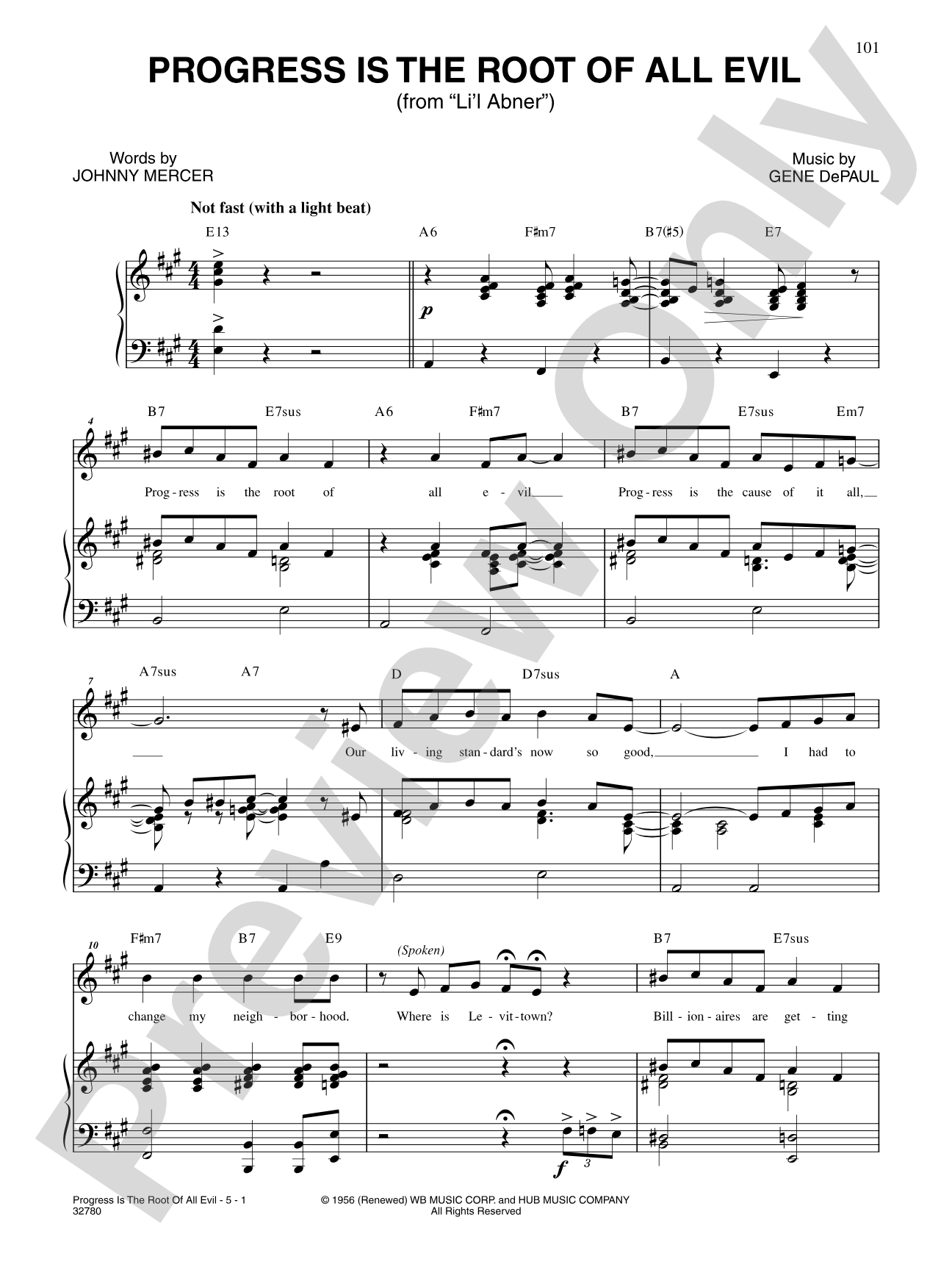

Progress Is the Root of All Evil (From "Li'l Abner"): Piano/Vocal/Chords
Ed. Lisa DeSpain
Item: 00-PS-0010337
$4.99
One moment…
Related Items
Love in a Home (From "Li'l Abner"): Piano/Vocal/Chords |
$4.99
|
View | |
The Sailor of My Dreams: Piano/Vocal/Chords |
$4.99
|
View | |
Timid Frieda: Piano/Vocal/Chords |
$4.99
|
View | |
Goodbye, Little Dream, Goodbye (From "Red, Hot and Blue"): Piano/Vocal/Chords |
$4.99
|
View | |
A Little Bit of Good (From "Chicago"): Piano/Vocal/Chords |
$4.99
|
View | |
My Love Is on the Way (From "the Golden Apple"): Piano/Vocal/Chords |
$4.99
|
View | |
Just Imagine (From "Good News"): Piano/Vocal/Chords |
$4.99
|
View | |
A Little Bit in Love (From "Wonderful Town"): Piano/Vocal/Chords |
$5.99
|
View | |
Windflowers (From "the Golden Apple"): Piano/Vocal/Chords |
$4.99
|
View | |
Long Ago (From "Half a Sixpence"): Piano/Vocal/Chords |
$4.99
|
View | |
My Man's Gone Now (From "Porgy and Bess"): Piano/Vocal/Chords |
$5.99
|
View | |
This Is All Very New to Me: Piano/Vocal/Chords |
$5.99
|
View | |
Bring on Tomorrow (From "Fame-the Musical"): Piano/Vocal/Chords |
$5.99
|
View | |
All for You: Piano/Vocal/Chords |
$4.99
|
View | |
Only Love (From "the Scarlet Pimpernel"): Piano/Vocal/Chords |
$4.99
|
View | |
Mira (From "Carnival"): Piano/Vocal/Chords |
$4.99
|
View | |
I'm a Stranger Here Myself: Piano/Vocal/Chords |
$5.99
|
View | |
Tell Me (From "Marie Christine"): Piano/Vocal/Chords |
$4.99
|
View | |
Romance (From "the Desert Song"): Piano/Vocal/Chords |
$5.99
|
View | |
Why Shouldn't I? (From "Jubilee"): Piano/Vocal/Chords |
$4.99
|
View | |
The Sun, Whose Rays Are All Ablaze (From "The Mikado"): Piano/Vocal/Chords |
$4.99
|
View | |
Some Other Time (From "On the Town"): Piano/Vocal/Chords |
$5.99
|
View | |
Love Is Sweeping the Country (From "of Thee I Sing"): Piano/Vocal/Chords |
$5.99
|
View | |
Ballad of Dependency: Piano/Vocal/Chords |
$4.99
|
View | |
Patterns (From "Baby"): Piano/Vocal/Chords |
$5.99
|
View | |
The Boy Friend (From "the Boy Friend"): Piano/Vocal/Chords |
$4.99
|
View | |
I Speak Six Languages (From "the 25th Annual Putnam County Spelling Bee"): Piano/Vocal/Chords |
$5.99
|
View | |
Safety in Numbers: Piano/Vocal/Chords |
$4.99
|
View | |
Jilted: Piano/Vocal/Chords |
$4.99
|
View | |
Yes, My Heart: Piano/Vocal/Chords |
$9.99
|
View | |
Millwork (From "Working"): Piano/Vocal/Chords |
$5.99
|
View | |
Wonderful, Wonderful Day (From "Seven Brides for Seven Brothers"): Piano/Vocal/Chords |
$4.99
|
View | |
Over the Rainbow (From "the Wizard of Oz"): Piano/Vocal/Chords |
$4.99
|
View | |
My Own Best Friend (From "Chicago"): Piano/Vocal/Chords |
$4.99
|
View | |
How Can I Wait? (From "Paint Your Wagon"): Piano/Vocal/Chords |
$5.99
|
View | |
If You Hadn't but You Did (From "Two on the Aisle"): Piano/Vocal/Chords |
$5.99
|
View | |
Lazy Afternoon (From "The Golden Apple"): Piano/Vocal/Chords |
$4.99
|
View | |
What Is a Woman? (From "I Do, I Do"): Piano/Vocal/Chords |
$4.99
|
View | |
Zip (From "Pal Joey"): Piano/Vocal/Chords |
$4.99
|
View | |
Ladies (From "Destry Rides Again"): Piano/Vocal/Chords |
$4.99
|
View | |
Think of Meryl Streep (From "Fame-the Musical"): Piano/Vocal/Chords |
$5.99
|
View | |
West End Avenue (From "The Magic Show"): Piano/Vocal/Chords |
$5.99
|
View | |
Notice Me, Horton (From "Seussical the Musical"): Piano/Vocal/Chords |
$5.99
|
View | |
My Cousin in Milwaukee (From "Pardon My English"): Piano/Vocal/Chords |
$5.99
|
View | |
Somewhere That's Green (From "Little Shop of Horrors"): Piano/Vocal/Chords |
$5.99
|
View | |
Old Friend (From "I'm Getting My Act Together and Taking It on the Road"): Piano/Vocal/Chords |
$5.99
|
View | |
Holding to the Ground (From "Falsettos"): Piano/Vocal/Chords |
$5.99
|
View | |
Back on Base (From "Closer than Ever"): Piano/Vocal/Chords |
$5.99
|
View | |
The Music Still Plays On (From "A New Brain"): Piano/Vocal/Chords |
$5.99
|
View | |
What a Nice Idea? (From "Two Gentlemen of Verona"): Piano/Vocal/Chords |
$4.99
|
View |
Description
For aspiring and professional singers who love Broadway, Alfred's Singer's Library of Musical Theatre presents an elegant collection of the best-loved musical theatre songs in their original keys, authentically transcribed from their original vocal scores. Perfect for study, and equally suitable for the most important auditions and performances, each volume is dedicated to a specific vocal range, and contains dozens of songs from a variety of shows that span decades of theatre history. Multiple volumes are available for each of four vocal ranges: Soprano, Mezzo-Soprano/Alto, Tenor, and Baritone/Bass. Authoritative historical and contextual commentary, audition tips, and 16-bar cut suggestions for each song make it the most useful and relevant song library of its kind.
Titles: Everything Old Is New Again (The Boy from Oz) * She's My Love (Carnival) * Those Were The Good Old Days! (Damn Yankees) * A Jug of Wine (The Day Before Spring) * Anyone Would Love You (Destry Rides Again) * All of My Life (Do Re Mi) * After Today Dr. Doolittle) * Gigi (Gigi) * Store-Bought Suit (The Golden Apple) * The Best Things In Life Are Free (Good News) * Where Do I Go? (Hair) * I Love My Wife (I Do! I Do!) * It's a Well Known Fact (I Do! I Do!) * No More (Into the Woods) * They Go Wild, Simply Wild, Over Me (Irene) * Progress Is the Root of All Evil (Lil' Abner) * Love Who You Love (A Man of No Importance) * Marriage Proposal (March of the Falsettos) * Me and My Girl (Me and My Girl) * Reviewing the Situation (Oliver!) * I Talk to the Trees (Paint Your Wagon) * Isn't It a Pity? (Pardon My English) * No One Has Ever Loved Me (Passion) * I'm Back in Circulation (Redhead) * Love's a Bond (Saturday Night) * Bless Your Beautiful Hide (Seven Brides for Seven Brothers) * I Don't Remember Christmas (Starting Here, Starting Now) * Once in a Lifetime (Stop The World . . . I Want To Get Off) * The Barber and His Wife (Sweeny Todd) * The Mansion (Two Gentlemen of Verona) * If I Were the King of the Forest (The Wizard of Oz) * A Quiet Girl (Wonderful Town).


Titles: Everything Old Is New Again (The Boy from Oz) * She's My Love (Carnival) * Those Were The Good Old Days! (Damn Yankees) * A Jug of Wine (The Day Before Spring) * Anyone Would Love You (Destry Rides Again) * All of My Life (Do Re Mi) * After Today Dr. Doolittle) * Gigi (Gigi) * Store-Bought Suit (The Golden Apple) * The Best Things In Life Are Free (Good News) * Where Do I Go? (Hair) * I Love My Wife (I Do! I Do!) * It's a Well Known Fact (I Do! I Do!) * No More (Into the Woods) * They Go Wild, Simply Wild, Over Me (Irene) * Progress Is the Root of All Evil (Lil' Abner) * Love Who You Love (A Man of No Importance) * Marriage Proposal (March of the Falsettos) * Me and My Girl (Me and My Girl) * Reviewing the Situation (Oliver!) * I Talk to the Trees (Paint Your Wagon) * Isn't It a Pity? (Pardon My English) * No One Has Ever Loved Me (Passion) * I'm Back in Circulation (Redhead) * Love's a Bond (Saturday Night) * Bless Your Beautiful Hide (Seven Brides for Seven Brothers) * I Don't Remember Christmas (Starting Here, Starting Now) * Once in a Lifetime (Stop The World . . . I Want To Get Off) * The Barber and His Wife (Sweeny Todd) * The Mansion (Two Gentlemen of Verona) * If I Were the King of the Forest (The Wizard of Oz) * A Quiet Girl (Wonderful Town).
Progress Is the Root of All Evil (From "Li'l Abner"): Piano/Vocal/Chords isn't in MakeMusic Cloud just yet...but it could be. Let us know you'd like to see it, and you'll help shape what comes next. In the meantime, start a free trial and dive into thousands of interactive titles your students can play along with today.
Request This Title
Tell us you want it.
Start Your Free Trial
Explore everything that's ready to play right now.
Sample Audio
1
If I Were King Of The Forest from The Wizard Of Oz
--:--
If I Were King Of The Forest from The Wizard Of Oz
0:00
0:00
Sample Video
No sample videos found.
Additional Details
Series:
Singer's Library of Musical Theatre
Publisher:
Alfred Music
Page Count:
188
SKU:
00-PS-0010337
More about this title
About the Composer: Gene DePaul
Gene DePaul composed for Broadway during the golden age of musical theatre, crafting melodies that balanced sophisticated harmony with genuine theatrical warmth. His work on shows like Li'l Abner and The Golden Apple demonstrates a composer who understood both the demands of the stage and the needs of singers performing at their technical edge.
DePaul's catalog offers music teachers and vocal coaches a wealth of material that sits comfortably in the voice without requiring operatic training. His songs reward careful attention to phrasing and style, making them ideal teaching tools for singers developing nuance and theatrical communication.
Why we love this
This collection captures a specific era of musical theatre songwriting when melody and singability weren't negotiable. You get dozens of songs from shows that span real stylistic range, all in original keys and transcribed faithfully from vocal scores, so every marking and articulation reflects what audiences actually heard. The 16-bar cut suggestions alone make this invaluable for audition prep.
What to expect
These songs occupy a sweet spot between musical theatre accessibility and genuine musical substance. Each one has been written to sit in a singer's voice naturally while maintaining theatrical integrity, creating moments where technique and storytelling feel inseparable.
Who it's for
Singers preparing for auditions, studying musical theatre technique, or building a personal performance repertoire need this collection. It's equally useful for vocal coaches mapping out study plans and for directors casting shows who want singers working from authentic source material.
How to get the most out of it
- Attend to the historical style of each show. A song from Hair will sit very differently in your voice than one from Gigi; research the original production to understand the vocal expectations.
- Study the provided contextual notes before singing. They often flag specific interpretive choices that make the difference between a competent performance and a compelling one.
- Work with the suggested cuts for auditions, but sing through full versions in rehearsal. Understanding the complete arc teaches you things about character development that 16 bars alone cannot.
- Use the chord notations to explore different accompaniment textures with your collaborators. Even straightforward theatre songs can breathe differently depending on how the harmony is voiced.
How to use it
Build an audition masterclass around songs from this collection, pairing them with the historical and contextual commentary included in the book. You might also program a concert featuring music from underperformed shows represented here, introducing students to the deeper catalogue beyond the standard rotation.
Skills your students will build
- Stylistic flexibility across decades of theatrical music
- Authentic interpretation of period-specific vocal writing
- Audition preparation and cut selection
- Musical theatre diction and character motivation through song
- Collaboration with accompanists using chord charts and original arrangements