
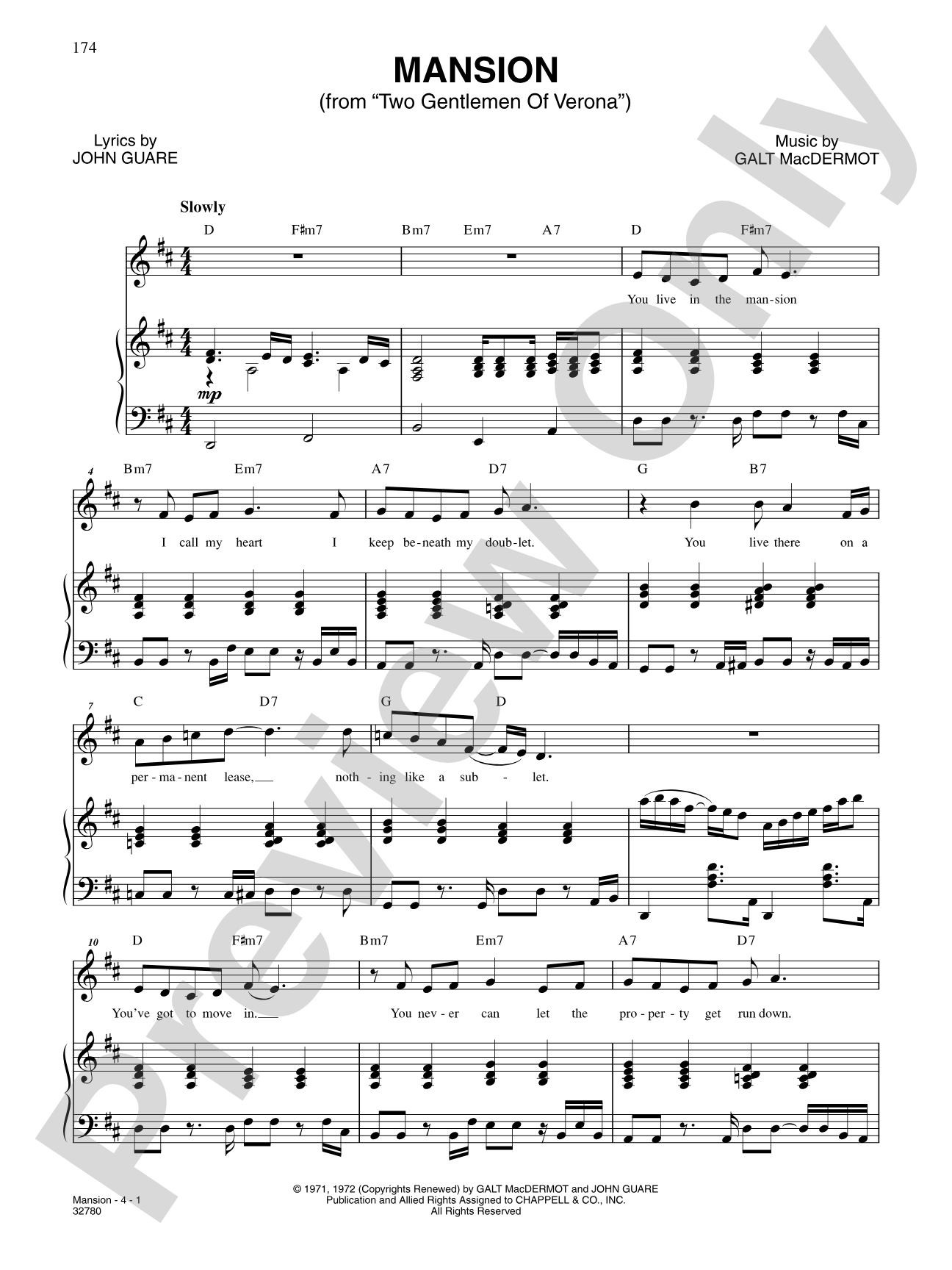

Mansion (From "Two Gentlemen of Verona"): Piano/Vocal/Chords
Ed. Lisa DeSpain
Item: 00-PS-0010478
$4.99
One moment…
Related Items
Love in a Home (From "Li'l Abner"): Piano/Vocal/Chords |
$4.99
|
View | |
The Sailor of My Dreams: Piano/Vocal/Chords |
$4.99
|
View | |
Timid Frieda: Piano/Vocal/Chords |
$4.99
|
View | |
Goodbye, Little Dream, Goodbye (From "Red, Hot and Blue"): Piano/Vocal/Chords |
$4.99
|
View | |
A Little Bit of Good (From "Chicago"): Piano/Vocal/Chords |
$4.99
|
View | |
My Love Is on the Way (From "the Golden Apple"): Piano/Vocal/Chords |
$4.99
|
View | |
Just Imagine (From "Good News"): Piano/Vocal/Chords |
$4.99
|
View | |
A Little Bit in Love (From "Wonderful Town"): Piano/Vocal/Chords |
$5.99
|
View | |
Windflowers (From "the Golden Apple"): Piano/Vocal/Chords |
$4.99
|
View | |
Long Ago (From "Half a Sixpence"): Piano/Vocal/Chords |
$4.99
|
View | |
My Man's Gone Now (From "Porgy and Bess"): Piano/Vocal/Chords |
$5.99
|
View | |
This Is All Very New to Me: Piano/Vocal/Chords |
$5.99
|
View | |
Bring on Tomorrow (From "Fame-the Musical"): Piano/Vocal/Chords |
$5.99
|
View | |
All for You: Piano/Vocal/Chords |
$4.99
|
View | |
Only Love (From "the Scarlet Pimpernel"): Piano/Vocal/Chords |
$4.99
|
View | |
Mira (From "Carnival"): Piano/Vocal/Chords |
$4.99
|
View | |
I'm a Stranger Here Myself: Piano/Vocal/Chords |
$5.99
|
View | |
Tell Me (From "Marie Christine"): Piano/Vocal/Chords |
$4.99
|
View | |
Romance (From "the Desert Song"): Piano/Vocal/Chords |
$5.99
|
View | |
Why Shouldn't I? (From "Jubilee"): Piano/Vocal/Chords |
$4.99
|
View | |
The Sun, Whose Rays Are All Ablaze (From "The Mikado"): Piano/Vocal/Chords |
$4.99
|
View | |
Some Other Time (From "On the Town"): Piano/Vocal/Chords |
$5.99
|
View | |
Love Is Sweeping the Country (From "of Thee I Sing"): Piano/Vocal/Chords |
$5.99
|
View | |
Ballad of Dependency: Piano/Vocal/Chords |
$4.99
|
View | |
Patterns (From "Baby"): Piano/Vocal/Chords |
$5.99
|
View | |
The Boy Friend (From "the Boy Friend"): Piano/Vocal/Chords |
$4.99
|
View | |
I Speak Six Languages (From "the 25th Annual Putnam County Spelling Bee"): Piano/Vocal/Chords |
$5.99
|
View | |
Safety in Numbers: Piano/Vocal/Chords |
$4.99
|
View | |
Jilted: Piano/Vocal/Chords |
$4.99
|
View | |
Yes, My Heart: Piano/Vocal/Chords |
$9.99
|
View | |
Millwork (From "Working"): Piano/Vocal/Chords |
$5.99
|
View | |
Wonderful, Wonderful Day (From "Seven Brides for Seven Brothers"): Piano/Vocal/Chords |
$4.99
|
View | |
Over the Rainbow (From "the Wizard of Oz"): Piano/Vocal/Chords |
$4.99
|
View | |
My Own Best Friend (From "Chicago"): Piano/Vocal/Chords |
$4.99
|
View | |
How Can I Wait? (From "Paint Your Wagon"): Piano/Vocal/Chords |
$5.99
|
View | |
If You Hadn't but You Did (From "Two on the Aisle"): Piano/Vocal/Chords |
$5.99
|
View | |
Lazy Afternoon (From "The Golden Apple"): Piano/Vocal/Chords |
$4.99
|
View | |
What Is a Woman? (From "I Do, I Do"): Piano/Vocal/Chords |
$4.99
|
View | |
Zip (From "Pal Joey"): Piano/Vocal/Chords |
$4.99
|
View | |
Ladies (From "Destry Rides Again"): Piano/Vocal/Chords |
$4.99
|
View | |
Think of Meryl Streep (From "Fame-the Musical"): Piano/Vocal/Chords |
$5.99
|
View | |
West End Avenue (From "The Magic Show"): Piano/Vocal/Chords |
$5.99
|
View | |
Notice Me, Horton (From "Seussical the Musical"): Piano/Vocal/Chords |
$5.99
|
View | |
My Cousin in Milwaukee (From "Pardon My English"): Piano/Vocal/Chords |
$5.99
|
View | |
Somewhere That's Green (From "Little Shop of Horrors"): Piano/Vocal/Chords |
$5.99
|
View | |
Old Friend (From "I'm Getting My Act Together and Taking It on the Road"): Piano/Vocal/Chords |
$5.99
|
View | |
Holding to the Ground (From "Falsettos"): Piano/Vocal/Chords |
$5.99
|
View | |
Back on Base (From "Closer than Ever"): Piano/Vocal/Chords |
$5.99
|
View | |
The Music Still Plays On (From "A New Brain"): Piano/Vocal/Chords |
$5.99
|
View | |
What a Nice Idea? (From "Two Gentlemen of Verona"): Piano/Vocal/Chords |
$4.99
|
View |
Description
For aspiring and professional singers who love Broadway, Alfred's Singer's Library of Musical Theatre presents an elegant collection of the best-loved musical theatre songs in their original keys, authentically transcribed from their original vocal scores. Perfect for study, and equally suitable for the most important auditions and performances, each volume is dedicated to a specific vocal range, and contains dozens of songs from a variety of shows that span decades of theatre history. Multiple volumes are available for each of four vocal ranges: Soprano, Mezzo-Soprano/Alto, Tenor, and Baritone/Bass. Authoritative historical and contextual commentary, audition tips, and 16-bar cut suggestions for each song make it the most useful and relevant song library of its kind.
Titles: Everything Old Is New Again (The Boy from Oz) * She's My Love (Carnival) * Those Were The Good Old Days! (Damn Yankees) * A Jug of Wine (The Day Before Spring) * Anyone Would Love You (Destry Rides Again) * All of My Life (Do Re Mi) * After Today Dr. Doolittle) * Gigi (Gigi) * Store-Bought Suit (The Golden Apple) * The Best Things In Life Are Free (Good News) * Where Do I Go? (Hair) * I Love My Wife (I Do! I Do!) * It's a Well Known Fact (I Do! I Do!) * No More (Into the Woods) * They Go Wild, Simply Wild, Over Me (Irene) * Progress Is the Root of All Evil (Lil' Abner) * Love Who You Love (A Man of No Importance) * Marriage Proposal (March of the Falsettos) * Me and My Girl (Me and My Girl) * Reviewing the Situation (Oliver!) * I Talk to the Trees (Paint Your Wagon) * Isn't It a Pity? (Pardon My English) * No One Has Ever Loved Me (Passion) * I'm Back in Circulation (Redhead) * Love's a Bond (Saturday Night) * Bless Your Beautiful Hide (Seven Brides for Seven Brothers) * I Don't Remember Christmas (Starting Here, Starting Now) * Once in a Lifetime (Stop The World . . . I Want To Get Off) * The Barber and His Wife (Sweeny Todd) * The Mansion (Two Gentlemen of Verona) * If I Were the King of the Forest (The Wizard of Oz) * A Quiet Girl (Wonderful Town).


Titles: Everything Old Is New Again (The Boy from Oz) * She's My Love (Carnival) * Those Were The Good Old Days! (Damn Yankees) * A Jug of Wine (The Day Before Spring) * Anyone Would Love You (Destry Rides Again) * All of My Life (Do Re Mi) * After Today Dr. Doolittle) * Gigi (Gigi) * Store-Bought Suit (The Golden Apple) * The Best Things In Life Are Free (Good News) * Where Do I Go? (Hair) * I Love My Wife (I Do! I Do!) * It's a Well Known Fact (I Do! I Do!) * No More (Into the Woods) * They Go Wild, Simply Wild, Over Me (Irene) * Progress Is the Root of All Evil (Lil' Abner) * Love Who You Love (A Man of No Importance) * Marriage Proposal (March of the Falsettos) * Me and My Girl (Me and My Girl) * Reviewing the Situation (Oliver!) * I Talk to the Trees (Paint Your Wagon) * Isn't It a Pity? (Pardon My English) * No One Has Ever Loved Me (Passion) * I'm Back in Circulation (Redhead) * Love's a Bond (Saturday Night) * Bless Your Beautiful Hide (Seven Brides for Seven Brothers) * I Don't Remember Christmas (Starting Here, Starting Now) * Once in a Lifetime (Stop The World . . . I Want To Get Off) * The Barber and His Wife (Sweeny Todd) * The Mansion (Two Gentlemen of Verona) * If I Were the King of the Forest (The Wizard of Oz) * A Quiet Girl (Wonderful Town).
Mansion (From "Two Gentlemen of Verona"): Piano/Vocal/Chords isn't in MakeMusic Cloud just yet...but it could be. Let us know you'd like to see it, and you'll help shape what comes next. In the meantime, start a free trial and dive into thousands of interactive titles your students can play along with today.
Request This Title
Tell us you want it.
Start Your Free Trial
Explore everything that's ready to play right now.
Sample Audio
1
If I Were King Of The Forest from The Wizard Of Oz
--:--
If I Were King Of The Forest from The Wizard Of Oz
0:00
0:00
Sample Video
No sample videos found.
Additional Details
Series:
Singer's Library of Musical Theatre
Publisher:
Alfred Music
Page Count:
188
SKU:
00-PS-0010478
More about this title
About the Composer: Galt MacDermot
Galt MacDermot composed the score for Hair, the groundbreaking 1968 musical that brought rock and pop sensibilities to Broadway and fundamentally changed what musical theatre could sound like. His ability to blend contemporary music idioms with theatrical storytelling made him a pivotal figure in expanding the musical theatre repertoire beyond traditional show music. MacDermot's work opened doors for generations of composers who followed, demonstrating that Broadway could embrace bold stylistic risks and still reach audiences deeply.
Why we love this
This collection gathers authentic, original-key transcriptions from decades of Broadway history, giving singers access to material exactly as composers intended it to be performed. The editorial apparatus is genuinely useful: historical context for each show, audition tips that reflect real performance scenarios, and practical 16-bar cut suggestions make this collection work as a study tool and a performance resource simultaneously. For singers preparing auditions or building a recital repertoire, having this many songs from different eras in their original keys eliminates the need to hunt through multiple sources.
What to expect
Moving through this collection is like walking through Broadway's living history. You encounter the optimism of mid-century musical comedy, the revolutionary energy of rock-influenced shows, the sophisticated wit of Stephen Sondheim, and the romantic lyricism that defines so much of the canon. Each song carries the stamp of its era while remaining immediate and singable.
Who it's for
This collection serves singers preparing for musical theatre auditions, students building a recital program from Broadway repertoire, and performers who need authoritative transcriptions in their vocal range. Whether you're a soprano, mezzo-soprano/alto, tenor, or baritone/bass, this series provides material specifically selected and transposed for your voice type.
How to get the most out of it
- Study the contextual notes provided for each song to understand the dramatic situation and character arc. This frames your interpretation and informs which emotional colors to explore in your performance.
- Use the 16-bar cut suggestions as a starting point for audition preparation, but feel free to adjust cuts based on the specific requirements of the audition or venue.
- Spend time with the harmony and chord changes, particularly in songs from different musical theatre eras. The harmonic language shifts significantly across these decades, and familiarity with the chord progression deepens your musicality.
- Work with a pianist to lock in the style and tempo of each piece. Broadway songs have specific rhythmic feels that vary by era and show, and having that partnership established early makes rehearsal more efficient.
How to use it
Use this collection to build audition books organized by song style, dramatic type, or era. You might program songs from different shows around a thematic idea, or draw from it to supplement a musical theatre survey course where students need material in their own vocal range. For singers working with a coach or voice teacher, this resource provides enough repertoire to rotate through different styles and demands over an entire season.
Skills your students will build
- Sight-reading music across different musical theatre styles and harmonic languages
- Interpreting character and dramatic context from song lyrics and historical context
- Adjusting vocal approach to match the stylistic demands of different eras (from operetta-influenced writing to contemporary pop-influenced scores)
- Working with chord symbols and understanding how they shape harmonic color and emotional arc
- Preparing audition-ready material with appropriate cuts and pacing