
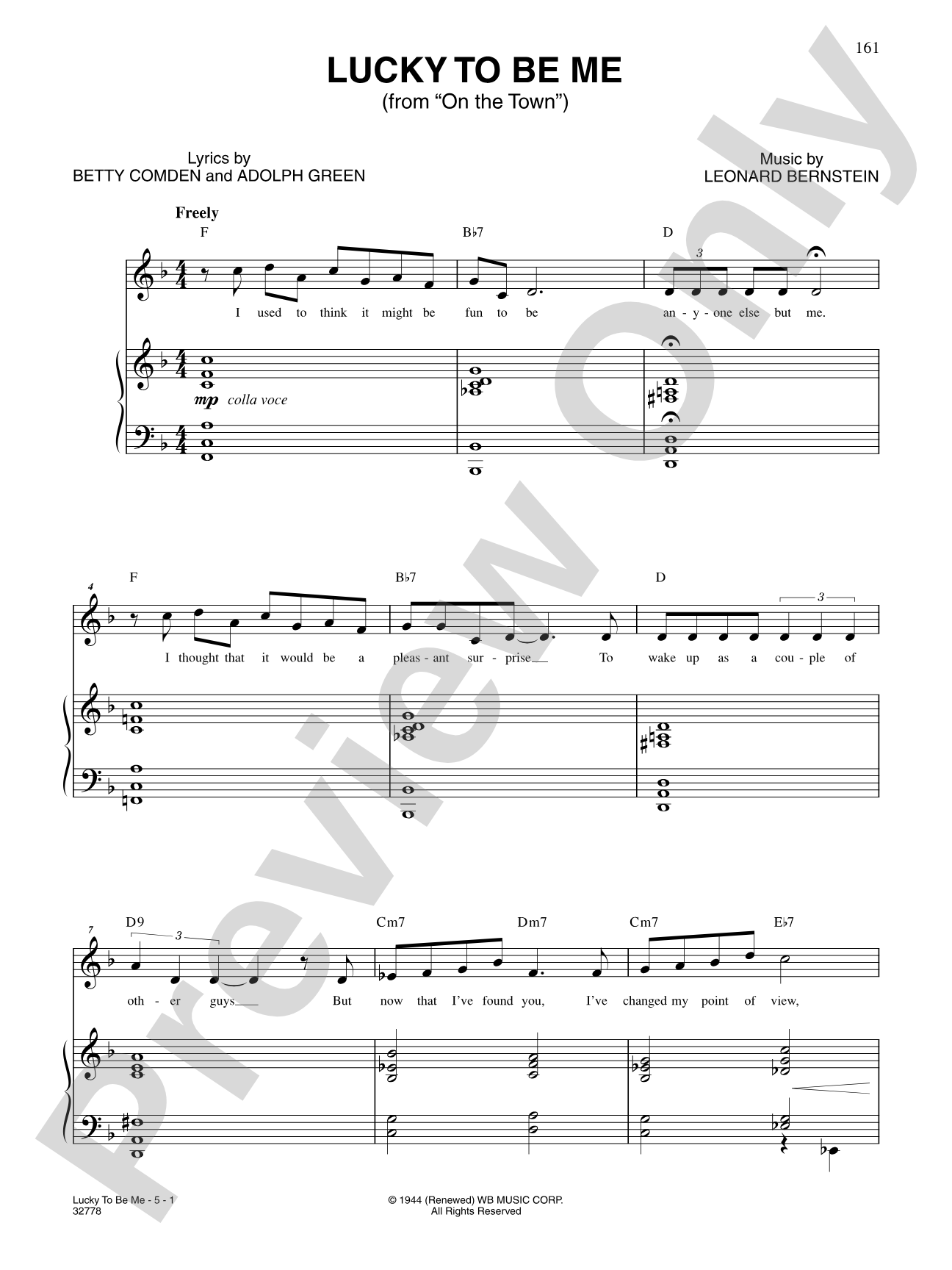

Lucky to Be Me (From "On the Town"): Piano/Vocal/Chords
Ed. Lisa DeSpain
Item: 00-PS-0010433
$4.99
One moment…
Related Items
Love in a Home (From "Li'l Abner"): Piano/Vocal/Chords |
$4.99
|
View | |
The Sailor of My Dreams: Piano/Vocal/Chords |
$4.99
|
View | |
Timid Frieda: Piano/Vocal/Chords |
$4.99
|
View | |
Goodbye, Little Dream, Goodbye (From "Red, Hot and Blue"): Piano/Vocal/Chords |
$4.99
|
View | |
A Little Bit of Good (From "Chicago"): Piano/Vocal/Chords |
$4.99
|
View | |
My Love Is on the Way (From "the Golden Apple"): Piano/Vocal/Chords |
$4.99
|
View | |
Just Imagine (From "Good News"): Piano/Vocal/Chords |
$4.99
|
View | |
A Little Bit in Love (From "Wonderful Town"): Piano/Vocal/Chords |
$5.99
|
View | |
Windflowers (From "the Golden Apple"): Piano/Vocal/Chords |
$4.99
|
View | |
Long Ago (From "Half a Sixpence"): Piano/Vocal/Chords |
$4.99
|
View | |
My Man's Gone Now (From "Porgy and Bess"): Piano/Vocal/Chords |
$5.99
|
View | |
This Is All Very New to Me: Piano/Vocal/Chords |
$5.99
|
View | |
Bring on Tomorrow (From "Fame-the Musical"): Piano/Vocal/Chords |
$5.99
|
View | |
All for You: Piano/Vocal/Chords |
$4.99
|
View | |
Only Love (From "the Scarlet Pimpernel"): Piano/Vocal/Chords |
$4.99
|
View | |
Mira (From "Carnival"): Piano/Vocal/Chords |
$4.99
|
View | |
I'm a Stranger Here Myself: Piano/Vocal/Chords |
$5.99
|
View | |
Tell Me (From "Marie Christine"): Piano/Vocal/Chords |
$4.99
|
View | |
Romance (From "the Desert Song"): Piano/Vocal/Chords |
$5.99
|
View | |
Why Shouldn't I? (From "Jubilee"): Piano/Vocal/Chords |
$4.99
|
View | |
The Sun, Whose Rays Are All Ablaze (From "The Mikado"): Piano/Vocal/Chords |
$4.99
|
View | |
Some Other Time (From "On the Town"): Piano/Vocal/Chords |
$5.99
|
View | |
Love Is Sweeping the Country (From "of Thee I Sing"): Piano/Vocal/Chords |
$5.99
|
View | |
Ballad of Dependency: Piano/Vocal/Chords |
$4.99
|
View | |
Patterns (From "Baby"): Piano/Vocal/Chords |
$5.99
|
View | |
The Boy Friend (From "the Boy Friend"): Piano/Vocal/Chords |
$4.99
|
View | |
I Speak Six Languages (From "the 25th Annual Putnam County Spelling Bee"): Piano/Vocal/Chords |
$5.99
|
View | |
Safety in Numbers: Piano/Vocal/Chords |
$4.99
|
View | |
Jilted: Piano/Vocal/Chords |
$4.99
|
View | |
Yes, My Heart: Piano/Vocal/Chords |
$9.99
|
View | |
Millwork (From "Working"): Piano/Vocal/Chords |
$5.99
|
View | |
Wonderful, Wonderful Day (From "Seven Brides for Seven Brothers"): Piano/Vocal/Chords |
$4.99
|
View | |
Over the Rainbow (From "the Wizard of Oz"): Piano/Vocal/Chords |
$4.99
|
View | |
My Own Best Friend (From "Chicago"): Piano/Vocal/Chords |
$4.99
|
View | |
How Can I Wait? (From "Paint Your Wagon"): Piano/Vocal/Chords |
$5.99
|
View | |
If You Hadn't but You Did (From "Two on the Aisle"): Piano/Vocal/Chords |
$5.99
|
View | |
Lazy Afternoon (From "The Golden Apple"): Piano/Vocal/Chords |
$4.99
|
View | |
What Is a Woman? (From "I Do, I Do"): Piano/Vocal/Chords |
$4.99
|
View | |
Zip (From "Pal Joey"): Piano/Vocal/Chords |
$4.99
|
View | |
Ladies (From "Destry Rides Again"): Piano/Vocal/Chords |
$4.99
|
View | |
Think of Meryl Streep (From "Fame-the Musical"): Piano/Vocal/Chords |
$5.99
|
View | |
West End Avenue (From "The Magic Show"): Piano/Vocal/Chords |
$5.99
|
View | |
Notice Me, Horton (From "Seussical the Musical"): Piano/Vocal/Chords |
$5.99
|
View | |
My Cousin in Milwaukee (From "Pardon My English"): Piano/Vocal/Chords |
$5.99
|
View | |
Somewhere That's Green (From "Little Shop of Horrors"): Piano/Vocal/Chords |
$5.99
|
View | |
Old Friend (From "I'm Getting My Act Together and Taking It on the Road"): Piano/Vocal/Chords |
$5.99
|
View | |
Holding to the Ground (From "Falsettos"): Piano/Vocal/Chords |
$5.99
|
View | |
Back on Base (From "Closer than Ever"): Piano/Vocal/Chords |
$5.99
|
View | |
The Music Still Plays On (From "A New Brain"): Piano/Vocal/Chords |
$5.99
|
View | |
What a Nice Idea? (From "Two Gentlemen of Verona"): Piano/Vocal/Chords |
$4.99
|
View |
Description
For aspiring and professional singers who love Broadway, Alfred's Singer's Library of Musical Theatre presents an elegant collection of the best-loved musical theatre songs in their original keys, authentically transcribed from their original vocal scores. Perfect for study, and equally suitable for the most important auditions and performances, each volume is dedicated to a specific vocal range, and contains dozens of songs from a variety of shows that span decades of theatre history. Multiple volumes are available for each of four vocal ranges: Soprano, Mezzo-Soprano/Alto, Tenor, and Baritone/Bass. Authoritative historical and contextual commentary, audition tips, and 16-bar cut suggestions for each song make it the most useful and relevant song library of its kind.
Titles: I'm Not That Smart (The 25th Annual Putnam County Spelling Bee) * My Unfortunate Erection (Chip's Lament) (The 25th Annual Putnam County Spelling Bee) * Dames (42nd Street) * Radames' Letter (Elton John and Tim Rice's "Aida") * The Gypsy in Me Anything Goes (1988 Revival)) * Ballad of Booth (Part III) (Assassins) * What Am I Doin'? (Closer Than Ever) * Broadway Baby (Dames At Sea) * Blah, Blah, Blah (Delicious) * When the Earth Stopped Turning (Elegies) * You Gotta Die Sometime (Falsettos) * I Want to Make Magic (Fame: The Musical) * Sandy (Grease) * Donna (Hair) * Different (Honk!) * The Phone Call (Lucky Stiff) * Knowing Me, Knowing You (Mamma Mia) * To Each His Dulcinea (Man of La Mancha) * Larger Than Life (My Favorite Year) * I'm Falling in Love with Someone (Naughty Marrietta) * And They're Off (A New Brain) * Stouthearted Men (The New Moon) * Lucky to Be Me (On the Town) * A New Town Is a Blue Town (The Pajama Game) * Extraordinary (Pippin) * There's a Boat Dat's Leavin' Soon for New York (Porgy and Bess®) * You Took Advantage of Me (Present Arms) * Alone in the Universe (Seussical the Musical) * Something to Live For (Sophisticated Ladies) * Strike Up The Band (Strike Up The Band) * Ballad of the Easy Life (The Threepenny Opera) * Calla Lily Lady (Two Gentlemen of Verona) * Love's Revenge (Two Gentlemen of Verona) * They Won't Know Me (Wish You ere Here) * If I Only Had a Brain (The Wizard of Oz)


Titles: I'm Not That Smart (The 25th Annual Putnam County Spelling Bee) * My Unfortunate Erection (Chip's Lament) (The 25th Annual Putnam County Spelling Bee) * Dames (42nd Street) * Radames' Letter (Elton John and Tim Rice's "Aida") * The Gypsy in Me Anything Goes (1988 Revival)) * Ballad of Booth (Part III) (Assassins) * What Am I Doin'? (Closer Than Ever) * Broadway Baby (Dames At Sea) * Blah, Blah, Blah (Delicious) * When the Earth Stopped Turning (Elegies) * You Gotta Die Sometime (Falsettos) * I Want to Make Magic (Fame: The Musical) * Sandy (Grease) * Donna (Hair) * Different (Honk!) * The Phone Call (Lucky Stiff) * Knowing Me, Knowing You (Mamma Mia) * To Each His Dulcinea (Man of La Mancha) * Larger Than Life (My Favorite Year) * I'm Falling in Love with Someone (Naughty Marrietta) * And They're Off (A New Brain) * Stouthearted Men (The New Moon) * Lucky to Be Me (On the Town) * A New Town Is a Blue Town (The Pajama Game) * Extraordinary (Pippin) * There's a Boat Dat's Leavin' Soon for New York (Porgy and Bess®) * You Took Advantage of Me (Present Arms) * Alone in the Universe (Seussical the Musical) * Something to Live For (Sophisticated Ladies) * Strike Up The Band (Strike Up The Band) * Ballad of the Easy Life (The Threepenny Opera) * Calla Lily Lady (Two Gentlemen of Verona) * Love's Revenge (Two Gentlemen of Verona) * They Won't Know Me (Wish You ere Here) * If I Only Had a Brain (The Wizard of Oz)
Lucky to Be Me (From "On the Town"): Piano/Vocal/Chords isn't in MakeMusic Cloud just yet...but it could be. Let us know you'd like to see it, and you'll help shape what comes next. In the meantime, start a free trial and dive into thousands of interactive titles your students can play along with today.
Request This Title
Tell us you want it.
Start Your Free Trial
Explore everything that's ready to play right now.
Sample Audio
1
My Man's Gone Now from Porgy And Bess
--:--
My Man's Gone Now from Porgy And Bess
0:00
0:00
Sample Video
No sample videos found.
Additional Details
Series:
Singer's Library of Musical Theatre
Publisher:
Alfred Music
Page Count:
224
SKU:
00-PS-0010433
More about this title
About the Composer: Leonard Bernstein
Leonard Bernstein (1918-1990) was an American composer, conductor, and educator whose work spanned classical music, ballet, operetta, and musical theatre. His gift for melody and harmonic sophistication elevated Broadway songwriting to an art form that could stand alongside concert music. Bernstein's theatrical works, particularly "West Side Story" and "On the Town," remain cornerstones of the American musical theatre canon and continue to define how singers approach twentieth-century vocal literature.
Why we love this
This collection captures Bernstein's theatrical genius across multiple shows and vocal ranges, giving singers access to his distinctive melodic voice in original keys. The inclusion of audition tips and 16-bar cut suggestions makes these scores immediately practical for preparation and performance. Bernstein's writing sits at the intersection of Broadway accessibility and musical substance, offering singers material that rewards both technical skill and interpretive depth.
What to expect
Bernstein's music pulses with intelligence and warmth. These songs balance Broadway accessibility with harmonic and melodic sophistication; you'll find yourself discovering new layers in the accompaniment even after multiple run-throughs. The emotional range spans from comic effervescence to genuine vulnerability, all grounded in clear, singable melody.
Who it's for
This collection serves singers preparing for auditions, master classes, and recital performances, as well as voice teachers building a curated audition library. Whether you're exploring Bernstein's theatrical output or seeking songs in your vocal range from across the Golden Age and beyond, these authenticated transcriptions provide reliable, performance-ready scores.
How to get the most out of it
- Lean into the lyrical line; Bernstein's melodies are crafted to sing and will support your phrasing naturally when you trust the contour.
- Pay attention to the harmonic changes beneath the vocal line. His sophisticated chords create emotional context that informs your interpretation.
- Use the provided cut suggestions as starting points, but familiarize yourself with the full song first so you understand the dramatic arc before condensing it.
- Balance the piano part aurally. These songs were written for orchestral accompaniment originally, so the piano transcription may contain fuller sonorities than you're used to in other vocal scores.
How to use it
Build a recital around individual songs from different shows within this collection to create a Bernstein-themed concert that showcases his range across decades of theatre. The variety of material makes it ideal for song study classes, where singers can compare Bernstein's approach to character and storytelling across multiple theatrical contexts. Use the audition tips and cuts as teaching tools when coaching singers on selecting and preparing material.
Skills your students will build
- Interpreting sophisticated harmonic language in a vocal line
- Working with authentic Broadway transcriptions and orchestral voicings in piano accompaniment
- Selecting and preparing 16-bar cuts for audition without losing dramatic intent
- Understanding character and subtext in musical theatre song
- Singing across multiple vocal ranges and theatrical contexts within a single composer's body of work