
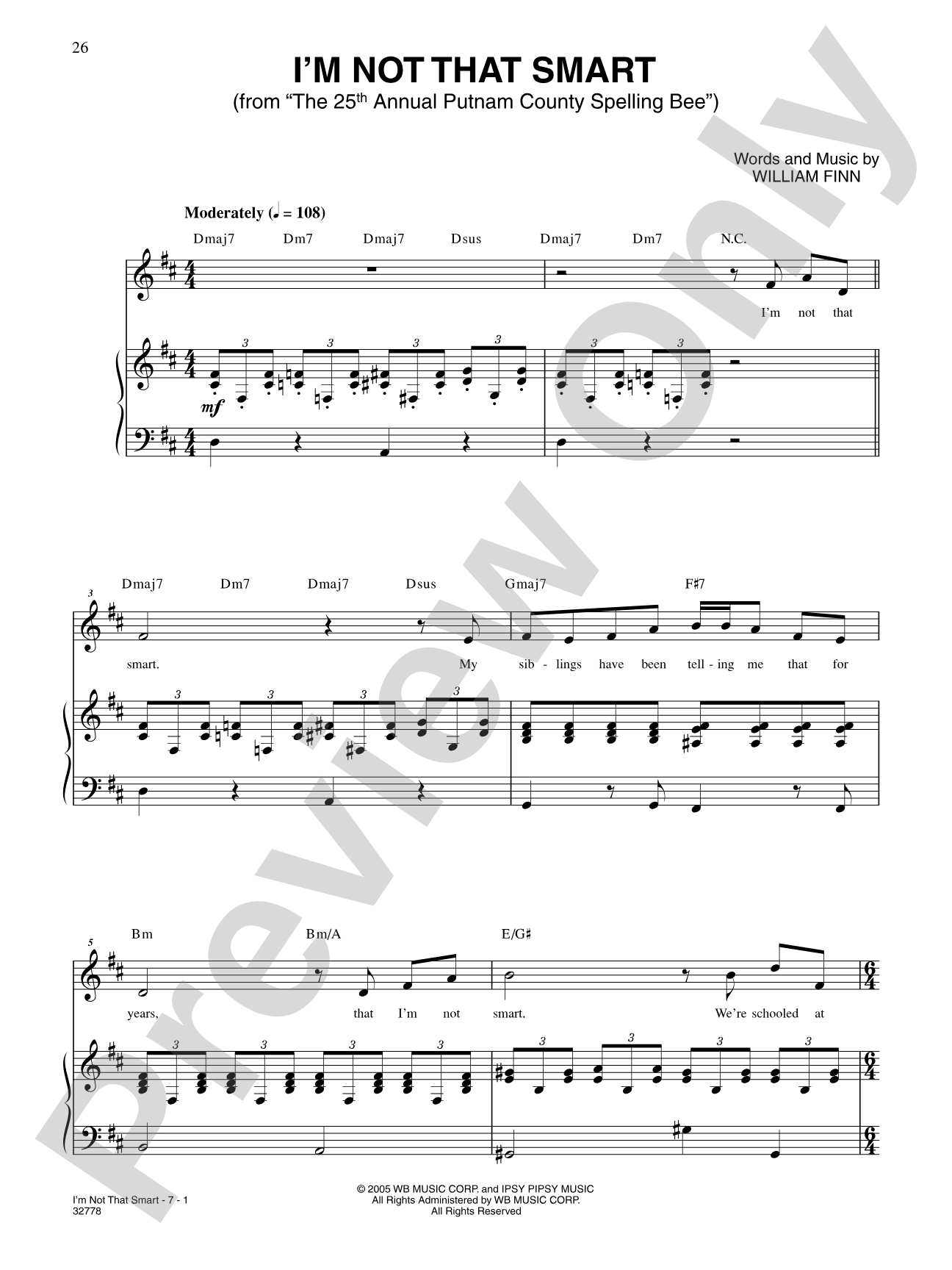
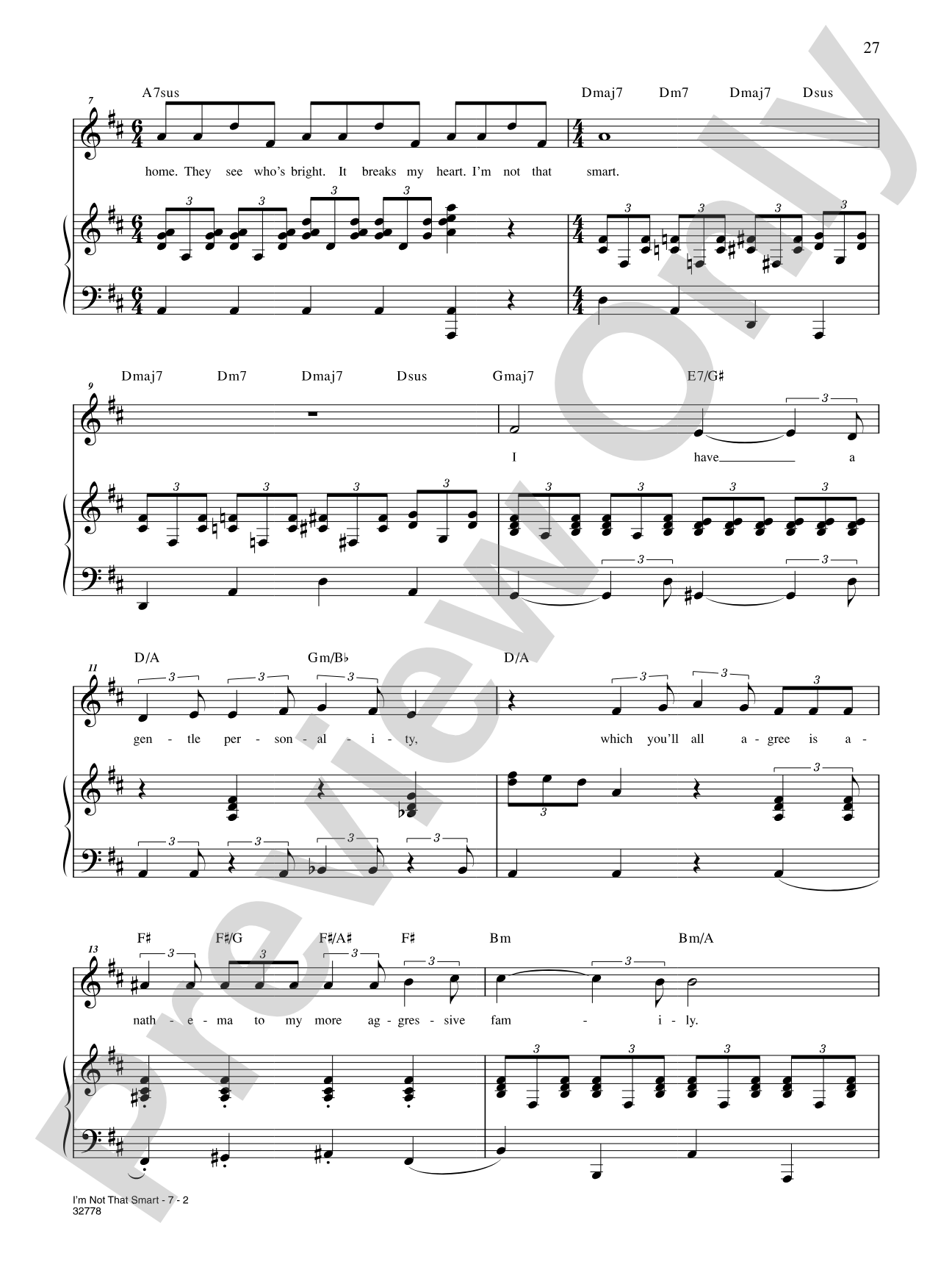

I'm Not That Smart (From "the 25th Annual Putnam County Spelling Bee"): Piano/Vocal/Chords
Ed. Lisa DeSpain
Item: 00-PS-0010495
$5.99
One moment…
Related Items
Love in a Home (From "Li'l Abner"): Piano/Vocal/Chords |
$4.99
|
View | |
The Sailor of My Dreams: Piano/Vocal/Chords |
$4.99
|
View | |
Timid Frieda: Piano/Vocal/Chords |
$4.99
|
View | |
Goodbye, Little Dream, Goodbye (From "Red, Hot and Blue"): Piano/Vocal/Chords |
$4.99
|
View | |
A Little Bit of Good (From "Chicago"): Piano/Vocal/Chords |
$4.99
|
View | |
My Love Is on the Way (From "the Golden Apple"): Piano/Vocal/Chords |
$4.99
|
View | |
Just Imagine (From "Good News"): Piano/Vocal/Chords |
$4.99
|
View | |
A Little Bit in Love (From "Wonderful Town"): Piano/Vocal/Chords |
$5.99
|
View | |
Windflowers (From "the Golden Apple"): Piano/Vocal/Chords |
$4.99
|
View | |
Long Ago (From "Half a Sixpence"): Piano/Vocal/Chords |
$4.99
|
View | |
My Man's Gone Now (From "Porgy and Bess"): Piano/Vocal/Chords |
$5.99
|
View | |
This Is All Very New to Me: Piano/Vocal/Chords |
$5.99
|
View | |
Bring on Tomorrow (From "Fame-the Musical"): Piano/Vocal/Chords |
$5.99
|
View | |
All for You: Piano/Vocal/Chords |
$4.99
|
View | |
Only Love (From "the Scarlet Pimpernel"): Piano/Vocal/Chords |
$4.99
|
View | |
Mira (From "Carnival"): Piano/Vocal/Chords |
$4.99
|
View | |
I'm a Stranger Here Myself: Piano/Vocal/Chords |
$5.99
|
View | |
Tell Me (From "Marie Christine"): Piano/Vocal/Chords |
$4.99
|
View | |
Romance (From "the Desert Song"): Piano/Vocal/Chords |
$5.99
|
View | |
Why Shouldn't I? (From "Jubilee"): Piano/Vocal/Chords |
$4.99
|
View | |
The Sun, Whose Rays Are All Ablaze (From "The Mikado"): Piano/Vocal/Chords |
$4.99
|
View | |
Some Other Time (From "On the Town"): Piano/Vocal/Chords |
$5.99
|
View | |
Love Is Sweeping the Country (From "of Thee I Sing"): Piano/Vocal/Chords |
$5.99
|
View | |
Ballad of Dependency: Piano/Vocal/Chords |
$4.99
|
View | |
Patterns (From "Baby"): Piano/Vocal/Chords |
$5.99
|
View | |
The Boy Friend (From "the Boy Friend"): Piano/Vocal/Chords |
$4.99
|
View | |
I Speak Six Languages (From "the 25th Annual Putnam County Spelling Bee"): Piano/Vocal/Chords |
$5.99
|
View | |
Safety in Numbers: Piano/Vocal/Chords |
$4.99
|
View | |
Jilted: Piano/Vocal/Chords |
$4.99
|
View | |
Yes, My Heart: Piano/Vocal/Chords |
$9.99
|
View | |
Millwork (From "Working"): Piano/Vocal/Chords |
$5.99
|
View | |
Wonderful, Wonderful Day (From "Seven Brides for Seven Brothers"): Piano/Vocal/Chords |
$4.99
|
View | |
Over the Rainbow (From "the Wizard of Oz"): Piano/Vocal/Chords |
$4.99
|
View | |
My Own Best Friend (From "Chicago"): Piano/Vocal/Chords |
$4.99
|
View | |
How Can I Wait? (From "Paint Your Wagon"): Piano/Vocal/Chords |
$5.99
|
View | |
If You Hadn't but You Did (From "Two on the Aisle"): Piano/Vocal/Chords |
$5.99
|
View | |
Lazy Afternoon (From "The Golden Apple"): Piano/Vocal/Chords |
$4.99
|
View | |
What Is a Woman? (From "I Do, I Do"): Piano/Vocal/Chords |
$4.99
|
View | |
Zip (From "Pal Joey"): Piano/Vocal/Chords |
$4.99
|
View | |
Ladies (From "Destry Rides Again"): Piano/Vocal/Chords |
$4.99
|
View | |
Think of Meryl Streep (From "Fame-the Musical"): Piano/Vocal/Chords |
$5.99
|
View | |
West End Avenue (From "The Magic Show"): Piano/Vocal/Chords |
$5.99
|
View | |
Notice Me, Horton (From "Seussical the Musical"): Piano/Vocal/Chords |
$5.99
|
View | |
My Cousin in Milwaukee (From "Pardon My English"): Piano/Vocal/Chords |
$5.99
|
View | |
Somewhere That's Green (From "Little Shop of Horrors"): Piano/Vocal/Chords |
$5.99
|
View | |
Old Friend (From "I'm Getting My Act Together and Taking It on the Road"): Piano/Vocal/Chords |
$5.99
|
View | |
Holding to the Ground (From "Falsettos"): Piano/Vocal/Chords |
$5.99
|
View | |
Back on Base (From "Closer than Ever"): Piano/Vocal/Chords |
$5.99
|
View | |
The Music Still Plays On (From "A New Brain"): Piano/Vocal/Chords |
$5.99
|
View | |
What a Nice Idea? (From "Two Gentlemen of Verona"): Piano/Vocal/Chords |
$4.99
|
View |
Description
For aspiring and professional singers who love Broadway, Alfred's Singer's Library of Musical Theatre presents an elegant collection of the best-loved musical theatre songs in their original keys, authentically transcribed from their original vocal scores. Perfect for study, and equally suitable for the most important auditions and performances, each volume is dedicated to a specific vocal range, and contains dozens of songs from a variety of shows that span decades of theatre history. Multiple volumes are available for each of four vocal ranges: Soprano, Mezzo-Soprano/Alto, Tenor, and Baritone/Bass. Authoritative historical and contextual commentary, audition tips, and 16-bar cut suggestions for each song make it the most useful and relevant song library of its kind.
Titles: I'm Not That Smart (The 25th Annual Putnam County Spelling Bee) * My Unfortunate Erection (Chip's Lament) (The 25th Annual Putnam County Spelling Bee) * Dames (42nd Street) * Radames' Letter (Elton John and Tim Rice's "Aida") * The Gypsy in Me Anything Goes (1988 Revival)) * Ballad of Booth (Part III) (Assassins) * What Am I Doin'? (Closer Than Ever) * Broadway Baby (Dames At Sea) * Blah, Blah, Blah (Delicious) * When the Earth Stopped Turning (Elegies) * You Gotta Die Sometime (Falsettos) * I Want to Make Magic (Fame: The Musical) * Sandy (Grease) * Donna (Hair) * Different (Honk!) * The Phone Call (Lucky Stiff) * Knowing Me, Knowing You (Mamma Mia) * To Each His Dulcinea (Man of La Mancha) * Larger Than Life (My Favorite Year) * I'm Falling in Love with Someone (Naughty Marrietta) * And They're Off (A New Brain) * Stouthearted Men (The New Moon) * Lucky to Be Me (On the Town) * A New Town Is a Blue Town (The Pajama Game) * Extraordinary (Pippin) * There's a Boat Dat's Leavin' Soon for New York (Porgy and Bess®) * You Took Advantage of Me (Present Arms) * Alone in the Universe (Seussical the Musical) * Something to Live For (Sophisticated Ladies) * Strike Up The Band (Strike Up The Band) * Ballad of the Easy Life (The Threepenny Opera) * Calla Lily Lady (Two Gentlemen of Verona) * Love's Revenge (Two Gentlemen of Verona) * They Won't Know Me (Wish You ere Here) * If I Only Had a Brain (The Wizard of Oz)


Titles: I'm Not That Smart (The 25th Annual Putnam County Spelling Bee) * My Unfortunate Erection (Chip's Lament) (The 25th Annual Putnam County Spelling Bee) * Dames (42nd Street) * Radames' Letter (Elton John and Tim Rice's "Aida") * The Gypsy in Me Anything Goes (1988 Revival)) * Ballad of Booth (Part III) (Assassins) * What Am I Doin'? (Closer Than Ever) * Broadway Baby (Dames At Sea) * Blah, Blah, Blah (Delicious) * When the Earth Stopped Turning (Elegies) * You Gotta Die Sometime (Falsettos) * I Want to Make Magic (Fame: The Musical) * Sandy (Grease) * Donna (Hair) * Different (Honk!) * The Phone Call (Lucky Stiff) * Knowing Me, Knowing You (Mamma Mia) * To Each His Dulcinea (Man of La Mancha) * Larger Than Life (My Favorite Year) * I'm Falling in Love with Someone (Naughty Marrietta) * And They're Off (A New Brain) * Stouthearted Men (The New Moon) * Lucky to Be Me (On the Town) * A New Town Is a Blue Town (The Pajama Game) * Extraordinary (Pippin) * There's a Boat Dat's Leavin' Soon for New York (Porgy and Bess®) * You Took Advantage of Me (Present Arms) * Alone in the Universe (Seussical the Musical) * Something to Live For (Sophisticated Ladies) * Strike Up The Band (Strike Up The Band) * Ballad of the Easy Life (The Threepenny Opera) * Calla Lily Lady (Two Gentlemen of Verona) * Love's Revenge (Two Gentlemen of Verona) * They Won't Know Me (Wish You ere Here) * If I Only Had a Brain (The Wizard of Oz)
I'm Not That Smart (From "the 25th Annual Putnam County Spelling Bee"): Piano/Vocal/Chords isn't in MakeMusic Cloud just yet...but it could be. Let us know you'd like to see it, and you'll help shape what comes next. In the meantime, start a free trial and dive into thousands of interactive titles your students can play along with today.
Request This Title
Tell us you want it.
Start Your Free Trial
Explore everything that's ready to play right now.
Sample Audio
1
My Man's Gone Now from Porgy And Bess
--:--
My Man's Gone Now from Porgy And Bess
0:00
0:00
Sample Video
No sample videos found.
Additional Details
Series:
Singer's Library of Musical Theatre
Publisher:
Alfred Music
Page Count:
224
SKU:
00-PS-0010495
More about this title
About the Composer: William Finn
William Finn is a composer and lyricist whose work spans musical theatre, opera, and concert music. His theatrical voice blends humor with emotional vulnerability, often exploring complex character psychology through conversational, rhythmically inventive music. Finn's scores for shows including Falsettos, Assassins, and The 25th Annual Putnam County Spelling Bee have earned him recognition for writing songs that feel simultaneously intimate and theatrically powerful, making his work central to contemporary American musical theatre.
Why we love this
This collection anchors itself in Finn's distinctive gift for character songs that blend specificity with universal emotional truth. Singers find in his work songs that demand genuine connection to a character's interior life rather than surface charm, and the range of vocal types represented across this volume means multiple singers in your studio or company will find material that fits both their voice and their artistic instincts.
What to expect
Finn's songs occupy the space between comedy and heartbreak, where a character's self-awareness about their own flaws becomes endearing rather than pitiful. The music mirrors this duality with conversational melodies that feel close to speech, harmonies that surprise, and emotional arcs that shift unexpectedly, making each song feel like overhearing a genuine moment of self-reckoning.
Who it's for
This collection serves singers preparing auditions for contemporary musical theatre roles, particularly those seeking material by a composer whose work demands intelligent, character-driven interpretation. It's equally valuable for singers in applied lessons studying contemporary Broadway writing or building audition repertoire that extends beyond traditional standards.
How to get the most out of it
- Lean into the conversational quality of Finn's lyrics; his rhythms follow speech patterns rather than impose strict regularity, so let the character's voice shape your phrasing rather than the other way around.
- Pay attention to harmonic shifts as emotional landmarks. Finn uses unexpected chord changes to signal psychological turns, so highlight those moments through your vocal line rather than smoothing over them.
- Balance humor with specificity in character songs like 'I'm Not That Smart.' Comedy lands when the emotional stakes feel real; commit fully to the character's vulnerability beneath the surface joke.
How to use it
Feature Finn's work in cabarets or solo recitals built around contemporary American songwriting, where his pieces fit naturally alongside Schwartz, Sondheim, and other modern theatrical voices. Songs from this collection also serve as excellent audition material for music theatre programs and professional theatre companies seeking actors who can navigate character-driven contemporary material.
Skills your students will build
- Interpreting conversational rhythm and speech-based phrasing in contemporary musical theatre scores
- Identifying and performing harmonic surprises as emotional markers
- Building character specificity through vocal choices rather than relying on stock theatrical delivery
- Sight-reading contemporary vocal writing with irregular phrase lengths and non-traditional melodic contours