
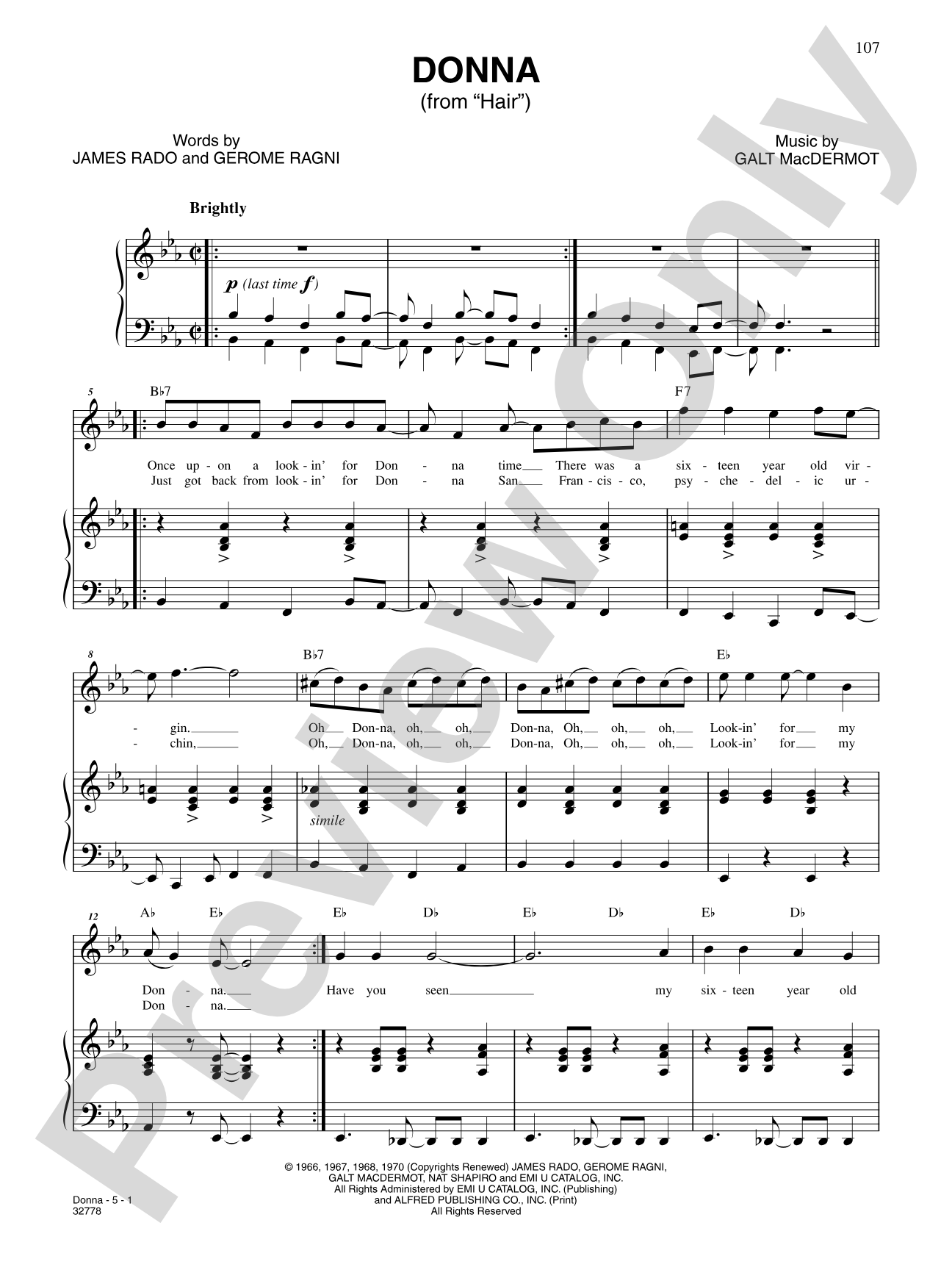

Donna (From "Hair"): Piano/Vocal/Chords
Ed. Lisa DeSpain
Item: 00-PS-0010346
$4.99
One moment…
Related Items
Love in a Home (From "Li'l Abner"): Piano/Vocal/Chords |
$4.99
|
View | |
The Sailor of My Dreams: Piano/Vocal/Chords |
$4.99
|
View | |
Timid Frieda: Piano/Vocal/Chords |
$4.99
|
View | |
Goodbye, Little Dream, Goodbye (From "Red, Hot and Blue"): Piano/Vocal/Chords |
$4.99
|
View | |
A Little Bit of Good (From "Chicago"): Piano/Vocal/Chords |
$4.99
|
View | |
My Love Is on the Way (From "the Golden Apple"): Piano/Vocal/Chords |
$4.99
|
View | |
Just Imagine (From "Good News"): Piano/Vocal/Chords |
$4.99
|
View | |
A Little Bit in Love (From "Wonderful Town"): Piano/Vocal/Chords |
$5.99
|
View | |
Windflowers (From "the Golden Apple"): Piano/Vocal/Chords |
$4.99
|
View | |
Long Ago (From "Half a Sixpence"): Piano/Vocal/Chords |
$4.99
|
View | |
My Man's Gone Now (From "Porgy and Bess"): Piano/Vocal/Chords |
$5.99
|
View | |
This Is All Very New to Me: Piano/Vocal/Chords |
$5.99
|
View | |
Bring on Tomorrow (From "Fame-the Musical"): Piano/Vocal/Chords |
$5.99
|
View | |
All for You: Piano/Vocal/Chords |
$4.99
|
View | |
Only Love (From "the Scarlet Pimpernel"): Piano/Vocal/Chords |
$4.99
|
View | |
Mira (From "Carnival"): Piano/Vocal/Chords |
$4.99
|
View | |
I'm a Stranger Here Myself: Piano/Vocal/Chords |
$5.99
|
View | |
Tell Me (From "Marie Christine"): Piano/Vocal/Chords |
$4.99
|
View | |
Romance (From "the Desert Song"): Piano/Vocal/Chords |
$5.99
|
View | |
Why Shouldn't I? (From "Jubilee"): Piano/Vocal/Chords |
$4.99
|
View | |
The Sun, Whose Rays Are All Ablaze (From "The Mikado"): Piano/Vocal/Chords |
$4.99
|
View | |
Some Other Time (From "On the Town"): Piano/Vocal/Chords |
$5.99
|
View | |
Love Is Sweeping the Country (From "of Thee I Sing"): Piano/Vocal/Chords |
$5.99
|
View | |
Ballad of Dependency: Piano/Vocal/Chords |
$4.99
|
View | |
Patterns (From "Baby"): Piano/Vocal/Chords |
$5.99
|
View | |
The Boy Friend (From "the Boy Friend"): Piano/Vocal/Chords |
$4.99
|
View | |
I Speak Six Languages (From "the 25th Annual Putnam County Spelling Bee"): Piano/Vocal/Chords |
$5.99
|
View | |
Safety in Numbers: Piano/Vocal/Chords |
$4.99
|
View | |
Jilted: Piano/Vocal/Chords |
$4.99
|
View | |
Yes, My Heart: Piano/Vocal/Chords |
$9.99
|
View | |
Millwork (From "Working"): Piano/Vocal/Chords |
$5.99
|
View | |
Wonderful, Wonderful Day (From "Seven Brides for Seven Brothers"): Piano/Vocal/Chords |
$4.99
|
View | |
Over the Rainbow (From "the Wizard of Oz"): Piano/Vocal/Chords |
$4.99
|
View | |
My Own Best Friend (From "Chicago"): Piano/Vocal/Chords |
$4.99
|
View | |
How Can I Wait? (From "Paint Your Wagon"): Piano/Vocal/Chords |
$5.99
|
View | |
If You Hadn't but You Did (From "Two on the Aisle"): Piano/Vocal/Chords |
$5.99
|
View | |
Lazy Afternoon (From "The Golden Apple"): Piano/Vocal/Chords |
$4.99
|
View | |
What Is a Woman? (From "I Do, I Do"): Piano/Vocal/Chords |
$4.99
|
View | |
Zip (From "Pal Joey"): Piano/Vocal/Chords |
$4.99
|
View | |
Ladies (From "Destry Rides Again"): Piano/Vocal/Chords |
$4.99
|
View | |
Think of Meryl Streep (From "Fame-the Musical"): Piano/Vocal/Chords |
$5.99
|
View | |
West End Avenue (From "The Magic Show"): Piano/Vocal/Chords |
$5.99
|
View | |
Notice Me, Horton (From "Seussical the Musical"): Piano/Vocal/Chords |
$5.99
|
View | |
My Cousin in Milwaukee (From "Pardon My English"): Piano/Vocal/Chords |
$5.99
|
View | |
Somewhere That's Green (From "Little Shop of Horrors"): Piano/Vocal/Chords |
$5.99
|
View | |
Old Friend (From "I'm Getting My Act Together and Taking It on the Road"): Piano/Vocal/Chords |
$5.99
|
View | |
Holding to the Ground (From "Falsettos"): Piano/Vocal/Chords |
$5.99
|
View | |
Back on Base (From "Closer than Ever"): Piano/Vocal/Chords |
$5.99
|
View | |
The Music Still Plays On (From "A New Brain"): Piano/Vocal/Chords |
$5.99
|
View | |
What a Nice Idea? (From "Two Gentlemen of Verona"): Piano/Vocal/Chords |
$4.99
|
View |
Description
For aspiring and professional singers who love Broadway, Alfred's Singer's Library of Musical Theatre presents an elegant collection of the best-loved musical theatre songs in their original keys, authentically transcribed from their original vocal scores. Perfect for study, and equally suitable for the most important auditions and performances, each volume is dedicated to a specific vocal range, and contains dozens of songs from a variety of shows that span decades of theatre history. Multiple volumes are available for each of four vocal ranges: Soprano, Mezzo-Soprano/Alto, Tenor, and Baritone/Bass. Authoritative historical and contextual commentary, audition tips, and 16-bar cut suggestions for each song make it the most useful and relevant song library of its kind.
Titles: I'm Not That Smart (The 25th Annual Putnam County Spelling Bee) * My Unfortunate Erection (Chip's Lament) (The 25th Annual Putnam County Spelling Bee) * Dames (42nd Street) * Radames' Letter (Elton John and Tim Rice's "Aida") * The Gypsy in Me Anything Goes (1988 Revival)) * Ballad of Booth (Part III) (Assassins) * What Am I Doin'? (Closer Than Ever) * Broadway Baby (Dames At Sea) * Blah, Blah, Blah (Delicious) * When the Earth Stopped Turning (Elegies) * You Gotta Die Sometime (Falsettos) * I Want to Make Magic (Fame: The Musical) * Sandy (Grease) * Donna (Hair) * Different (Honk!) * The Phone Call (Lucky Stiff) * Knowing Me, Knowing You (Mamma Mia) * To Each His Dulcinea (Man of La Mancha) * Larger Than Life (My Favorite Year) * I'm Falling in Love with Someone (Naughty Marrietta) * And They're Off (A New Brain) * Stouthearted Men (The New Moon) * Lucky to Be Me (On the Town) * A New Town Is a Blue Town (The Pajama Game) * Extraordinary (Pippin) * There's a Boat Dat's Leavin' Soon for New York (Porgy and Bess®) * You Took Advantage of Me (Present Arms) * Alone in the Universe (Seussical the Musical) * Something to Live For (Sophisticated Ladies) * Strike Up The Band (Strike Up The Band) * Ballad of the Easy Life (The Threepenny Opera) * Calla Lily Lady (Two Gentlemen of Verona) * Love's Revenge (Two Gentlemen of Verona) * They Won't Know Me (Wish You ere Here) * If I Only Had a Brain (The Wizard of Oz)


Titles: I'm Not That Smart (The 25th Annual Putnam County Spelling Bee) * My Unfortunate Erection (Chip's Lament) (The 25th Annual Putnam County Spelling Bee) * Dames (42nd Street) * Radames' Letter (Elton John and Tim Rice's "Aida") * The Gypsy in Me Anything Goes (1988 Revival)) * Ballad of Booth (Part III) (Assassins) * What Am I Doin'? (Closer Than Ever) * Broadway Baby (Dames At Sea) * Blah, Blah, Blah (Delicious) * When the Earth Stopped Turning (Elegies) * You Gotta Die Sometime (Falsettos) * I Want to Make Magic (Fame: The Musical) * Sandy (Grease) * Donna (Hair) * Different (Honk!) * The Phone Call (Lucky Stiff) * Knowing Me, Knowing You (Mamma Mia) * To Each His Dulcinea (Man of La Mancha) * Larger Than Life (My Favorite Year) * I'm Falling in Love with Someone (Naughty Marrietta) * And They're Off (A New Brain) * Stouthearted Men (The New Moon) * Lucky to Be Me (On the Town) * A New Town Is a Blue Town (The Pajama Game) * Extraordinary (Pippin) * There's a Boat Dat's Leavin' Soon for New York (Porgy and Bess®) * You Took Advantage of Me (Present Arms) * Alone in the Universe (Seussical the Musical) * Something to Live For (Sophisticated Ladies) * Strike Up The Band (Strike Up The Band) * Ballad of the Easy Life (The Threepenny Opera) * Calla Lily Lady (Two Gentlemen of Verona) * Love's Revenge (Two Gentlemen of Verona) * They Won't Know Me (Wish You ere Here) * If I Only Had a Brain (The Wizard of Oz)
Donna (From "Hair"): Piano/Vocal/Chords isn't in MakeMusic Cloud just yet...but it could be. Let us know you'd like to see it, and you'll help shape what comes next. In the meantime, start a free trial and dive into thousands of interactive titles your students can play along with today.
Request This Title
Tell us you want it.
Start Your Free Trial
Explore everything that's ready to play right now.
Sample Audio
1
My Man's Gone Now from Porgy And Bess
--:--
My Man's Gone Now from Porgy And Bess
0:00
0:00
Sample Video
No sample videos found.
Additional Details
Series:
Singer's Library of Musical Theatre
Publisher:
Alfred Music
Page Count:
224
SKU:
00-PS-0010346
More about this title
About the Composer: Galt MacDermot
Galt MacDermot composed the score for Hair, the 1968 rock musical that fundamentally changed what Broadway could be. His work blended classical training with rock and pop sensibilities, creating songs that felt simultaneously theatrical and genuinely contemporary. MacDermot's ability to write memorable melodies within unconventional harmonic structures made him a pivotal figure in expanding the musical theatre canon beyond traditional operetta forms.
For music educators, MacDermot's legacy lies in his demonstration that serious compositional craft and popular accessibility are not mutually exclusive. His scores reward careful study of voice leading, modal harmony, and rhythmic flexibility, making them rich teaching tools for singers navigating the intersection of classical technique and contemporary expression.
Why we love this
Donna sits in the heart of a collection that treats each song as an audition-ready vehicle rather than a casual selection. The editorial choices here matter: original keys preserved, historically accurate transcriptions, and those 16-bar cut suggestions mean singers aren't left to guess what works in a room. For teachers building a repertoire library, having 224 pages of Broadway spanning seven decades, all thoughtfully contextual ized, beats cobbling together photocopies from disparate sources.
What to expect
Donna carries the optimistic idealism and gentle rock sensibility that defined Hair. The song feels like a conversation, intimate and unhurried, with harmonic movement that suggests both innocence and emotional depth. There's a looseness to the phrasing that invites interpretation while still respecting the integrity of MacDermot's melodic line.
Who it's for
This collection serves singers preparing for auditions, music theatre teachers building a curated repertoire, and serious vocalists studying how different composers across different eras approach the same dramatic challenges. It's equally useful for students analyzing vocal writing styles and for professionals who need performance-ready arrangements in original keys.
How to get the most out of it
- Balance the folksy sincerity of the lyric with the harmonic sophistication underneath; Hair's genius is making complexity feel effortless.
- Use the chord symbols not just for accompaniment reference but as a map for where your voice can land expressively between the written melody.
- Pay attention to the rhythmic freedom the era allows; this isn't recitative, but it's not metronomic either.
How to use it
Include this as part of a 1960s musical theatre retrospective that traces how Broadway began absorbing rock influences, or program it in a cabaret setting where its conversational tone feels at home. For singers studying song interpretation across styles, it's a natural pairing with pieces from Sondheim and Kander and Ebb to explore how different composers handled character voice in the same era.
Skills your students will build
- Singing in original keys and adjusting technique for lower tessitura passages
- Reading and interpreting chord charts in a performance context
- Managing stylistic shifts between sung melody and rhythmically flexible phrasing
- Understanding harmonic progressions in modal and contemporary popular idioms
- Preparing audition cuts and identifying the most dramatically compelling 16-bar selections