
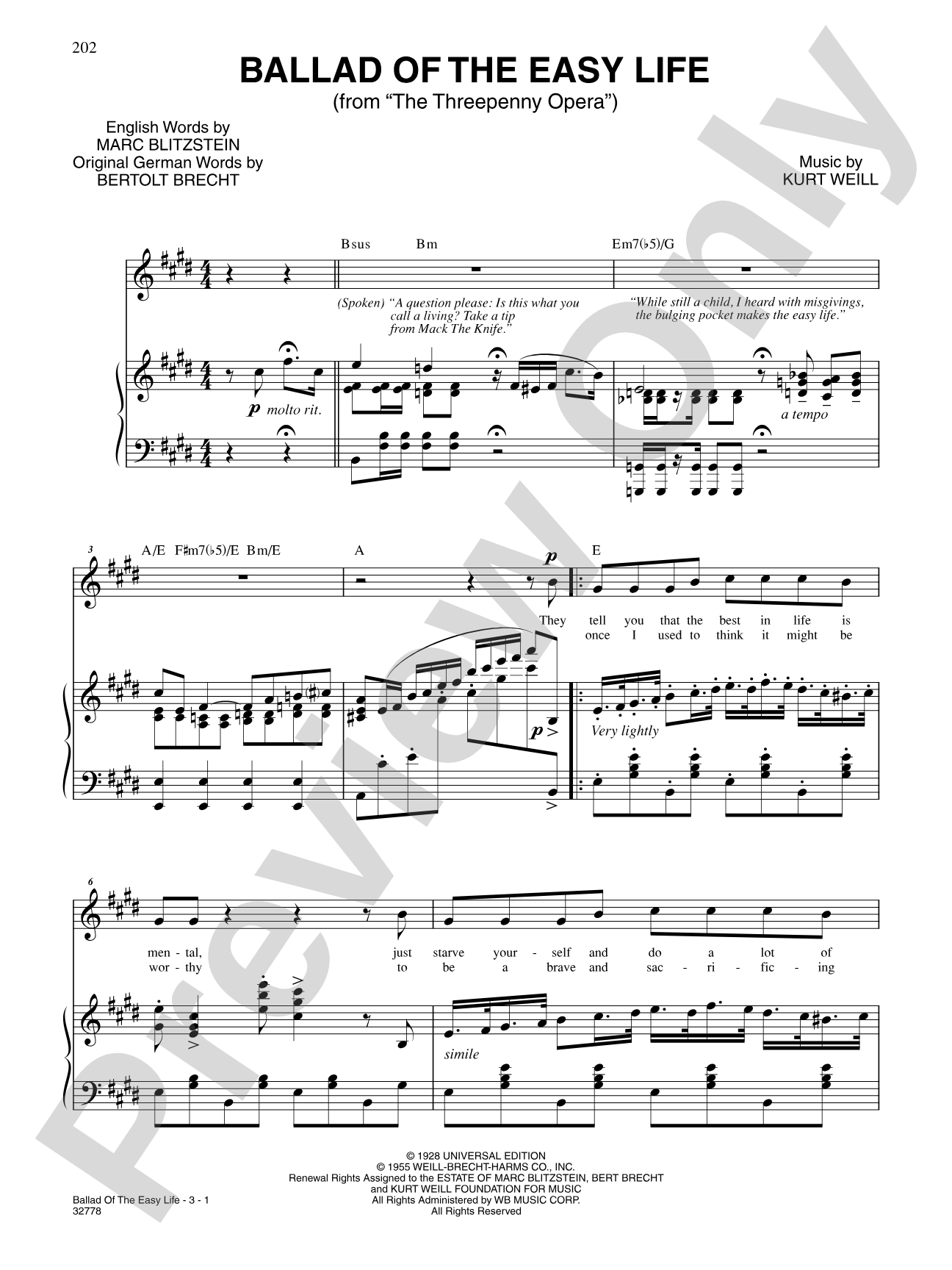

Ballad of the Easy Life (From "The Threepenny Opera"): Piano/Vocal/Chords
Ed. Lisa DeSpain
Item: 00-PS-0010430
$4.99
One moment…
Related Items
Love in a Home (From "Li'l Abner"): Piano/Vocal/Chords |
$4.99
|
View | |
The Sailor of My Dreams: Piano/Vocal/Chords |
$4.99
|
View | |
Timid Frieda: Piano/Vocal/Chords |
$4.99
|
View | |
Goodbye, Little Dream, Goodbye (From "Red, Hot and Blue"): Piano/Vocal/Chords |
$4.99
|
View | |
A Little Bit of Good (From "Chicago"): Piano/Vocal/Chords |
$4.99
|
View | |
My Love Is on the Way (From "the Golden Apple"): Piano/Vocal/Chords |
$4.99
|
View | |
Just Imagine (From "Good News"): Piano/Vocal/Chords |
$4.99
|
View | |
A Little Bit in Love (From "Wonderful Town"): Piano/Vocal/Chords |
$5.99
|
View | |
Windflowers (From "the Golden Apple"): Piano/Vocal/Chords |
$4.99
|
View | |
Long Ago (From "Half a Sixpence"): Piano/Vocal/Chords |
$4.99
|
View | |
My Man's Gone Now (From "Porgy and Bess"): Piano/Vocal/Chords |
$5.99
|
View | |
This Is All Very New to Me: Piano/Vocal/Chords |
$5.99
|
View | |
Bring on Tomorrow (From "Fame-the Musical"): Piano/Vocal/Chords |
$5.99
|
View | |
All for You: Piano/Vocal/Chords |
$4.99
|
View | |
Only Love (From "the Scarlet Pimpernel"): Piano/Vocal/Chords |
$4.99
|
View | |
Mira (From "Carnival"): Piano/Vocal/Chords |
$4.99
|
View | |
I'm a Stranger Here Myself: Piano/Vocal/Chords |
$5.99
|
View | |
Tell Me (From "Marie Christine"): Piano/Vocal/Chords |
$4.99
|
View | |
Romance (From "the Desert Song"): Piano/Vocal/Chords |
$5.99
|
View | |
Why Shouldn't I? (From "Jubilee"): Piano/Vocal/Chords |
$4.99
|
View | |
The Sun, Whose Rays Are All Ablaze (From "The Mikado"): Piano/Vocal/Chords |
$4.99
|
View | |
Some Other Time (From "On the Town"): Piano/Vocal/Chords |
$5.99
|
View | |
Love Is Sweeping the Country (From "of Thee I Sing"): Piano/Vocal/Chords |
$5.99
|
View | |
Ballad of Dependency: Piano/Vocal/Chords |
$4.99
|
View | |
Patterns (From "Baby"): Piano/Vocal/Chords |
$5.99
|
View | |
The Boy Friend (From "the Boy Friend"): Piano/Vocal/Chords |
$4.99
|
View | |
I Speak Six Languages (From "the 25th Annual Putnam County Spelling Bee"): Piano/Vocal/Chords |
$5.99
|
View | |
Safety in Numbers: Piano/Vocal/Chords |
$4.99
|
View | |
Jilted: Piano/Vocal/Chords |
$4.99
|
View | |
Yes, My Heart: Piano/Vocal/Chords |
$9.99
|
View | |
Millwork (From "Working"): Piano/Vocal/Chords |
$5.99
|
View | |
Wonderful, Wonderful Day (From "Seven Brides for Seven Brothers"): Piano/Vocal/Chords |
$4.99
|
View | |
Over the Rainbow (From "the Wizard of Oz"): Piano/Vocal/Chords |
$4.99
|
View | |
My Own Best Friend (From "Chicago"): Piano/Vocal/Chords |
$4.99
|
View | |
How Can I Wait? (From "Paint Your Wagon"): Piano/Vocal/Chords |
$5.99
|
View | |
If You Hadn't but You Did (From "Two on the Aisle"): Piano/Vocal/Chords |
$5.99
|
View | |
Lazy Afternoon (From "The Golden Apple"): Piano/Vocal/Chords |
$4.99
|
View | |
What Is a Woman? (From "I Do, I Do"): Piano/Vocal/Chords |
$4.99
|
View | |
Zip (From "Pal Joey"): Piano/Vocal/Chords |
$4.99
|
View | |
Ladies (From "Destry Rides Again"): Piano/Vocal/Chords |
$4.99
|
View | |
Think of Meryl Streep (From "Fame-the Musical"): Piano/Vocal/Chords |
$5.99
|
View | |
West End Avenue (From "The Magic Show"): Piano/Vocal/Chords |
$5.99
|
View | |
Notice Me, Horton (From "Seussical the Musical"): Piano/Vocal/Chords |
$5.99
|
View | |
My Cousin in Milwaukee (From "Pardon My English"): Piano/Vocal/Chords |
$5.99
|
View | |
Somewhere That's Green (From "Little Shop of Horrors"): Piano/Vocal/Chords |
$5.99
|
View | |
Old Friend (From "I'm Getting My Act Together and Taking It on the Road"): Piano/Vocal/Chords |
$5.99
|
View | |
Holding to the Ground (From "Falsettos"): Piano/Vocal/Chords |
$5.99
|
View | |
Back on Base (From "Closer than Ever"): Piano/Vocal/Chords |
$5.99
|
View | |
The Music Still Plays On (From "A New Brain"): Piano/Vocal/Chords |
$5.99
|
View | |
What a Nice Idea? (From "Two Gentlemen of Verona"): Piano/Vocal/Chords |
$4.99
|
View |
Description
For aspiring and professional singers who love Broadway, Alfred's Singer's Library of Musical Theatre presents an elegant collection of the best-loved musical theatre songs in their original keys, authentically transcribed from their original vocal scores. Perfect for study, and equally suitable for the most important auditions and performances, each volume is dedicated to a specific vocal range, and contains dozens of songs from a variety of shows that span decades of theatre history. Multiple volumes are available for each of four vocal ranges: Soprano, Mezzo-Soprano/Alto, Tenor, and Baritone/Bass. Authoritative historical and contextual commentary, audition tips, and 16-bar cut suggestions for each song make it the most useful and relevant song library of its kind.
Titles: I'm Not That Smart (The 25th Annual Putnam County Spelling Bee) * My Unfortunate Erection (Chip's Lament) (The 25th Annual Putnam County Spelling Bee) * Dames (42nd Street) * Radames' Letter (Elton John and Tim Rice's "Aida") * The Gypsy in Me Anything Goes (1988 Revival)) * Ballad of Booth (Part III) (Assassins) * What Am I Doin'? (Closer Than Ever) * Broadway Baby (Dames At Sea) * Blah, Blah, Blah (Delicious) * When the Earth Stopped Turning (Elegies) * You Gotta Die Sometime (Falsettos) * I Want to Make Magic (Fame: The Musical) * Sandy (Grease) * Donna (Hair) * Different (Honk!) * The Phone Call (Lucky Stiff) * Knowing Me, Knowing You (Mamma Mia) * To Each His Dulcinea (Man of La Mancha) * Larger Than Life (My Favorite Year) * I'm Falling in Love with Someone (Naughty Marrietta) * And They're Off (A New Brain) * Stouthearted Men (The New Moon) * Lucky to Be Me (On the Town) * A New Town Is a Blue Town (The Pajama Game) * Extraordinary (Pippin) * There's a Boat Dat's Leavin' Soon for New York (Porgy and Bess®) * You Took Advantage of Me (Present Arms) * Alone in the Universe (Seussical the Musical) * Something to Live For (Sophisticated Ladies) * Strike Up The Band (Strike Up The Band) * Ballad of the Easy Life (The Threepenny Opera) * Calla Lily Lady (Two Gentlemen of Verona) * Love's Revenge (Two Gentlemen of Verona) * They Won't Know Me (Wish You ere Here) * If I Only Had a Brain (The Wizard of Oz)


Titles: I'm Not That Smart (The 25th Annual Putnam County Spelling Bee) * My Unfortunate Erection (Chip's Lament) (The 25th Annual Putnam County Spelling Bee) * Dames (42nd Street) * Radames' Letter (Elton John and Tim Rice's "Aida") * The Gypsy in Me Anything Goes (1988 Revival)) * Ballad of Booth (Part III) (Assassins) * What Am I Doin'? (Closer Than Ever) * Broadway Baby (Dames At Sea) * Blah, Blah, Blah (Delicious) * When the Earth Stopped Turning (Elegies) * You Gotta Die Sometime (Falsettos) * I Want to Make Magic (Fame: The Musical) * Sandy (Grease) * Donna (Hair) * Different (Honk!) * The Phone Call (Lucky Stiff) * Knowing Me, Knowing You (Mamma Mia) * To Each His Dulcinea (Man of La Mancha) * Larger Than Life (My Favorite Year) * I'm Falling in Love with Someone (Naughty Marrietta) * And They're Off (A New Brain) * Stouthearted Men (The New Moon) * Lucky to Be Me (On the Town) * A New Town Is a Blue Town (The Pajama Game) * Extraordinary (Pippin) * There's a Boat Dat's Leavin' Soon for New York (Porgy and Bess®) * You Took Advantage of Me (Present Arms) * Alone in the Universe (Seussical the Musical) * Something to Live For (Sophisticated Ladies) * Strike Up The Band (Strike Up The Band) * Ballad of the Easy Life (The Threepenny Opera) * Calla Lily Lady (Two Gentlemen of Verona) * Love's Revenge (Two Gentlemen of Verona) * They Won't Know Me (Wish You ere Here) * If I Only Had a Brain (The Wizard of Oz)
Ballad of the Easy Life (From "The Threepenny Opera"): Piano/Vocal/Chords isn't in MakeMusic Cloud just yet...but it could be. Let us know you'd like to see it, and you'll help shape what comes next. In the meantime, start a free trial and dive into thousands of interactive titles your students can play along with today.
Request This Title
Tell us you want it.
Start Your Free Trial
Explore everything that's ready to play right now.
Sample Audio
1
My Man's Gone Now from Porgy And Bess
--:--
My Man's Gone Now from Porgy And Bess
0:00
0:00
Sample Video
No sample videos found.
Additional Details
Series:
Singer's Library of Musical Theatre
Publisher:
Alfred Music
Page Count:
224
SKU:
00-PS-0010430
More about this title
About the Composer: Kurt Weill
Kurt Weill (1900-1950) was a German-American composer who fundamentally changed how music functions in theatre. He studied under some of Europe's most rigorous composers, including Ferruccio Busoni, and developed a style that blended modernist sophistication with direct emotional appeal. His partnership with lyricist Bertolt Brecht in 1920s Berlin produced works of lasting theatrical power, most notably The Threepenny Opera, which married biting social commentary to unforgettable melodies that audiences could actually sing and remember.
Weill believed music should serve the dramatic moment first. He rejected the idea that theatre music needed to be "pretty" or decorative; instead, his songs penetrate character and conflict with surgical precision. After emigrating to the United States in 1935, he brought this same uncompromising sensibility to Broadway, creating scores that demanded serious musicianship from singers while remaining fundamentally theatrical. His influence on how songs function in musical drama remains the standard against which contemporary theatre music is measured.
Why we love this
This collection anchors singers in Weill's original keys and harmonic language, which is essential for understanding how his melodies interact with the songs around them in their shows. The Singer's Library format gives you the audition-ready cuts and historical context that make preparation efficient without sacrificing authenticity. Weill's music rewards careful listening; his harmonies contain sophistication that elevates any singer's interpretation beyond surface-level performance.
What to expect
Weill's melodies are immediately memorable yet harmonically complex, creating songs that feel both accessible and deeply sophisticated. His music carries an undertone of melancholy and moral complexity; even lighter moments contain a world-weariness that gives them resonance. The result is vocal material that feels mature and intellectually engaging while remaining emotionally direct.
Who it's for
Singers preparing auditions or recitals need scores that represent composers authentically and in their original keys, and this collection delivers exactly that. Whether you're building a diverse audition book or deepening your understanding of twentieth-century musical theatre composition, Weill's work provides material that challenges singers to grow beyond surface technique into genuine dramatic storytelling.
How to get the most out of it
- Study the harmonic movement underneath the melody; Weill uses unexpected chord progressions to deepen emotional moments, and singing through them with awareness (rather than over them) creates immediate dramatic connection.
- Respect the specificity of Weill's rhythmic writing. His syncopations and rests aren't ornamental; they control the pacing of emotional revelation. Precision here sounds like intention.
- Anchor your interpretation in the piano part. Weill composed for the voice-and-piano medium deliberately, and the accompaniment often contains the dramatic subtext that colors your vocal choices.
- Balance legit vocal technique with directness of delivery. Weill's songs require supported singing, but they should never feel formal or distant. The music demands connection to the character's predicament.
How to use it
Program Weill songs to represent the intersection of European modernism and Broadway theatre, or use them to show singers how character and musical form work together. A recital that includes several Weill pieces demonstrates range and seriousness; these songs program well alongside Sondheim or Bernstein as part of a twentieth-century American theatre narrative.
Skills your students will build
- Navigating seventh chords, minor ninths, and chromatic harmony in legit vocal performance
- Interpreting rhythmic precision and syncopation as dramatic devices, not just technical challenges
- Balancing lyrical singing with sharp comic or cynical character work
- Reading complex accompaniment patterns and connecting them to melodic interpretation
- Understanding how European operatic tradition shaped American musical theatre composition