
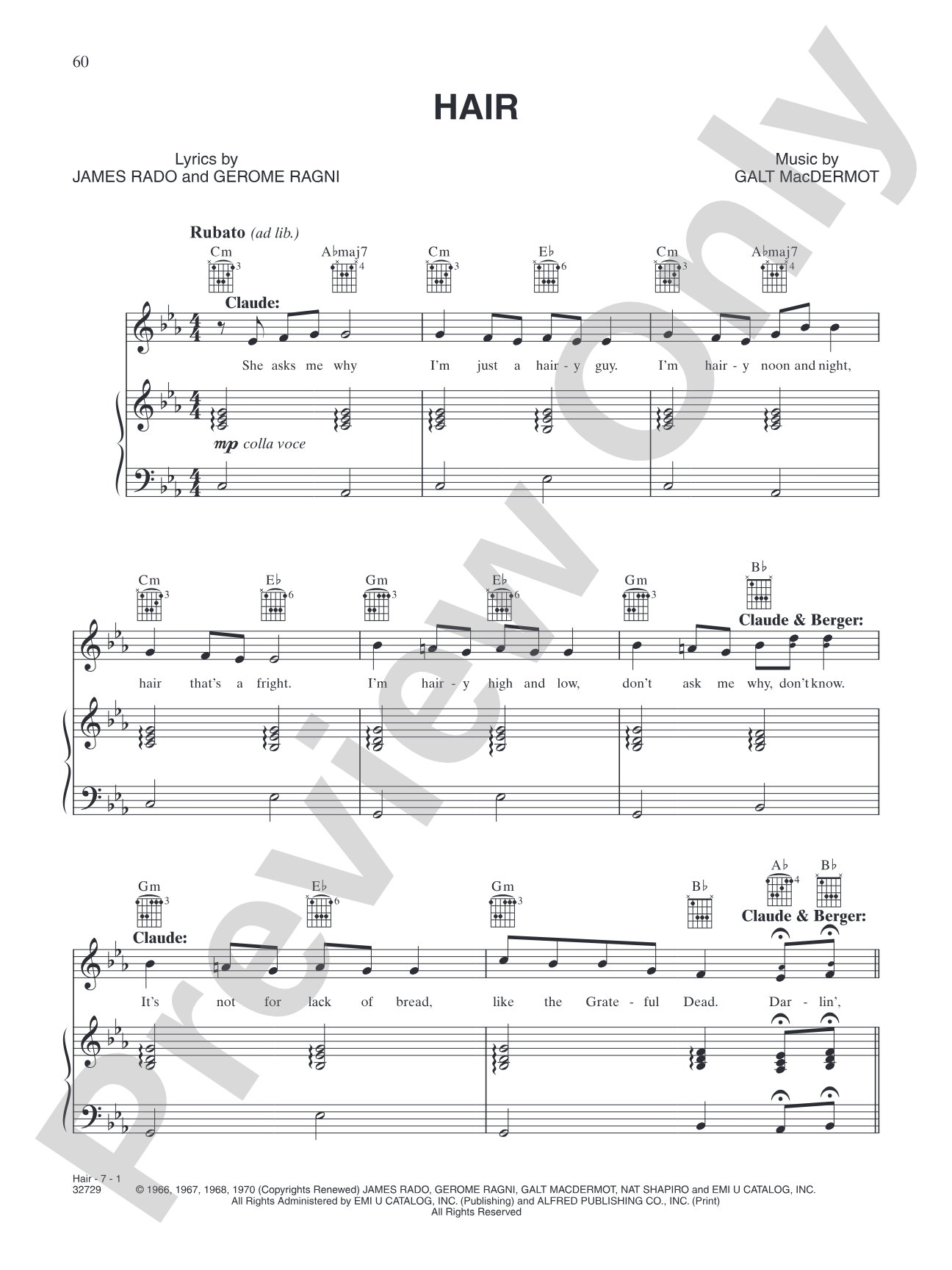
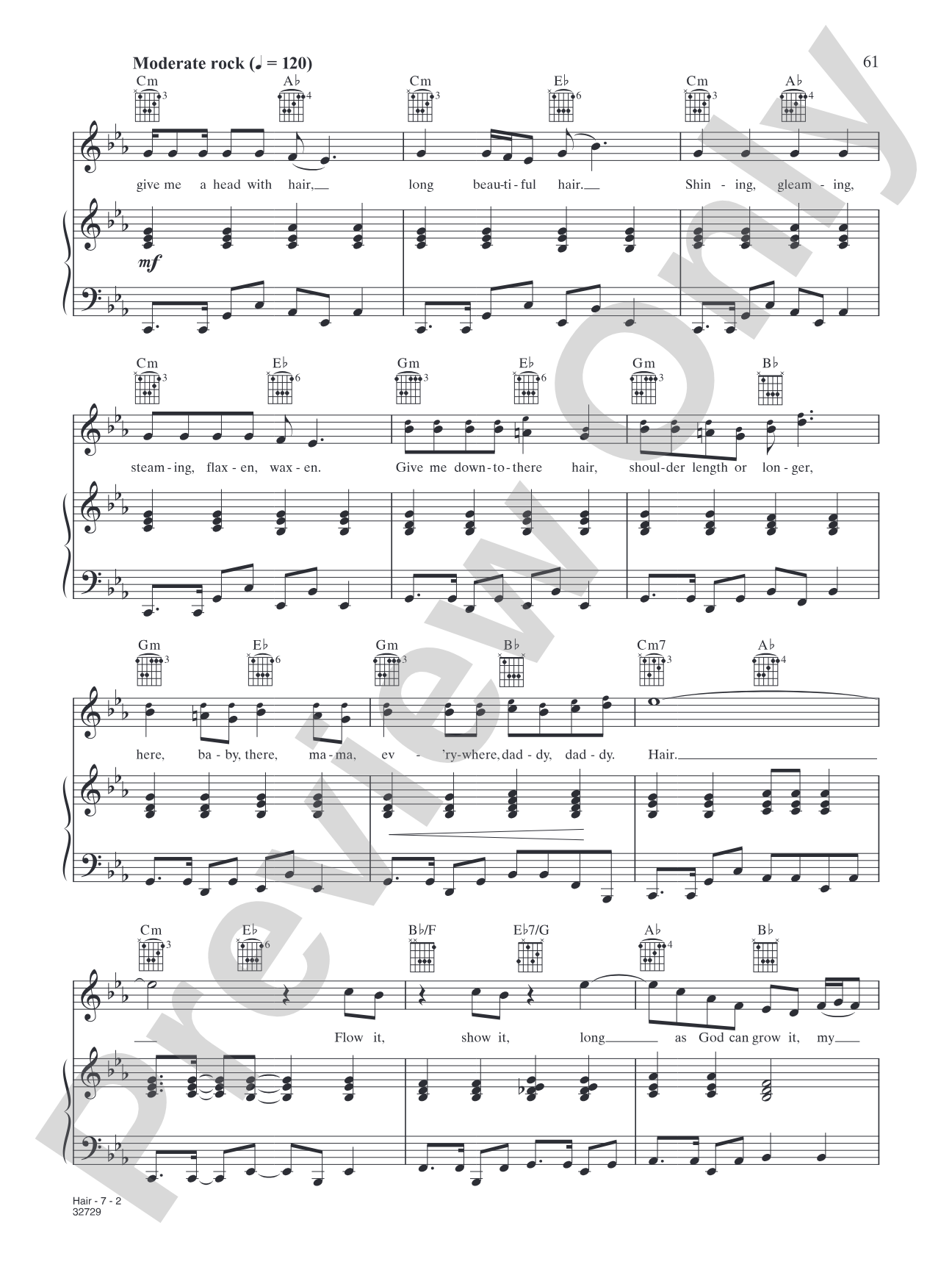

Hair: Piano/Vocal/Chords
Music by Galt MacDermot, words by James Rado and Gerome Ragni
Item: 00-PS-0000520
$5.99
One moment…
Related Items
Walking In Space: Piano/Vocal/Chords |
$5.99
|
View | |
Manchester England: Piano/Vocal/Chords |
$4.99
|
View | |
White Boys: Piano/Vocal/Chords |
$5.99
|
View | |
Donna: Piano/Vocal/Chords |
$5.99
|
View | |
Easy to Be Hard (from "Hair"): Piano/Vocal/Chords |
$4.99
|
View | |
Four Score / Abie Baby (from "Hair"): Piano/Vocal/Chords |
$4.99
|
View | |
Hashish (from "Hair"): Piano/Vocal/Chords |
$4.99
|
View | |
Air (from "Hair"): Piano/Vocal/Chords |
$4.99
|
View | |
What a Piece of Work Is Man / How Dare They Try (from "Hair"): Piano/Vocal/Chords |
$4.99
|
View | |
I Got Life (from "Hair"): Piano/Vocal/Chords |
$5.99
|
View | |
Electric Blues (from "Hair"): Piano/Vocal/Chords |
$5.99
|
View | |
I'm Black / Ain't Got No (from "Hair"): Piano/Vocal/Chords |
$4.99
|
View | |
Black Boys (from "Hair"): Piano/Vocal/Chords |
$4.99
|
View | |
Where Do I Go? (from "Hair"): Piano/Vocal/Chords |
$4.99
|
View | |
Three-Five-Zero-Zero (from "Hair"): Piano/Vocal/Chords |
$4.99
|
View | |
Good Morning Starshine (from "Hair"): Piano/Vocal/Chords |
$4.99
|
View | |
Frank Mills (from "Hair"): Piano/Vocal/Chords |
$4.99
|
View | |
Hare Krishna / Be In (from "Hair"): Piano/Vocal/Chords |
$5.99
|
View | |
Sodomy (from "Hair"): Piano/Vocal/Chords |
$4.99
|
View | |
Colored Spade (from "Hair"): Piano/Vocal/Chords |
$4.99
|
View | |
Sheila Franklin / I Believe in Love (from "Hair"): Piano/Vocal/Chords |
$4.99
|
View | |
Initials (from "Hair"): Piano/Vocal/Chords |
$4.99
|
View | |
Going Down (from "Hair"): Piano/Vocal/Chords |
$5.99
|
View | |
My Conviction (from "Hair"): Piano/Vocal/Chords |
$4.99
|
View | |
Oh Great God of Power / Manchester England (Reprise) (from "Hair"): Piano/Vocal/Chords |
$4.99
|
View | |
Yes, I's Finished on Y'all's Farmlands (from "Hair"): Piano/Vocal/Chords |
$4.99
|
View | |
Flesh Failures / Eyes Look Your Last / Let the Sun Shine In (from "Hair"): Piano/Vocal/Chords |
$5.99
|
View | |
Give Up All Desires (from "Hair"): Piano/Vocal/Chords |
$4.99
|
View | |
Hair: Vocal Selections (Broadway Edition): Piano/Vocal/Chords Book |
$19.95
|
View |
Description
The musical Hair was a cultural phenomenon in the epoch-changing era of the 1960s. Broadway has never been the same. This songbook includes highlights from the smash hit revival of the show, which has attracted raves from audiences and critics alike. Relive the new dawning of the Age of Aquarius and let the sun shine in! Titles: Air * Aquarius * Black Boys * Colored Spade * Donna * Easy to Be Hard * Flesh Failures, The / Let the Sun Shine In * Frank Mills * Give Up All Desires * Going Down * Good Morning Starshine * Hair * Hare Krishna (Be In) * Hashish * I Believe in Love * I Got Life * I'm Black / Ain't Got No * Initials * Manchester England * My Conviction * Old Fashioned Melody / Electric Blues * Sodomy * Three-Five-Zero-Zero * Walking in Space * What a Piece of Work Is Man * Where Do I Go? * White Boys * Yes, I's Finished on Y'alls Farmlands / Abie Baby.


Hair: Piano/Vocal/Chords isn't in MakeMusic Cloud just yet...but it could be. Let us know you'd like to see it, and you'll help shape what comes next. In the meantime, start a free trial and dive into thousands of interactive titles your students can play along with today.
Request This Title
Tell us you want it.
Start Your Free Trial
Explore everything that's ready to play right now.
Sample Audio
No sample audio found.
Sample Video
No sample videos found.
Additional Details
Publisher:
Alfred Music
Page Count:
150
SKU:
00-PS-0000520
More about this title
About the Composer: Galt MacDermot
Galt MacDermot (1928-2018) was a Canadian-American composer and pianist whose work bridged classical training and popular music. His score for Hair, which opened Off-Broadway in 1967 and moved to Broadway the following year, became one of the most influential theatrical compositions of the twentieth century. MacDermot composed for stage, film, and television throughout his career, bringing sophisticated harmonic language to rock and pop idioms.
Why we love this
Hair remains one of the most singable and immediately engaging Broadway scores ever written. These songs sit comfortably for voices across multiple ranges, the piano accompaniments balance accessibility with genuine sophistication, and the material itself generates real enthusiasm from singers and audiences alike. Whether you're building a musical theater program, need concert repertoire with cultural weight, or want students to experience songs that genuinely changed American theater, this collection delivers.
What to expect
These songs pulse with the optimism and social idealism of the late 1960s, yet they carry genuine emotional depth. The melodies are instantly memorable, the harmonies are modern without being difficult, and the text speaks directly to performers and audiences with an immediacy that hasn't faded.
Who it's for
Singers preparing Broadway audition material, voice teachers building contemporary repertoire, and pianists accompanying musical theater programs. This songbook works equally well for solo recital singers exploring twentieth-century theater music and for ensemble rehearsals where singers need accessible, engaging material with real cultural significance.
How to get the most out of it
- Lean into the rhythmic freedom of these songs. Many MacDermot melodies work best when singers breathe naturally rather than rigidly metering phrases, allowing the text to drive the phrasing.
- Shape the harmonic progressions deliberately at the piano. MacDermot's chords are modern and colorful; let them breathe and resolve with intention rather than rushing through changes.
- Balance the ensemble sound in ensemble numbers by thinking of the piano as setting harmonic color, not just keeping time. Adjust your touch to support vocal blend.
- Explore the theatrical context of each song. These pieces were written to serve dramatic moments and character development; finding that intention will make accompaniment choices clear.
How to use it
Program songs from Hair in a concert celebrating twentieth-century American musical theater or devote an entire program to the score as a thematic retrospective. Individual songs work beautifully in recitals as a bridge between classical art song and contemporary theater music, or use selections in a musical theater intensive or workshop setting where singers can explore how MacDermot's harmonic language shapes character and emotion.
Skills your students will build
- Reading and interpreting contemporary harmonic language in theatrical settings
- Sustaining open, resonant vowels in the middle and upper ranges required for Broadway singing
- Handling rhythmic flexibility and natural text phrasing in songs with modern melodic contours
- Accompanying ensemble singing with attention to blend and harmonic support
- Understanding how piano color and voicing choices support vocal characterization