
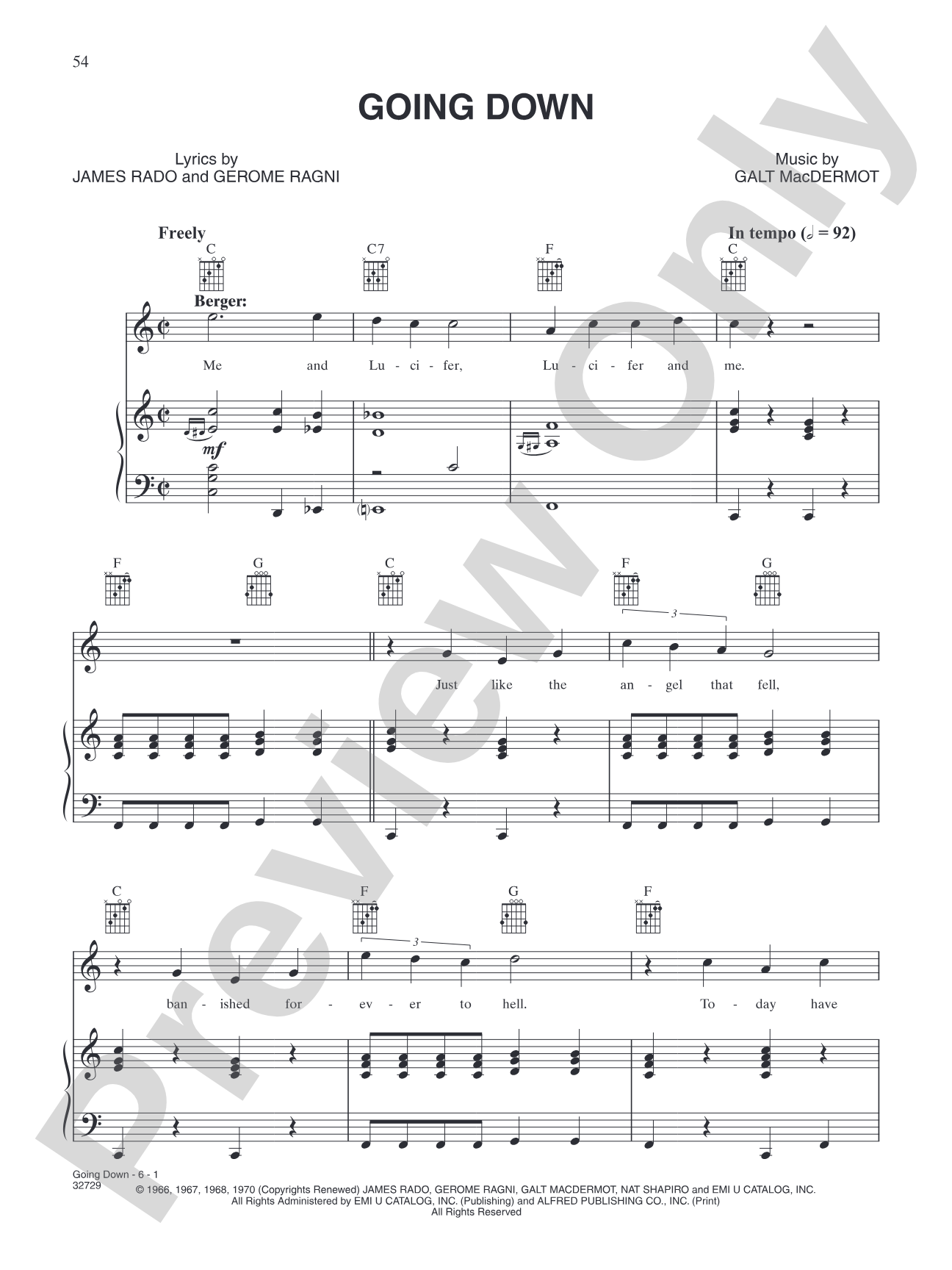
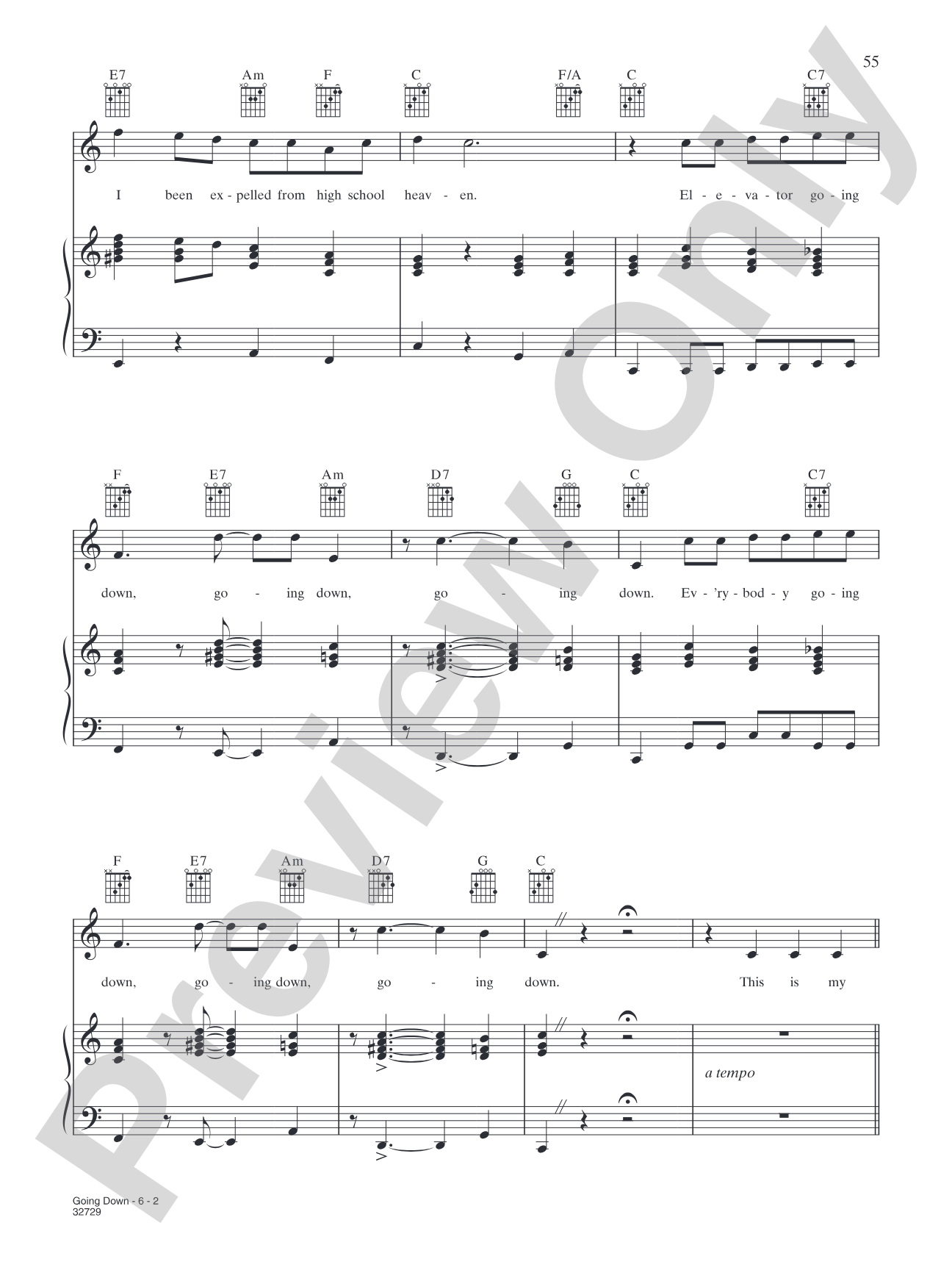

Going Down (from "Hair"): Piano/Vocal/Chords
Music by Galt MacDermot, words by James Rado and Gerome Ragni
Item: 00-PS-0011230
$5.99
One moment…
Related Items
Hair: Piano/Vocal/Chords |
$5.99
|
View | |
Walking In Space: Piano/Vocal/Chords |
$5.99
|
View | |
Manchester England: Piano/Vocal/Chords |
$4.99
|
View | |
White Boys: Piano/Vocal/Chords |
$5.99
|
View | |
Donna: Piano/Vocal/Chords |
$5.99
|
View | |
Easy to Be Hard (from "Hair"): Piano/Vocal/Chords |
$4.99
|
View | |
Four Score / Abie Baby (from "Hair"): Piano/Vocal/Chords |
$4.99
|
View | |
Hashish (from "Hair"): Piano/Vocal/Chords |
$4.99
|
View | |
Air (from "Hair"): Piano/Vocal/Chords |
$4.99
|
View | |
What a Piece of Work Is Man / How Dare They Try (from "Hair"): Piano/Vocal/Chords |
$4.99
|
View | |
I Got Life (from "Hair"): Piano/Vocal/Chords |
$5.99
|
View | |
Electric Blues (from "Hair"): Piano/Vocal/Chords |
$5.99
|
View | |
I'm Black / Ain't Got No (from "Hair"): Piano/Vocal/Chords |
$4.99
|
View | |
Black Boys (from "Hair"): Piano/Vocal/Chords |
$4.99
|
View | |
Where Do I Go? (from "Hair"): Piano/Vocal/Chords |
$4.99
|
View | |
Three-Five-Zero-Zero (from "Hair"): Piano/Vocal/Chords |
$4.99
|
View | |
Good Morning Starshine (from "Hair"): Piano/Vocal/Chords |
$4.99
|
View | |
Frank Mills (from "Hair"): Piano/Vocal/Chords |
$4.99
|
View | |
Hare Krishna / Be In (from "Hair"): Piano/Vocal/Chords |
$5.99
|
View | |
Sodomy (from "Hair"): Piano/Vocal/Chords |
$4.99
|
View | |
Colored Spade (from "Hair"): Piano/Vocal/Chords |
$4.99
|
View | |
Sheila Franklin / I Believe in Love (from "Hair"): Piano/Vocal/Chords |
$4.99
|
View | |
Initials (from "Hair"): Piano/Vocal/Chords |
$4.99
|
View | |
My Conviction (from "Hair"): Piano/Vocal/Chords |
$4.99
|
View | |
Oh Great God of Power / Manchester England (Reprise) (from "Hair"): Piano/Vocal/Chords |
$4.99
|
View | |
Yes, I's Finished on Y'all's Farmlands (from "Hair"): Piano/Vocal/Chords |
$4.99
|
View | |
Flesh Failures / Eyes Look Your Last / Let the Sun Shine In (from "Hair"): Piano/Vocal/Chords |
$5.99
|
View | |
Give Up All Desires (from "Hair"): Piano/Vocal/Chords |
$4.99
|
View | |
Hair: Vocal Selections (Broadway Edition): Piano/Vocal/Chords Book |
$19.95
|
View |
Description
The musical Hair was a cultural phenomenon in the epoch-changing era of the 1960s. Broadway has never been the same. This songbook includes highlights from the smash hit revival of the show, which has attracted raves from audiences and critics alike. Relive the new dawning of the Age of Aquarius and let the sun shine in! Titles: Air * Aquarius * Black Boys * Colored Spade * Donna * Easy to Be Hard * Flesh Failures, The / Let the Sun Shine In * Frank Mills * Give Up All Desires * Going Down * Good Morning Starshine * Hair * Hare Krishna (Be In) * Hashish * I Believe in Love * I Got Life * I'm Black / Ain't Got No * Initials * Manchester England * My Conviction * Old Fashioned Melody / Electric Blues * Sodomy * Three-Five-Zero-Zero * Walking in Space * What a Piece of Work Is Man * Where Do I Go? * White Boys * Yes, I's Finished on Y'alls Farmlands / Abie Baby.


Discover MakeMusic Cloud: thousands of interactive titles your students can play along with today.
Sample Audio
No sample audio found.
Sample Video
No sample videos found.
Additional Details
Publisher:
Alfred Music
Page Count:
150
SKU:
00-PS-0011230
More about this title
About the Composer: Galt MacDermot
Galt MacDermot composed the score for Hair, which premiered off-Broadway in 1967 and became one of the most influential musicals of the twentieth century. His innovative fusion of rock, soul, and pop sensibilities with theatrical storytelling redefined what Broadway music could be, earning him a Tony Award and a lasting place in musical theater history.
Why we love this
MacDermot's score captures the raw energy and idealism of the era without ever feeling dated. The collection swings between intimate ballads and explosive ensemble numbers, giving pianists and singers real emotional range to explore. Whether you're teaching pop-influenced theater or simply want material that connects with students across generations, these songs deliver authentic storytelling alongside genuinely singable melodies.
What to expect
These songs pulse with the optimism and urgency of a generation. There's an infectious vitality to the melodies, a directness in the storytelling, and an undeniable humanity in lyrics that range from spiritual searching to social critique. The sound is lush but never overworked, allowing performers to connect intimately with both text and tune.
Who it's for
This collection works for pianists and singers preparing audition material, church musicians seeking contemporary repertoire with substance, and music theater programs looking to teach the songs that changed Broadway. It's equally at home in a classroom exploring 1960s cultural history through music or in a recital setting where a performer wants to showcase range and character.
How to get the most out of it
- Lean into the rhythmic grooves, especially in numbers like "Going Down." The songs sit somewhere between pop and theater, so honor the pocket rather than over-theatricalize the delivery.
- Pay attention to lyrical authenticity and the social commentary embedded in the text. The music serves the message, so commit fully to what the song is saying.
- Balance the ensemble moments with clear solo work. Many songs shift between group participation and individual spotlight, so rehearse those transitions cleanly.
- Use the chord symbols to explore harmonic improvisation where appropriate. MacDermot's accompaniments are often fairly open, inviting musicians to find their own voice within the framework.
How to use it
Slot individual numbers into concert programs featuring twentieth-century American music or Broadway highlights. You might also build an entire program around Hair's most recognizable songs ("Aquarius," "Let the Sun Shine In," "Easy to Be Hard") as a thematic exploration of the musical's cultural impact. These pieces work particularly well when paired with other rock-influenced theater scores from the same period.
Skills your students will build
- Reading chord symbols and realizing accompaniments in contemporary popular idioms
- Interpreting lyrical content with awareness of historical and social context
- Navigating rhythmic flexibility between pop and theatrical phrasing
- Building stamina for singing and playing material that demands emotional authenticity
- Arranging and adapting songs based on harmonic frameworks rather than fixed notation