
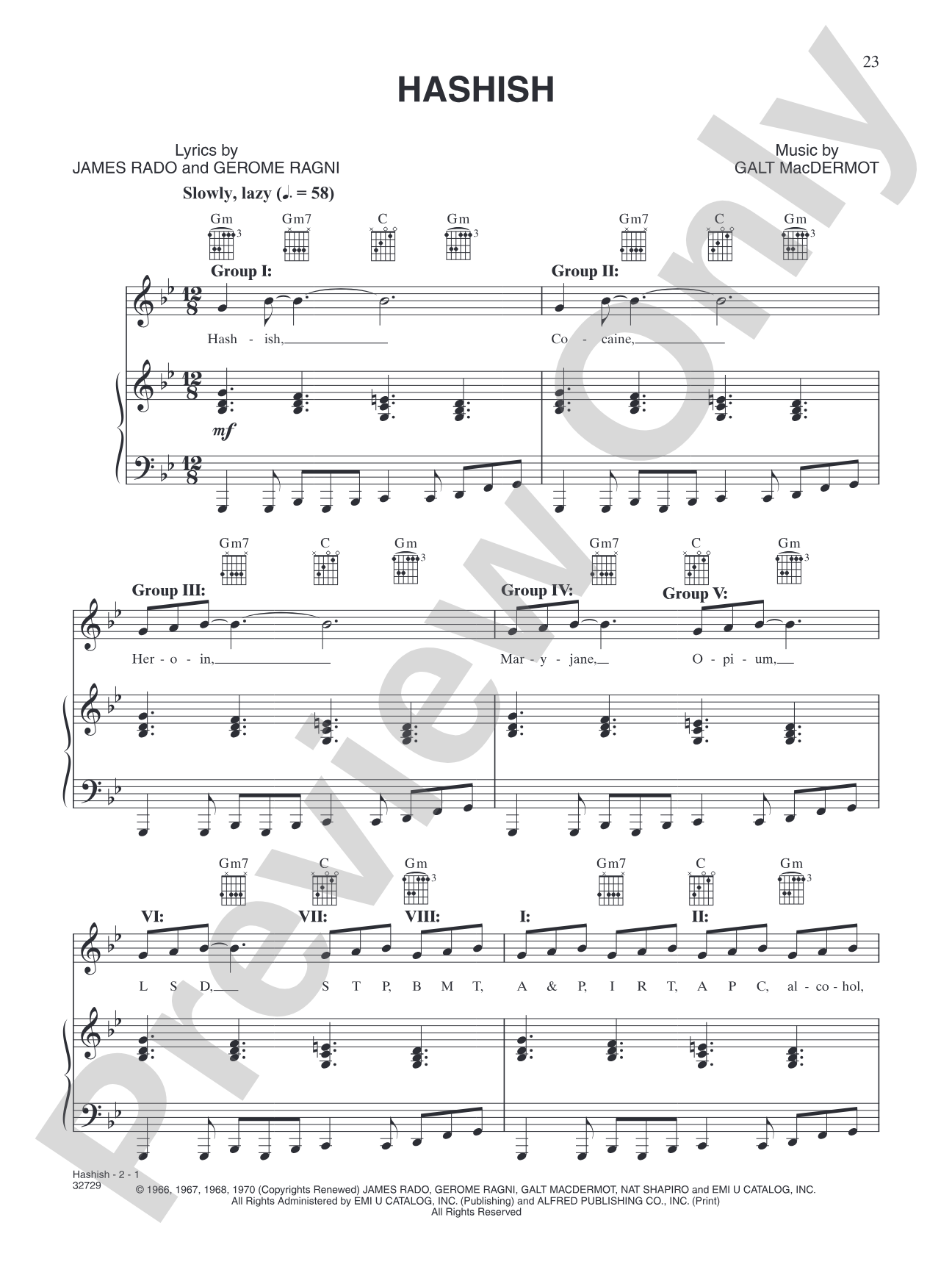

Hashish (from "Hair"): Piano/Vocal/Chords
Music by Galt MacDermot, words by James Rado and Gerome Ragni
Item: 00-PS-0011109
$4.99
One moment…
Related Items
Hair: Piano/Vocal/Chords |
$5.99
|
View | |
Walking In Space: Piano/Vocal/Chords |
$5.99
|
View | |
Manchester England: Piano/Vocal/Chords |
$4.99
|
View | |
White Boys: Piano/Vocal/Chords |
$5.99
|
View | |
Donna: Piano/Vocal/Chords |
$5.99
|
View | |
Easy to Be Hard (from "Hair"): Piano/Vocal/Chords |
$4.99
|
View | |
Four Score / Abie Baby (from "Hair"): Piano/Vocal/Chords |
$4.99
|
View | |
Air (from "Hair"): Piano/Vocal/Chords |
$4.99
|
View | |
What a Piece of Work Is Man / How Dare They Try (from "Hair"): Piano/Vocal/Chords |
$4.99
|
View | |
I Got Life (from "Hair"): Piano/Vocal/Chords |
$5.99
|
View | |
Electric Blues (from "Hair"): Piano/Vocal/Chords |
$5.99
|
View | |
I'm Black / Ain't Got No (from "Hair"): Piano/Vocal/Chords |
$4.99
|
View | |
Black Boys (from "Hair"): Piano/Vocal/Chords |
$4.99
|
View | |
Where Do I Go? (from "Hair"): Piano/Vocal/Chords |
$4.99
|
View | |
Three-Five-Zero-Zero (from "Hair"): Piano/Vocal/Chords |
$4.99
|
View | |
Good Morning Starshine (from "Hair"): Piano/Vocal/Chords |
$4.99
|
View | |
Frank Mills (from "Hair"): Piano/Vocal/Chords |
$4.99
|
View | |
Hare Krishna / Be In (from "Hair"): Piano/Vocal/Chords |
$5.99
|
View | |
Sodomy (from "Hair"): Piano/Vocal/Chords |
$4.99
|
View | |
Colored Spade (from "Hair"): Piano/Vocal/Chords |
$4.99
|
View | |
Sheila Franklin / I Believe in Love (from "Hair"): Piano/Vocal/Chords |
$4.99
|
View | |
Initials (from "Hair"): Piano/Vocal/Chords |
$4.99
|
View | |
Going Down (from "Hair"): Piano/Vocal/Chords |
$5.99
|
View | |
My Conviction (from "Hair"): Piano/Vocal/Chords |
$4.99
|
View | |
Oh Great God of Power / Manchester England (Reprise) (from "Hair"): Piano/Vocal/Chords |
$4.99
|
View | |
Yes, I's Finished on Y'all's Farmlands (from "Hair"): Piano/Vocal/Chords |
$4.99
|
View | |
Flesh Failures / Eyes Look Your Last / Let the Sun Shine In (from "Hair"): Piano/Vocal/Chords |
$5.99
|
View | |
Give Up All Desires (from "Hair"): Piano/Vocal/Chords |
$4.99
|
View | |
Hair: Vocal Selections (Broadway Edition): Piano/Vocal/Chords Book |
$19.95
|
View |
Description
The musical Hair was a cultural phenomenon in the epoch-changing era of the 1960s. Broadway has never been the same. This songbook includes highlights from the smash hit revival of the show, which has attracted raves from audiences and critics alike. Relive the new dawning of the Age of Aquarius and let the sun shine in! Titles: Air * Aquarius * Black Boys * Colored Spade * Donna * Easy to Be Hard * Flesh Failures, The / Let the Sun Shine In * Frank Mills * Give Up All Desires * Going Down * Good Morning Starshine * Hair * Hare Krishna (Be In) * Hashish * I Believe in Love * I Got Life * I'm Black / Ain't Got No * Initials * Manchester England * My Conviction * Old Fashioned Melody / Electric Blues * Sodomy * Three-Five-Zero-Zero * Walking in Space * What a Piece of Work Is Man * Where Do I Go? * White Boys * Yes, I's Finished on Y'alls Farmlands / Abie Baby.


Hashish (from "Hair"): Piano/Vocal/Chords isn't in MakeMusic Cloud just yet...but it could be. Let us know you'd like to see it, and you'll help shape what comes next. In the meantime, start a free trial and dive into thousands of interactive titles your students can play along with today.
Request This Title
Tell us you want it.
Start Your Free Trial
Explore everything that's ready to play right now.
Sample Audio
No sample audio found.
Sample Video
No sample videos found.
Additional Details
Publisher:
Alfred Music
Page Count:
150
SKU:
00-PS-0011109
More about this title
About the Composer: Galt MacDermot
Galt MacDermot (1928-2018) was a composer and pianist whose work spanned classical, jazz, and musical theater. He studied at Oxford University and later in Paris under Nadia Boulanger, bringing a sophisticated harmonic sensibility to every genre he touched. MacDermot's score for Hair (1967) became the defining work of his career, proving that Broadway music could be experimental, politically urgent, and deeply moving without sacrificing melodic accessibility.
Why we love this
Hair remains endlessly programmable because it speaks to questions of identity, freedom, and social conscience that resonate across generations. MacDermot's score moves fluidly between rock, soul, gospel, and art song, giving singers and pianists material that demands genuine musicality rather than mere technical display. This collection captures the full dramatic and emotional range of the show in singable, playable arrangements.
What to expect
Hair pulses with the restless spirit of the late 1960s, moving between moments of exuberant celebration and searching vulnerability. The music captures the texture of that era while remaining urgently alive; it feels neither dated nor nostalgia-bound, but rather like a time capsule that speaks directly to right now.
Who it's for
This collection works for singers preparing auditions or recitals featuring contemporary Broadway material, as well as voice teachers and pianists seeking repertoire that bridges classical training and modern musical theater. It also serves pianists who want to expand beyond standard showbook fare into music that demands both technical control and stylistic flexibility.
How to get the most out of it
- Balance the amplified energy of the rock numbers with the intimate vulnerability of songs like 'Frank Mills' and 'Easy to Be Hard'; the score's power lies in its emotional contrasts, not in volume alone.
- Pay close attention to the harmonic language in the piano part. MacDermot frequently uses modal and jazz-inflected voicings that define the character of each song; resist the urge to simplify or 'clean up' the chords.
- Use the lyrical content as your interpretive guide. The specificity of each song's subject matter should shape your tempo choices, dynamic phrasing, and rhythmic feel rather than relying on a one-size-fits-all energy level.
How to use it
Feature individual songs in recitals or cabaret-style performances to create thematic programs around identity, love, or social change. The range of moods and styles makes it ideal for mixed concert programs that need contemporary material with theatrical substance. A voice student might perform 'Easy to Be Hard' or 'Where Do I Go?' as a contrasting piece in a classical recital; a pianist could program 'Aquarius' or 'Good Morning Starshine' as an encore.
Skills your students will build
- Reading jazz and modal harmony voicings in the piano accompaniment
- Interpreting contemporary Broadway music with theatrical authenticity
- Balancing rhythmic freedom (rubato, syncopation) with harmonic precision
- Connecting lyrical content to musical interpretation
- Performing across multiple vocal and stylistic idioms in a single collection