
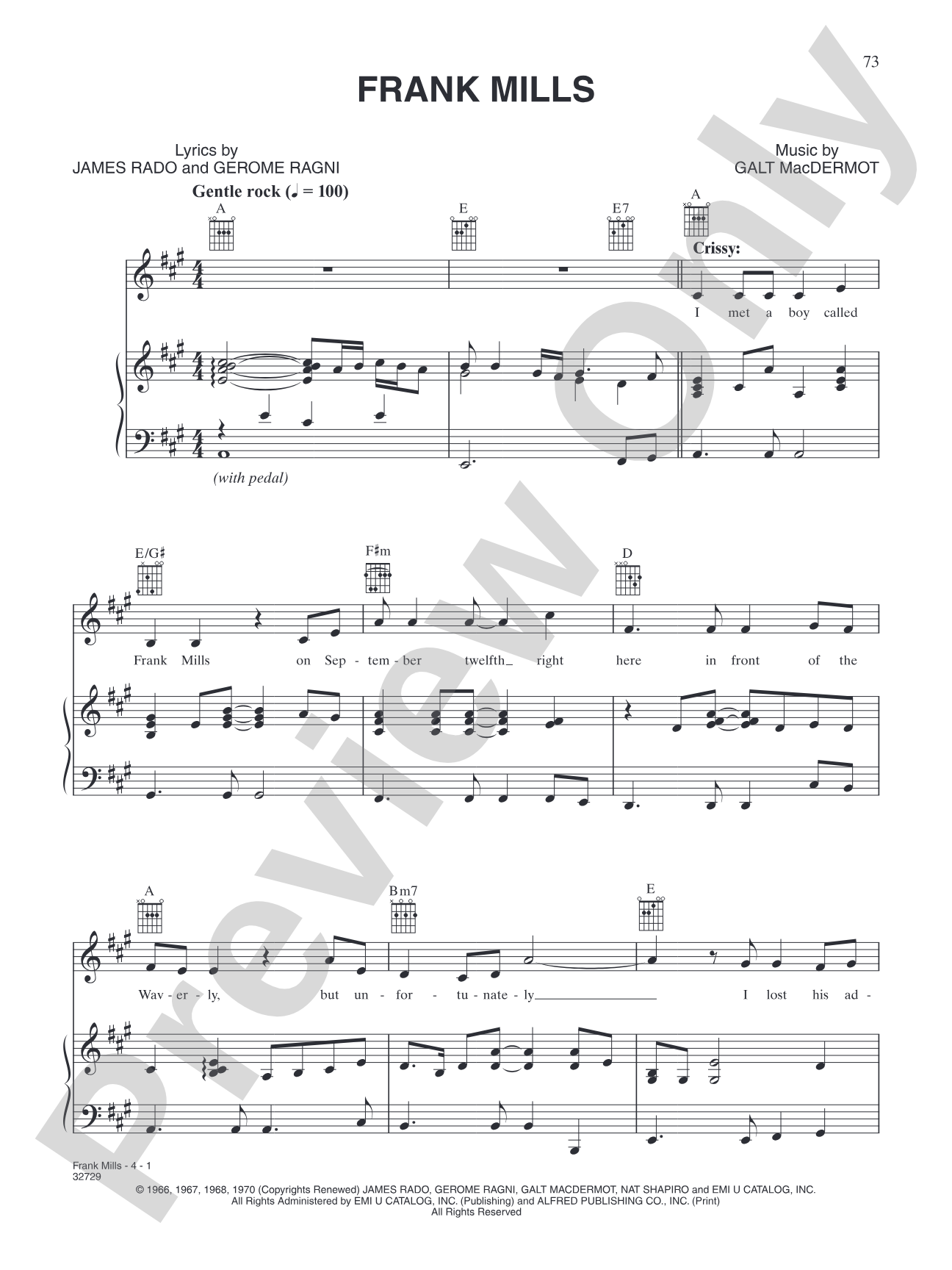

Frank Mills (from "Hair"): Piano/Vocal/Chords
Music by Galt MacDermot, words by James Rado and Gerome Ragni
Item: 00-PS-0011119
$4.99
One moment…
Related Items
Hair: Piano/Vocal/Chords |
$5.99
|
View | |
Walking In Space: Piano/Vocal/Chords |
$5.99
|
View | |
Manchester England: Piano/Vocal/Chords |
$4.99
|
View | |
White Boys: Piano/Vocal/Chords |
$5.99
|
View | |
Donna: Piano/Vocal/Chords |
$5.99
|
View | |
Easy to Be Hard (from "Hair"): Piano/Vocal/Chords |
$4.99
|
View | |
Four Score / Abie Baby (from "Hair"): Piano/Vocal/Chords |
$4.99
|
View | |
Hashish (from "Hair"): Piano/Vocal/Chords |
$4.99
|
View | |
Air (from "Hair"): Piano/Vocal/Chords |
$4.99
|
View | |
What a Piece of Work Is Man / How Dare They Try (from "Hair"): Piano/Vocal/Chords |
$4.99
|
View | |
I Got Life (from "Hair"): Piano/Vocal/Chords |
$5.99
|
View | |
Electric Blues (from "Hair"): Piano/Vocal/Chords |
$5.99
|
View | |
I'm Black / Ain't Got No (from "Hair"): Piano/Vocal/Chords |
$4.99
|
View | |
Black Boys (from "Hair"): Piano/Vocal/Chords |
$4.99
|
View | |
Where Do I Go? (from "Hair"): Piano/Vocal/Chords |
$4.99
|
View | |
Three-Five-Zero-Zero (from "Hair"): Piano/Vocal/Chords |
$4.99
|
View | |
Good Morning Starshine (from "Hair"): Piano/Vocal/Chords |
$4.99
|
View | |
Hare Krishna / Be In (from "Hair"): Piano/Vocal/Chords |
$5.99
|
View | |
Sodomy (from "Hair"): Piano/Vocal/Chords |
$4.99
|
View | |
Colored Spade (from "Hair"): Piano/Vocal/Chords |
$4.99
|
View | |
Sheila Franklin / I Believe in Love (from "Hair"): Piano/Vocal/Chords |
$4.99
|
View | |
Initials (from "Hair"): Piano/Vocal/Chords |
$4.99
|
View | |
Going Down (from "Hair"): Piano/Vocal/Chords |
$5.99
|
View | |
My Conviction (from "Hair"): Piano/Vocal/Chords |
$4.99
|
View | |
Oh Great God of Power / Manchester England (Reprise) (from "Hair"): Piano/Vocal/Chords |
$4.99
|
View | |
Yes, I's Finished on Y'all's Farmlands (from "Hair"): Piano/Vocal/Chords |
$4.99
|
View | |
Flesh Failures / Eyes Look Your Last / Let the Sun Shine In (from "Hair"): Piano/Vocal/Chords |
$5.99
|
View | |
Give Up All Desires (from "Hair"): Piano/Vocal/Chords |
$4.99
|
View | |
Hair: Vocal Selections (Broadway Edition): Piano/Vocal/Chords Book |
$19.95
|
View |
Description
The musical Hair was a cultural phenomenon in the epoch-changing era of the 1960s. Broadway has never been the same. This songbook includes highlights from the smash hit revival of the show, which has attracted raves from audiences and critics alike. Relive the new dawning of the Age of Aquarius and let the sun shine in! Titles: Air * Aquarius * Black Boys * Colored Spade * Donna * Easy to Be Hard * Flesh Failures, The / Let the Sun Shine In * Frank Mills * Give Up All Desires * Going Down * Good Morning Starshine * Hair * Hare Krishna (Be In) * Hashish * I Believe in Love * I Got Life * I'm Black / Ain't Got No * Initials * Manchester England * My Conviction * Old Fashioned Melody / Electric Blues * Sodomy * Three-Five-Zero-Zero * Walking in Space * What a Piece of Work Is Man * Where Do I Go? * White Boys * Yes, I's Finished on Y'alls Farmlands / Abie Baby.


Discover MakeMusic Cloud: thousands of interactive titles your students can play along with today.
Sample Audio
No sample audio found.
Sample Video
No sample videos found.
Additional Details
Publisher:
Alfred Music
Page Count:
150
SKU:
00-PS-0011119
More about this title
About the Composer: Galt MacDermot
Galt MacDermot (1928-2018) was a Canadian-American composer whose work bridged classical training and popular music. His score for Hair, which premiered off-Broadway in 1967 and moved to Broadway in 1968, became one of the most influential musical theater scores of the 20th century, earning him a Tony Award and establishing him as a major voice in rock-influenced musical theater.
Beyond Hair, MacDermot composed numerous other theatrical works and film scores, but Hair remains his signature achievement. The score's integration of rock, soul, and gospel idioms into the Broadway musical form influenced generations of composers and remains a touchstone for understanding how contemporary music shaped theater in the modern era.
Why we love this
This collection captures one of Broadway's most transformative scores in a format that serves both singers and pianists equally. The arrangements preserve the character and groove of the original while remaining playable in rehearsal and performance settings. Programming selections from Hair signals to audiences that you're willing to take risks with repertoire that still resonates across generations.
What to expect
These songs capture the optimism, rebellion, and social consciousness of the late 1960s through melodies that sit somewhere between pop hooks and theatrical reach. The score swings between introspective ballads and communal choral moments, all underscored by MacDermot's gift for melody that feels both urgent and timeless.
Who it's for
This is essential for music theater programs, pop-rock vocal ensembles, and pianists who work with singers exploring contemporary Broadway styles. It serves students and professionals seeking authentic arrangements from one of musical theater's defining works.
How to get the most out of it
- Lean into the rhythmic drive of the rock and soul idioms throughout. These songs need forward momentum; resist over-legit phrasing even in the quieter moments.
- Use the piano part to anchor ensemble numbers like "Aquarius" and "Let the Sun Shine In." The accompaniment is written to support vocal lines, not compete with them.
- Balance the groove-based accompaniments in uptempo songs with clear, idiomatic articulation. The rhythm section feel matters as much as pitch accuracy.
- Practice the key relationships between pieces before programming multiple selections. Some titles sit in tessituras that demand transposition for your vocalist or ensemble.
How to use it
Feature "Aquarius" or "Good Morning Starshine" as a confident opener for a pops concert or musical theater recital. "Easy to Be Hard" and "Frank Mills" work as solo audition pieces for singers developing maturity in their interpretation. A medley of three to four selections creates a focused act that introduces audiences to Hair's scope without overextending performance time.
Skills your students will build
- Singing and playing simultaneously with rhythmic independence between vocal line and accompaniment
- Interpreting rock and soul stylistic conventions within a theatrical context
- Managing key relationships and transposition for different vocal ranges
- Balancing melodic beauty with groove-oriented rhythm patterns
- Navigating period-specific language and cultural references in lyrics