
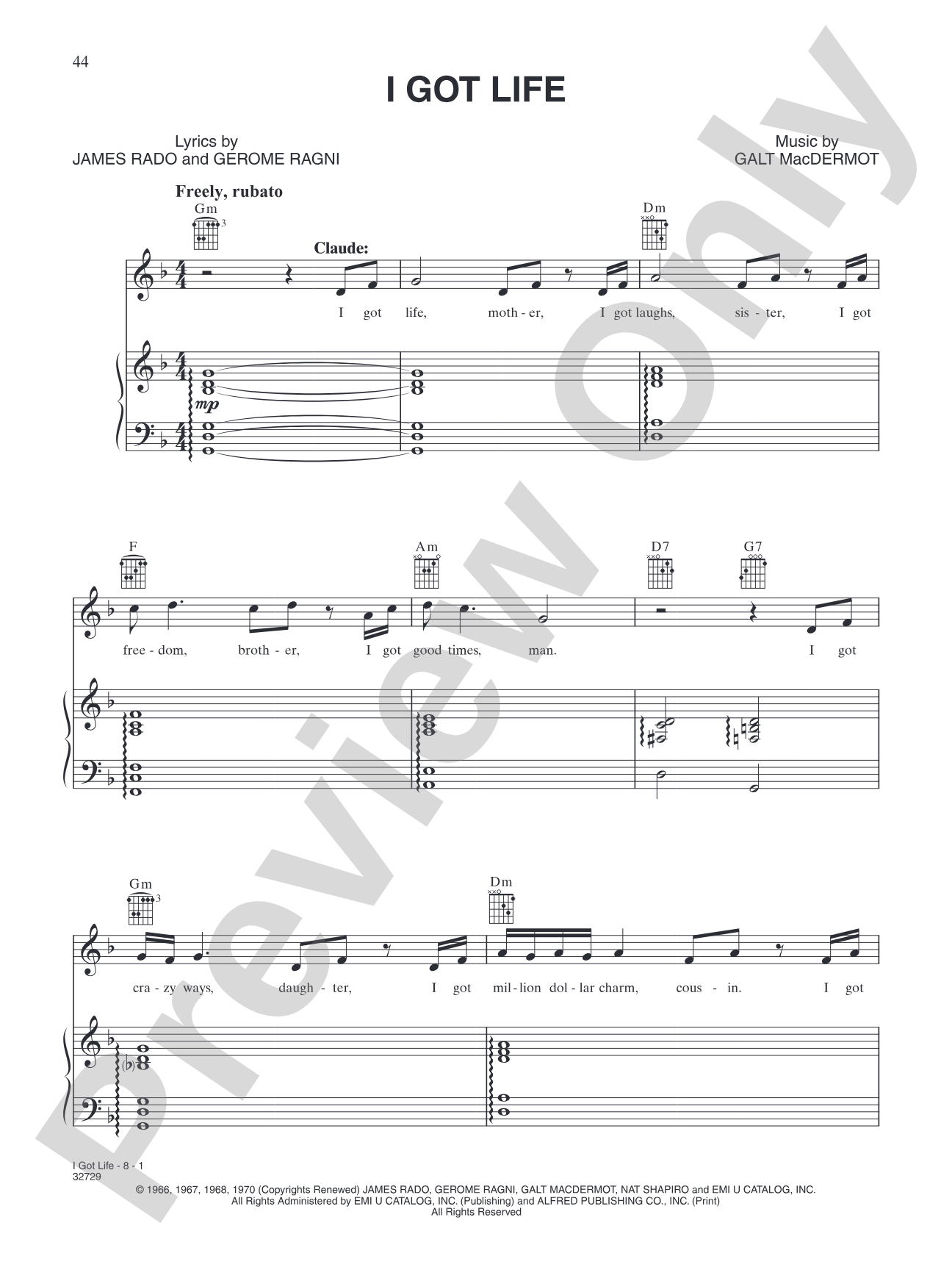
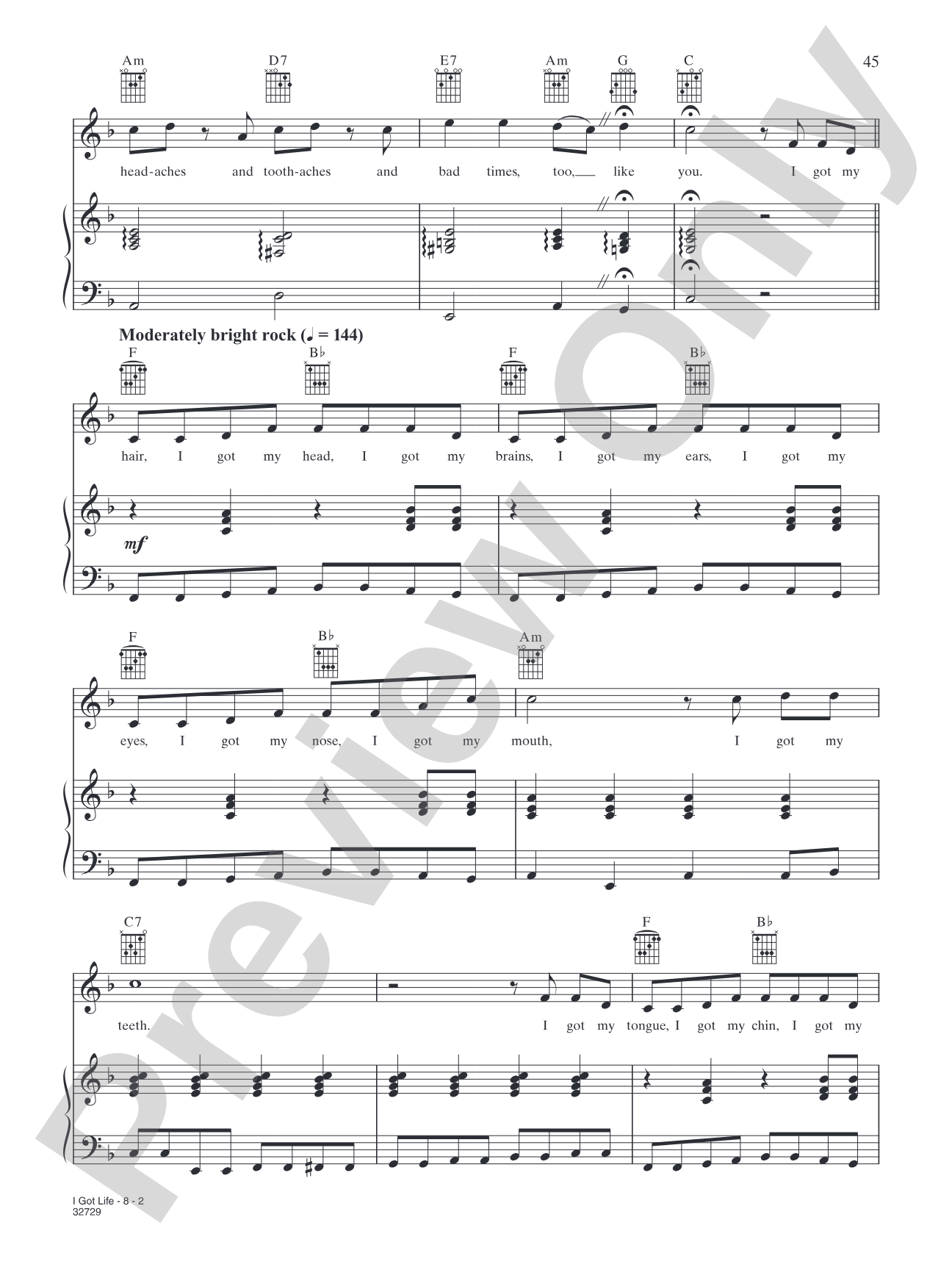

I Got Life (from "Hair"): Piano/Vocal/Chords
Music by Galt MacDermot, words by James Rado and Gerome Ragni
Item: 00-PS-0011112
$5.99
One moment…
Related Items
Hair: Piano/Vocal/Chords |
$5.99
|
View | |
Walking In Space: Piano/Vocal/Chords |
$5.99
|
View | |
Manchester England: Piano/Vocal/Chords |
$4.99
|
View | |
White Boys: Piano/Vocal/Chords |
$5.99
|
View | |
Donna: Piano/Vocal/Chords |
$5.99
|
View | |
Easy to Be Hard (from "Hair"): Piano/Vocal/Chords |
$4.99
|
View | |
Four Score / Abie Baby (from "Hair"): Piano/Vocal/Chords |
$4.99
|
View | |
Hashish (from "Hair"): Piano/Vocal/Chords |
$4.99
|
View | |
Air (from "Hair"): Piano/Vocal/Chords |
$4.99
|
View | |
What a Piece of Work Is Man / How Dare They Try (from "Hair"): Piano/Vocal/Chords |
$4.99
|
View | |
Electric Blues (from "Hair"): Piano/Vocal/Chords |
$5.99
|
View | |
I'm Black / Ain't Got No (from "Hair"): Piano/Vocal/Chords |
$4.99
|
View | |
Black Boys (from "Hair"): Piano/Vocal/Chords |
$4.99
|
View | |
Where Do I Go? (from "Hair"): Piano/Vocal/Chords |
$4.99
|
View | |
Three-Five-Zero-Zero (from "Hair"): Piano/Vocal/Chords |
$4.99
|
View | |
Good Morning Starshine (from "Hair"): Piano/Vocal/Chords |
$4.99
|
View | |
Frank Mills (from "Hair"): Piano/Vocal/Chords |
$4.99
|
View | |
Hare Krishna / Be In (from "Hair"): Piano/Vocal/Chords |
$5.99
|
View | |
Sodomy (from "Hair"): Piano/Vocal/Chords |
$4.99
|
View | |
Colored Spade (from "Hair"): Piano/Vocal/Chords |
$4.99
|
View | |
Sheila Franklin / I Believe in Love (from "Hair"): Piano/Vocal/Chords |
$4.99
|
View | |
Initials (from "Hair"): Piano/Vocal/Chords |
$4.99
|
View | |
Going Down (from "Hair"): Piano/Vocal/Chords |
$5.99
|
View | |
My Conviction (from "Hair"): Piano/Vocal/Chords |
$4.99
|
View | |
Oh Great God of Power / Manchester England (Reprise) (from "Hair"): Piano/Vocal/Chords |
$4.99
|
View | |
Yes, I's Finished on Y'all's Farmlands (from "Hair"): Piano/Vocal/Chords |
$4.99
|
View | |
Flesh Failures / Eyes Look Your Last / Let the Sun Shine In (from "Hair"): Piano/Vocal/Chords |
$5.99
|
View | |
Give Up All Desires (from "Hair"): Piano/Vocal/Chords |
$4.99
|
View | |
Hair: Vocal Selections (Broadway Edition): Piano/Vocal/Chords Book |
$19.95
|
View |
Description
The musical Hair was a cultural phenomenon in the epoch-changing era of the 1960s. Broadway has never been the same. This songbook includes highlights from the smash hit revival of the show, which has attracted raves from audiences and critics alike. Relive the new dawning of the Age of Aquarius and let the sun shine in! Titles: Air * Aquarius * Black Boys * Colored Spade * Donna * Easy to Be Hard * Flesh Failures, The / Let the Sun Shine In * Frank Mills * Give Up All Desires * Going Down * Good Morning Starshine * Hair * Hare Krishna (Be In) * Hashish * I Believe in Love * I Got Life * I'm Black / Ain't Got No * Initials * Manchester England * My Conviction * Old Fashioned Melody / Electric Blues * Sodomy * Three-Five-Zero-Zero * Walking in Space * What a Piece of Work Is Man * Where Do I Go? * White Boys * Yes, I's Finished on Y'alls Farmlands / Abie Baby.


I Got Life (from "Hair"): Piano/Vocal/Chords isn't in MakeMusic Cloud just yet...but it could be. Let us know you'd like to see it, and you'll help shape what comes next. In the meantime, start a free trial and dive into thousands of interactive titles your students can play along with today.
Request This Title
Tell us you want it.
Start Your Free Trial
Explore everything that's ready to play right now.
Sample Audio
No sample audio found.
Sample Video
No sample videos found.
Additional Details
Publisher:
Alfred Music
Page Count:
150
SKU:
00-PS-0011112
More about this title
About the Composer: Galt MacDermot
Galt MacDermot (1928-2018) was a Canadian composer who fundamentally changed Broadway's sound by bringing contemporary popular music idioms into the musical theater world. His score for Hair, which opened off-Broadway in 1967 and moved to Broadway the following year, became one of the most influential theater compositions of the 20th century, earning him a Tony Award and establishing him as a pioneering voice in theatrical innovation.
Beyond Hair, MacDermot composed for stage, film, and television, and later turned his attention to sacred music and world music influences. His willingness to blend rock, soul, pop, and other contemporary genres with traditional songwriting made him an essential figure for music educators interested in repertoire that reflects cultural moment and demonstrates how popular forms can coexist with theatrical storytelling.
Why we love this
This collection captures some of the most singable and harmonically accessible moments from Hair, which means singers at intermediate levels can immediately connect with songs that feel contemporary and relevant rather than dusty or dated. The piano/vocal format gives singers and pianists complete control over tempo and interpretation; there's no need to match a recording, making this ideal for recitals, auditions, or teaching performers to develop their own musical voice. Every song carries real emotional weight (whether it's the searching vulnerability of 'Where Do I Go?' or the brash confidence of 'Easy to Be Hard'), so students aren't just learning notes but exploring character, subtext, and generational perspective.
What to expect
These songs pulse with the energy and idealism of the 1960s, balancing genuine vulnerability and youthful questioning with moments of defiant joy. The harmonic language sits somewhere between pop songwriting and theater sophistication, so nothing feels artificial or overly complex, yet everything carries real depth and intention.
Who it's for
Singers preparing songs for recitals, auditions, or performance classes will find accessible yet sophisticated material here; pianists supporting these singers need fluent sight-reading skills and comfort with contemporary harmonic language. Music teachers introducing students to theater music beyond traditional musical theater will value how these songs represent a specific cultural moment and voice.
How to get the most out of it
- Balance the vocal line with harmonic fullness in the piano part rather than treating it as accompaniment; the songs work best when both instruments have narrative presence.
- Lean into the contemporary rhythmic feels—syncopation, groove, and rhythmic variety define these songs, so rhythm section precision matters as much as melodic beauty.
- Let the lyrics drive phrasing decisions; these are songs with distinct attitudes and arguments, so oral delivery and articulation shape meaning as much as vocal technique.
How to use it
Draw individual songs from this collection for end-of-year recitals or audition showcases, where the material will feel fresh and emotionally immediate to both performers and audiences. Pair these with other theater songs or contemporary art songs to build a recital that showcases how different eras approach storytelling in music. For music history or cultural studies classes, use these texts as primary documents of 1960s social consciousness and as examples of how popular musical language entered the Broadway stage.
Skills your students will build
- Phrasing and interpretation of songs with distinct character and attitude
- Reading piano/vocal scores with contemporary harmonic language
- Rhythmic accuracy and feel in syncopated, groove-based material
- Connecting lyrical meaning to musical expression and vocal delivery
- Transposing and adapting songs to suit individual voice types and ranges