
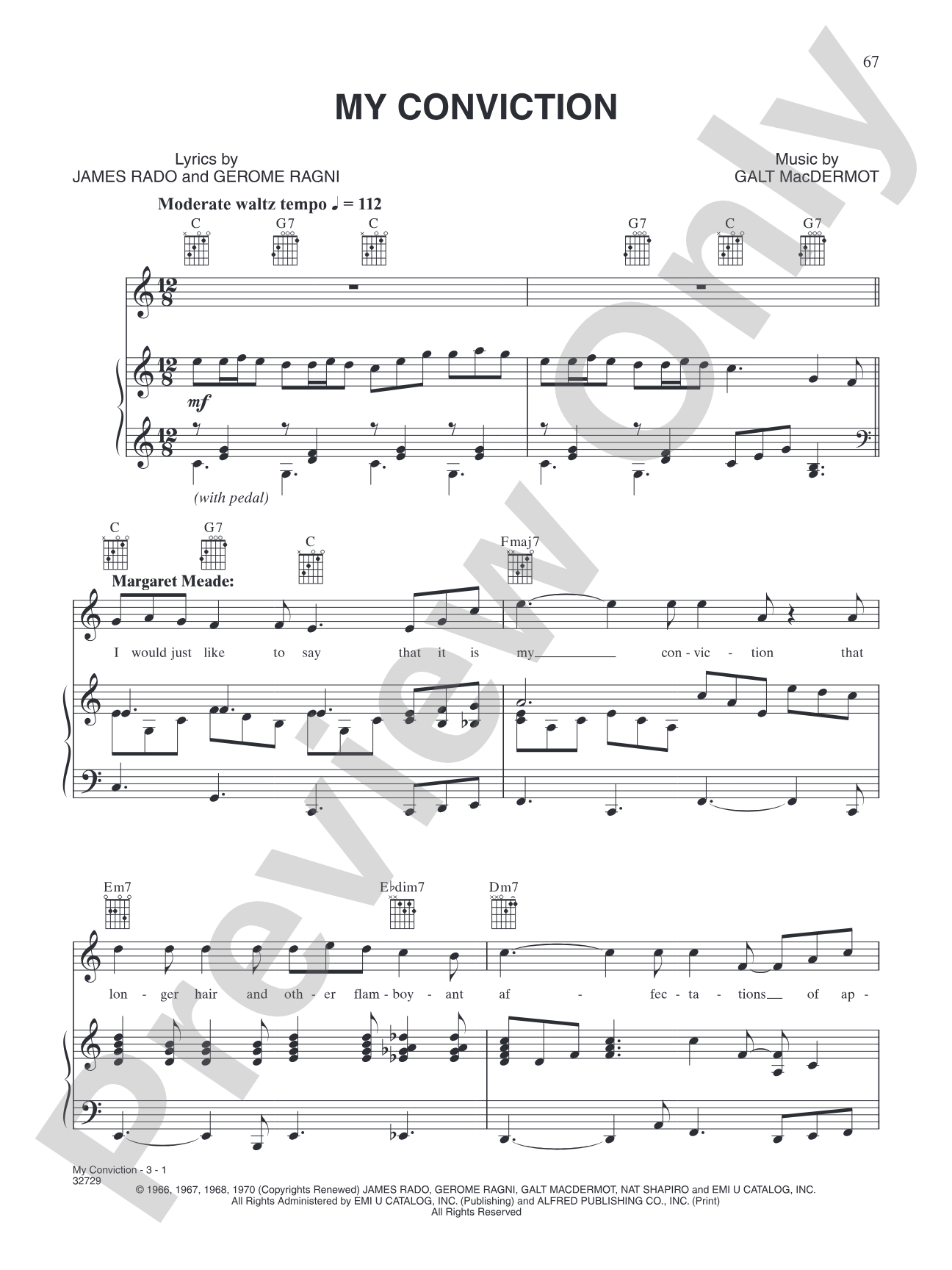

My Conviction (from "Hair"): Piano/Vocal/Chords
Music by Galt MacDermot, words by James Rado and Gerome Ragni
Item: 00-PS-0011231
$4.99
One moment…
Related Items
Hair: Piano/Vocal/Chords |
$5.99
|
View | |
Walking In Space: Piano/Vocal/Chords |
$5.99
|
View | |
Manchester England: Piano/Vocal/Chords |
$4.99
|
View | |
White Boys: Piano/Vocal/Chords |
$5.99
|
View | |
Donna: Piano/Vocal/Chords |
$5.99
|
View | |
Easy to Be Hard (from "Hair"): Piano/Vocal/Chords |
$4.99
|
View | |
Four Score / Abie Baby (from "Hair"): Piano/Vocal/Chords |
$4.99
|
View | |
Hashish (from "Hair"): Piano/Vocal/Chords |
$4.99
|
View | |
Air (from "Hair"): Piano/Vocal/Chords |
$4.99
|
View | |
What a Piece of Work Is Man / How Dare They Try (from "Hair"): Piano/Vocal/Chords |
$4.99
|
View | |
I Got Life (from "Hair"): Piano/Vocal/Chords |
$5.99
|
View | |
Electric Blues (from "Hair"): Piano/Vocal/Chords |
$5.99
|
View | |
I'm Black / Ain't Got No (from "Hair"): Piano/Vocal/Chords |
$4.99
|
View | |
Black Boys (from "Hair"): Piano/Vocal/Chords |
$4.99
|
View | |
Where Do I Go? (from "Hair"): Piano/Vocal/Chords |
$4.99
|
View | |
Three-Five-Zero-Zero (from "Hair"): Piano/Vocal/Chords |
$4.99
|
View | |
Good Morning Starshine (from "Hair"): Piano/Vocal/Chords |
$4.99
|
View | |
Frank Mills (from "Hair"): Piano/Vocal/Chords |
$4.99
|
View | |
Hare Krishna / Be In (from "Hair"): Piano/Vocal/Chords |
$5.99
|
View | |
Sodomy (from "Hair"): Piano/Vocal/Chords |
$4.99
|
View | |
Colored Spade (from "Hair"): Piano/Vocal/Chords |
$4.99
|
View | |
Sheila Franklin / I Believe in Love (from "Hair"): Piano/Vocal/Chords |
$4.99
|
View | |
Initials (from "Hair"): Piano/Vocal/Chords |
$4.99
|
View | |
Going Down (from "Hair"): Piano/Vocal/Chords |
$5.99
|
View | |
Oh Great God of Power / Manchester England (Reprise) (from "Hair"): Piano/Vocal/Chords |
$4.99
|
View | |
Yes, I's Finished on Y'all's Farmlands (from "Hair"): Piano/Vocal/Chords |
$4.99
|
View | |
Flesh Failures / Eyes Look Your Last / Let the Sun Shine In (from "Hair"): Piano/Vocal/Chords |
$5.99
|
View | |
Give Up All Desires (from "Hair"): Piano/Vocal/Chords |
$4.99
|
View | |
Hair: Vocal Selections (Broadway Edition): Piano/Vocal/Chords Book |
$19.95
|
View |
Description
The musical Hair was a cultural phenomenon in the epoch-changing era of the 1960s. Broadway has never been the same. This songbook includes highlights from the smash hit revival of the show, which has attracted raves from audiences and critics alike. Relive the new dawning of the Age of Aquarius and let the sun shine in! Titles: Air * Aquarius * Black Boys * Colored Spade * Donna * Easy to Be Hard * Flesh Failures, The / Let the Sun Shine In * Frank Mills * Give Up All Desires * Going Down * Good Morning Starshine * Hair * Hare Krishna (Be In) * Hashish * I Believe in Love * I Got Life * I'm Black / Ain't Got No * Initials * Manchester England * My Conviction * Old Fashioned Melody / Electric Blues * Sodomy * Three-Five-Zero-Zero * Walking in Space * What a Piece of Work Is Man * Where Do I Go? * White Boys * Yes, I's Finished on Y'alls Farmlands / Abie Baby.


My Conviction (from "Hair"): Piano/Vocal/Chords isn't in MakeMusic Cloud just yet...but it could be. Let us know you'd like to see it, and you'll help shape what comes next. In the meantime, start a free trial and dive into thousands of interactive titles your students can play along with today.
Request This Title
Tell us you want it.
Start Your Free Trial
Explore everything that's ready to play right now.
Sample Audio
No sample audio found.
Sample Video
No sample videos found.
Additional Details
Publisher:
Alfred Music
Page Count:
150
SKU:
00-PS-0011231
More about this title
About the Composer: Galt MacDermot
Galt MacDermot (1928-2000) was a Canadian-American composer whose work on Hair in 1967 fundamentally changed the sound of Broadway. A classically trained musician with deep roots in jazz and world music, MacDermot created a score that blended rock, soul, gospel, and orchestral idioms in ways that mainstream musical theater had never attempted. His willingness to break from convention made Hair not just a hit but a cultural watershed.
MacDermot's career extended well beyond Hair. He composed for film and television, wrote two symphonies, and created numerous other theatrical scores. His legacy rests on his ability to absorb diverse musical influences and synthesize them into something entirely his own. For singers and pianists, his work remains a masterclass in how melody, harmony, and rhythm can reflect the spirit of an era.
Why we love this
This collection captures the raw energy and melodic sophistication that made Hair revolutionary. MacDermot's songs demand genuine emotional commitment from singers; they cannot be performed glibly or safely. The piano/vocal arrangements preserve the harmonic ingenuity of the original score while remaining accessible for performance in studio, recital, or classroom settings.
What to expect
These songs carry the restless energy and idealism of their era. They move from playful and irreverent to deeply vulnerable, often within a single number. Singing them feels like inhabiting a moment of radical possibility, where music and words together ask uncomfortable questions and refuse easy answers.
Who it's for
This book serves singers preparing for auditions, recitals, or concert performances of Hair repertoire, as well as pianists seeking substantial contemporary musical theater material. Voice teachers will find songs that teach genuine musical interpretation and emotional authenticity. Musicians drawn to the cultural and musical significance of 1960s Broadway will value having these scores in accessible form.
How to get the most out of it
- Invest in the lyrics. MacDermot's melodies serve the words; singers who rush through the text or treat it as mere vehicle will lose the power of these songs. Take time to understand what each lyric is claiming and sing from that conviction.
- Navigate the harmonic shifts with intention. The score moves freely between jazz sonorities, blues progressions, and contemporary rock idioms. Play chords with awareness of their color rather than defaulting to a steady, neutral accompaniment.
- Honor the rhythmic flexibility where it exists. Some passages sit squarely in time; others breathe more openly. Listen to recordings to understand the intended pulse, but do not sacrifice genuine phrasing for metronomic precision.
How to use it
Perform individual songs in a recital program to explore the range of MacDermot's songwriting, from the plaintive introspection of "Easy to Be Hard" to the exuberant declaration of "Good Morning Starshine." Songs from Hair also work beautifully in concert settings focused on musical theater history or American popular song. Consider programming a Hair-centered voice recital that traces the show's emotional and stylistic journey.
Skills your students will build
- Interpreting contemporary harmony (jazz voicings, blues changes, and chromatic movement)
- Connecting lyrical meaning to vocal phrasing and expression
- Understanding rock and soul idioms in a theater context
- Sight-reading and performing from lead sheet notation
- Building stamina and emotional range across a full song cycle