
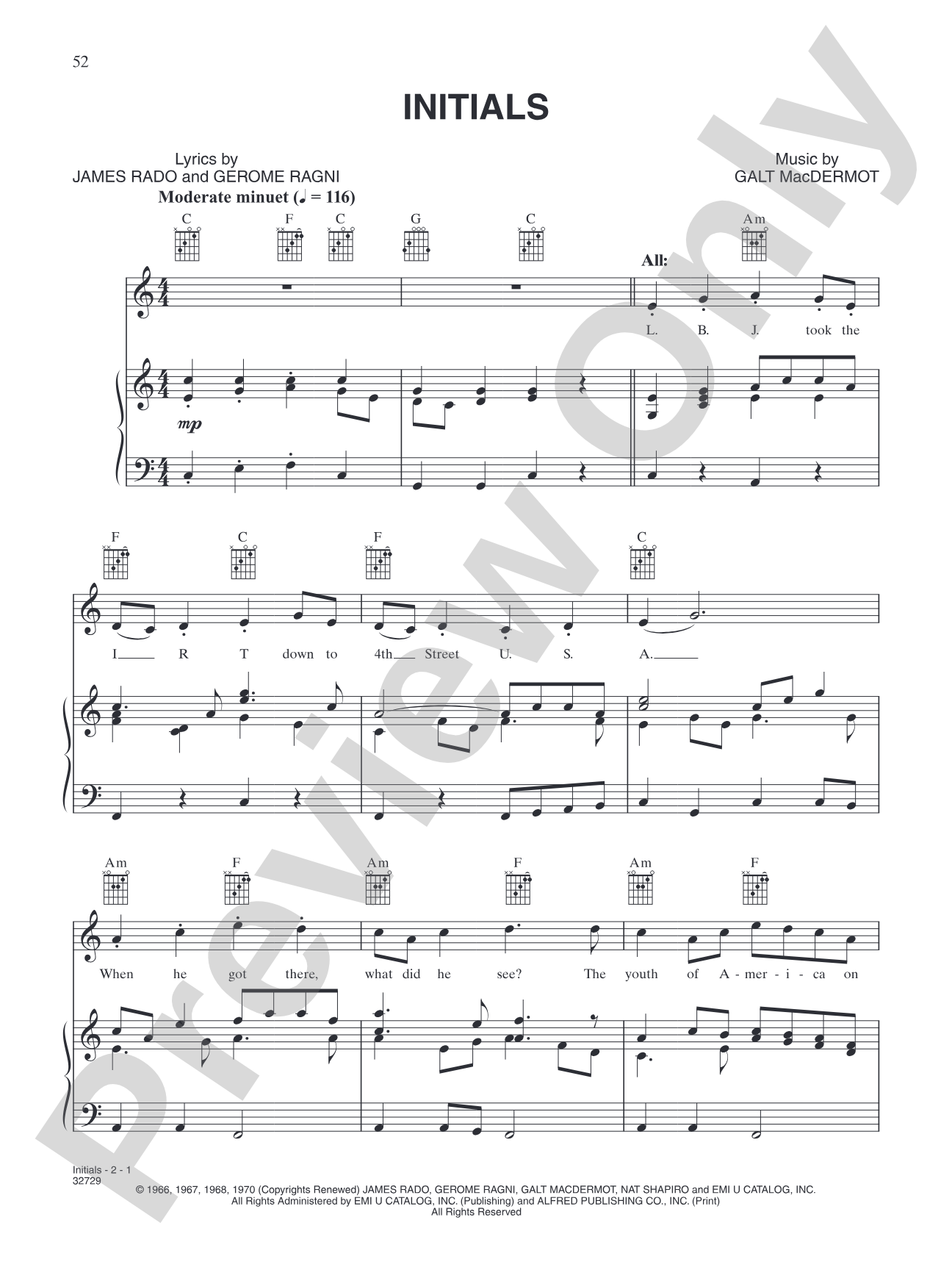

Initials (from "Hair"): Piano/Vocal/Chords
Music by Galt MacDermot, words by James Rado and Gerome Ragni
Item: 00-PS-0011229
$4.99
One moment…
Related Items
Hair: Piano/Vocal/Chords |
$5.99
|
View | |
Walking In Space: Piano/Vocal/Chords |
$5.99
|
View | |
Manchester England: Piano/Vocal/Chords |
$4.99
|
View | |
White Boys: Piano/Vocal/Chords |
$5.99
|
View | |
Donna: Piano/Vocal/Chords |
$5.99
|
View | |
Easy to Be Hard (from "Hair"): Piano/Vocal/Chords |
$4.99
|
View | |
Four Score / Abie Baby (from "Hair"): Piano/Vocal/Chords |
$4.99
|
View | |
Hashish (from "Hair"): Piano/Vocal/Chords |
$4.99
|
View | |
Air (from "Hair"): Piano/Vocal/Chords |
$4.99
|
View | |
What a Piece of Work Is Man / How Dare They Try (from "Hair"): Piano/Vocal/Chords |
$4.99
|
View | |
I Got Life (from "Hair"): Piano/Vocal/Chords |
$5.99
|
View | |
Electric Blues (from "Hair"): Piano/Vocal/Chords |
$5.99
|
View | |
I'm Black / Ain't Got No (from "Hair"): Piano/Vocal/Chords |
$4.99
|
View | |
Black Boys (from "Hair"): Piano/Vocal/Chords |
$4.99
|
View | |
Where Do I Go? (from "Hair"): Piano/Vocal/Chords |
$4.99
|
View | |
Three-Five-Zero-Zero (from "Hair"): Piano/Vocal/Chords |
$4.99
|
View | |
Good Morning Starshine (from "Hair"): Piano/Vocal/Chords |
$4.99
|
View | |
Frank Mills (from "Hair"): Piano/Vocal/Chords |
$4.99
|
View | |
Hare Krishna / Be In (from "Hair"): Piano/Vocal/Chords |
$5.99
|
View | |
Sodomy (from "Hair"): Piano/Vocal/Chords |
$4.99
|
View | |
Colored Spade (from "Hair"): Piano/Vocal/Chords |
$4.99
|
View | |
Sheila Franklin / I Believe in Love (from "Hair"): Piano/Vocal/Chords |
$4.99
|
View | |
Going Down (from "Hair"): Piano/Vocal/Chords |
$5.99
|
View | |
My Conviction (from "Hair"): Piano/Vocal/Chords |
$4.99
|
View | |
Oh Great God of Power / Manchester England (Reprise) (from "Hair"): Piano/Vocal/Chords |
$4.99
|
View | |
Yes, I's Finished on Y'all's Farmlands (from "Hair"): Piano/Vocal/Chords |
$4.99
|
View | |
Flesh Failures / Eyes Look Your Last / Let the Sun Shine In (from "Hair"): Piano/Vocal/Chords |
$5.99
|
View | |
Give Up All Desires (from "Hair"): Piano/Vocal/Chords |
$4.99
|
View | |
Hair: Vocal Selections (Broadway Edition): Piano/Vocal/Chords Book |
$19.95
|
View |
Description
The musical Hair was a cultural phenomenon in the epoch-changing era of the 1960s. Broadway has never been the same. This songbook includes highlights from the smash hit revival of the show, which has attracted raves from audiences and critics alike. Relive the new dawning of the Age of Aquarius and let the sun shine in! Titles: Air * Aquarius * Black Boys * Colored Spade * Donna * Easy to Be Hard * Flesh Failures, The / Let the Sun Shine In * Frank Mills * Give Up All Desires * Going Down * Good Morning Starshine * Hair * Hare Krishna (Be In) * Hashish * I Believe in Love * I Got Life * I'm Black / Ain't Got No * Initials * Manchester England * My Conviction * Old Fashioned Melody / Electric Blues * Sodomy * Three-Five-Zero-Zero * Walking in Space * What a Piece of Work Is Man * Where Do I Go? * White Boys * Yes, I's Finished on Y'alls Farmlands / Abie Baby.


Discover MakeMusic Cloud: thousands of interactive titles your students can play along with today.
Sample Audio
No sample audio found.
Sample Video
No sample videos found.
Additional Details
Publisher:
Alfred Music
Page Count:
150
SKU:
00-PS-0011229
More about this title
About the Composer: Galt MacDermot
Galt MacDermot composed the score for Hair, the groundbreaking 1967 musical that redefined what Broadway could be. A classically trained composer with deep roots in jazz and world music, MacDermot created a score that seamlessly wove rock, soul, folk, and classical elements into a unified theatrical voice. His ability to craft memorable melodies that carried both emotional weight and cultural urgency made Hair a watershed moment in American musical theater.
MacDermot's work on Hair demonstrated that popular music and serious composition were not opposing forces. The songs work equally well in concert settings, in classrooms, and on the stage, a testament to his skill as both a songwriter and orchestrator. His influence on subsequent musical theater composers remains substantial, as does his legacy in music education, where Hair has become an essential text for understanding how musicals can engage with contemporary social issues.
Why we love this
This collection captures the full sonic spectrum of Hair's cultural impact. The piano/vocal arrangements preserve the singability of these iconic melodies while opening up the score to musicians who might never encounter it in a full production context. Directors programming concert selections from this era will find songs that resonate with students and audiences alike, with built-in relevance that requires no explanation.
What to expect
These songs breathe with the optimism and urgency of a cultural turning point. There's an infectious energy in numbers like 'Good Morning Starshine' and 'Aquarius,' balanced by moments of genuine introspection and vulnerability. The score feels both of its era and timeless, with melodies that stick with you long after the final chord.
Who it's for
This collection serves pianists and vocalists preparing solo repertoire from one of Broadway's most influential scores. It works equally well for music teachers building a contemporary musical theater curriculum, for singers exploring songs beyond the standard jazz or classical canon, and for pianist-vocalist pairs developing collaborative performing skills.
How to get the most out of it
- Lean into the rhythmic freedom of these arrangements. MacDermot's writing allows for rubato and interpretive flexibility that honor both pop sensibility and musical theater tradition. Don't lock everything into a grid.
- Balance accessibility with authenticity. The chord symbols provide a clear harmonic roadmap, but they also invite pianists to voice chords in ways that reflect contemporary jazz and soul music rather than classical piano voicing conventions.
- Consider the lyrical content and social context when approaching these songs. Numbers like 'Easy to Be Hard' and 'What a Piece of Work Is Man' carry thematic weight that shapes phrasing and emotional delivery.
- Use the full 150-page scope of this book strategically. Pairing songs thematically (spiritual songs, love songs, protest numbers) can create unexpected resonance in recital or classroom programming.
How to use it
Feature individual songs in senior recitals or student showcase concerts to introduce audiences to music theater repertoire beyond the standard canon. Use selections in a thematic concert pairing Hair with other 1960s-70s songwriting, or build a program around songs of social consciousness that span multiple genres. In educational settings, use these arrangements to teach harmonic analysis and contemporary song structure alongside performance.
Skills your students will build
- Singing with rhythmic flexibility and syncopation in popular music idioms
- Reading and interpreting chord symbols in jazz and contemporary styles
- Balancing melody with harmonic sophistication in theater songs
- Connecting lyrical content to interpretive and emotional choices
- Collaborative skills between vocalist and pianist in learning repertoire together