
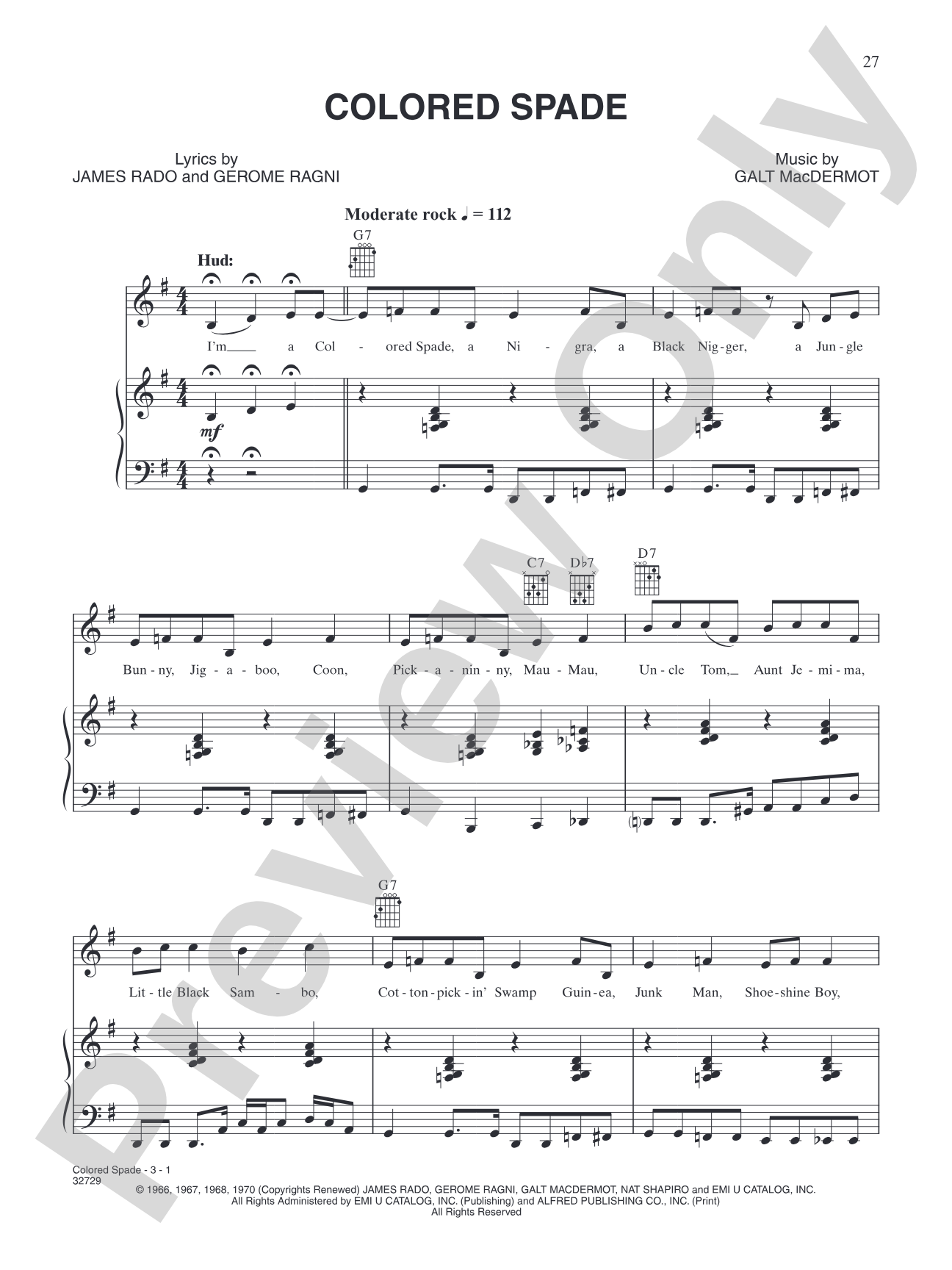

Colored Spade (from "Hair"): Piano/Vocal/Chords
Music by Galt MacDermot, words by James Rado and Gerome Ragni
Item: 00-PS-0011227
$4.99
One moment…
Related Items
Hair: Piano/Vocal/Chords |
$5.99
|
View | |
Walking In Space: Piano/Vocal/Chords |
$5.99
|
View | |
Manchester England: Piano/Vocal/Chords |
$4.99
|
View | |
White Boys: Piano/Vocal/Chords |
$5.99
|
View | |
Donna: Piano/Vocal/Chords |
$5.99
|
View | |
Easy to Be Hard (from "Hair"): Piano/Vocal/Chords |
$4.99
|
View | |
Four Score / Abie Baby (from "Hair"): Piano/Vocal/Chords |
$4.99
|
View | |
Hashish (from "Hair"): Piano/Vocal/Chords |
$4.99
|
View | |
Air (from "Hair"): Piano/Vocal/Chords |
$4.99
|
View | |
What a Piece of Work Is Man / How Dare They Try (from "Hair"): Piano/Vocal/Chords |
$4.99
|
View | |
I Got Life (from "Hair"): Piano/Vocal/Chords |
$5.99
|
View | |
Electric Blues (from "Hair"): Piano/Vocal/Chords |
$5.99
|
View | |
I'm Black / Ain't Got No (from "Hair"): Piano/Vocal/Chords |
$4.99
|
View | |
Black Boys (from "Hair"): Piano/Vocal/Chords |
$4.99
|
View | |
Where Do I Go? (from "Hair"): Piano/Vocal/Chords |
$4.99
|
View | |
Three-Five-Zero-Zero (from "Hair"): Piano/Vocal/Chords |
$4.99
|
View | |
Good Morning Starshine (from "Hair"): Piano/Vocal/Chords |
$4.99
|
View | |
Frank Mills (from "Hair"): Piano/Vocal/Chords |
$4.99
|
View | |
Hare Krishna / Be In (from "Hair"): Piano/Vocal/Chords |
$5.99
|
View | |
Sodomy (from "Hair"): Piano/Vocal/Chords |
$4.99
|
View | |
Sheila Franklin / I Believe in Love (from "Hair"): Piano/Vocal/Chords |
$4.99
|
View | |
Initials (from "Hair"): Piano/Vocal/Chords |
$4.99
|
View | |
Going Down (from "Hair"): Piano/Vocal/Chords |
$5.99
|
View | |
My Conviction (from "Hair"): Piano/Vocal/Chords |
$4.99
|
View | |
Oh Great God of Power / Manchester England (Reprise) (from "Hair"): Piano/Vocal/Chords |
$4.99
|
View | |
Yes, I's Finished on Y'all's Farmlands (from "Hair"): Piano/Vocal/Chords |
$4.99
|
View | |
Flesh Failures / Eyes Look Your Last / Let the Sun Shine In (from "Hair"): Piano/Vocal/Chords |
$5.99
|
View | |
Give Up All Desires (from "Hair"): Piano/Vocal/Chords |
$4.99
|
View | |
Hair: Vocal Selections (Broadway Edition): Piano/Vocal/Chords Book |
$19.95
|
View |
Description
The musical Hair was a cultural phenomenon in the epoch-changing era of the 1960s. Broadway has never been the same. This songbook includes highlights from the smash hit revival of the show, which has attracted raves from audiences and critics alike. Relive the new dawning of the Age of Aquarius and let the sun shine in! Titles: Air * Aquarius * Black Boys * Colored Spade * Donna * Easy to Be Hard * Flesh Failures, The / Let the Sun Shine In * Frank Mills * Give Up All Desires * Going Down * Good Morning Starshine * Hair * Hare Krishna (Be In) * Hashish * I Believe in Love * I Got Life * I'm Black / Ain't Got No * Initials * Manchester England * My Conviction * Old Fashioned Melody / Electric Blues * Sodomy * Three-Five-Zero-Zero * Walking in Space * What a Piece of Work Is Man * Where Do I Go? * White Boys * Yes, I's Finished on Y'alls Farmlands / Abie Baby.


Colored Spade (from "Hair"): Piano/Vocal/Chords isn't in MakeMusic Cloud just yet...but it could be. Let us know you'd like to see it, and you'll help shape what comes next. In the meantime, start a free trial and dive into thousands of interactive titles your students can play along with today.
Request This Title
Tell us you want it.
Start Your Free Trial
Explore everything that's ready to play right now.
Sample Audio
No sample audio found.
Sample Video
No sample videos found.
Additional Details
Publisher:
Alfred Music
Page Count:
150
SKU:
00-PS-0011227
More about this title
About the Composer: Galt MacDermot
Galt MacDermot (1928-2018) was a Canadian composer who fundamentally changed the sound of Broadway. His score for Hair, which premiered off-Broadway in 1967 and transferred to Broadway in 1968, blended rock, soul, gospel, and pop idioms into a theatrical language that felt urgently contemporary. MacDermot's willingness to abandon traditional musical theater conventions in favor of authentic rock instrumentation and vernacular song structures helped Hair become a watershed moment in American musical theater.
Beyond Hair, MacDermot composed for theater, film, and dance throughout his career. His body of work demonstrates a composer unafraid to embrace popular music forms and youth culture as serious compositional material. For music educators, MacDermot's legacy offers a model of how Broadway can authentically incorporate the musical vernacular of its audience rather than existing in isolation from it.
Why we love this
This collection captures the raw energy and social urgency that made Hair revolutionary. Teaching these songs gives singers direct access to music that speaks in their own cultural idiom rather than asking them to inhabit a formal theatrical tradition. The score's blend of accessible melodies with genuine rock and soul sensibility makes it engaging material for students who might otherwise feel disconnected from traditional musical theater.
What to expect
These songs pulse with the idealism and restlessness of the 1960s counterculture. MacDermot's melodies are often simple and memorable, but they're paired with lyrics that tackle race, identity, sexuality, and social change with startling directness. The score captures both the exuberance of youth rebellion and moments of genuine vulnerability and longing.
Who it's for
This collection serves pianists and singers preparing Hair for concert, classroom, or production contexts. Whether you're teaching the show's history, assembling a music theater anthology for a recital, or staging a full production, this piano/vocal score gives you direct access to MacDermot's original melodies and chords.
How to get the most out of it
- Honor the rock and soul influences in MacDermot's orchestration. Even on piano, the rhythmic feel should drive forward with the energy of a rock band rather than settling into standard musical theater phrasing.
- Let the lyrical content inform your interpretation. These songs address identity, belonging, and social conscience directly. Singers should understand what their character is advocating for or struggling with before they approach the melody.
- Attend to the groove and pocket in rhythmically syncopated passages. Hair's songs rarely sit on the beat in predictable ways; locking into the intended rhythmic feel is essential to the music's impact.
How to use it
Program individual numbers as part of a musical theater history concert or a thematic recital exploring American song. The diversity of musical styles within the show (rock anthem, soul ballad, gospel-influenced piece, folk-inflected melody) means you can select songs that speak to different vocal ranges and interests in an ensemble or studio. Teaching Hair's music also creates natural opportunities to discuss how Broadway has evolved to reflect the cultural moment in which shows are created.
Skills your students will build
- Singing with rhythmic authenticity in rock and soul idioms
- Interpreting syncopated rhythms and groove-based accompaniment patterns
- Connecting lyrical content to vocal interpretation and emotional authenticity
- Understanding the harmonic vocabulary of 1960s popular music as used in theater