
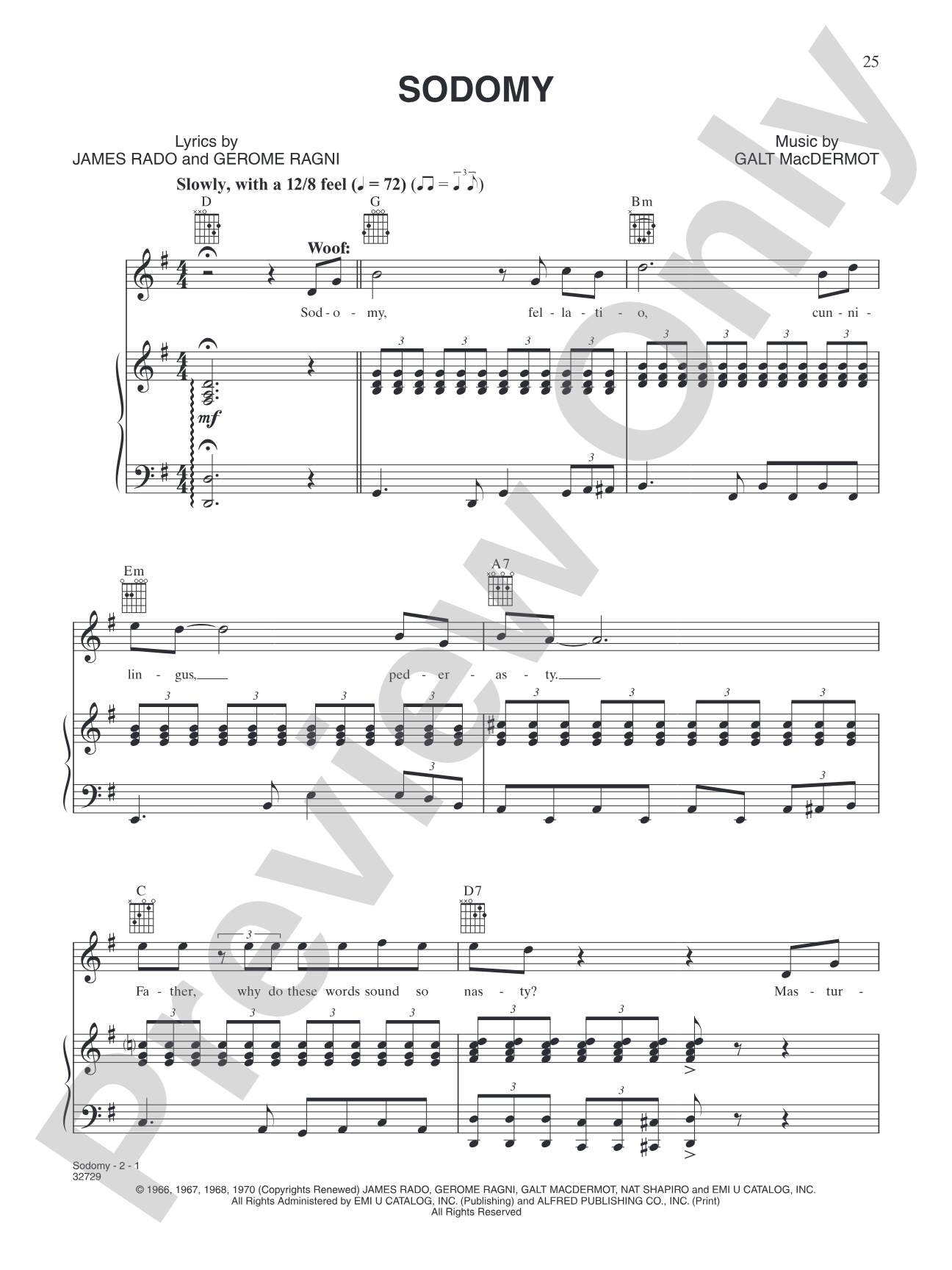

Sodomy (from "Hair"): Piano/Vocal/Chords
Music by Galt MacDermot, words by James Rado and Gerome Ragni
Item: 00-PS-0011126
$4.99
One moment…
Related Items
Hair: Piano/Vocal/Chords |
$5.99
|
View | |
Walking In Space: Piano/Vocal/Chords |
$5.99
|
View | |
Manchester England: Piano/Vocal/Chords |
$4.99
|
View | |
White Boys: Piano/Vocal/Chords |
$5.99
|
View | |
Donna: Piano/Vocal/Chords |
$5.99
|
View | |
Easy to Be Hard (from "Hair"): Piano/Vocal/Chords |
$4.99
|
View | |
Four Score / Abie Baby (from "Hair"): Piano/Vocal/Chords |
$4.99
|
View | |
Hashish (from "Hair"): Piano/Vocal/Chords |
$4.99
|
View | |
Air (from "Hair"): Piano/Vocal/Chords |
$4.99
|
View | |
What a Piece of Work Is Man / How Dare They Try (from "Hair"): Piano/Vocal/Chords |
$4.99
|
View | |
I Got Life (from "Hair"): Piano/Vocal/Chords |
$5.99
|
View | |
Electric Blues (from "Hair"): Piano/Vocal/Chords |
$5.99
|
View | |
I'm Black / Ain't Got No (from "Hair"): Piano/Vocal/Chords |
$4.99
|
View | |
Black Boys (from "Hair"): Piano/Vocal/Chords |
$4.99
|
View | |
Where Do I Go? (from "Hair"): Piano/Vocal/Chords |
$4.99
|
View | |
Three-Five-Zero-Zero (from "Hair"): Piano/Vocal/Chords |
$4.99
|
View | |
Good Morning Starshine (from "Hair"): Piano/Vocal/Chords |
$4.99
|
View | |
Frank Mills (from "Hair"): Piano/Vocal/Chords |
$4.99
|
View | |
Hare Krishna / Be In (from "Hair"): Piano/Vocal/Chords |
$5.99
|
View | |
Colored Spade (from "Hair"): Piano/Vocal/Chords |
$4.99
|
View | |
Sheila Franklin / I Believe in Love (from "Hair"): Piano/Vocal/Chords |
$4.99
|
View | |
Initials (from "Hair"): Piano/Vocal/Chords |
$4.99
|
View | |
Going Down (from "Hair"): Piano/Vocal/Chords |
$5.99
|
View | |
My Conviction (from "Hair"): Piano/Vocal/Chords |
$4.99
|
View | |
Oh Great God of Power / Manchester England (Reprise) (from "Hair"): Piano/Vocal/Chords |
$4.99
|
View | |
Yes, I's Finished on Y'all's Farmlands (from "Hair"): Piano/Vocal/Chords |
$4.99
|
View | |
Flesh Failures / Eyes Look Your Last / Let the Sun Shine In (from "Hair"): Piano/Vocal/Chords |
$5.99
|
View | |
Give Up All Desires (from "Hair"): Piano/Vocal/Chords |
$4.99
|
View | |
Hair: Vocal Selections (Broadway Edition): Piano/Vocal/Chords Book |
$19.95
|
View |
Description
The musical Hair was a cultural phenomenon in the epoch-changing era of the 1960s. Broadway has never been the same. This songbook includes highlights from the smash hit revival of the show, which has attracted raves from audiences and critics alike. Relive the new dawning of the Age of Aquarius and let the sun shine in! Titles: Air * Aquarius * Black Boys * Colored Spade * Donna * Easy to Be Hard * Flesh Failures, The / Let the Sun Shine In * Frank Mills * Give Up All Desires * Going Down * Good Morning Starshine * Hair * Hare Krishna (Be In) * Hashish * I Believe in Love * I Got Life * I'm Black / Ain't Got No * Initials * Manchester England * My Conviction * Old Fashioned Melody / Electric Blues * Sodomy * Three-Five-Zero-Zero * Walking in Space * What a Piece of Work Is Man * Where Do I Go? * White Boys * Yes, I's Finished on Y'alls Farmlands / Abie Baby.


Discover MakeMusic Cloud: thousands of interactive titles your students can play along with today.
Sample Audio
No sample audio found.
Sample Video
No sample videos found.
Additional Details
Publisher:
Alfred Music
Page Count:
150
SKU:
00-PS-0011126
More about this title
About the Composer: Galt MacDermot
Galt MacDermot was a Canadian composer and pianist whose score for Hair became one of the most influential theatrical compositions of the 20th century. Originally trained in classical music, MacDermot composed the score that would define a generation, blending rock, pop, soul, and classical elements into a cohesive theatrical experience that broke every rule of traditional Broadway orchestration.
Beyond Hair, MacDermot composed scores for numerous stage productions and films, always pushing the boundaries of what musical theater could express. His ability to capture the spirit of an era through music made him a pivotal figure in popular music history and a composer whose work remains essential to understanding how Broadway evolved.
Why we love this
This collection captures the raw energy and cultural urgency of Hair in a format that lets singers and pianists access these iconic songs without losing their harmonic sophistication or emotional immediacy. Each song stands alone as a complete performance piece while maintaining the theatrical vision that made the original revival a critical and popular success. Performing these arrangements connects students and young artists directly to a pivotal moment in American musical theater history.
What to expect
These songs pulse with optimism, rebellion, and spiritual searching. The harmonies shift between lush romanticism and sparse folk simplicity, while the lyrics oscillate between celebration and social critique, creating an emotional landscape that feels both of its time and timeless. Performing them invites singers into a world of contradictions resolved through music: sacred and profane, structured and anarchic, deeply personal and universally shared.
Who it's for
This collection serves pianists and vocalists preparing songs for auditions, recitals, or concert performances, as well as music theater ensembles seeking authentic arrangements of Hair's most beloved numbers. It's ideal for students exploring how contemporary music, folk traditions, and classical harmony intersect within musical theater. Teachers and directors can draw from these pieces to introduce students to a transformative era of American musical culture.
How to get the most out of it
- Balance the vocal line with accompaniment to preserve the song's intimacy; these arrangements are written to support the voice, not overpower it.
- Explore the rhythmic flexibility within these songs. Many of them resist strict metering, so allow room for the text and emotional content to shape the phrasing.
- Study the harmonic progressions carefully, particularly in songs like 'Aquarius' and 'Easy to Be Hard,' where chord choices carry dramatic weight.
- Connect the piano accompaniment to the emotional arc of each song; MacDermot's voicings often suggest the mood before the lyrics begin.
How to use it
Program individual songs from this collection for variety within a concert, mixing Hair with other contemporary musical theater or songs from different eras to highlight how MacDermot's compositional voice stands apart. Use these pieces as audition material for students pursuing music theater training. Consider pairing multiple songs from the collection for a thematic program exploring 1960s social consciousness and artistic experimentation.
Skills your students will build
- Interpreting extended harmonies in a popular music context
- Balancing vocal performance with piano accompaniment
- Understanding the historical and cultural significance of 1960s musical theater
- Navigating flexible rhythmic phrasing and text-driven interpretation
- Reading chord charts and adapting arrangements for different vocal ranges