
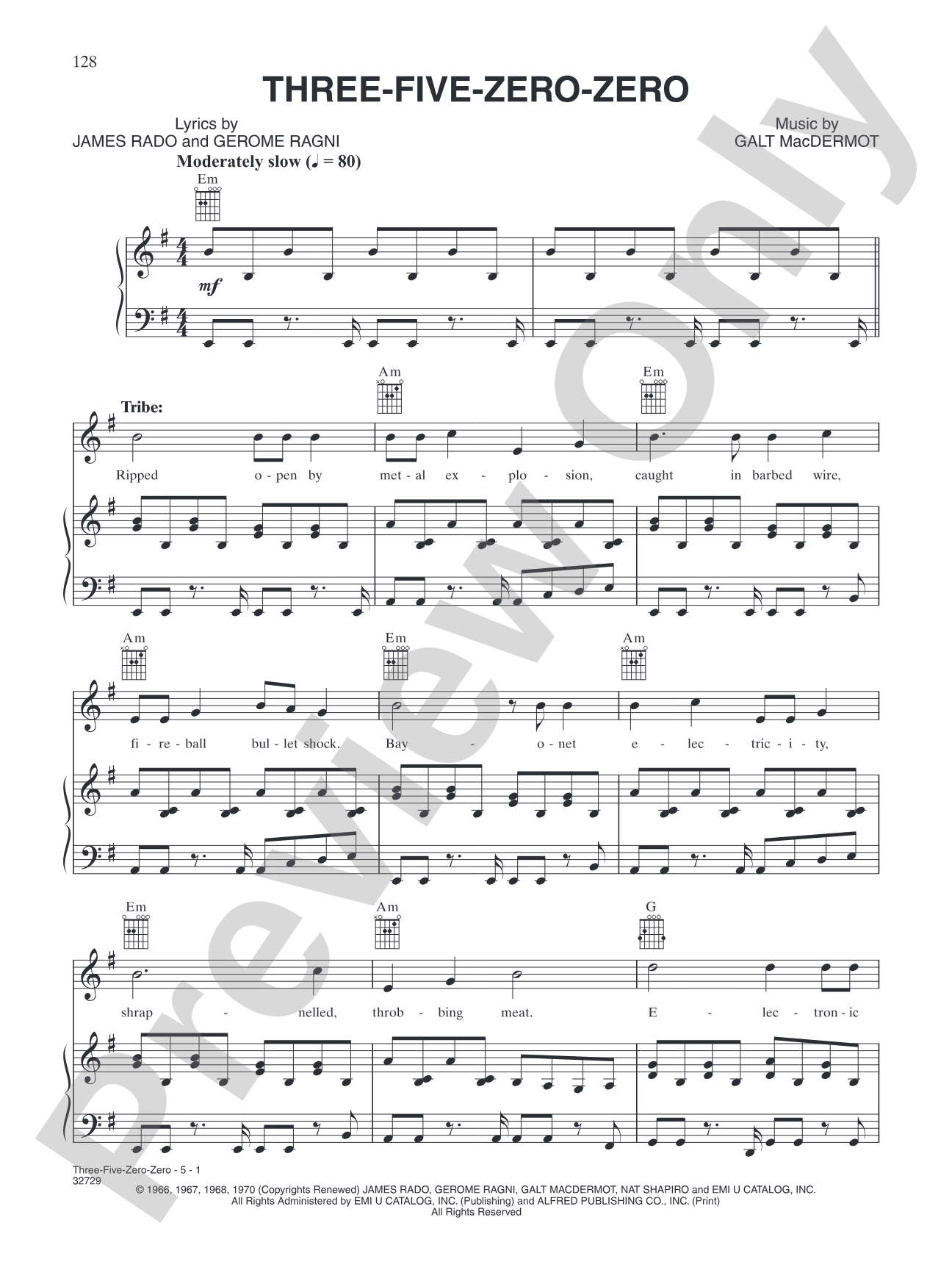

Three-Five-Zero-Zero (from "Hair"): Piano/Vocal/Chords
Music by Galt MacDermot, words by James Rado and Gerome Ragni
Item: 00-PS-0011117
$4.99
One moment…
Related Items
Hair: Piano/Vocal/Chords |
$5.99
|
View | |
Walking In Space: Piano/Vocal/Chords |
$5.99
|
View | |
Manchester England: Piano/Vocal/Chords |
$4.99
|
View | |
White Boys: Piano/Vocal/Chords |
$5.99
|
View | |
Donna: Piano/Vocal/Chords |
$5.99
|
View | |
Easy to Be Hard (from "Hair"): Piano/Vocal/Chords |
$4.99
|
View | |
Four Score / Abie Baby (from "Hair"): Piano/Vocal/Chords |
$4.99
|
View | |
Hashish (from "Hair"): Piano/Vocal/Chords |
$4.99
|
View | |
Air (from "Hair"): Piano/Vocal/Chords |
$4.99
|
View | |
What a Piece of Work Is Man / How Dare They Try (from "Hair"): Piano/Vocal/Chords |
$4.99
|
View | |
I Got Life (from "Hair"): Piano/Vocal/Chords |
$5.99
|
View | |
Electric Blues (from "Hair"): Piano/Vocal/Chords |
$5.99
|
View | |
I'm Black / Ain't Got No (from "Hair"): Piano/Vocal/Chords |
$4.99
|
View | |
Black Boys (from "Hair"): Piano/Vocal/Chords |
$4.99
|
View | |
Where Do I Go? (from "Hair"): Piano/Vocal/Chords |
$4.99
|
View | |
Good Morning Starshine (from "Hair"): Piano/Vocal/Chords |
$4.99
|
View | |
Frank Mills (from "Hair"): Piano/Vocal/Chords |
$4.99
|
View | |
Hare Krishna / Be In (from "Hair"): Piano/Vocal/Chords |
$5.99
|
View | |
Sodomy (from "Hair"): Piano/Vocal/Chords |
$4.99
|
View | |
Colored Spade (from "Hair"): Piano/Vocal/Chords |
$4.99
|
View | |
Sheila Franklin / I Believe in Love (from "Hair"): Piano/Vocal/Chords |
$4.99
|
View | |
Initials (from "Hair"): Piano/Vocal/Chords |
$4.99
|
View | |
Going Down (from "Hair"): Piano/Vocal/Chords |
$5.99
|
View | |
My Conviction (from "Hair"): Piano/Vocal/Chords |
$4.99
|
View | |
Oh Great God of Power / Manchester England (Reprise) (from "Hair"): Piano/Vocal/Chords |
$4.99
|
View | |
Yes, I's Finished on Y'all's Farmlands (from "Hair"): Piano/Vocal/Chords |
$4.99
|
View | |
Flesh Failures / Eyes Look Your Last / Let the Sun Shine In (from "Hair"): Piano/Vocal/Chords |
$5.99
|
View | |
Give Up All Desires (from "Hair"): Piano/Vocal/Chords |
$4.99
|
View | |
Hair: Vocal Selections (Broadway Edition): Piano/Vocal/Chords Book |
$19.95
|
View |
Description
The musical Hair was a cultural phenomenon in the epoch-changing era of the 1960s. Broadway has never been the same. This songbook includes highlights from the smash hit revival of the show, which has attracted raves from audiences and critics alike. Relive the new dawning of the Age of Aquarius and let the sun shine in! Titles: Air * Aquarius * Black Boys * Colored Spade * Donna * Easy to Be Hard * Flesh Failures, The / Let the Sun Shine In * Frank Mills * Give Up All Desires * Going Down * Good Morning Starshine * Hair * Hare Krishna (Be In) * Hashish * I Believe in Love * I Got Life * I'm Black / Ain't Got No * Initials * Manchester England * My Conviction * Old Fashioned Melody / Electric Blues * Sodomy * Three-Five-Zero-Zero * Walking in Space * What a Piece of Work Is Man * Where Do I Go? * White Boys * Yes, I's Finished on Y'alls Farmlands / Abie Baby.


Three-Five-Zero-Zero (from "Hair"): Piano/Vocal/Chords isn't in MakeMusic Cloud just yet...but it could be. Let us know you'd like to see it, and you'll help shape what comes next. In the meantime, start a free trial and dive into thousands of interactive titles your students can play along with today.
Request This Title
Tell us you want it.
Start Your Free Trial
Explore everything that's ready to play right now.
Sample Audio
No sample audio found.
Sample Video
No sample videos found.
Additional Details
Publisher:
Alfred Music
Page Count:
150
SKU:
00-PS-0011117
More about this title
About the Composer: Galt MacDermot
Galt MacDermot (1928-2018) was a Canadian composer and pianist whose work bridged classical training and popular music. He studied at the Juilliard School and had a career as a concert pianist before turning to musical theater, where he found his defining voice.
MacDermot's score for Hair (1968) became one of the most influential Broadway compositions of the twentieth century. The show's integration of rock, soul, gospel, and orchestral elements reflected the cultural upheaval of its era and established MacDermot as a composer unafraid to challenge theatrical convention. His ability to craft memorable melodies within innovative harmonic and rhythmic frameworks made Hair both commercially successful and artistically significant.
Why we love this
Hair's songs remain remarkably playable for singers and pianists at intermediate levels, with melodies that sit naturally in the voice and accompaniments that balance harmonic interest with accessibility. The collection spans rock numbers, introspective ballads, and ensemble pieces, giving your students authentic material from a show that fundamentally changed what Broadway music could be. Programming selections from this songbook signals to audiences that musical theater repertoire extends far beyond standard fare.
What to expect
Hair pulses with the energy of a cultural turning point. The songs move between tender introspection and explosive ensemble celebration, with melodies that feel both earthy and expansive. There's a permissive, searching quality to much of the writing, as though each song invites you to question, dream, and speak your truth.
Who it's for
Singers preparing audition material, recital repertoire, or revue programming will find authentic Broadway writing that showcases both vulnerability and vocal presence. Pianists benefit from the dual role of keeping time and providing harmonic support, developing skills in contemporary vocal accompaniment. Students interested in musical theater history will connect with music that shaped the genre.
How to get the most out of it
- Lean into the rhythmic drive of rock-based numbers. The piano accompaniment often sits in a contemporary groove, so lock into the subdivision rather than playing mechanically; swing slightly where the groove suggests it.
- Honor the social and political context of individual songs. Pieces like 'Easy to Be Hard' and 'Where Do I Go?' carry emotional weight rooted in 1960s activism; sing with conviction rather than lightness.
- Balance the chordal accompaniment with clear melody support. Many arrangements use rich tertian harmonies; let the vocal line cut through without drowning the harmonic color underneath.
- Experiment with the optional chord symbols to add improvisation or variation on repeats, particularly in songs that benefit from jazz voicings or contemporary reharmonization.
How to use it
Construct a recital set around a single artist's journey through the show, perhaps pairing 'Where Do I Go?' with 'Easy to Be Hard' and 'Good Morning Starshine' to trace emotional progression. Feature a piano and voice recital focused on 1960s musical theater, situating Hair alongside Kander and Ebb or Stephen Sondheim to demonstrate the range of voices shaping Broadway during that decade. Use individual selections in a pop-influenced concert or as audition preparation for students pursuing musical theater training.
Skills your students will build
- Reading and interpreting chord symbols in a contemporary harmonic language
- Singing through syncopated rhythmic patterns and rock-influenced phrasing
- Accompanying a soloist with flexible, groove-based rhythmic support
- Understanding how theatrical context and historical setting inform interpretation
- Managing vocal legit technique while incorporating contemporary stylistic flexibility