
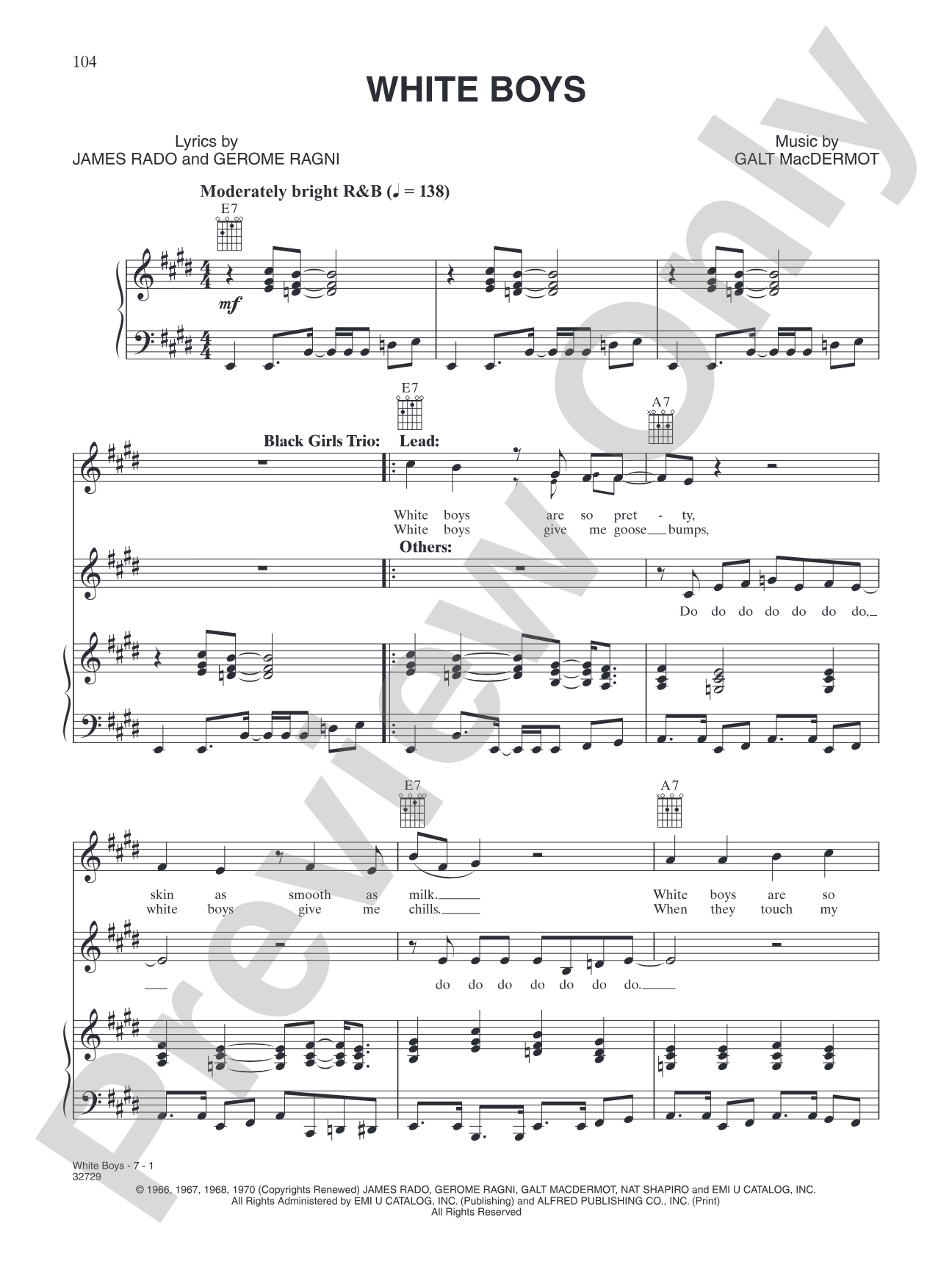
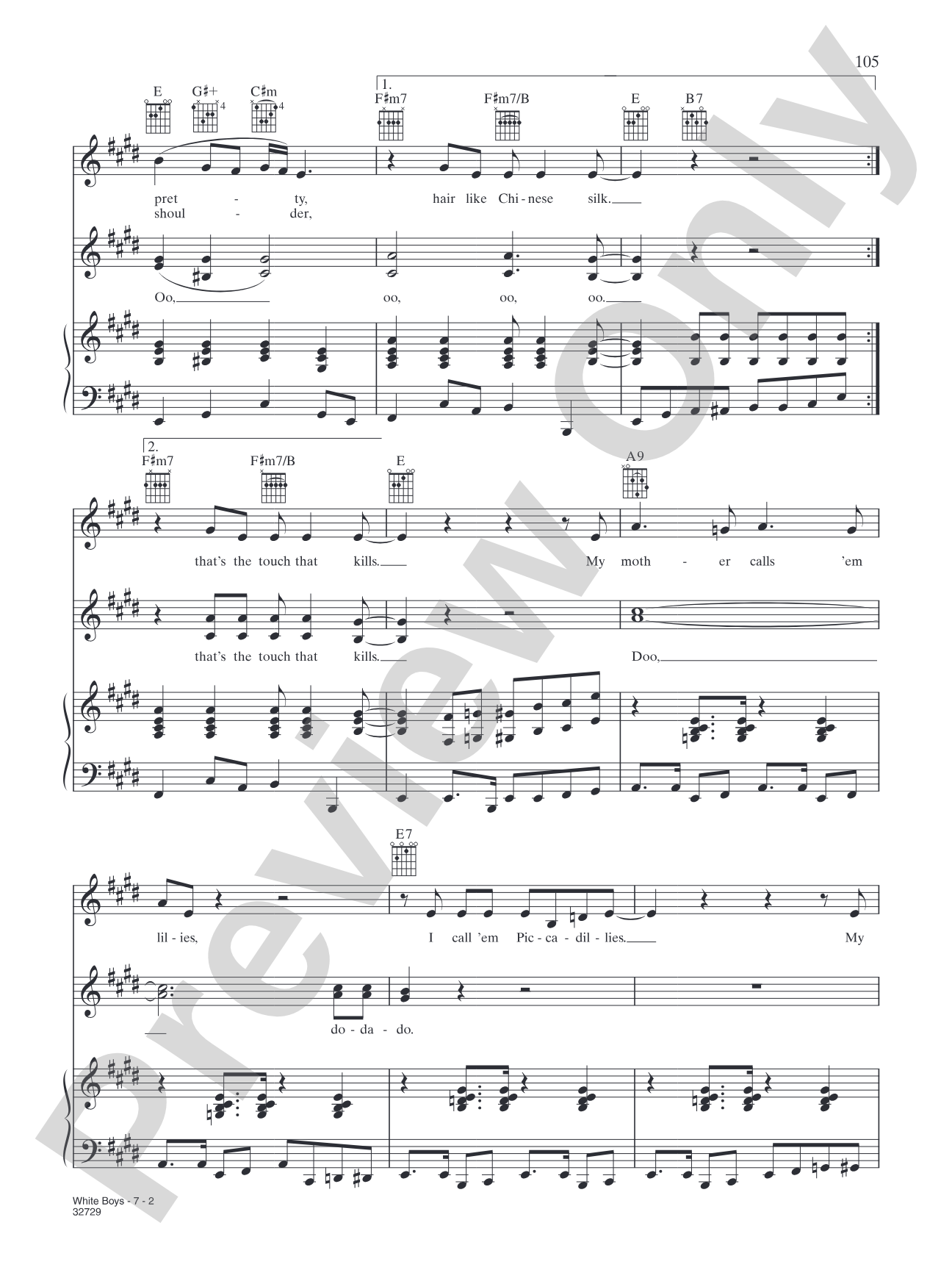

White Boys: Piano/Vocal/Chords
Music by Galt MacDermot, words by James Rado and Gerome Ragni
Item: 00-PS-0000658
$5.99
One moment…
Related Items
Hair: Piano/Vocal/Chords |
$5.99
|
View | |
Walking In Space: Piano/Vocal/Chords |
$5.99
|
View | |
Manchester England: Piano/Vocal/Chords |
$4.99
|
View | |
Donna: Piano/Vocal/Chords |
$5.99
|
View | |
Easy to Be Hard (from "Hair"): Piano/Vocal/Chords |
$4.99
|
View | |
Four Score / Abie Baby (from "Hair"): Piano/Vocal/Chords |
$4.99
|
View | |
Hashish (from "Hair"): Piano/Vocal/Chords |
$4.99
|
View | |
Air (from "Hair"): Piano/Vocal/Chords |
$4.99
|
View | |
What a Piece of Work Is Man / How Dare They Try (from "Hair"): Piano/Vocal/Chords |
$4.99
|
View | |
I Got Life (from "Hair"): Piano/Vocal/Chords |
$5.99
|
View | |
Electric Blues (from "Hair"): Piano/Vocal/Chords |
$5.99
|
View | |
I'm Black / Ain't Got No (from "Hair"): Piano/Vocal/Chords |
$4.99
|
View | |
Black Boys (from "Hair"): Piano/Vocal/Chords |
$4.99
|
View | |
Where Do I Go? (from "Hair"): Piano/Vocal/Chords |
$4.99
|
View | |
Three-Five-Zero-Zero (from "Hair"): Piano/Vocal/Chords |
$4.99
|
View | |
Good Morning Starshine (from "Hair"): Piano/Vocal/Chords |
$4.99
|
View | |
Frank Mills (from "Hair"): Piano/Vocal/Chords |
$4.99
|
View | |
Hare Krishna / Be In (from "Hair"): Piano/Vocal/Chords |
$5.99
|
View | |
Sodomy (from "Hair"): Piano/Vocal/Chords |
$4.99
|
View | |
Colored Spade (from "Hair"): Piano/Vocal/Chords |
$4.99
|
View | |
Sheila Franklin / I Believe in Love (from "Hair"): Piano/Vocal/Chords |
$4.99
|
View | |
Initials (from "Hair"): Piano/Vocal/Chords |
$4.99
|
View | |
Going Down (from "Hair"): Piano/Vocal/Chords |
$5.99
|
View | |
My Conviction (from "Hair"): Piano/Vocal/Chords |
$4.99
|
View | |
Oh Great God of Power / Manchester England (Reprise) (from "Hair"): Piano/Vocal/Chords |
$4.99
|
View | |
Yes, I's Finished on Y'all's Farmlands (from "Hair"): Piano/Vocal/Chords |
$4.99
|
View | |
Flesh Failures / Eyes Look Your Last / Let the Sun Shine In (from "Hair"): Piano/Vocal/Chords |
$5.99
|
View | |
Give Up All Desires (from "Hair"): Piano/Vocal/Chords |
$4.99
|
View | |
Hair: Vocal Selections (Broadway Edition): Piano/Vocal/Chords Book |
$19.95
|
View |
Description
The musical Hair was a cultural phenomenon in the epoch-changing era of the 1960s. Broadway has never been the same. This songbook includes highlights from the smash hit revival of the show, which has attracted raves from audiences and critics alike. Relive the new dawning of the Age of Aquarius and let the sun shine in! Titles: Air * Aquarius * Black Boys * Colored Spade * Donna * Easy to Be Hard * Flesh Failures, The / Let the Sun Shine In * Frank Mills * Give Up All Desires * Going Down * Good Morning Starshine * Hair * Hare Krishna (Be In) * Hashish * I Believe in Love * I Got Life * I'm Black / Ain't Got No * Initials * Manchester England * My Conviction * Old Fashioned Melody / Electric Blues * Sodomy * Three-Five-Zero-Zero * Walking in Space * What a Piece of Work Is Man * Where Do I Go? * White Boys * Yes, I's Finished on Y'alls Farmlands / Abie Baby.


White Boys: Piano/Vocal/Chords isn't in MakeMusic Cloud just yet...but it could be. Let us know you'd like to see it, and you'll help shape what comes next. In the meantime, start a free trial and dive into thousands of interactive titles your students can play along with today.
Request This Title
Tell us you want it.
Start Your Free Trial
Explore everything that's ready to play right now.
Sample Audio
No sample audio found.
Sample Video
No sample videos found.
Additional Details
Publisher:
Alfred Music
Page Count:
150
SKU:
00-PS-0000658
More about this title
About the Composer: Galt MacDermot
Galt MacDermot composed the score for Hair, the 1967 musical that fundamentally reshaped Broadway's relationship with popular music, youth culture, and social commentary. His work earned a Grammy Award and introduced unforgettable songs that became standards in the American songbook. MacDermot brought classical training to rock and pop idioms, creating a score that felt both theatrical and authentically of its time.
Why we love this
This collection captures one of Broadway's most infectious and socially vital scores, offering singers and pianists the chance to work with music that changed what musical theater could be. The songs hold up because they balance accessibility with genuine harmonic and melodic sophistication. Whether you're teaching 1960s cultural history, building a jazz-inflected repertoire for a young vocalist, or simply exploring how rock and soul informed Broadway composition, these pieces deliver.
What to expect
These songs radiate optimism, irreverence, and a sense of possibility that defined the late 1960s counterculture. The music swings between tender introspection (Frank Mills, Easy to Be Hard) and uninhibited celebration (Good Morning Starshine, Aquarius), capturing the era's spiritual searching and sexual liberation without cynicism. Every song carries the energy of a generation that believed music could change the world.
Who it's for
Singers preparing audition material from Broadway's golden age of rock-influenced musicals will find essential repertoire here. Pianists and voice teachers can use these pieces to explore how popular music vocabulary integrated into theatrical composition. This collection also serves high school and college singers performing Hair or studying how 1960s social movements influenced American musical theater.
How to get the most out of it
- Lean into the rhythmic grooves and syncopation rather than treating these arrangements as traditional show tunes. The piano voicings should feel relaxed and contemporary, not strict or overly formal.
- Pay attention to the lyrical content and what each song is expressing socially and personally. The emotional authenticity of the vocals will come through when performers understand the cultural moment these songs captured.
- Use the chord symbols as a foundation for improvisation and reharmonization, especially in ensemble or jam contexts. These songs were built to be flexible and alive, not fixed.
How to use it
This book works beautifully in concert programs exploring the evolution of Broadway beyond traditional operetta and standard show tunes. Feature individual songs in recitals as encore material or pair selections with other 1960s rock-influenced theater music for a cohesive program. It's also invaluable for directing students through the complete score if your school or theater company produces Hair.
Skills your students will build
- Reading and interpreting swing rhythms and syncopated figures at the piano
- Singing through jazz and soul-influenced melodic lines with rhythmic flexibility
- Understanding chord extensions and contemporary harmonic language in a theatrical context
- Balancing legit singing technique with a contemporary, conversational vocal style
- Interpreting social and emotional subtext in lyrics to inform musical choices