
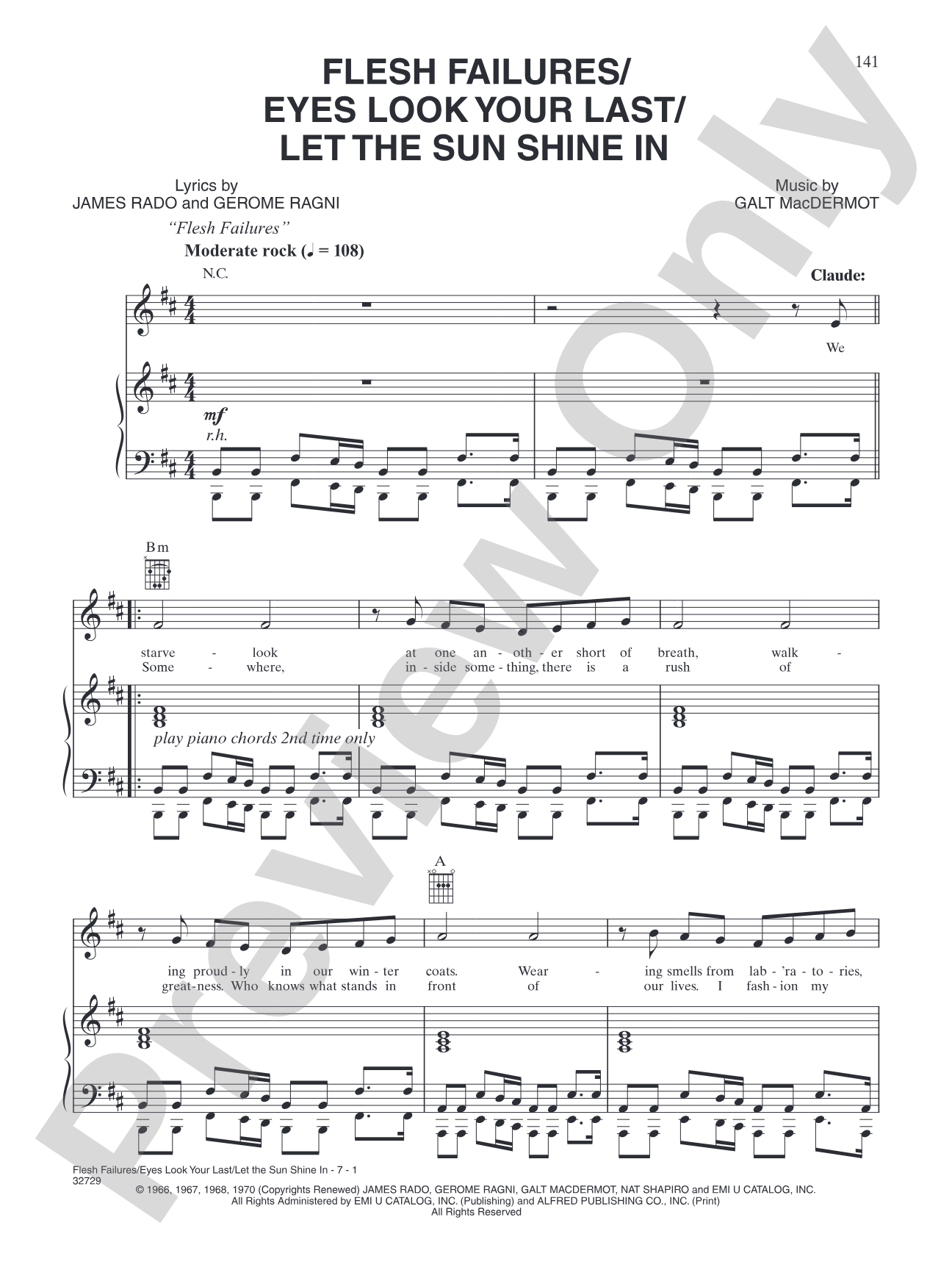
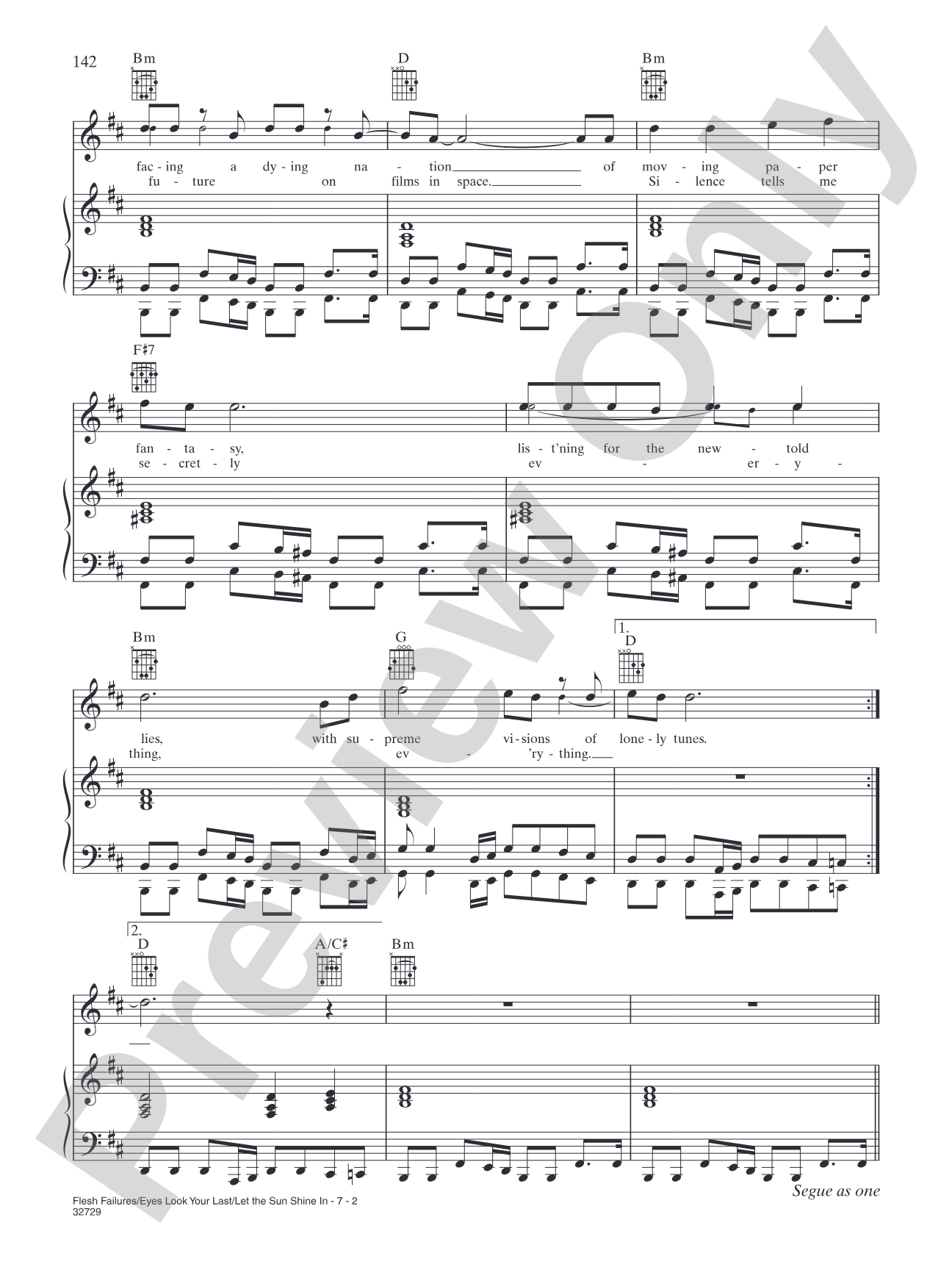

Flesh Failures / Eyes Look Your Last / Let the Sun Shine In (from "Hair"): Piano/Vocal/Chords
Music by Galt MacDermot, words by James Rado and Gerome Ragni
Item: 00-PS-0011234
$5.99
One moment…
Related Items
Hair: Piano/Vocal/Chords |
$5.99
|
View | |
Walking In Space: Piano/Vocal/Chords |
$5.99
|
View | |
Manchester England: Piano/Vocal/Chords |
$4.99
|
View | |
White Boys: Piano/Vocal/Chords |
$5.99
|
View | |
Donna: Piano/Vocal/Chords |
$5.99
|
View | |
Easy to Be Hard (from "Hair"): Piano/Vocal/Chords |
$4.99
|
View | |
Four Score / Abie Baby (from "Hair"): Piano/Vocal/Chords |
$4.99
|
View | |
Hashish (from "Hair"): Piano/Vocal/Chords |
$4.99
|
View | |
Air (from "Hair"): Piano/Vocal/Chords |
$4.99
|
View | |
What a Piece of Work Is Man / How Dare They Try (from "Hair"): Piano/Vocal/Chords |
$4.99
|
View | |
I Got Life (from "Hair"): Piano/Vocal/Chords |
$5.99
|
View | |
Electric Blues (from "Hair"): Piano/Vocal/Chords |
$5.99
|
View | |
I'm Black / Ain't Got No (from "Hair"): Piano/Vocal/Chords |
$4.99
|
View | |
Black Boys (from "Hair"): Piano/Vocal/Chords |
$4.99
|
View | |
Where Do I Go? (from "Hair"): Piano/Vocal/Chords |
$4.99
|
View | |
Three-Five-Zero-Zero (from "Hair"): Piano/Vocal/Chords |
$4.99
|
View | |
Good Morning Starshine (from "Hair"): Piano/Vocal/Chords |
$4.99
|
View | |
Frank Mills (from "Hair"): Piano/Vocal/Chords |
$4.99
|
View | |
Hare Krishna / Be In (from "Hair"): Piano/Vocal/Chords |
$5.99
|
View | |
Sodomy (from "Hair"): Piano/Vocal/Chords |
$4.99
|
View | |
Colored Spade (from "Hair"): Piano/Vocal/Chords |
$4.99
|
View | |
Sheila Franklin / I Believe in Love (from "Hair"): Piano/Vocal/Chords |
$4.99
|
View | |
Initials (from "Hair"): Piano/Vocal/Chords |
$4.99
|
View | |
Going Down (from "Hair"): Piano/Vocal/Chords |
$5.99
|
View | |
My Conviction (from "Hair"): Piano/Vocal/Chords |
$4.99
|
View | |
Oh Great God of Power / Manchester England (Reprise) (from "Hair"): Piano/Vocal/Chords |
$4.99
|
View | |
Yes, I's Finished on Y'all's Farmlands (from "Hair"): Piano/Vocal/Chords |
$4.99
|
View | |
Give Up All Desires (from "Hair"): Piano/Vocal/Chords |
$4.99
|
View | |
Hair: Vocal Selections (Broadway Edition): Piano/Vocal/Chords Book |
$19.95
|
View |
Description
The musical Hair was a cultural phenomenon in the epoch-changing era of the 1960s. Broadway has never been the same. This songbook includes highlights from the smash hit revival of the show, which has attracted raves from audiences and critics alike. Relive the new dawning of the Age of Aquarius and let the sun shine in! Titles: Air * Aquarius * Black Boys * Colored Spade * Donna * Easy to Be Hard * Flesh Failures, The / Let the Sun Shine In * Frank Mills * Give Up All Desires * Going Down * Good Morning Starshine * Hair * Hare Krishna (Be In) * Hashish * I Believe in Love * I Got Life * I'm Black / Ain't Got No * Initials * Manchester England * My Conviction * Old Fashioned Melody / Electric Blues * Sodomy * Three-Five-Zero-Zero * Walking in Space * What a Piece of Work Is Man * Where Do I Go? * White Boys * Yes, I's Finished on Y'alls Farmlands / Abie Baby.


Flesh Failures / Eyes Look Your Last / Let the Sun Shine In (from "Hair"): Piano/Vocal/Chords isn't in MakeMusic Cloud just yet...but it could be. Let us know you'd like to see it, and you'll help shape what comes next. In the meantime, start a free trial and dive into thousands of interactive titles your students can play along with today.
Request This Title
Tell us you want it.
Start Your Free Trial
Explore everything that's ready to play right now.
Sample Audio
No sample audio found.
Sample Video
No sample videos found.
Additional Details
Publisher:
Alfred Music
Page Count:
150
SKU:
00-PS-0011234
More about this title
About the Composer: Galt MacDermot
Galt MacDermot was a Canadian composer and pianist whose score for Hair (1967) became one of the most influential Broadway soundtracks of the 20th century. Working with librettists Gerome Ragni and James Rado, MacDermot created music that seamlessly blended rock, soul, pop, and theatrical idioms, capturing the spirit of the counterculture movement while remaining accessible to mainstream audiences.
MacDermot's gift was his ability to write memorable melodies that could function as both standalone pop songs and integrated theatrical moments. His work on Hair demonstrated that Broadway music could embrace contemporary popular styles without sacrificing harmonic sophistication or theatrical purpose. This collection remains essential repertoire for understanding how classical training and jazz-influenced harmony can enliven popular song.
Why we love this
This collection captures some of Broadway's most singable and socially resonant material. The songs move easily from intimate moments ("Frank Mills") to ensemble declarations ("Let the Sun Shine In"), giving pianists and singers a diverse set of scenes to work with. What makes this edition particularly valuable is how the piano/vocal/chords format preserves both the theatrical context and the pop accessibility that made Hair a crossover phenomenon.
What to expect
Opening these pages transports you to a moment when Broadway felt urgent and alive. The music pulses with optimism, social consciousness, and unironic joy. Whether you're singing about flowers and astrology or wrestling with identity and belonging, the songs resist cynicism while acknowledging real struggle. There's a generosity in the melodies and a clarity in the harmonies that feels both of its era and timeless.
Who it's for
This collection serves singers preparing audition material, pianists building their popular song repertoire, music theater students, and accompanists accompanying vocalists. It's equally valuable for high school and college singers who want to explore material beyond traditional musical theater or contemporary pop, and for pianists interested in the specific harmonic and rhythmic language MacDermot developed for the stage.
How to get the most out of it
- Pay attention to the rhythmic specificity in songs like "Aquarius" and "Good Morning Starshine." MacDermot's syncopation sits between rock and jazz, and the groove matters as much as the melody.
- Balance the singer's emotional authenticity with the piano's rhythmic drive. These songs emerged from a genuine cultural moment, and performers who lean into that sincerity connect with audiences immediately.
- Experiment with chord voicings and rhythmic interpretations in the accompaniment. The lead sheet notation invites personal arrangement while keeping the harmonic foundation intact.
- Consider the dramatic arc across multiple songs if programming several from this collection. "The Flesh Failures / Let the Sun Shine In" and "Where Do I Go?" function as emotional climaxes and deserve space to breathe.
How to use it
Program individual songs as recital repertoire alongside art songs, jazz standards, and contemporary pop. A full cabaret or concert celebrating 1960s musical theater could center on this collection, contrasting Hair's revolutionary approach with more traditional Broadway material. For music theater classes and audition coaching, these songs offer immediate engagement and proven audience appeal.
Skills your students will build
- Sight-reading jazz and popular chord notations with slash chords and alterations
- Balancing rhythmic precision in syncopated vocal lines with natural phrasing
- Accompanying singers in material that bridges theatrical and popular styles
- Understanding harmonic color and voice leading in contemporary pop-influenced composition
- Interpreting lead sheet notation to create musically informed accompaniment choices