
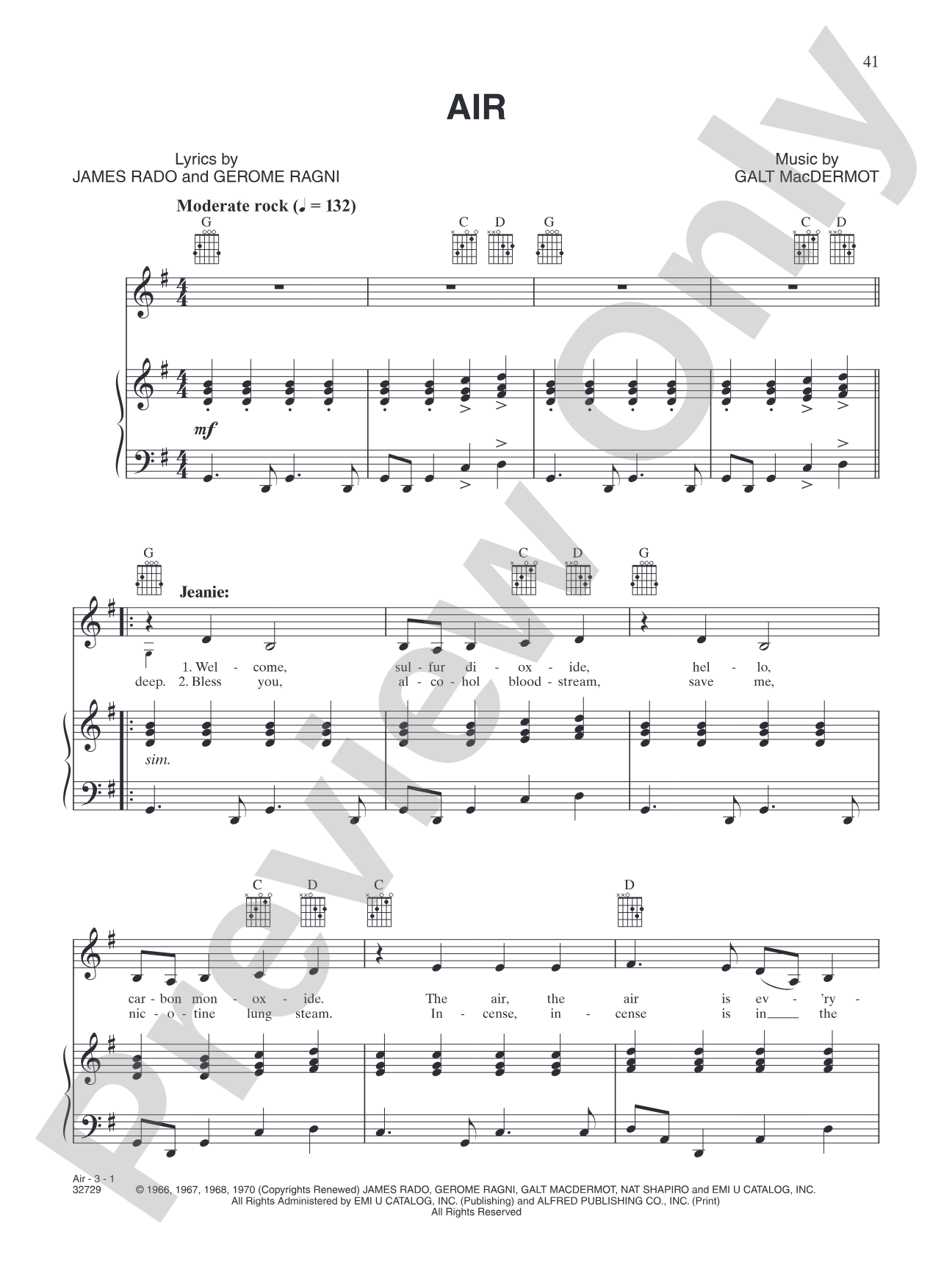

Air (from "Hair"): Piano/Vocal/Chords
Music by Galt MacDermot, words by James Rado and Gerome Ragni
Item: 00-PS-0011110
$4.99
One moment…
Related Items
Hair: Piano/Vocal/Chords |
$5.99
|
View | |
Walking In Space: Piano/Vocal/Chords |
$5.99
|
View | |
Manchester England: Piano/Vocal/Chords |
$4.99
|
View | |
White Boys: Piano/Vocal/Chords |
$5.99
|
View | |
Donna: Piano/Vocal/Chords |
$5.99
|
View | |
Easy to Be Hard (from "Hair"): Piano/Vocal/Chords |
$4.99
|
View | |
Four Score / Abie Baby (from "Hair"): Piano/Vocal/Chords |
$4.99
|
View | |
Hashish (from "Hair"): Piano/Vocal/Chords |
$4.99
|
View | |
What a Piece of Work Is Man / How Dare They Try (from "Hair"): Piano/Vocal/Chords |
$4.99
|
View | |
I Got Life (from "Hair"): Piano/Vocal/Chords |
$5.99
|
View | |
Electric Blues (from "Hair"): Piano/Vocal/Chords |
$5.99
|
View | |
I'm Black / Ain't Got No (from "Hair"): Piano/Vocal/Chords |
$4.99
|
View | |
Black Boys (from "Hair"): Piano/Vocal/Chords |
$4.99
|
View | |
Where Do I Go? (from "Hair"): Piano/Vocal/Chords |
$4.99
|
View | |
Three-Five-Zero-Zero (from "Hair"): Piano/Vocal/Chords |
$4.99
|
View | |
Good Morning Starshine (from "Hair"): Piano/Vocal/Chords |
$4.99
|
View | |
Frank Mills (from "Hair"): Piano/Vocal/Chords |
$4.99
|
View | |
Hare Krishna / Be In (from "Hair"): Piano/Vocal/Chords |
$5.99
|
View | |
Sodomy (from "Hair"): Piano/Vocal/Chords |
$4.99
|
View | |
Colored Spade (from "Hair"): Piano/Vocal/Chords |
$4.99
|
View | |
Sheila Franklin / I Believe in Love (from "Hair"): Piano/Vocal/Chords |
$4.99
|
View | |
Initials (from "Hair"): Piano/Vocal/Chords |
$4.99
|
View | |
Going Down (from "Hair"): Piano/Vocal/Chords |
$5.99
|
View | |
My Conviction (from "Hair"): Piano/Vocal/Chords |
$4.99
|
View | |
Oh Great God of Power / Manchester England (Reprise) (from "Hair"): Piano/Vocal/Chords |
$4.99
|
View | |
Yes, I's Finished on Y'all's Farmlands (from "Hair"): Piano/Vocal/Chords |
$4.99
|
View | |
Flesh Failures / Eyes Look Your Last / Let the Sun Shine In (from "Hair"): Piano/Vocal/Chords |
$5.99
|
View | |
Give Up All Desires (from "Hair"): Piano/Vocal/Chords |
$4.99
|
View | |
Hair: Vocal Selections (Broadway Edition): Piano/Vocal/Chords Book |
$19.95
|
View |
Description
The musical Hair was a cultural phenomenon in the epoch-changing era of the 1960s. Broadway has never been the same. This songbook includes highlights from the smash hit revival of the show, which has attracted raves from audiences and critics alike. Relive the new dawning of the Age of Aquarius and let the sun shine in! Titles: Air * Aquarius * Black Boys * Colored Spade * Donna * Easy to Be Hard * Flesh Failures, The / Let the Sun Shine In * Frank Mills * Give Up All Desires * Going Down * Good Morning Starshine * Hair * Hare Krishna (Be In) * Hashish * I Believe in Love * I Got Life * I'm Black / Ain't Got No * Initials * Manchester England * My Conviction * Old Fashioned Melody / Electric Blues * Sodomy * Three-Five-Zero-Zero * Walking in Space * What a Piece of Work Is Man * Where Do I Go? * White Boys * Yes, I's Finished on Y'alls Farmlands / Abie Baby.


Discover MakeMusic Cloud: thousands of interactive titles your students can play along with today.
Sample Audio
No sample audio found.
Sample Video
No sample videos found.
Additional Details
Publisher:
Alfred Music
Page Count:
150
SKU:
00-PS-0011110
More about this title
About the Composer: Galt MacDermot
Galt MacDermot (1928-2018) was a Canadian composer whose work bridged classical training and popular music. He studied at the University of Cape Town and the Juilliard School, where he developed a gift for melody that would define his Broadway career.
MacDermot's score for Hair (1967) became one of the most influential theatrical works of the twentieth century, fusing rock, soul, and orchestral writing in ways that fundamentally changed how composers approached musical theater. His ability to write songs that were simultaneously radio-friendly and dramatically coherent made the show accessible to audiences far beyond Broadway.
Why we love this
Hair's songs demand real musicianship from pianists and singers. The harmonic language sits between contemporary pop and jazz sophistication, offering performers something substantive to interpret rather than simply execute. For a program seeking music that engages both popular culture and serious musicians, this collection delivers exactly that balance.
What to expect
Exuberant, provocative, and unmistakably of its moment, yet the melodies endure across decades. These songs balance idealism with wit, earnestness with satire, creating emotional space for singers to find their own interpretation. The instrumentation is lean but the harmonic palette is rich, inviting pianists into genuine musical problem-solving.
Who it's for
Singers and pianists preparing audition material, cabaret sets, or concert performances of Broadway songs. Teachers looking to introduce students to a theatrical score with genuine artistic depth and cultural weight. Solo performers wanting to explore a landmark American musical without requiring a full ensemble.
How to get the most out of it
- Balance the vocal line with the piano accompaniment; these songs reward lyrical singing but the harmonic movement is often complex enough to draw focus if not managed carefully.
- Pay attention to rhythmic groove. Many of these numbers sit in a rock or soul idiom; locking into the underlying pulse prevents the piano part from feeling academic.
- Experiment with the chord symbols provided. The comping style you choose will dramatically shift whether a song feels period-accurate or fresh.
- Let the text guide your phrasing. Hair's lyrics are intrinsically connected to its melodic line; rush the lyric and the melody loses its impact.
How to use it
Pair individual songs from this collection with other Broadway repertoire in a concert celebrating 1960s musical theater innovation. These pieces work equally well in a solo recital context, where their theatrical energy and memorable melodies draw audiences in. Consider programming them alongside contemporary musical theater to illuminate how Hair's compositional approach influenced everything that followed.
Skills your students will build
- Reading and interpreting chord symbols in a jazz/pop harmonic idiom
- Balancing vocal melody with complex piano accompaniment
- Understanding rhythm and groove in rock-influenced theater music
- Interpreting lyrics dramatically while maintaining musical line integrity
- Stylistically appropriate comping and accompaniment choices