
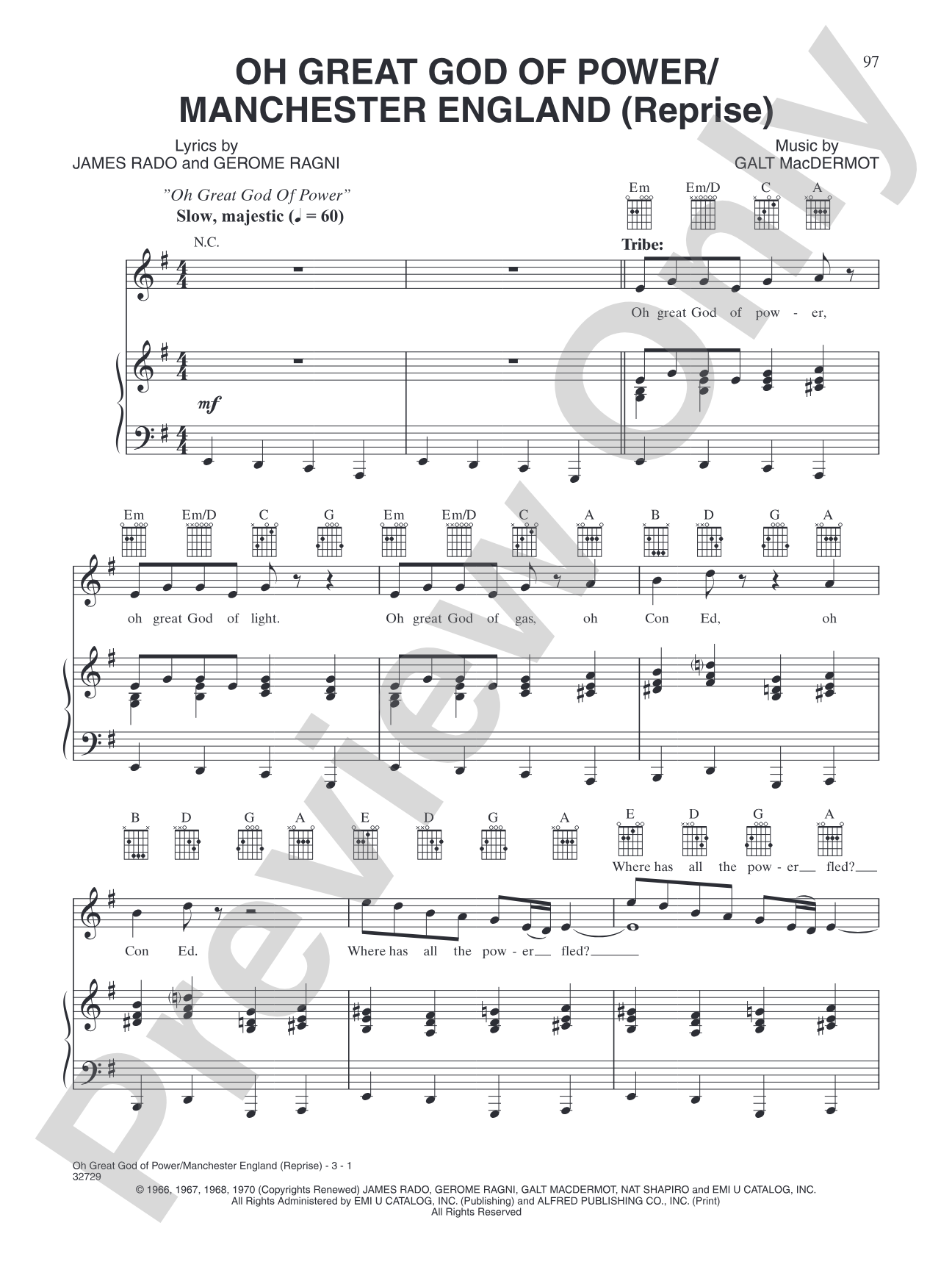

Oh Great God of Power / Manchester England (Reprise) (from "Hair"): Piano/Vocal/Chords
Music by Galt MacDermot, words by James Rado and Gerome Ragni
Item: 00-PS-0011232
$4.99
One moment…
Related Items
Hair: Piano/Vocal/Chords |
$5.99
|
View | |
Walking In Space: Piano/Vocal/Chords |
$5.99
|
View | |
Manchester England: Piano/Vocal/Chords |
$4.99
|
View | |
White Boys: Piano/Vocal/Chords |
$5.99
|
View | |
Donna: Piano/Vocal/Chords |
$5.99
|
View | |
Easy to Be Hard (from "Hair"): Piano/Vocal/Chords |
$4.99
|
View | |
Four Score / Abie Baby (from "Hair"): Piano/Vocal/Chords |
$4.99
|
View | |
Hashish (from "Hair"): Piano/Vocal/Chords |
$4.99
|
View | |
Air (from "Hair"): Piano/Vocal/Chords |
$4.99
|
View | |
What a Piece of Work Is Man / How Dare They Try (from "Hair"): Piano/Vocal/Chords |
$4.99
|
View | |
I Got Life (from "Hair"): Piano/Vocal/Chords |
$5.99
|
View | |
Electric Blues (from "Hair"): Piano/Vocal/Chords |
$5.99
|
View | |
I'm Black / Ain't Got No (from "Hair"): Piano/Vocal/Chords |
$4.99
|
View | |
Black Boys (from "Hair"): Piano/Vocal/Chords |
$4.99
|
View | |
Where Do I Go? (from "Hair"): Piano/Vocal/Chords |
$4.99
|
View | |
Three-Five-Zero-Zero (from "Hair"): Piano/Vocal/Chords |
$4.99
|
View | |
Good Morning Starshine (from "Hair"): Piano/Vocal/Chords |
$4.99
|
View | |
Frank Mills (from "Hair"): Piano/Vocal/Chords |
$4.99
|
View | |
Hare Krishna / Be In (from "Hair"): Piano/Vocal/Chords |
$5.99
|
View | |
Sodomy (from "Hair"): Piano/Vocal/Chords |
$4.99
|
View | |
Colored Spade (from "Hair"): Piano/Vocal/Chords |
$4.99
|
View | |
Sheila Franklin / I Believe in Love (from "Hair"): Piano/Vocal/Chords |
$4.99
|
View | |
Initials (from "Hair"): Piano/Vocal/Chords |
$4.99
|
View | |
Going Down (from "Hair"): Piano/Vocal/Chords |
$5.99
|
View | |
My Conviction (from "Hair"): Piano/Vocal/Chords |
$4.99
|
View | |
Yes, I's Finished on Y'all's Farmlands (from "Hair"): Piano/Vocal/Chords |
$4.99
|
View | |
Flesh Failures / Eyes Look Your Last / Let the Sun Shine In (from "Hair"): Piano/Vocal/Chords |
$5.99
|
View | |
Give Up All Desires (from "Hair"): Piano/Vocal/Chords |
$4.99
|
View | |
Hair: Vocal Selections (Broadway Edition): Piano/Vocal/Chords Book |
$19.95
|
View |
Description
The musical Hair was a cultural phenomenon in the epoch-changing era of the 1960s. Broadway has never been the same. This songbook includes highlights from the smash hit revival of the show, which has attracted raves from audiences and critics alike. Relive the new dawning of the Age of Aquarius and let the sun shine in! Titles: Air * Aquarius * Black Boys * Colored Spade * Donna * Easy to Be Hard * Flesh Failures, The / Let the Sun Shine In * Frank Mills * Give Up All Desires * Going Down * Good Morning Starshine * Hair * Hare Krishna (Be In) * Hashish * I Believe in Love * I Got Life * I'm Black / Ain't Got No * Initials * Manchester England * My Conviction * Old Fashioned Melody / Electric Blues * Sodomy * Three-Five-Zero-Zero * Walking in Space * What a Piece of Work Is Man * Where Do I Go? * White Boys * Yes, I's Finished on Y'alls Farmlands / Abie Baby.


Discover MakeMusic Cloud: thousands of interactive titles your students can play along with today.
Sample Audio
No sample audio found.
Sample Video
No sample videos found.
Additional Details
Publisher:
Alfred Music
Page Count:
150
SKU:
00-PS-0011232
More about this title
About the Composer: Galt MacDermot
Galt MacDermot (1928-2000) was a Canadian composer and pianist who fundamentally changed musical theater with Hair, the first rock musical on Broadway. His score broke from decades of conventional show music by embracing contemporary sounds, unconventional song structures, and the spirit of the era it depicted. MacDermot's willingness to let rock music, jazz, and experimental instrumentation coexist with theatrical storytelling opened doors for countless composers who followed.
Beyond Hair, MacDermot composed for numerous Broadway productions and worked extensively in film and television, but his legacy rests primarily on his revolutionary approach to blending popular music idioms with theatrical narrative. For music educators, his work demonstrates how composers can honor both the demands of musical theater craft and the authentic voice of their cultural moment.
Why we love this
This collection captures a pivotal moment in musical theater history when rock music and social consciousness transformed what Broadway could be. The songs themselves are remarkably singable and accessible to student musicians while maintaining genuine artistic substance. Programming Hair allows your ensemble to explore contemporary harmonies, mixed meters, and rhythmic vitality that standard show fare rarely demands.
What to expect
These songs radiate urgency, hope, and defiance. The melodies sit comfortably in the voice while the harmonies and rhythms pulse with kinetic energy. Whether playful and irreverent or emotionally raw, the music of Hair never feels precious or restrained; it meets you where you are and invites you into a cultural conversation that still resonates.
Who it's for
Singers preparing audition material, actors building their contemporary musical theater repertoire, and pianists developing fluency with rock and pop harmonic language. High school and college programs looking to mount Hair or simply incorporate its songs into concerts will find this collection essential.
How to get the most out of it
- Lock the groove with the band by staying rhythmically grounded; these songs breathe with a pop-rock sensibility, so resist the instinct to impose theatrical phrasing over steady time.
- Pay attention to the chord symbols and consider the instrumentation suggestions in the piano voicings; they're blueprints for how the song can shift between intimate and full-ensemble moments.
- Balance the vocal melody against rich harmonic movement in the accompaniment; the piano part often carries as much musical information as the sung line.
How to use it
Weave Hair into a concert exploring the evolution of musical theater, pairing it with traditional Broadway standards to highlight how dramatically the form changed in the 1960s. Individual songs work beautifully as recital selections or audition pieces, especially for singers interested in contemporary musical theater. An entire Hair concert, whether concert presentation or full staging, remains a powerful statement about artistic ambition and social relevance.
Skills your students will build
- Reading and performing rock and pop harmonic idioms (seventh chords, suspended harmonies, modal inflection)
- Maintaining steady rhythmic pulse against syncopated and asymmetrical melodic lines
- Interpreting chord symbols and realizing piano accompaniment textures independently
- Singing through unconventional phrase structures and song forms
- Connecting vocal performance to ensemble and band instrumentation through the piano-vocal score