
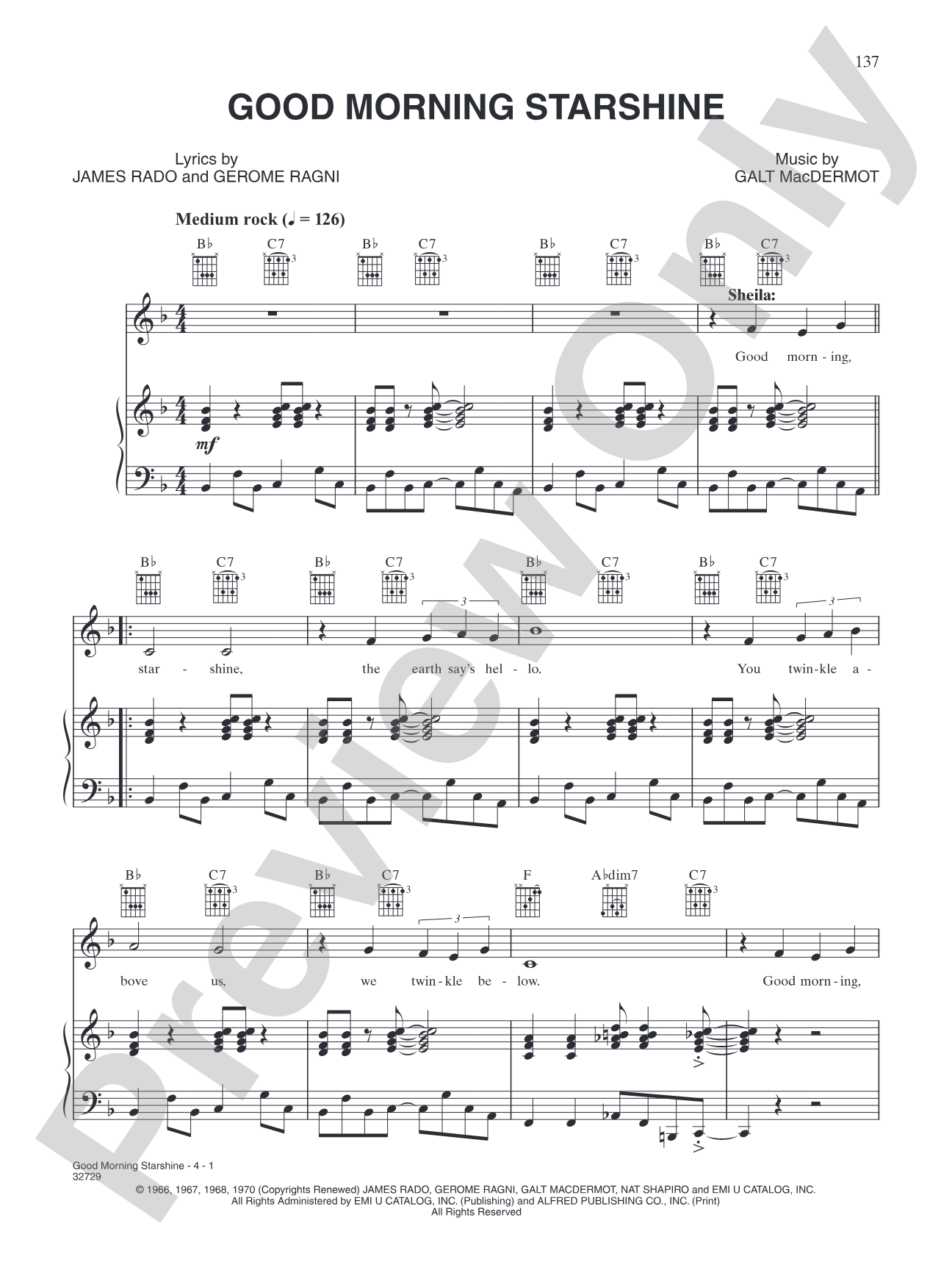

Good Morning Starshine (from "Hair"): Piano/Vocal/Chords
Music by Galt MacDermot, words by James Rado and Gerome Ragni
Item: 00-PS-0011118
$4.99
One moment…
Related Items
Hair: Piano/Vocal/Chords |
$5.99
|
View | |
Walking In Space: Piano/Vocal/Chords |
$5.99
|
View | |
Manchester England: Piano/Vocal/Chords |
$4.99
|
View | |
White Boys: Piano/Vocal/Chords |
$5.99
|
View | |
Donna: Piano/Vocal/Chords |
$5.99
|
View | |
Easy to Be Hard (from "Hair"): Piano/Vocal/Chords |
$4.99
|
View | |
Four Score / Abie Baby (from "Hair"): Piano/Vocal/Chords |
$4.99
|
View | |
Hashish (from "Hair"): Piano/Vocal/Chords |
$4.99
|
View | |
Air (from "Hair"): Piano/Vocal/Chords |
$4.99
|
View | |
What a Piece of Work Is Man / How Dare They Try (from "Hair"): Piano/Vocal/Chords |
$4.99
|
View | |
I Got Life (from "Hair"): Piano/Vocal/Chords |
$5.99
|
View | |
Electric Blues (from "Hair"): Piano/Vocal/Chords |
$5.99
|
View | |
I'm Black / Ain't Got No (from "Hair"): Piano/Vocal/Chords |
$4.99
|
View | |
Black Boys (from "Hair"): Piano/Vocal/Chords |
$4.99
|
View | |
Where Do I Go? (from "Hair"): Piano/Vocal/Chords |
$4.99
|
View | |
Three-Five-Zero-Zero (from "Hair"): Piano/Vocal/Chords |
$4.99
|
View | |
Frank Mills (from "Hair"): Piano/Vocal/Chords |
$4.99
|
View | |
Hare Krishna / Be In (from "Hair"): Piano/Vocal/Chords |
$5.99
|
View | |
Sodomy (from "Hair"): Piano/Vocal/Chords |
$4.99
|
View | |
Colored Spade (from "Hair"): Piano/Vocal/Chords |
$4.99
|
View | |
Sheila Franklin / I Believe in Love (from "Hair"): Piano/Vocal/Chords |
$4.99
|
View | |
Initials (from "Hair"): Piano/Vocal/Chords |
$4.99
|
View | |
Going Down (from "Hair"): Piano/Vocal/Chords |
$5.99
|
View | |
My Conviction (from "Hair"): Piano/Vocal/Chords |
$4.99
|
View | |
Oh Great God of Power / Manchester England (Reprise) (from "Hair"): Piano/Vocal/Chords |
$4.99
|
View | |
Yes, I's Finished on Y'all's Farmlands (from "Hair"): Piano/Vocal/Chords |
$4.99
|
View | |
Flesh Failures / Eyes Look Your Last / Let the Sun Shine In (from "Hair"): Piano/Vocal/Chords |
$5.99
|
View | |
Give Up All Desires (from "Hair"): Piano/Vocal/Chords |
$4.99
|
View | |
Hair: Vocal Selections (Broadway Edition): Piano/Vocal/Chords Book |
$19.95
|
View |
Description
The musical Hair was a cultural phenomenon in the epoch-changing era of the 1960s. Broadway has never been the same. This songbook includes highlights from the smash hit revival of the show, which has attracted raves from audiences and critics alike. Relive the new dawning of the Age of Aquarius and let the sun shine in! Titles: Air * Aquarius * Black Boys * Colored Spade * Donna * Easy to Be Hard * Flesh Failures, The / Let the Sun Shine In * Frank Mills * Give Up All Desires * Going Down * Good Morning Starshine * Hair * Hare Krishna (Be In) * Hashish * I Believe in Love * I Got Life * I'm Black / Ain't Got No * Initials * Manchester England * My Conviction * Old Fashioned Melody / Electric Blues * Sodomy * Three-Five-Zero-Zero * Walking in Space * What a Piece of Work Is Man * Where Do I Go? * White Boys * Yes, I's Finished on Y'alls Farmlands / Abie Baby.


Good Morning Starshine (from "Hair"): Piano/Vocal/Chords isn't in MakeMusic Cloud just yet...but it could be. Let us know you'd like to see it, and you'll help shape what comes next. In the meantime, start a free trial and dive into thousands of interactive titles your students can play along with today.
Request This Title
Tell us you want it.
Start Your Free Trial
Explore everything that's ready to play right now.
Sample Audio
No sample audio found.
Sample Video
No sample videos found.
Additional Details
Publisher:
Alfred Music
Page Count:
150
SKU:
00-PS-0011118
More about this title
About the Composer: Galt MacDermot
Galt MacDermot composed the groundbreaking score for Hair in 1967, creating a fusion of rock, soul, and theatrical music that revolutionized Broadway sound design. His work on Hair earned him a Tony Award and established him as a composer who could bridge the gap between popular music and musical theater, influencing generations of songwriters who followed.
Why we love this
Hair remains one of the most singable and instantly recognizable scores in musical theater repertoire. These songs work beautifully in recital settings or mixed programs because they're accessible to singers at multiple levels while retaining genuine theatrical substance. The harmonies are sophisticated enough to keep pianists engaged without becoming overly complicated.
What to expect
These songs capture a moment of cultural awakening and youthful optimism. Whether you're singing 'Aquarius' with its soaring melody or 'Good Morning Starshine' with its playful charm, the music radiates hope and unbounded energy that feels as vital today as it did in 1968.
Who it's for
Singers performing in recitals, cabaret settings, or choral pops concerts will find accessible material that audiences adore. Pianists accompanying solo vocalists or leading community theater productions benefit from the clear chord notation and straightforward but expressive voicings.
How to get the most out of it
- Lean into the rock sensibility of these arrangements rather than treating them as traditional Broadway ballads. The groove matters as much as perfect diction.
- Use the chord symbols liberally for reharmonization and improvisation, especially in ensemble numbers. MacDermot's harmonies invite creative interpretation.
- Balance the vocal line against the accompaniment carefully in slower songs like 'Frank Mills' so the intimacy of the lyric lands without getting lost under the chords.
- Capture the era's spirit through stylistic choices in rhythm and phrasing. These songs sound best when they breathe with the energy of the 1960s counterculture.
How to use it
Include these songs in a concert celebrating rock-influenced musical theater alongside contemporary pop standards. A full Hair program works wonderfully for cabaret nights or pops concerts. Single songs integrate easily into recitals focused on 20th-century American music or thematic programs about social change.
Skills your students will build
- Singing with rhythmic flexibility and groove-based phrasing
- Reading and interpreting chord symbols for accompaniment
- Balancing legit singing technique with contemporary vocal style
- Understanding modal harmony and non-traditional song structures
- Connecting lyrics to historical and cultural context