
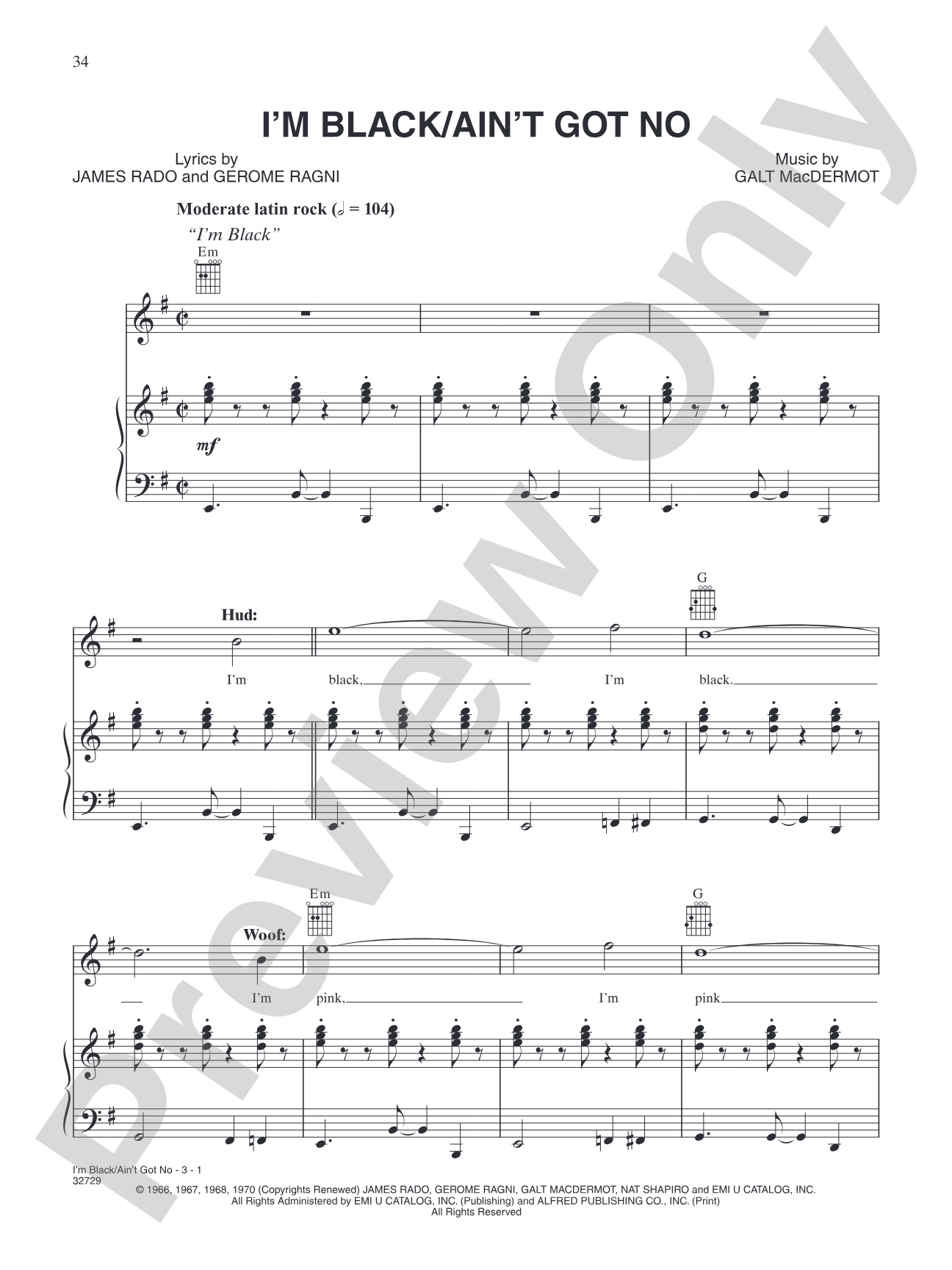

I'm Black / Ain't Got No (from "Hair"): Piano/Vocal/Chords
Music by Galt MacDermot, words by James Rado and Gerome Ragni
Item: 00-PS-0011114
$4.99
One moment…
Related Items
Hair: Piano/Vocal/Chords |
$5.99
|
View | |
Walking In Space: Piano/Vocal/Chords |
$5.99
|
View | |
Manchester England: Piano/Vocal/Chords |
$4.99
|
View | |
White Boys: Piano/Vocal/Chords |
$5.99
|
View | |
Donna: Piano/Vocal/Chords |
$5.99
|
View | |
Easy to Be Hard (from "Hair"): Piano/Vocal/Chords |
$4.99
|
View | |
Four Score / Abie Baby (from "Hair"): Piano/Vocal/Chords |
$4.99
|
View | |
Hashish (from "Hair"): Piano/Vocal/Chords |
$4.99
|
View | |
Air (from "Hair"): Piano/Vocal/Chords |
$4.99
|
View | |
What a Piece of Work Is Man / How Dare They Try (from "Hair"): Piano/Vocal/Chords |
$4.99
|
View | |
I Got Life (from "Hair"): Piano/Vocal/Chords |
$5.99
|
View | |
Electric Blues (from "Hair"): Piano/Vocal/Chords |
$5.99
|
View | |
Black Boys (from "Hair"): Piano/Vocal/Chords |
$4.99
|
View | |
Where Do I Go? (from "Hair"): Piano/Vocal/Chords |
$4.99
|
View | |
Three-Five-Zero-Zero (from "Hair"): Piano/Vocal/Chords |
$4.99
|
View | |
Good Morning Starshine (from "Hair"): Piano/Vocal/Chords |
$4.99
|
View | |
Frank Mills (from "Hair"): Piano/Vocal/Chords |
$4.99
|
View | |
Hare Krishna / Be In (from "Hair"): Piano/Vocal/Chords |
$5.99
|
View | |
Sodomy (from "Hair"): Piano/Vocal/Chords |
$4.99
|
View | |
Colored Spade (from "Hair"): Piano/Vocal/Chords |
$4.99
|
View | |
Sheila Franklin / I Believe in Love (from "Hair"): Piano/Vocal/Chords |
$4.99
|
View | |
Initials (from "Hair"): Piano/Vocal/Chords |
$4.99
|
View | |
Going Down (from "Hair"): Piano/Vocal/Chords |
$5.99
|
View | |
My Conviction (from "Hair"): Piano/Vocal/Chords |
$4.99
|
View | |
Oh Great God of Power / Manchester England (Reprise) (from "Hair"): Piano/Vocal/Chords |
$4.99
|
View | |
Yes, I's Finished on Y'all's Farmlands (from "Hair"): Piano/Vocal/Chords |
$4.99
|
View | |
Flesh Failures / Eyes Look Your Last / Let the Sun Shine In (from "Hair"): Piano/Vocal/Chords |
$5.99
|
View | |
Give Up All Desires (from "Hair"): Piano/Vocal/Chords |
$4.99
|
View | |
Hair: Vocal Selections (Broadway Edition): Piano/Vocal/Chords Book |
$19.95
|
View |
Description
The musical Hair was a cultural phenomenon in the epoch-changing era of the 1960s. Broadway has never been the same. This songbook includes highlights from the smash hit revival of the show, which has attracted raves from audiences and critics alike. Relive the new dawning of the Age of Aquarius and let the sun shine in! Titles: Air * Aquarius * Black Boys * Colored Spade * Donna * Easy to Be Hard * Flesh Failures, The / Let the Sun Shine In * Frank Mills * Give Up All Desires * Going Down * Good Morning Starshine * Hair * Hare Krishna (Be In) * Hashish * I Believe in Love * I Got Life * I'm Black / Ain't Got No * Initials * Manchester England * My Conviction * Old Fashioned Melody / Electric Blues * Sodomy * Three-Five-Zero-Zero * Walking in Space * What a Piece of Work Is Man * Where Do I Go? * White Boys * Yes, I's Finished on Y'alls Farmlands / Abie Baby.


I'm Black / Ain't Got No (from "Hair"): Piano/Vocal/Chords isn't in MakeMusic Cloud just yet...but it could be. Let us know you'd like to see it, and you'll help shape what comes next. In the meantime, start a free trial and dive into thousands of interactive titles your students can play along with today.
Request This Title
Tell us you want it.
Start Your Free Trial
Explore everything that's ready to play right now.
Sample Audio
No sample audio found.
Sample Video
No sample videos found.
Additional Details
Publisher:
Alfred Music
Page Count:
150
SKU:
00-PS-0011114
More about this title
About the Composer: Galt MacDermot
Galt MacDermot composed the score for Hair, one of the most influential musicals ever written. His work helped define the sound of 1960s counterculture and remains a cornerstone of contemporary musical theatre education and performance.
MacDermot's harmonic language blends rock, soul, and pop idioms with theatrical sophistication, creating music that speaks directly to singers and audiences across generations. His melodies are singable yet distinctive, and his arrangements reward both simple solo performance and full ensemble treatment.
Why we love this
This collection captures the revolutionary energy of Hair in a form that actually works in the rehearsal room and on stage. The piano/vocal/chords format gives singers the melodic clarity they need while the chord symbols provide flexibility for accompanists to adapt arrangements to their ensemble's needs. Whether you're building a cabaret show, programming an American musical theatre concert, or introducing students to the social and musical urgency of 1960s Broadway, these songs deliver impact without requiring a full pit orchestra.
What to expect
These songs pulse with the optimism and urgency of a generation asking hard questions about identity, belonging, and freedom. The vocal lines soar with conviction; the harmonies shift between brightness and introspection. There's intimacy in songs like "Frank Mills" and defiance in "I'm Black," giving singers emotional material that cuts across time.
Who it's for
This collection serves singers and pianist collaborators preparing Hair for auditions, recitals, or cabaret programming. Music directors building a modern American musical theatre curriculum will find essential repertoire here. Piano teachers working with intermediate to advanced students can build sight-reading and ensemble skills through these arrangements.
How to get the most out of it
- Let the vocal melody breathe naturally; MacDermot's lines often sit high and need space to land. Avoid over-accompanying the singer with busy piano parts in verses.
- Pay close attention to the harmonic shifts, particularly in songs that move between major and minor tonalities. These changes carry emotional weight and shouldn't be smoothed over.
- Treat the rhythm section feel as essential rather than optional. Many of these songs have a specific groove (whether rock-influenced or soul-based) that transforms the character of the piece. The pianist can establish this with rhythmic precision rather than chord-by-chord playing.
- Use the lead sheet voicings as a starting point, not a ceiling. The chords invite reharmonization and contemporary coloring while the melody remains steady.
How to use it
A single song from this collection can anchor a contemporary musical theatre or American popular song recital. Several songs work beautifully in sequence for a thematic program exploring identity and social awareness in 1960s culture. Directors can also program Hair selections alongside other contemporary or classic Broadway material to create concert programs that span theatrical eras.
Skills your students will build
- Reading lead sheets and understanding chord symbol notation
- Vocal independence and phrasing in a rock-influenced harmonic language
- Accompanying singers with rhythmic accuracy and stylistic sensitivity
- Interpreting theatrical intention from a score
- Negotiating non-traditional harmonic progressions typical of 1960s popular music