
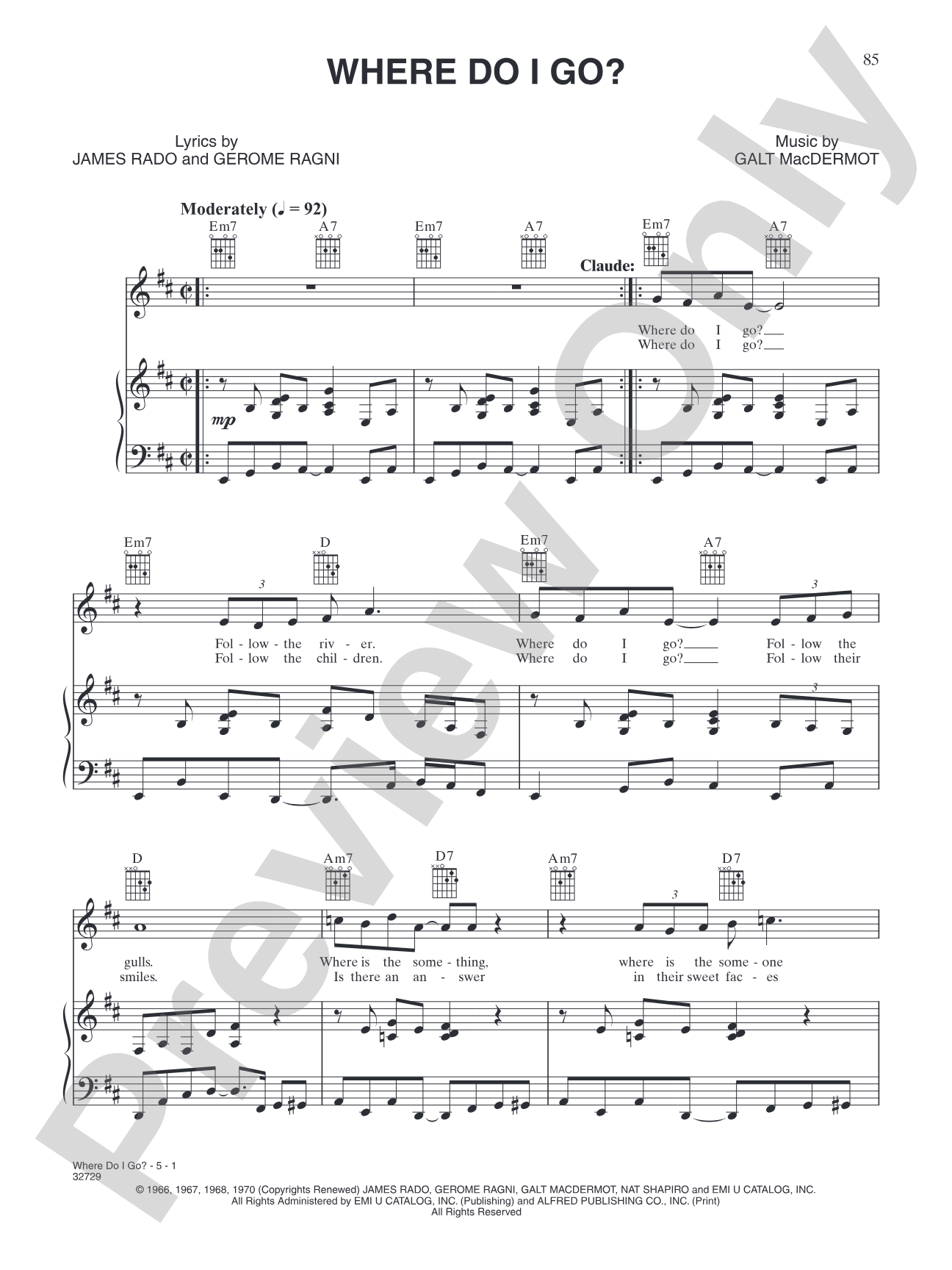

Where Do I Go? (from "Hair"): Piano/Vocal/Chords
Music by Galt MacDermot, words by James Rado and Gerome Ragni
Item: 00-PS-0011116
$4.99
One moment…
Related Items
Hair: Piano/Vocal/Chords |
$5.99
|
View | |
Walking In Space: Piano/Vocal/Chords |
$5.99
|
View | |
Manchester England: Piano/Vocal/Chords |
$4.99
|
View | |
White Boys: Piano/Vocal/Chords |
$5.99
|
View | |
Donna: Piano/Vocal/Chords |
$5.99
|
View | |
Easy to Be Hard (from "Hair"): Piano/Vocal/Chords |
$4.99
|
View | |
Four Score / Abie Baby (from "Hair"): Piano/Vocal/Chords |
$4.99
|
View | |
Hashish (from "Hair"): Piano/Vocal/Chords |
$4.99
|
View | |
Air (from "Hair"): Piano/Vocal/Chords |
$4.99
|
View | |
What a Piece of Work Is Man / How Dare They Try (from "Hair"): Piano/Vocal/Chords |
$4.99
|
View | |
I Got Life (from "Hair"): Piano/Vocal/Chords |
$5.99
|
View | |
Electric Blues (from "Hair"): Piano/Vocal/Chords |
$5.99
|
View | |
I'm Black / Ain't Got No (from "Hair"): Piano/Vocal/Chords |
$4.99
|
View | |
Black Boys (from "Hair"): Piano/Vocal/Chords |
$4.99
|
View | |
Three-Five-Zero-Zero (from "Hair"): Piano/Vocal/Chords |
$4.99
|
View | |
Good Morning Starshine (from "Hair"): Piano/Vocal/Chords |
$4.99
|
View | |
Frank Mills (from "Hair"): Piano/Vocal/Chords |
$4.99
|
View | |
Hare Krishna / Be In (from "Hair"): Piano/Vocal/Chords |
$5.99
|
View | |
Sodomy (from "Hair"): Piano/Vocal/Chords |
$4.99
|
View | |
Colored Spade (from "Hair"): Piano/Vocal/Chords |
$4.99
|
View | |
Sheila Franklin / I Believe in Love (from "Hair"): Piano/Vocal/Chords |
$4.99
|
View | |
Initials (from "Hair"): Piano/Vocal/Chords |
$4.99
|
View | |
Going Down (from "Hair"): Piano/Vocal/Chords |
$5.99
|
View | |
My Conviction (from "Hair"): Piano/Vocal/Chords |
$4.99
|
View | |
Oh Great God of Power / Manchester England (Reprise) (from "Hair"): Piano/Vocal/Chords |
$4.99
|
View | |
Yes, I's Finished on Y'all's Farmlands (from "Hair"): Piano/Vocal/Chords |
$4.99
|
View | |
Flesh Failures / Eyes Look Your Last / Let the Sun Shine In (from "Hair"): Piano/Vocal/Chords |
$5.99
|
View | |
Give Up All Desires (from "Hair"): Piano/Vocal/Chords |
$4.99
|
View | |
Hair: Vocal Selections (Broadway Edition): Piano/Vocal/Chords Book |
$19.95
|
View |
Description
The musical Hair was a cultural phenomenon in the epoch-changing era of the 1960s. Broadway has never been the same. This songbook includes highlights from the smash hit revival of the show, which has attracted raves from audiences and critics alike. Relive the new dawning of the Age of Aquarius and let the sun shine in! Titles: Air * Aquarius * Black Boys * Colored Spade * Donna * Easy to Be Hard * Flesh Failures, The / Let the Sun Shine In * Frank Mills * Give Up All Desires * Going Down * Good Morning Starshine * Hair * Hare Krishna (Be In) * Hashish * I Believe in Love * I Got Life * I'm Black / Ain't Got No * Initials * Manchester England * My Conviction * Old Fashioned Melody / Electric Blues * Sodomy * Three-Five-Zero-Zero * Walking in Space * What a Piece of Work Is Man * Where Do I Go? * White Boys * Yes, I's Finished on Y'alls Farmlands / Abie Baby.


Where Do I Go? (from "Hair"): Piano/Vocal/Chords isn't in MakeMusic Cloud just yet...but it could be. Let us know you'd like to see it, and you'll help shape what comes next. In the meantime, start a free trial and dive into thousands of interactive titles your students can play along with today.
Request This Title
Tell us you want it.
Start Your Free Trial
Explore everything that's ready to play right now.
Sample Audio
No sample audio found.
Sample Video
No sample videos found.
Additional Details
Publisher:
Alfred Music
Page Count:
150
SKU:
00-PS-0011116
More about this title
About the Composer: Galt MacDermot
Galt MacDermot (1928-2018) was a Canadian composer and pianist whose work bridged classical training and popular music theater. He composed the score for Hair, which debuted off-Broadway in 1967 and became one of the most influential musicals of the twentieth century. MacDermot's ability to blend rock, pop, and theatrical idioms created a soundscape that captured the spirit of the era while remaining musically sophisticated and durable.
Why we love this
Hair remains a goldmine for music programs seeking repertoire that engages singers and pianists while reflecting genuine cultural and historical significance. The vocal lines sit naturally for contemporary singers, and the harmonic language rewards both classical pianists and those comfortable with popular chord symbols. Programming these songs signals that you understand your students' world without sacrificing musical integrity.
What to expect
These songs capture the optimism, idealism, and musical adventurousness of the late 1960s, balancing rock-inflected melodies with genuine emotional depth. Whether singing about freedom, identity, or simple human connection, each piece carries the infectious energy and earnestness that made Hair revolutionary.
Who it's for
Vocalists preparing songs for auditions, recitals, or classroom performance, as well as pianists accompanying singers or performing solo arrangements. This collection appeals to students exploring musical theater repertoire and teachers introducing the cultural and musical legacy of Hair.
How to get the most out of it
- Balance the vocal line with the piano accompaniment so lyrics remain clear; the songs were written for amplified voices on stage, but in recital or classroom settings, let the words drive the performance.
- Experiment with the groove and rhythmic feel, particularly in uptempo numbers. These pieces sit between pop and theater, so slight rhythmic flexibility often sounds more authentic than metronomic precision.
- Use the chord symbols to add voicing variations and improvisation, especially in the accompaniment. MacDermot's harmonies support both straight interpretations and creative reharmonization.
How to use it
Incorporate individual songs into a musical theater unit or a concert celebrating American songwriting across genres. These pieces work equally well as standalone recital selections or as part of a thematic program exploring music and social change.
Skills your students will build
- singing with rhythmic clarity in syncopated and rock-influenced contexts
- accompanying vocalists using chord symbols and jazz-inflected voicings
- balancing contemporary and classical vocal technique in a single piece
- interpreting musical idiom and style across pop, rock, and theater genres