
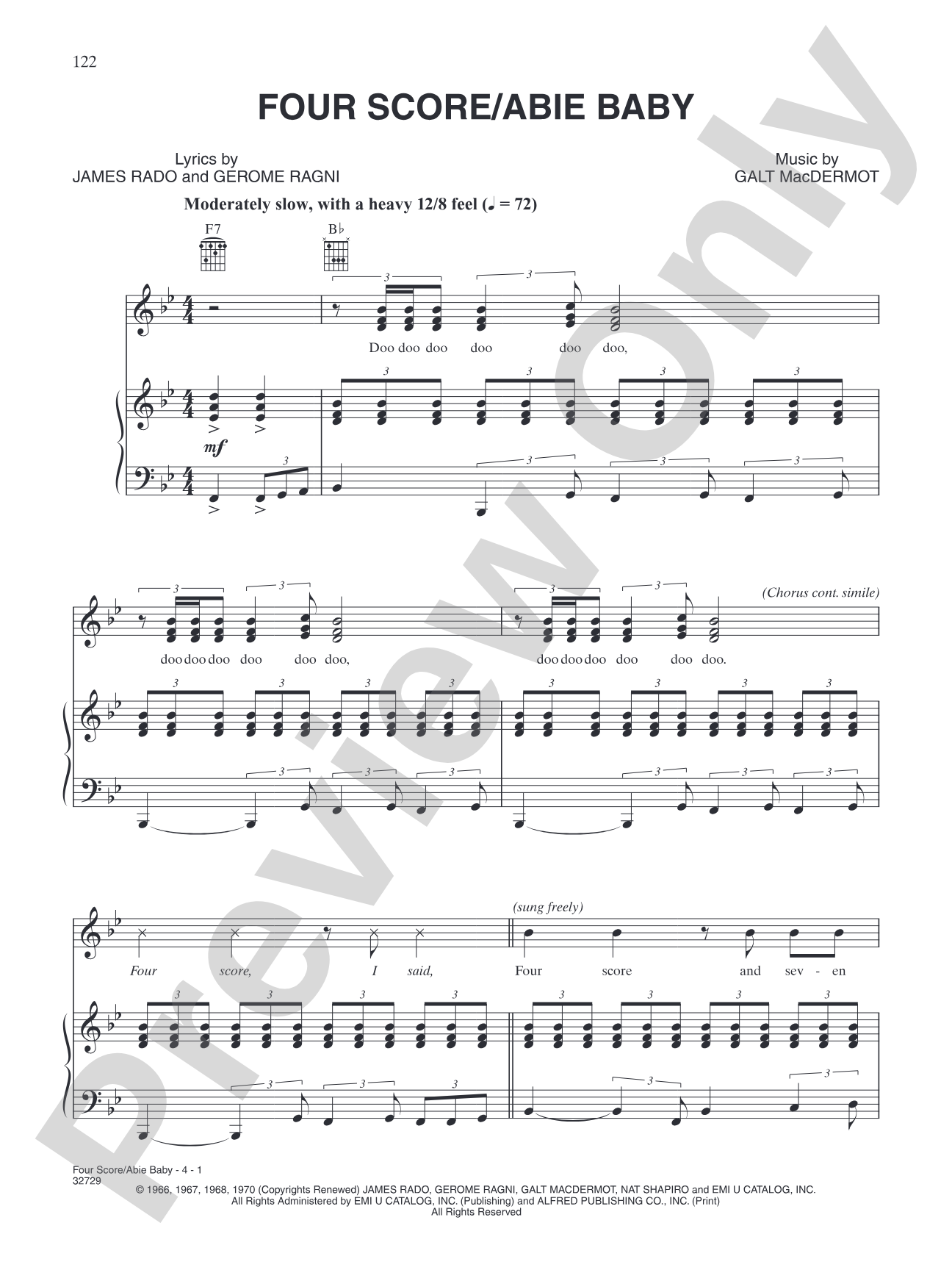

Four Score / Abie Baby (from "Hair"): Piano/Vocal/Chords
Music by Galt MacDermot, words by James Rado and Gerome Ragni
Item: 00-PS-0011108
$4.99
One moment…
Related Items
Hair: Piano/Vocal/Chords |
$5.99
|
View | |
Walking In Space: Piano/Vocal/Chords |
$5.99
|
View | |
Manchester England: Piano/Vocal/Chords |
$4.99
|
View | |
White Boys: Piano/Vocal/Chords |
$5.99
|
View | |
Donna: Piano/Vocal/Chords |
$5.99
|
View | |
Easy to Be Hard (from "Hair"): Piano/Vocal/Chords |
$4.99
|
View | |
Hashish (from "Hair"): Piano/Vocal/Chords |
$4.99
|
View | |
Air (from "Hair"): Piano/Vocal/Chords |
$4.99
|
View | |
What a Piece of Work Is Man / How Dare They Try (from "Hair"): Piano/Vocal/Chords |
$4.99
|
View | |
I Got Life (from "Hair"): Piano/Vocal/Chords |
$5.99
|
View | |
Electric Blues (from "Hair"): Piano/Vocal/Chords |
$5.99
|
View | |
I'm Black / Ain't Got No (from "Hair"): Piano/Vocal/Chords |
$4.99
|
View | |
Black Boys (from "Hair"): Piano/Vocal/Chords |
$4.99
|
View | |
Where Do I Go? (from "Hair"): Piano/Vocal/Chords |
$4.99
|
View | |
Three-Five-Zero-Zero (from "Hair"): Piano/Vocal/Chords |
$4.99
|
View | |
Good Morning Starshine (from "Hair"): Piano/Vocal/Chords |
$4.99
|
View | |
Frank Mills (from "Hair"): Piano/Vocal/Chords |
$4.99
|
View | |
Hare Krishna / Be In (from "Hair"): Piano/Vocal/Chords |
$5.99
|
View | |
Sodomy (from "Hair"): Piano/Vocal/Chords |
$4.99
|
View | |
Colored Spade (from "Hair"): Piano/Vocal/Chords |
$4.99
|
View | |
Sheila Franklin / I Believe in Love (from "Hair"): Piano/Vocal/Chords |
$4.99
|
View | |
Initials (from "Hair"): Piano/Vocal/Chords |
$4.99
|
View | |
Going Down (from "Hair"): Piano/Vocal/Chords |
$5.99
|
View | |
My Conviction (from "Hair"): Piano/Vocal/Chords |
$4.99
|
View | |
Oh Great God of Power / Manchester England (Reprise) (from "Hair"): Piano/Vocal/Chords |
$4.99
|
View | |
Yes, I's Finished on Y'all's Farmlands (from "Hair"): Piano/Vocal/Chords |
$4.99
|
View | |
Flesh Failures / Eyes Look Your Last / Let the Sun Shine In (from "Hair"): Piano/Vocal/Chords |
$5.99
|
View | |
Give Up All Desires (from "Hair"): Piano/Vocal/Chords |
$4.99
|
View | |
Hair: Vocal Selections (Broadway Edition): Piano/Vocal/Chords Book |
$19.95
|
View |
Description
The musical Hair was a cultural phenomenon in the epoch-changing era of the 1960s. Broadway has never been the same. This songbook includes highlights from the smash hit revival of the show, which has attracted raves from audiences and critics alike. Relive the new dawning of the Age of Aquarius and let the sun shine in! Titles: Air * Aquarius * Black Boys * Colored Spade * Donna * Easy to Be Hard * Flesh Failures, The / Let the Sun Shine In * Frank Mills * Give Up All Desires * Going Down * Good Morning Starshine * Hair * Hare Krishna (Be In) * Hashish * I Believe in Love * I Got Life * I'm Black / Ain't Got No * Initials * Manchester England * My Conviction * Old Fashioned Melody / Electric Blues * Sodomy * Three-Five-Zero-Zero * Walking in Space * What a Piece of Work Is Man * Where Do I Go? * White Boys * Yes, I's Finished on Y'alls Farmlands / Abie Baby.


Four Score / Abie Baby (from "Hair"): Piano/Vocal/Chords isn't in MakeMusic Cloud just yet...but it could be. Let us know you'd like to see it, and you'll help shape what comes next. In the meantime, start a free trial and dive into thousands of interactive titles your students can play along with today.
Request This Title
Tell us you want it.
Start Your Free Trial
Explore everything that's ready to play right now.
Sample Audio
No sample audio found.
Sample Video
No sample videos found.
Additional Details
Publisher:
Alfred Music
Page Count:
150
SKU:
00-PS-0011108
More about this title
About the Composer: Galt MacDermot
Galt MacDermot composed the score for Hair, the groundbreaking 1968 musical that fundamentally reshaped American musical theater. His work transcended the traditional Broadway sound by incorporating rock, soul, and psychedelic influences, creating a score that became as culturally significant as the show itself.
MacDermot's gift lay in crafting memorable melodies that could function equally well as standalone pop songs and as integrated theatrical moments. His compositional approach opened doors for countless songwriters who followed, proving that Broadway could speak in contemporary musical languages without sacrificing emotional depth or harmonic sophistication.
Why we love this
This collection captures one of the most audacious scores in Broadway history, and the piano-vocal-chords format makes every song immediately singable and interpretable. Directors can draw from 30+ numbers, each with distinct character and energy, making it ideal for curated concert programming, revue selections, or full production work. The harmonic language feels fresh even now, offering pianists and singers substantive musical content that rewards careful interpretation.
What to expect
The collection radiates the exuberance and idealism of its moment, from the contemplative introspection of "Frank Mills" to the defiant energy of "I Got Life." You'll move between intimate character moments and sprawling ensemble celebrations, each rooted in MacDermot's instinct for melodic generosity and harmonic color that feels both of its time and timeless.
Who it's for
Singers and pianists working on Hair repertoire for recitals, concert productions, or auditions will find the complete range of song styles here. Music directors programming a Hair tribute, revue, or full production benefit from having all major numbers in one accessible volume. High school and college programs looking to mount contemporary musical theater benefit from the clarity and singability of these transcriptions.
How to get the most out of it
- Treat the rock and soul grooves as foundational to the sound, not ornamental; locking into the rhythmic pocket makes both the vocal lines and accompaniment figures land with intended impact.
- Balance the song's theatrical intention with its pop sensibility; many of these numbers work best when singers commit fully to emotional truth rather than winking at their own accessibility.
- Use the chord symbols actively to inform voicing and reharmonization options; the original accompaniment supports but doesn't constrain what pianists can bring to the harmonic palette.
- Honor the counterpoint in ensemble numbers where it appears; layered vocal lines create texture that can be lost if treated as background material rather than integral composition.
How to use it
Extract numbers for a "Broadway Reimagined" concert that pairs Hair with contemporary musical theater, or build an entire concert around the show's themes of identity, belonging, and social awakening. For full productions, this volume provides the complete reference for all major and supporting numbers. Solo singers and accompanists can draw individual songs for recital programming, particularly the introspective ballads alongside the showpiece vocals.
Skills your students will build
- reading and interpreting rock and soul rhythmic figures in a classical notation context
- voice leading across contemporary harmonic progressions (seventh chords, modal mixture, suspended chords)
- balancing legit and belt vocal techniques within the same song
- accompanying singers through syncopated and off-beat melodic lines
- interpreting slash chords and implied harmonic substitutions from chord symbols
- maintaining character and emotional intention while sight-reading unfamiliar contemporary material