
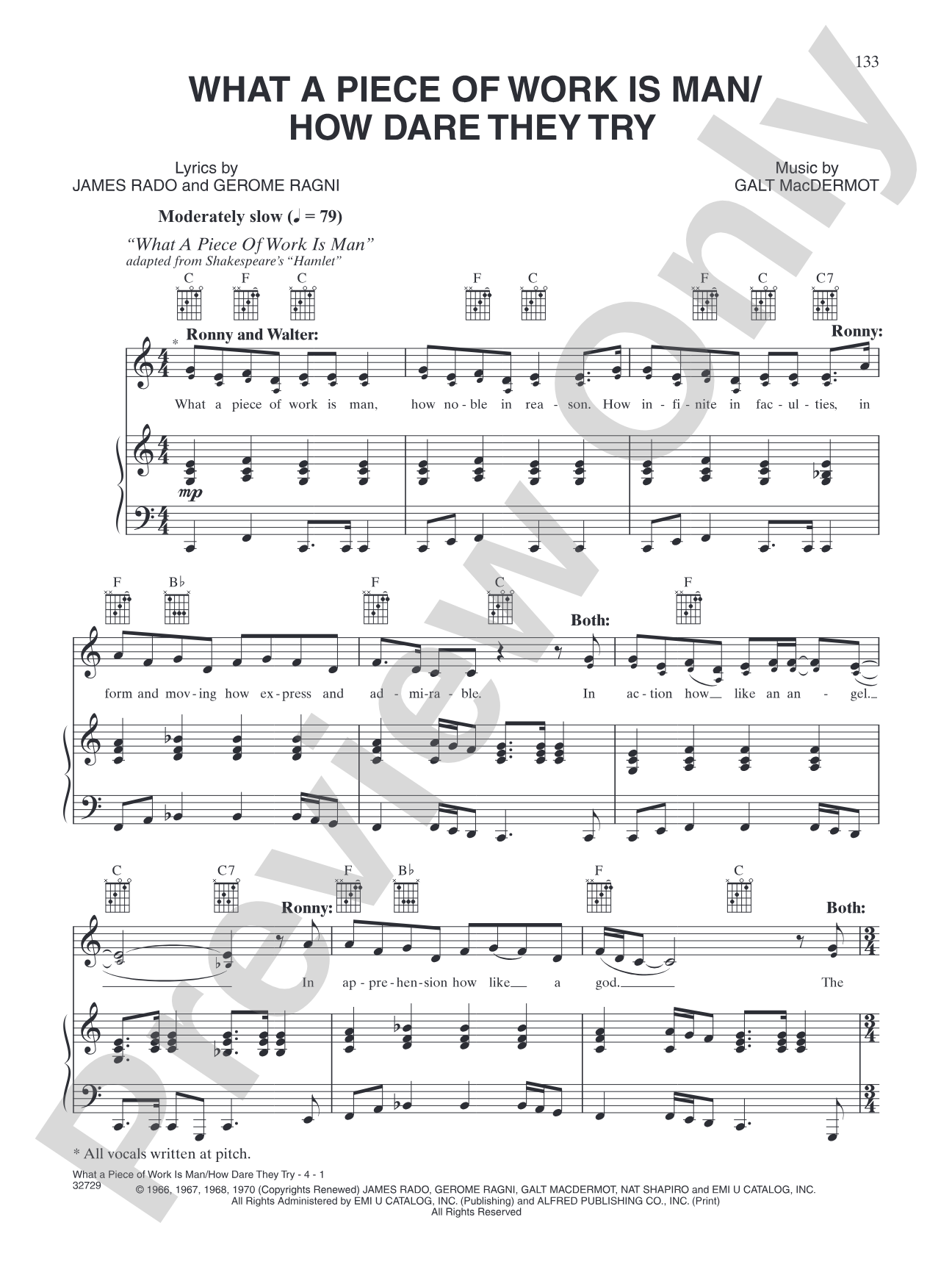

What a Piece of Work Is Man / How Dare They Try (from "Hair"): Piano/Vocal/Chords
Music by Galt MacDermot, words by James Rado and Gerome Ragni
Item: 00-PS-0011111
$4.99
One moment…
Related Items
Hair: Piano/Vocal/Chords |
$5.99
|
View | |
Walking In Space: Piano/Vocal/Chords |
$5.99
|
View | |
Manchester England: Piano/Vocal/Chords |
$4.99
|
View | |
White Boys: Piano/Vocal/Chords |
$5.99
|
View | |
Donna: Piano/Vocal/Chords |
$5.99
|
View | |
Easy to Be Hard (from "Hair"): Piano/Vocal/Chords |
$4.99
|
View | |
Four Score / Abie Baby (from "Hair"): Piano/Vocal/Chords |
$4.99
|
View | |
Hashish (from "Hair"): Piano/Vocal/Chords |
$4.99
|
View | |
Air (from "Hair"): Piano/Vocal/Chords |
$4.99
|
View | |
I Got Life (from "Hair"): Piano/Vocal/Chords |
$5.99
|
View | |
Electric Blues (from "Hair"): Piano/Vocal/Chords |
$5.99
|
View | |
I'm Black / Ain't Got No (from "Hair"): Piano/Vocal/Chords |
$4.99
|
View | |
Black Boys (from "Hair"): Piano/Vocal/Chords |
$4.99
|
View | |
Where Do I Go? (from "Hair"): Piano/Vocal/Chords |
$4.99
|
View | |
Three-Five-Zero-Zero (from "Hair"): Piano/Vocal/Chords |
$4.99
|
View | |
Good Morning Starshine (from "Hair"): Piano/Vocal/Chords |
$4.99
|
View | |
Frank Mills (from "Hair"): Piano/Vocal/Chords |
$4.99
|
View | |
Hare Krishna / Be In (from "Hair"): Piano/Vocal/Chords |
$5.99
|
View | |
Sodomy (from "Hair"): Piano/Vocal/Chords |
$4.99
|
View | |
Colored Spade (from "Hair"): Piano/Vocal/Chords |
$4.99
|
View | |
Sheila Franklin / I Believe in Love (from "Hair"): Piano/Vocal/Chords |
$4.99
|
View | |
Initials (from "Hair"): Piano/Vocal/Chords |
$4.99
|
View | |
Going Down (from "Hair"): Piano/Vocal/Chords |
$5.99
|
View | |
My Conviction (from "Hair"): Piano/Vocal/Chords |
$4.99
|
View | |
Oh Great God of Power / Manchester England (Reprise) (from "Hair"): Piano/Vocal/Chords |
$4.99
|
View | |
Yes, I's Finished on Y'all's Farmlands (from "Hair"): Piano/Vocal/Chords |
$4.99
|
View | |
Flesh Failures / Eyes Look Your Last / Let the Sun Shine In (from "Hair"): Piano/Vocal/Chords |
$5.99
|
View | |
Give Up All Desires (from "Hair"): Piano/Vocal/Chords |
$4.99
|
View | |
Hair: Vocal Selections (Broadway Edition): Piano/Vocal/Chords Book |
$19.95
|
View |
Description
The musical Hair was a cultural phenomenon in the epoch-changing era of the 1960s. Broadway has never been the same. This songbook includes highlights from the smash hit revival of the show, which has attracted raves from audiences and critics alike. Relive the new dawning of the Age of Aquarius and let the sun shine in! Titles: Air * Aquarius * Black Boys * Colored Spade * Donna * Easy to Be Hard * Flesh Failures, The / Let the Sun Shine In * Frank Mills * Give Up All Desires * Going Down * Good Morning Starshine * Hair * Hare Krishna (Be In) * Hashish * I Believe in Love * I Got Life * I'm Black / Ain't Got No * Initials * Manchester England * My Conviction * Old Fashioned Melody / Electric Blues * Sodomy * Three-Five-Zero-Zero * Walking in Space * What a Piece of Work Is Man * Where Do I Go? * White Boys * Yes, I's Finished on Y'alls Farmlands / Abie Baby.


What a Piece of Work Is Man / How Dare They Try (from "Hair"): Piano/Vocal/Chords isn't in MakeMusic Cloud just yet...but it could be. Let us know you'd like to see it, and you'll help shape what comes next. In the meantime, start a free trial and dive into thousands of interactive titles your students can play along with today.
Request This Title
Tell us you want it.
Start Your Free Trial
Explore everything that's ready to play right now.
Sample Audio
No sample audio found.
Sample Video
No sample videos found.
Additional Details
Publisher:
Alfred Music
Page Count:
150
SKU:
00-PS-0011111
More about this title
About the Composer: Galt MacDermot
Galt MacDermot composed the score for Hair, one of Broadway's most transformative musicals. His work on the show demonstrated a gift for blending rock, soul, and pop idioms with theatrical storytelling, creating music that captured the spirit of a generation while remaining deeply singable and dramatically effective.
Why we love this
This collection gives singers and pianists direct access to one of Broadway's most culturally significant scores. MacDermot's melodies are immediately memorable and emotionally direct, making these songs rewarding to perform whether you're tackling the showstopping ensemble numbers or the quieter character moments. The mix of rock sensibility with genuine theatrical craft means there's something here for teaching song interpretation across multiple styles.
What to expect
These songs pulse with the optimism, rebellion, and raw emotion of the era that shaped them. You'll find moments of lyricism and vulnerability alongside explosive ensemble celebration, all grounded in music that feels alive and conversational. The combination of personal reflection and collective joy runs through every track.
Who it's for
This collection serves pianists and singers preparing solo material from Hair, whether for auditions, recitals, or classroom performance. It's equally valuable for music educators introducing students to a landmark score that bridges popular music and musical theater, and for performers seeking contemporary material with genuine substance and cultural weight.
How to get the most out of it
- Balance the rock elements in the accompaniment with clarity in the vocal line. These songs live in a style that's conversational and direct, not operatic, so resist the urge to oversing.
- Pay attention to the rhythmic freedom MacDermot builds into many of these melodies. Songs like "What a Piece of Work Is Man" contain rubato and syncopation that reward careful listening to recorded versions before finalizing your interpretation.
- Handle the ensemble passages and choral moments with a sense of unity and purpose. Many of these songs are built on collective voices, so even when singing a solo version, maintain the communal energy that makes Hair resonate.
- Explore the harmonic language surrounding your part. MacDermot uses jazz and pop chord progressions that can guide your phrasing and help you find the emotional landing points within each phrase.
How to use it
Consider programming a solo or duet from Hair alongside other contemporary musical theater to demonstrate how the genre evolved beyond traditional Broadway sound. These pieces also work well in thematic programs exploring 1960s culture, social movement, or the intersection of popular and theatrical music. Individual songs can anchor a recital focused on American musical storytelling.
Skills your students will build
- singing in a conversational, contemporary style without sacrificing vocal technique
- interpreting rhythmic freedom and rubato within a rock-influenced harmonic language
- understanding ensemble arrangement and how to voice parts effectively
- recognizing and performing jazz and pop chord progressions
- translating cultural and historical context into emotional performance choices