
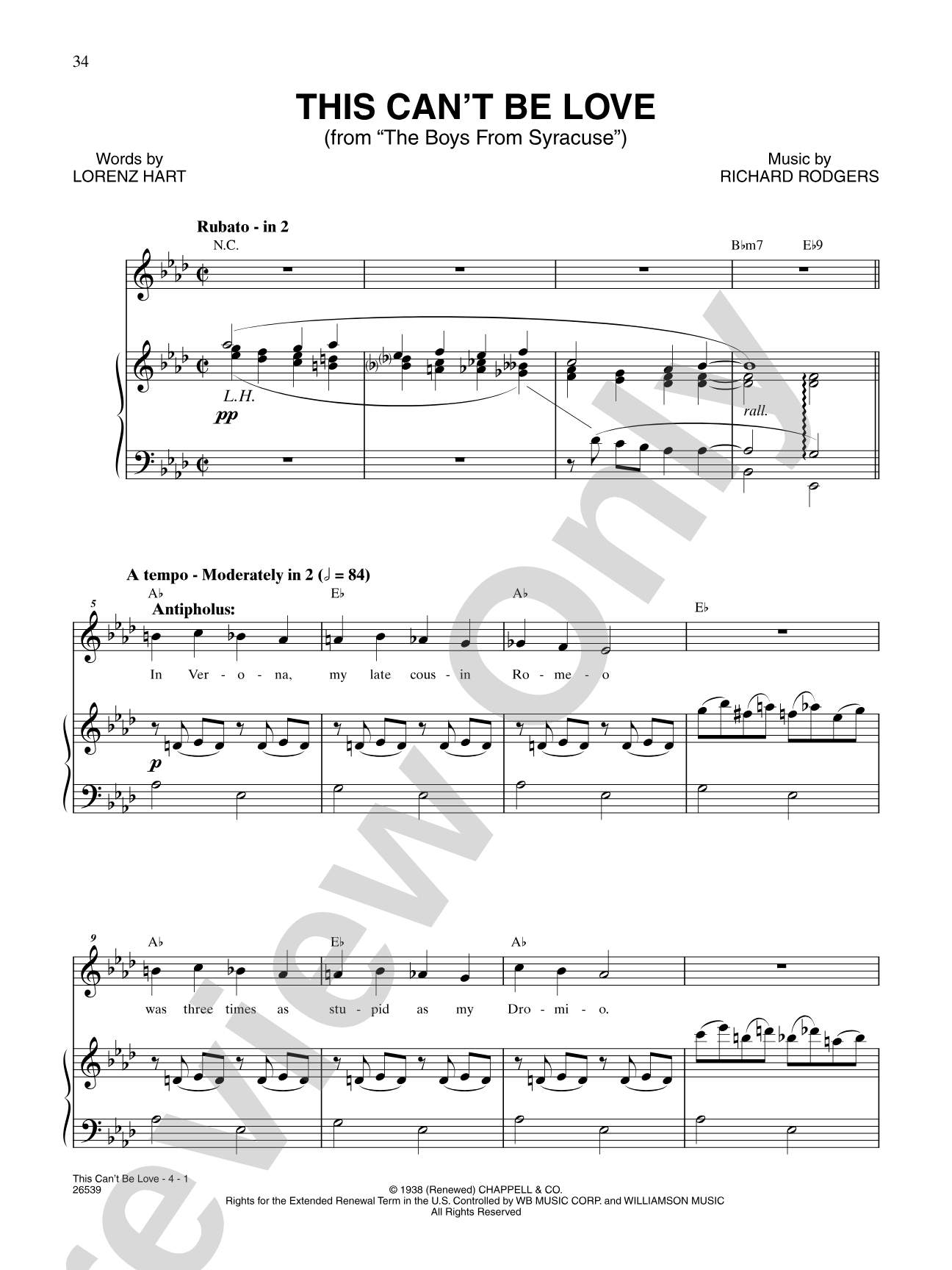

This Can't Be Love (From "The Boys from Syracuse"): Piano/Vocal/Chords
Item: 00-PSP-000571
$4.99
One moment…
Related Items
Namely You (From "Li'l Abner"): Piano/Vocal/Chords |
$4.99
|
View | |
Look to the Rainbow (From "Finian's Rainbow"): Piano/Vocal/Chords |
$4.99
|
View | |
I Loved (J'aimais) (From "Jacques Brel Is Alive and Well and Living in Paris"): Piano/Vocal/Chords |
$4.99
|
View | |
Simple Little Things (From "110 in the Shade"): Piano/Vocal/Chords |
$4.99
|
View | |
I Loved You Once in Silence (From "Camelot"): Piano/Vocal/Chords |
$5.99
|
View | |
Is It Really Me? (From "110 in the Shade"): Piano/Vocal/Chords |
$4.99
|
View | |
Little Lamb (From "Gypsy"): Piano/Vocal/Chords |
$4.99
|
View | |
Love, Don't Turn Away (From "110 in the Shade"): Piano/Vocal/Chords |
$4.99
|
View | |
Much More (From "The Fantasticks"): Piano/Vocal/Chords |
$4.99
|
View | |
The Simple Joys of Maidenhood (From "Camelot"): Piano/Vocal/Chords |
$5.99
|
View | |
What Is a Man? (From "Pal Joey"): Piano/Vocal/Chords |
$5.99
|
View | |
The Winner Takes It All (From "Mamma Mia!"): Piano/Vocal/Chords |
$5.99
|
View | |
Mamma Mia (From "Mamma Mia!"): Piano/Vocal/Chords |
$5.99
|
View | |
Love Who You Love (From "A Man of No Importance"): Piano/Vocal/Chords |
$4.99
|
View | |
I Can't Do the Sum (From "Babes in Toyland"): Piano/Vocal/Chords |
$4.99
|
View | |
Hangin' Around with You (From "Strike Up the Band"): Piano/Vocal/Chords |
$4.99
|
View | |
The Name of the Game (From "Mamma Mia!"): Piano/Vocal/Chords |
$5.99
|
View | |
Waiting for Life (From "Once On This Island"): Piano/Vocal/Chords |
$5.99
|
View | |
The Human Heart (From "Once On This Island"): Piano/Vocal/Chords |
$5.99
|
View | |
Come to My Garden (From "The Secret Garden"): Piano/Vocal/Chords |
$4.99
|
View | |
How Could I Ever Know? (From "The Secret Garden"): Piano/Vocal/Chords |
$4.99
|
View | |
Leavin' for De' Promise Lan' (From "Porgy and Bess"): Piano/Vocal/Chords |
$5.99
|
View | |
Princess (From "A Man of No Importance"): Piano/Vocal/Chords |
$5.99
|
View | |
Hernando's Hideaway (From "The Pajama Game"): Piano/Vocal/Chords |
$4.99
|
View | |
I'm Not at All in Love (From "The Pajama Game"): Piano/Vocal/Chords |
$5.99
|
View | |
Whatever Lola Wants (Lola Gets) (From "Damn Yankees"): Piano/Vocal/Chords |
$4.99
|
View | |
And All That Jazz (From "Chicago"): Piano/Vocal/Chords |
$5.99
|
View | |
When You're Good to Mama (From "Chicago"): Piano/Vocal/Chords |
$4.99
|
View | |
Don't Rain on My Parade (From "Funny Girl"): Piano/Vocal/Chords |
$5.99
|
View | |
Everything's Coming Up Roses (From "Gypsy"): Piano/Vocal/Chords |
$5.99
|
View | |
Johnny One Note (From "Babes in Arms"): Piano/Vocal/Chords |
$5.99
|
View | |
People (From "Funny Girl"): Piano/Vocal/Chords |
$4.99
|
View | |
Rose's Turn
|
$9.99
|
View | |
Change (From "A New Brain"): Piano/Vocal/Chords |
$9.99
|
View | |
No Time at All (From "Pippin"): Piano/Vocal/Chords |
$5.99
|
View | |
The Story Goes On (From "Baby"): Piano/Vocal/Chords |
$5.99
|
View | |
With You (From "Baby"): Piano/Vocal/Chords |
$4.99
|
View | |
Another Op'nin', Another Show (From "Kiss Me, Kate"): Piano/Vocal/Chords |
$5.99
|
View | |
C'est Magnifique (From "Can-Can"): Piano/Vocal/Chords |
$4.99
|
View | |
I Just Want to Be a Star (From "Nunsense"): Piano/Vocal/Chords |
$5.99
|
View | |
Miss Byrd (From "Closer Than Ever"): Piano/Vocal/Chords |
$9.99
|
View | |
Life Story (From "Closer Than Ever"): Piano/Vocal/Chords |
$9.99
|
View | |
When I Look at You (From "The Scarlet Pimpernel"): Piano/Vocal/Chords |
$4.99
|
View | |
Goodbye, My Love (From "Ragtime"): Piano/Vocal/Chords |
$5.99
|
View | |
Back to Before (From "Ragtime"): Piano/Vocal/Chords |
$5.99
|
View | |
Hey There! (From "The Pajama Game"): Piano/Vocal/Chords |
$4.99
|
View | |
Magic to Do (From "Pippin"): Piano/Vocal/Chords |
$4.99
|
View | |
Corner of the Sky (From "Pippin"): Piano/Vocal/Chords |
$4.99
|
View | |
When I'm Not Near the Girl I Love (From "Finian's Rainbow"): Piano/Vocal/Chords |
$4.99
|
View | |
Fifty Million Years Ago (From "Celebration"): Piano/Vocal/Chords |
$5.99
|
View |
Description
For aspiring and professional singers who love Broadway, Alfred's Singer's Library of Musical Theatre presents an elegant collection of the best-loved musical theatre songs in their original keys, authentically transcribed from their original vocal scores. Perfect for study, and equally suitable for the most important auditions and performances, each volume is dedicated to a specific vocal range, and contains dozens of songs from a variety of shows that span decades of theatre history. Multiple volumes are available for each of four vocal ranges: Soprano, Mezzo-Soprano/Alto, Tenor, and Baritone/Bass. Authoritative historical and contextual commentary, audition tips, and 16-bar cut suggestions for each song make it the most useful and relevant song library of its kind.
Titles: Comedy Tonight (A Funny Thing Happened on the Way to the Forum) * Get Me to the Church on Time (My Fair Lady) * If Ever I Would Leave You (Camelot) * Make Them Hear You (Ragtime, The Musical) * They Call the Wind Maria (Paint Your Wagon) * Try to Remember (The Fantasticks) and more.


Titles: Comedy Tonight (A Funny Thing Happened on the Way to the Forum) * Get Me to the Church on Time (My Fair Lady) * If Ever I Would Leave You (Camelot) * Make Them Hear You (Ragtime, The Musical) * They Call the Wind Maria (Paint Your Wagon) * Try to Remember (The Fantasticks) and more.
This Can't Be Love (From "The Boys from Syracuse"): Piano/Vocal/Chords isn't in MakeMusic Cloud just yet...but it could be. Let us know you'd like to see it, and you'll help shape what comes next. In the meantime, start a free trial and dive into thousands of interactive titles your students can play along with today.
Request This Title
Tell us you want it.
Start Your Free Trial
Explore everything that's ready to play right now.
Sample Audio
1
Camelot from Camelot
--:--
2
Ive Grown Accustomed To Her Face from My Fair Lady
--:--
3
Too Darn Hot from Kiss Me Kate
--:--
Camelot from Camelot
0:00
0:00
Sample Video
No sample videos found.
Additional Details
Series:
Singer's Library of Musical Theatre
Publisher:
Alfred Music
Page Count:
224
SKU:
00-PSP-000571
More about this title
About the Composer: Richard Rodgers
Richard Rodgers (1902-1979) shaped American musical theatre through five decades of prolific composition, creating melodies that became the backbone of the modern Broadway canon. His collaborations with lyricist Lorenz Hart and later Oscar Hammerstein II produced some of the most performed and recorded songs in theatre history, from intimate character songs to showstopping ensemble numbers. Rodgers's gift for writing vocally grateful lines that sit naturally in the human voice makes his work essential study for singers preparing auditions, recitals, and performances across all voice types and experience levels.
Why we love this
Rodgers wrote for singers, not against them. Every song in this collection sits authentically in its original key and maintains the dramatic and vocal integrity of the stage, which means singers study the roles as their creators intended them. The 16-bar cut suggestions and audition guidance acknowledge the real demands of performance preparation, turning this collection into a practical audition tool as much as a repertoire source.
What to expect
Rodgers's melodies have a deceptive simplicity. They sound effortless when sung well, yet they reveal layers of sophistication in their harmonic support and their ability to capture a character's emotional truth in just a few measures. There is both theatrical generosity and intimate restraint in these songs.
Who it's for
Singers preparing Broadway auditions, music theatre students building a foundational rep list, and vocal performers seeking authentic arrangements in original keys. Whether you're a young singer just discovering musical theatre or an experienced performer returning to these standards for a recital or revue, this collection gives you the songs exactly as audiences first heard them.
How to get the most out of it
- Study the historical and contextual notes before rehearsing. Understanding the character's situation and the show's dramatic arc shapes your phrasing and emotional choices in ways that generic musical training cannot.
- Use the original key as written. Rodgers crafted each song's tessitura deliberately. Transposing down or up changes not just the pitch but the vocal comfort and dramatic weight he designed into the line.
- Practice the accompaniment patterns as written on piano. The harmonic language of Rodgers's scores reveals how melody and harmony work together; playing through both parts deepens your understanding of the song's structure.
How to use it
Pair these songs with audition coaching sessions to build a strong list of contrasting material across multiple shows and decades. For recitals, cluster Rodgers selections thematically or by show to tell a coherent story about his evolution as a composer and his range across comedy, romance, and drama. Teachers can assign individual songs as repertoire studies to develop students' understanding of how melody, harmony, and character interweave.
Skills your students will build
- Singing authentic Broadway repertoire in original keys
- Understanding character motivation through lyric and melody analysis
- Navigating Rodgers's harmonic language and its relationship to vocal line
- Preparing audition material with historical context and dramatic clarity
- Sustaining legit singing technique across a range of theatrical styles and emotional demands