
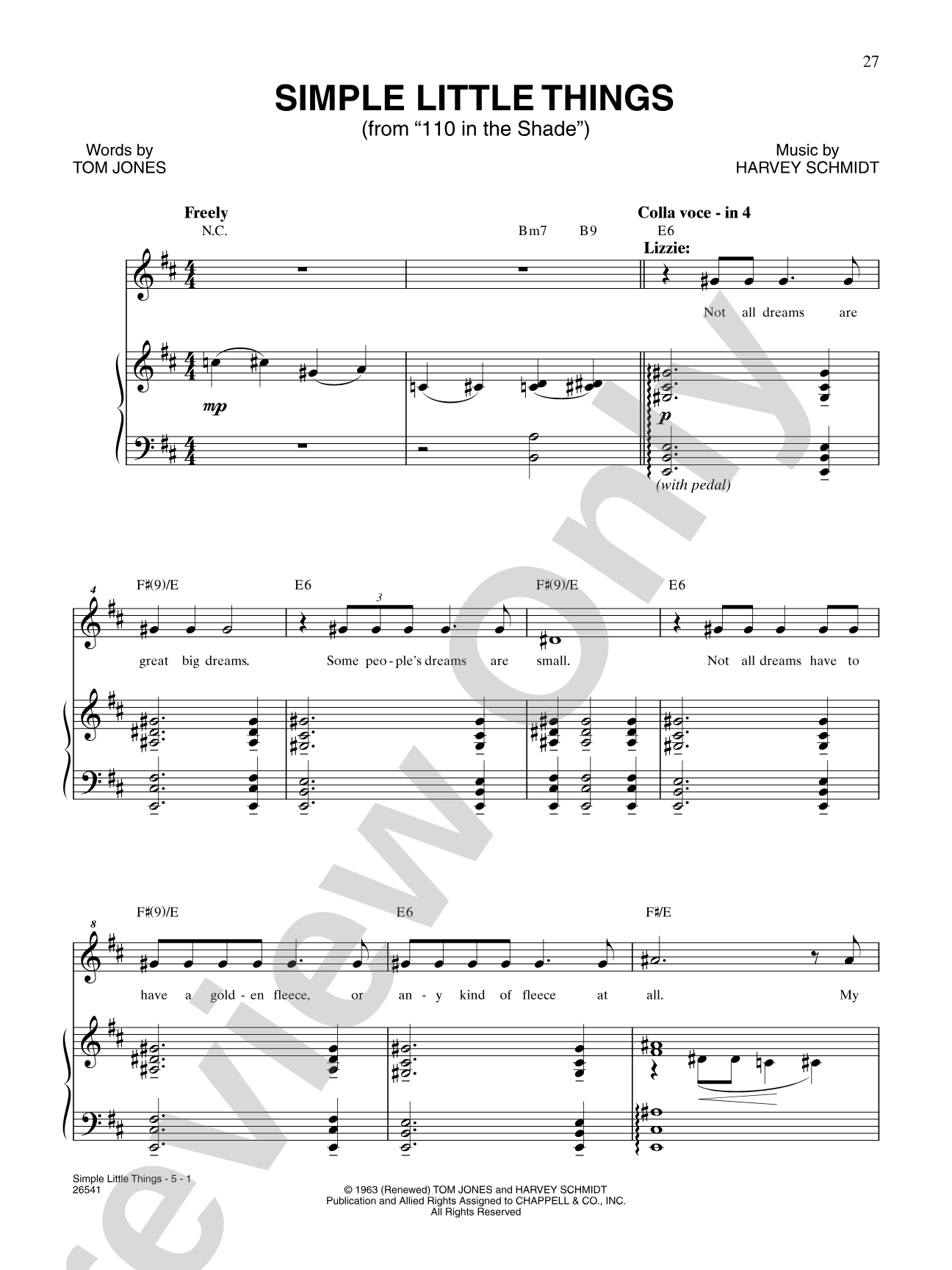

Simple Little Things (From "110 in the Shade"): Piano/Vocal/Chords
Item: 00-PSP-000564
$4.99
One moment…
Related Items
Namely You (From "Li'l Abner"): Piano/Vocal/Chords |
$4.99
|
View | |
Look to the Rainbow (From "Finian's Rainbow"): Piano/Vocal/Chords |
$4.99
|
View | |
I Loved (J'aimais) (From "Jacques Brel Is Alive and Well and Living in Paris"): Piano/Vocal/Chords |
$4.99
|
View | |
I Loved You Once in Silence (From "Camelot"): Piano/Vocal/Chords |
$5.99
|
View | |
Is It Really Me? (From "110 in the Shade"): Piano/Vocal/Chords |
$4.99
|
View | |
Little Lamb (From "Gypsy"): Piano/Vocal/Chords |
$4.99
|
View | |
Love, Don't Turn Away (From "110 in the Shade"): Piano/Vocal/Chords |
$4.99
|
View | |
Much More (From "The Fantasticks"): Piano/Vocal/Chords |
$4.99
|
View | |
The Simple Joys of Maidenhood (From "Camelot"): Piano/Vocal/Chords |
$5.99
|
View | |
What Is a Man? (From "Pal Joey"): Piano/Vocal/Chords |
$5.99
|
View | |
The Winner Takes It All (From "Mamma Mia!"): Piano/Vocal/Chords |
$5.99
|
View | |
Mamma Mia (From "Mamma Mia!"): Piano/Vocal/Chords |
$5.99
|
View | |
Love Who You Love (From "A Man of No Importance"): Piano/Vocal/Chords |
$4.99
|
View | |
I Can't Do the Sum (From "Babes in Toyland"): Piano/Vocal/Chords |
$4.99
|
View | |
Hangin' Around with You (From "Strike Up the Band"): Piano/Vocal/Chords |
$4.99
|
View | |
The Name of the Game (From "Mamma Mia!"): Piano/Vocal/Chords |
$5.99
|
View | |
Waiting for Life (From "Once On This Island"): Piano/Vocal/Chords |
$5.99
|
View | |
The Human Heart (From "Once On This Island"): Piano/Vocal/Chords |
$5.99
|
View | |
Come to My Garden (From "The Secret Garden"): Piano/Vocal/Chords |
$4.99
|
View | |
How Could I Ever Know? (From "The Secret Garden"): Piano/Vocal/Chords |
$4.99
|
View | |
Leavin' for De' Promise Lan' (From "Porgy and Bess"): Piano/Vocal/Chords |
$5.99
|
View | |
Princess (From "A Man of No Importance"): Piano/Vocal/Chords |
$5.99
|
View | |
Hernando's Hideaway (From "The Pajama Game"): Piano/Vocal/Chords |
$4.99
|
View | |
I'm Not at All in Love (From "The Pajama Game"): Piano/Vocal/Chords |
$5.99
|
View | |
Whatever Lola Wants (Lola Gets) (From "Damn Yankees"): Piano/Vocal/Chords |
$4.99
|
View | |
And All That Jazz (From "Chicago"): Piano/Vocal/Chords |
$5.99
|
View | |
When You're Good to Mama (From "Chicago"): Piano/Vocal/Chords |
$4.99
|
View | |
Don't Rain on My Parade (From "Funny Girl"): Piano/Vocal/Chords |
$5.99
|
View | |
Everything's Coming Up Roses (From "Gypsy"): Piano/Vocal/Chords |
$5.99
|
View | |
Johnny One Note (From "Babes in Arms"): Piano/Vocal/Chords |
$5.99
|
View | |
People (From "Funny Girl"): Piano/Vocal/Chords |
$4.99
|
View | |
Rose's Turn
|
$9.99
|
View | |
Change (From "A New Brain"): Piano/Vocal/Chords |
$9.99
|
View | |
No Time at All (From "Pippin"): Piano/Vocal/Chords |
$5.99
|
View | |
The Story Goes On (From "Baby"): Piano/Vocal/Chords |
$5.99
|
View | |
With You (From "Baby"): Piano/Vocal/Chords |
$4.99
|
View | |
Another Op'nin', Another Show (From "Kiss Me, Kate"): Piano/Vocal/Chords |
$5.99
|
View | |
C'est Magnifique (From "Can-Can"): Piano/Vocal/Chords |
$4.99
|
View | |
I Just Want to Be a Star (From "Nunsense"): Piano/Vocal/Chords |
$5.99
|
View | |
Miss Byrd (From "Closer Than Ever"): Piano/Vocal/Chords |
$9.99
|
View | |
Life Story (From "Closer Than Ever"): Piano/Vocal/Chords |
$9.99
|
View | |
When I Look at You (From "The Scarlet Pimpernel"): Piano/Vocal/Chords |
$4.99
|
View | |
Goodbye, My Love (From "Ragtime"): Piano/Vocal/Chords |
$5.99
|
View | |
Back to Before (From "Ragtime"): Piano/Vocal/Chords |
$5.99
|
View | |
Hey There! (From "The Pajama Game"): Piano/Vocal/Chords |
$4.99
|
View | |
Magic to Do (From "Pippin"): Piano/Vocal/Chords |
$4.99
|
View | |
Corner of the Sky (From "Pippin"): Piano/Vocal/Chords |
$4.99
|
View | |
When I'm Not Near the Girl I Love (From "Finian's Rainbow"): Piano/Vocal/Chords |
$4.99
|
View | |
Fifty Million Years Ago (From "Celebration"): Piano/Vocal/Chords |
$5.99
|
View | |
Asking for You (From "Do Re Mi"): Piano/Vocal/Chords |
$4.99
|
View |
Description
For aspiring and professional singers who love Broadway, Alfred's Singer's Library of Musical Theatre presents an elegant collection of the best-loved musical theatre songs in their original keys, authentically transcribed from their original vocal scores. Perfect for study, and equally suitable for the most important auditions and performances, each volume is dedicated to a specific vocal range, and contains dozens of songs from a variety of shows that span decades of theatre history. Multiple volumes are available for each of four vocal ranges: Soprano, Mezzo-Soprano/Alto, Tenor, and Baritone/Bass. Authoritative historical and contextual commentary, audition tips, and 16-bar cut suggestions for each song make it the most useful and relevant song library of its kind.
Titles: Anything Goes (Anything Goes) * Don't Rain on My Parade (Funny Girl) * People (Funny Girl) * Send in the Clowns (A Little Night Music) * Whatever Lola Wants (Lola Gets) (Damn Yankees) * When You're Good to Mama (Chicago) and more.


Titles: Anything Goes (Anything Goes) * Don't Rain on My Parade (Funny Girl) * People (Funny Girl) * Send in the Clowns (A Little Night Music) * Whatever Lola Wants (Lola Gets) (Damn Yankees) * When You're Good to Mama (Chicago) and more.
Discover MakeMusic Cloud: thousands of interactive titles your students can play along with today.
Sample Audio
1
Forty Days
--:--
2
Summertime
--:--
3
The Lady Is A Tramp
--:--
4
Without You
--:--
Forty Days
0:00
0:00
Sample Video
No sample videos found.
Additional Details
Series:
Singer's Library of Musical Theatre
Publisher:
Alfred Music
Page Count:
204
SKU:
00-PSP-000564
More about this title
About the Composer: Harvey Schmidt
Harvey Schmidt composed the music for some of Broadway's most enduring and intimate musicals, including "The Fantasticks," which holds the record for the longest-running off-Broadway production, and "110 in the Shade," a lush adaptation of "The Rainmaker." His gift for melody and his ability to write songs that reveal character through music made him a vital voice in musical theatre during the 1960s and beyond.
Schmidt's compositions favor singable, emotionally direct melodies that serve the story first. His work demonstrates that musical theatre songs need not be technically showy to be dramatically powerful or vocally rewarding. For singers studying the craft, his scores offer lessons in how restraint and clarity can achieve profound emotional impact.
Why we love this
This collection places "Simple Little Things" alongside dozens of Broadway standards, all authentically transcribed from original vocal scores and presented in their original keys. The 16-bar cut suggestions and audition guidance transform this from a reference book into a working tool for singers serious about musical theatre repertoire.
What to expect
Opening this collection, you enter a treasury of Broadway's most human moments. These are songs about longing, acceptance, resilience, and small gestures that matter. Schmidt's melodies sit naturally in the voice, allowing you to focus on the emotional truth of each lyric rather than fighting the music.
Who it's for
This collection serves aspiring and professional singers preparing auditions, building a Broadway repertoire, or studying how musical theatre songs function as both dramatic and musical statements. Whether you're a voice student exploring the genre or an experienced performer deepening your knowledge of the literature, this resource provides authentic, thoughtfully contextualized material.
How to get the most out of it
- Study the contextual notes provided for each song; understanding the dramatic moment and character intention shapes how you shape the phrase and where you breathe.
- Use the original key as your starting point, even if it feels uncomfortable at first. Original keys carry the composer's harmonic intent and the emotional weight of the show's original performance.
- If preparing for an audition, practice the suggested 16-bar cuts until they feel like complete musical thoughts, not abbreviated versions of the full song.
How to use it
Keep this volume within reach during voice lessons as a source for repertoire study and audition preparation. Build recital programs by pairing songs thematically or chronologically, using the historical context provided to frame each selection for your audience.
Skills your students will build
- Interpreting musical theatre character through melodic phrasing and emotional subtext
- Understanding how original keys support vocal range and dramatic intention
- Preparing audition cuts that feel complete and dramatically coherent
- Analyzing how melody, lyric, and harmony work together to reveal character motivation