
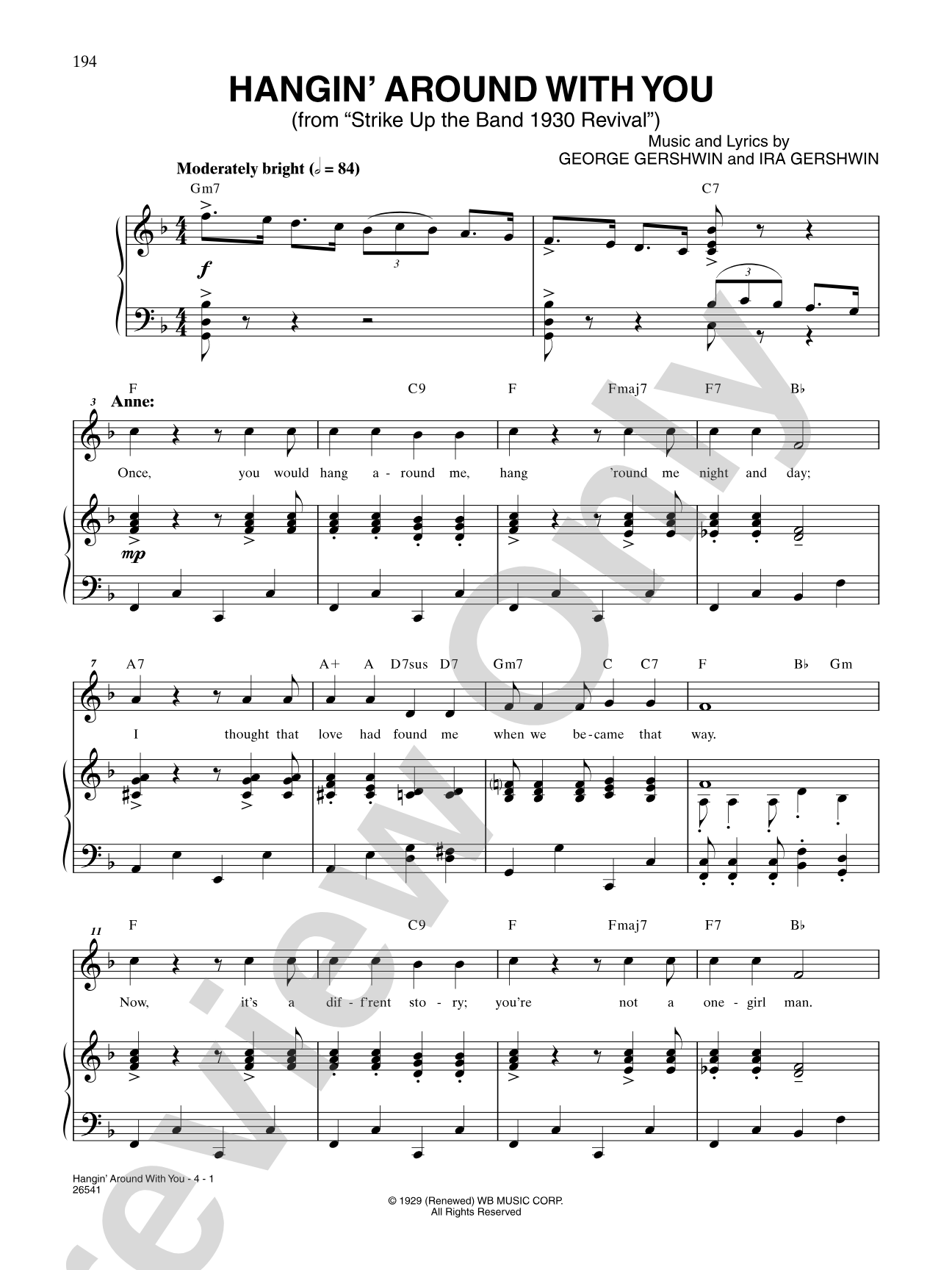

Hangin' Around with You (From "Strike Up the Band"): Piano/Vocal/Chords
Item: 00-PSP-000624
$4.99
One moment…
Related Items
Namely You (From "Li'l Abner"): Piano/Vocal/Chords |
$4.99
|
View | |
Look to the Rainbow (From "Finian's Rainbow"): Piano/Vocal/Chords |
$4.99
|
View | |
I Loved (J'aimais) (From "Jacques Brel Is Alive and Well and Living in Paris"): Piano/Vocal/Chords |
$4.99
|
View | |
Simple Little Things (From "110 in the Shade"): Piano/Vocal/Chords |
$4.99
|
View | |
I Loved You Once in Silence (From "Camelot"): Piano/Vocal/Chords |
$5.99
|
View | |
Is It Really Me? (From "110 in the Shade"): Piano/Vocal/Chords |
$4.99
|
View | |
Little Lamb (From "Gypsy"): Piano/Vocal/Chords |
$4.99
|
View | |
Love, Don't Turn Away (From "110 in the Shade"): Piano/Vocal/Chords |
$4.99
|
View | |
Much More (From "The Fantasticks"): Piano/Vocal/Chords |
$4.99
|
View | |
The Simple Joys of Maidenhood (From "Camelot"): Piano/Vocal/Chords |
$5.99
|
View | |
What Is a Man? (From "Pal Joey"): Piano/Vocal/Chords |
$5.99
|
View | |
The Winner Takes It All (From "Mamma Mia!"): Piano/Vocal/Chords |
$5.99
|
View | |
Mamma Mia (From "Mamma Mia!"): Piano/Vocal/Chords |
$5.99
|
View | |
Love Who You Love (From "A Man of No Importance"): Piano/Vocal/Chords |
$4.99
|
View | |
I Can't Do the Sum (From "Babes in Toyland"): Piano/Vocal/Chords |
$4.99
|
View | |
The Name of the Game (From "Mamma Mia!"): Piano/Vocal/Chords |
$5.99
|
View | |
Waiting for Life (From "Once On This Island"): Piano/Vocal/Chords |
$5.99
|
View | |
The Human Heart (From "Once On This Island"): Piano/Vocal/Chords |
$5.99
|
View | |
Come to My Garden (From "The Secret Garden"): Piano/Vocal/Chords |
$4.99
|
View | |
How Could I Ever Know? (From "The Secret Garden"): Piano/Vocal/Chords |
$4.99
|
View | |
Leavin' for De' Promise Lan' (From "Porgy and Bess"): Piano/Vocal/Chords |
$5.99
|
View | |
Princess (From "A Man of No Importance"): Piano/Vocal/Chords |
$5.99
|
View | |
Hernando's Hideaway (From "The Pajama Game"): Piano/Vocal/Chords |
$4.99
|
View | |
I'm Not at All in Love (From "The Pajama Game"): Piano/Vocal/Chords |
$5.99
|
View | |
Whatever Lola Wants (Lola Gets) (From "Damn Yankees"): Piano/Vocal/Chords |
$4.99
|
View | |
And All That Jazz (From "Chicago"): Piano/Vocal/Chords |
$5.99
|
View | |
When You're Good to Mama (From "Chicago"): Piano/Vocal/Chords |
$4.99
|
View | |
Don't Rain on My Parade (From "Funny Girl"): Piano/Vocal/Chords |
$5.99
|
View | |
Everything's Coming Up Roses (From "Gypsy"): Piano/Vocal/Chords |
$5.99
|
View | |
Johnny One Note (From "Babes in Arms"): Piano/Vocal/Chords |
$5.99
|
View | |
People (From "Funny Girl"): Piano/Vocal/Chords |
$4.99
|
View | |
Rose's Turn
|
$9.99
|
View | |
Change (From "A New Brain"): Piano/Vocal/Chords |
$9.99
|
View | |
No Time at All (From "Pippin"): Piano/Vocal/Chords |
$5.99
|
View | |
The Story Goes On (From "Baby"): Piano/Vocal/Chords |
$5.99
|
View | |
With You (From "Baby"): Piano/Vocal/Chords |
$4.99
|
View | |
Another Op'nin', Another Show (From "Kiss Me, Kate"): Piano/Vocal/Chords |
$5.99
|
View | |
C'est Magnifique (From "Can-Can"): Piano/Vocal/Chords |
$4.99
|
View | |
I Just Want to Be a Star (From "Nunsense"): Piano/Vocal/Chords |
$5.99
|
View | |
Miss Byrd (From "Closer Than Ever"): Piano/Vocal/Chords |
$9.99
|
View | |
Life Story (From "Closer Than Ever"): Piano/Vocal/Chords |
$9.99
|
View | |
When I Look at You (From "The Scarlet Pimpernel"): Piano/Vocal/Chords |
$4.99
|
View | |
Goodbye, My Love (From "Ragtime"): Piano/Vocal/Chords |
$5.99
|
View | |
Back to Before (From "Ragtime"): Piano/Vocal/Chords |
$5.99
|
View | |
Hey There! (From "The Pajama Game"): Piano/Vocal/Chords |
$4.99
|
View | |
Magic to Do (From "Pippin"): Piano/Vocal/Chords |
$4.99
|
View | |
Corner of the Sky (From "Pippin"): Piano/Vocal/Chords |
$4.99
|
View | |
When I'm Not Near the Girl I Love (From "Finian's Rainbow"): Piano/Vocal/Chords |
$4.99
|
View | |
Fifty Million Years Ago (From "Celebration"): Piano/Vocal/Chords |
$5.99
|
View | |
Asking for You (From "Do Re Mi"): Piano/Vocal/Chords |
$4.99
|
View |
Description
For aspiring and professional singers who love Broadway, Alfred's Singer's Library of Musical Theatre presents an elegant collection of the best-loved musical theatre songs in their original keys, authentically transcribed from their original vocal scores. Perfect for study, and equally suitable for the most important auditions and performances, each volume is dedicated to a specific vocal range, and contains dozens of songs from a variety of shows that span decades of theatre history. Multiple volumes are available for each of four vocal ranges: Soprano, Mezzo-Soprano/Alto, Tenor, and Baritone/Bass. Authoritative historical and contextual commentary, audition tips, and 16-bar cut suggestions for each song make it the most useful and relevant song library of its kind.
Titles: Anything Goes (Anything Goes) * Don't Rain on My Parade (Funny Girl) * People (Funny Girl) * Send in the Clowns (A Little Night Music) * Whatever Lola Wants (Lola Gets) (Damn Yankees) * When You're Good to Mama (Chicago) and more.


Titles: Anything Goes (Anything Goes) * Don't Rain on My Parade (Funny Girl) * People (Funny Girl) * Send in the Clowns (A Little Night Music) * Whatever Lola Wants (Lola Gets) (Damn Yankees) * When You're Good to Mama (Chicago) and more.
Discover MakeMusic Cloud: thousands of interactive titles your students can play along with today.
Sample Audio
1
Forty Days
--:--
2
Summertime
--:--
3
The Lady Is A Tramp
--:--
4
Without You
--:--
Forty Days
0:00
0:00
Sample Video
No sample videos found.
Additional Details
Series:
Singer's Library of Musical Theatre
Publisher:
Alfred Music
Page Count:
204
SKU:
00-PSP-000624
More about this title
About the Composer: George Gershwin
George Gershwin (1898-1937) bridged the worlds of concert music and popular song with a compositional voice that felt entirely new. His rhapsodic melodies, sophisticated harmonies, and keen ear for jazz idioms made him one of the most performed American composers of the twentieth century. Gershwin's theatrical works, written in collaboration with his brother Ira, defined an era of musical theatre and remain central to the soprano, mezzo, tenor, and baritone repertoire.
For singers and teachers, Gershwin's catalogue offers an extraordinary resource: songs that demand both technical precision and emotional authenticity. His vocal writing sits beautifully in the voice, his accompaniments reward thoughtful interpretation, and his melodies have proven durable enough to anchor auditions and recitals across generations.
Why we love this
This edition gives singers access to Gershwin's theatre songs in their authentic original keys and voicings, removing the guesswork that comes with assembling these pieces from scattered sources. The 16-bar cut suggestions and audition tips transform what could be a reference book into genuine preparation material; you're not just holding sheet music, you're holding a teacher's notes on how to sing these songs in high-stakes settings.
What to expect
Gershwin's melodies sparkle with wit and spontaneity even as they carry emotional weight. There's a sophistication to the harmonic language, a buoyant jazz influence threading through the accompaniment, and a generosity in the vocal writing that lets singers shine. These are songs that feel alive in the room.
Who it's for
Singers preparing auditions, building recital programs, or diving into the standard repertoire will find this collection essential. Whether you're a mezzo-soprano exploring material outside your typical range or a tenor solidifying your command of classic theatre writing, this volume offers historically accurate texts and professional-level presentation.
How to get the most out of it
- Anchor the rhythmic energy in the accompaniment's harmonic rhythm rather than fighting against it; Gershwin's syncopations lock together with the piano part, not against it.
- Shape the melodic line through the lyrics' dramatic arc, not just the notes' contours; these songs tell stories, and the music follows the emotional trajectory of the text.
- Let the chromaticism breathe without rushing; many of Gershwin's passages move by half-step, and phrasing clarity comes from respecting the harmonic movement.
- Study the original stage context for each song if possible; knowing whether a character is confessing, boasting, or deflecting changes how you color the melody.
How to use it
Gershwin songs work as standalone recital pieces, as part of a Broadway-focused cabaret program, or as audition repertoire for musical theatre training and performance. Programming one of his songs alongside art song and classical material demonstrates the singer's range and versatility, particularly in showcasing how American popular song can command the same interpretive depth as Lied or art song.
Skills your students will build
- Singing syncopated rhythms with text clarity in jazz-influenced idioms
- Shaping melodic lines through complex harmonic movement and chromatic passages
- Understanding the relationship between theatrical context and vocal interpretation
- Preparing audition-ready performances in original keys with proper phrasing and breathing
- Reading piano/vocal score notation and following complex accompaniment patterns