
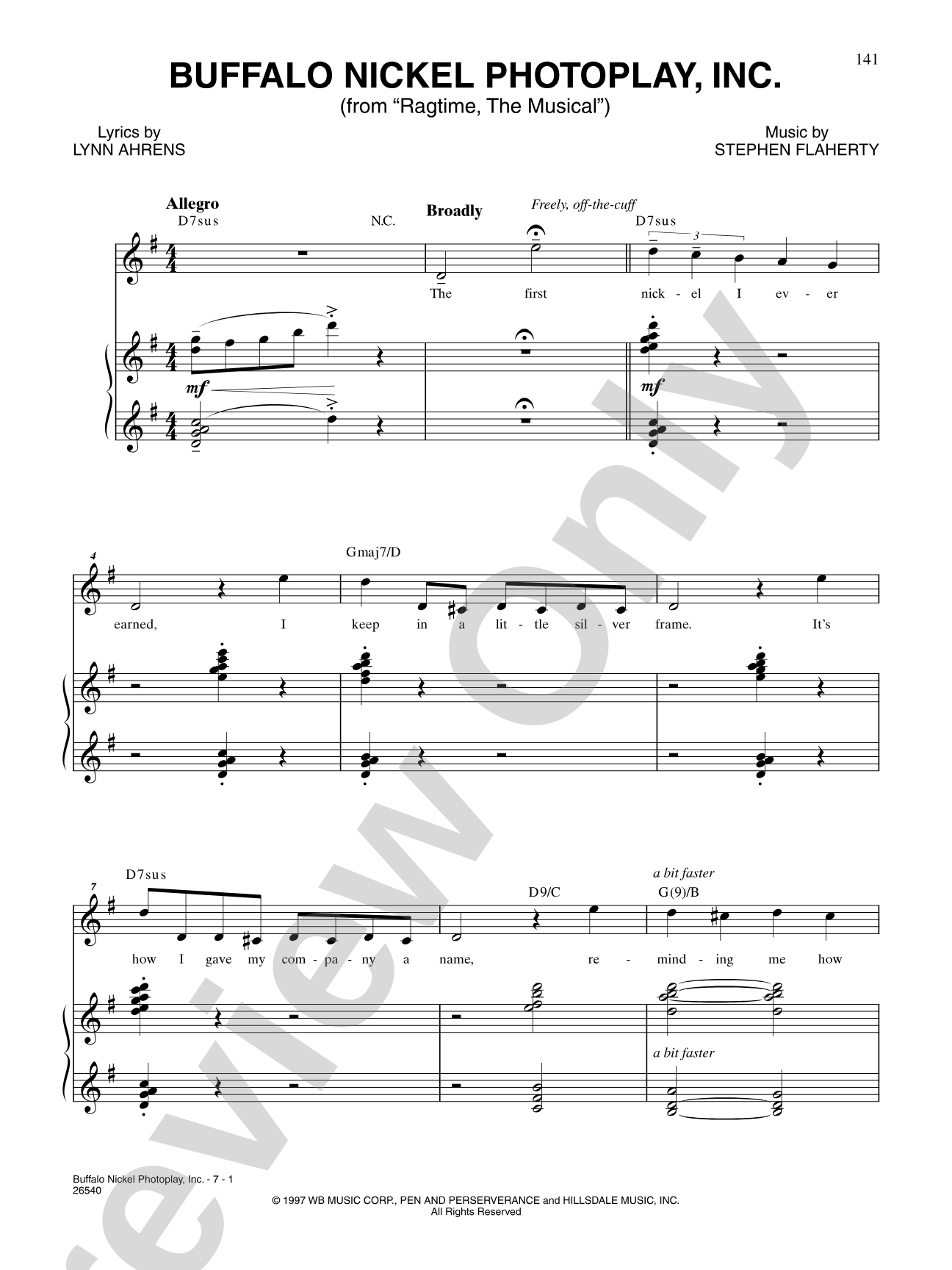
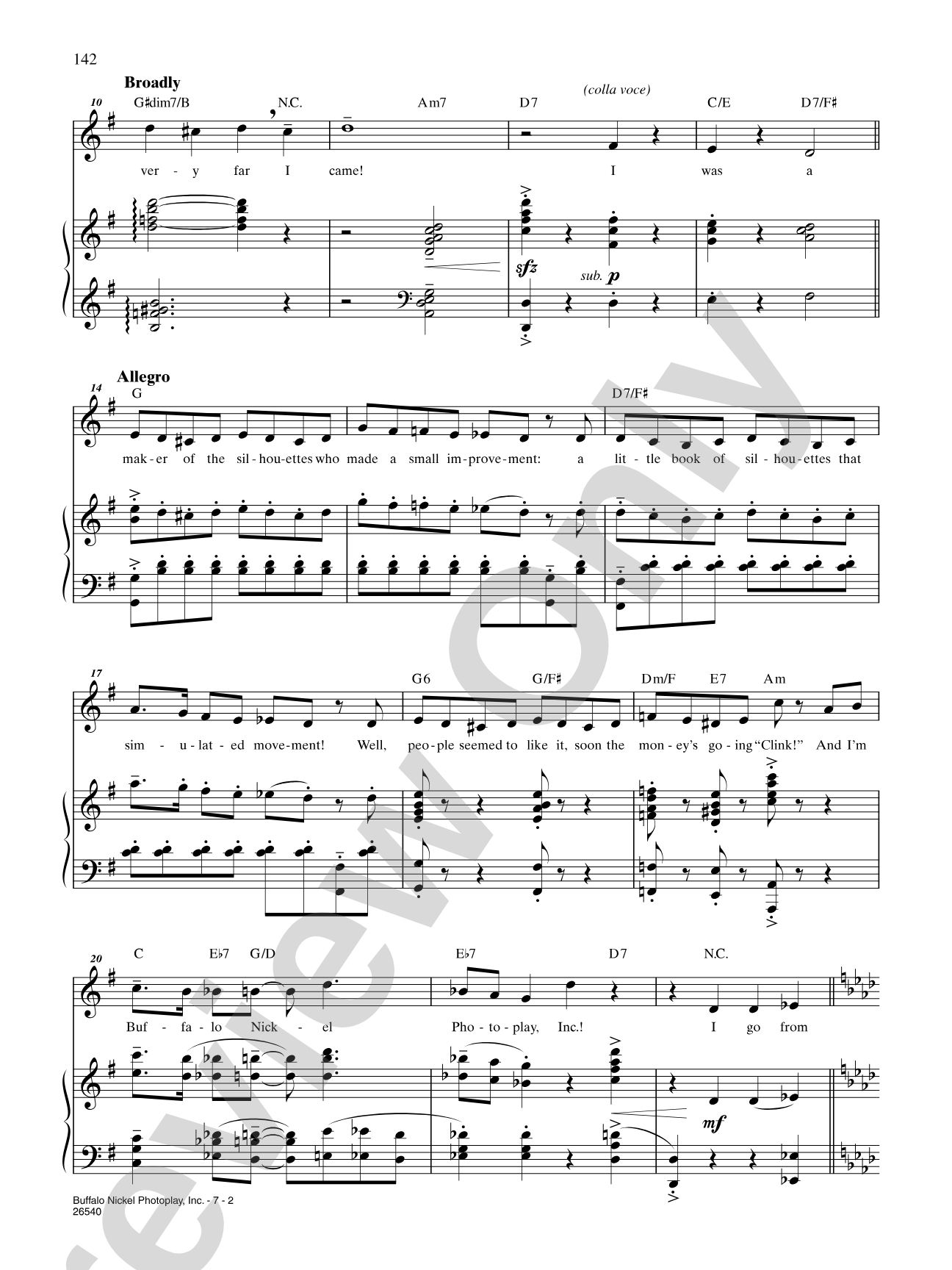

Buffalo Nickel Photoplay, Inc. (From "Ragtime"): Piano/Vocal/Chords
Item: 00-PSP-000683
$5.99
One moment…
Related Items
Namely You (From "Li'l Abner"): Piano/Vocal/Chords |
$4.99
|
View | |
Look to the Rainbow (From "Finian's Rainbow"): Piano/Vocal/Chords |
$4.99
|
View | |
I Loved (J'aimais) (From "Jacques Brel Is Alive and Well and Living in Paris"): Piano/Vocal/Chords |
$4.99
|
View | |
Simple Little Things (From "110 in the Shade"): Piano/Vocal/Chords |
$4.99
|
View | |
I Loved You Once in Silence (From "Camelot"): Piano/Vocal/Chords |
$5.99
|
View | |
Is It Really Me? (From "110 in the Shade"): Piano/Vocal/Chords |
$4.99
|
View | |
Little Lamb (From "Gypsy"): Piano/Vocal/Chords |
$4.99
|
View | |
Love, Don't Turn Away (From "110 in the Shade"): Piano/Vocal/Chords |
$4.99
|
View | |
Much More (From "The Fantasticks"): Piano/Vocal/Chords |
$4.99
|
View | |
The Simple Joys of Maidenhood (From "Camelot"): Piano/Vocal/Chords |
$5.99
|
View | |
What Is a Man? (From "Pal Joey"): Piano/Vocal/Chords |
$5.99
|
View | |
The Winner Takes It All (From "Mamma Mia!"): Piano/Vocal/Chords |
$5.99
|
View | |
Mamma Mia (From "Mamma Mia!"): Piano/Vocal/Chords |
$5.99
|
View | |
Love Who You Love (From "A Man of No Importance"): Piano/Vocal/Chords |
$4.99
|
View | |
I Can't Do the Sum (From "Babes in Toyland"): Piano/Vocal/Chords |
$4.99
|
View | |
Hangin' Around with You (From "Strike Up the Band"): Piano/Vocal/Chords |
$4.99
|
View | |
The Name of the Game (From "Mamma Mia!"): Piano/Vocal/Chords |
$5.99
|
View | |
Waiting for Life (From "Once On This Island"): Piano/Vocal/Chords |
$5.99
|
View | |
The Human Heart (From "Once On This Island"): Piano/Vocal/Chords |
$5.99
|
View | |
Come to My Garden (From "The Secret Garden"): Piano/Vocal/Chords |
$4.99
|
View | |
How Could I Ever Know? (From "The Secret Garden"): Piano/Vocal/Chords |
$4.99
|
View | |
Leavin' for De' Promise Lan' (From "Porgy and Bess"): Piano/Vocal/Chords |
$5.99
|
View | |
Princess (From "A Man of No Importance"): Piano/Vocal/Chords |
$5.99
|
View | |
Hernando's Hideaway (From "The Pajama Game"): Piano/Vocal/Chords |
$4.99
|
View | |
I'm Not at All in Love (From "The Pajama Game"): Piano/Vocal/Chords |
$5.99
|
View | |
Whatever Lola Wants (Lola Gets) (From "Damn Yankees"): Piano/Vocal/Chords |
$4.99
|
View | |
And All That Jazz (From "Chicago"): Piano/Vocal/Chords |
$5.99
|
View | |
When You're Good to Mama (From "Chicago"): Piano/Vocal/Chords |
$4.99
|
View | |
Don't Rain on My Parade (From "Funny Girl"): Piano/Vocal/Chords |
$5.99
|
View | |
Everything's Coming Up Roses (From "Gypsy"): Piano/Vocal/Chords |
$5.99
|
View | |
Johnny One Note (From "Babes in Arms"): Piano/Vocal/Chords |
$5.99
|
View | |
People (From "Funny Girl"): Piano/Vocal/Chords |
$4.99
|
View | |
Rose's Turn
|
$9.99
|
View | |
Change (From "A New Brain"): Piano/Vocal/Chords |
$9.99
|
View | |
No Time at All (From "Pippin"): Piano/Vocal/Chords |
$5.99
|
View | |
The Story Goes On (From "Baby"): Piano/Vocal/Chords |
$5.99
|
View | |
With You (From "Baby"): Piano/Vocal/Chords |
$4.99
|
View | |
Another Op'nin', Another Show (From "Kiss Me, Kate"): Piano/Vocal/Chords |
$5.99
|
View | |
C'est Magnifique (From "Can-Can"): Piano/Vocal/Chords |
$4.99
|
View | |
I Just Want to Be a Star (From "Nunsense"): Piano/Vocal/Chords |
$5.99
|
View | |
Miss Byrd (From "Closer Than Ever"): Piano/Vocal/Chords |
$9.99
|
View | |
Life Story (From "Closer Than Ever"): Piano/Vocal/Chords |
$9.99
|
View | |
When I Look at You (From "The Scarlet Pimpernel"): Piano/Vocal/Chords |
$4.99
|
View | |
Goodbye, My Love (From "Ragtime"): Piano/Vocal/Chords |
$5.99
|
View | |
Back to Before (From "Ragtime"): Piano/Vocal/Chords |
$5.99
|
View | |
Hey There! (From "The Pajama Game"): Piano/Vocal/Chords |
$4.99
|
View | |
Magic to Do (From "Pippin"): Piano/Vocal/Chords |
$4.99
|
View | |
Corner of the Sky (From "Pippin"): Piano/Vocal/Chords |
$4.99
|
View | |
When I'm Not Near the Girl I Love (From "Finian's Rainbow"): Piano/Vocal/Chords |
$4.99
|
View | |
Fifty Million Years Ago (From "Celebration"): Piano/Vocal/Chords |
$5.99
|
View |
Description
For aspiring and professional singers who love Broadway, Alfred's Singer's Library of Musical Theatre presents an elegant collection of the best-loved musical theatre songs in their original keys, authentically transcribed from their original vocal scores. Perfect for study, and equally suitable for the most important auditions and performances, each volume is dedicated to a specific vocal range, and contains dozens of songs from a variety of shows that span decades of theatre history. Multiple volumes are available for each of four vocal ranges: Soprano, Mezzo-Soprano/Alto, Tenor, and Baritone/Bass. Authoritative historical and contextual commentary, audition tips, and 16-bar cut suggestions for each song make it the most useful and relevant song library of its kind.
Titles: Corner of the Sky (Pippin) * The Games I Play (Falsettos) * I've Got a Crush on You (Strike Up the Band) * Not While I'm Around (Sweeney Todd) * On the Street Where You Live (My Fair Lady) and more.


Titles: Corner of the Sky (Pippin) * The Games I Play (Falsettos) * I've Got a Crush on You (Strike Up the Band) * Not While I'm Around (Sweeney Todd) * On the Street Where You Live (My Fair Lady) and more.
Buffalo Nickel Photoplay, Inc. (From "Ragtime"): Piano/Vocal/Chords isn't in MakeMusic Cloud just yet...but it could be. Let us know you'd like to see it, and you'll help shape what comes next. In the meantime, start a free trial and dive into thousands of interactive titles your students can play along with today.
Request This Title
Tell us you want it.
Start Your Free Trial
Explore everything that's ready to play right now.
Sample Audio
1
Gliding from Ragtime
--:--
2
Johanna from Sweeney Todd
--:--
3
Mister Cellophane from Chicago
--:--
Gliding from Ragtime
0:00
0:00
Sample Video
No sample videos found.
Additional Details
Series:
Singer's Library of Musical Theatre
Publisher:
Alfred Music
Page Count:
208
SKU:
00-PSP-000683
More about this title
About the Composer: Stephen Flaherty
Stephen Flaherty has established himself as one of Broadway's most versatile and prolific composers, with a gift for writing music that serves both intimate character moments and sweeping theatrical spectacle. His work spans from the intimate chamber piece Falsettos to the large-scale productions of Ragtime and Anastasia, demonstrating range across musical styles and emotional registers. Flaherty's scores are known for their craftsmanship, accessibility to singers across ranges, and ability to enhance storytelling through melody and harmonic language.
Why we love this
This collection brings together Flaherty's most singable material in a format designed specifically for the voice. The songs span his entire career and showcase his ability to write for different vocal types and dramatic situations, making this a resource that working singers will return to across auditions, recitals, and performances.
What to expect
Flaherty's melodies are direct and emotionally clear, often dwelling in accessible ranges that let singers connect authentically with text. The harmony is sophisticated without being self-conscious, supporting character revelation and lyrical storytelling with the kind of craft that feels effortless when performed well.
Who it's for
This resource serves singers preparing for musical theatre auditions and performances, from high school and college students auditioning for programs and roles to working professionals building their audition book. Whether you're studying interpretation or assembling repertoire for a specific vocal range and type, this collection provides authentic, professionally transcribed material from shows that represent decades of theatrical practice.
How to get the most out of it
- Study the historical and contextual notes provided for each song; understanding the character's dramatic arc and the show's setting deepens your interpretation and makes your choices at the audition table more informed.
- Use the 16-bar cut suggestions as a starting point, but test them in the room first. Some casting directors appreciate the full arc of a song, so be prepared to shift between the cut and the complete version.
- Pay attention to Flaherty's harmonic movement and rhythmic specificity, particularly in songs with syncopation; precision here elevates your musicianship and shows respect for the composer's intent.
- Consider the vocal demands of each piece in context of your range and current technique. This collection spans four distinct vocal ranges, so you can compare how songs sit across different transpositions.
How to use it
Draw from this collection to build recital programs that blend contemporary Broadway with classic standards, or use individual songs as audition selections for role-specific callbacks. The variety of emotional tone and dramatic situation makes it possible to construct a cohesive program that showcases range and interpretive skill across a single composer's output.
Skills your students will build
- Interpreting character intention through melodic phrasing and harmonic context
- Managing vocal demands across extended songs and rapid character shifts
- Reading piano/vocal scores and coordinating melody with harmonic accompaniment
- Preparing material for audition, including strategic cutting and memorization
- Understanding period and style conventions in contemporary musical theatre