
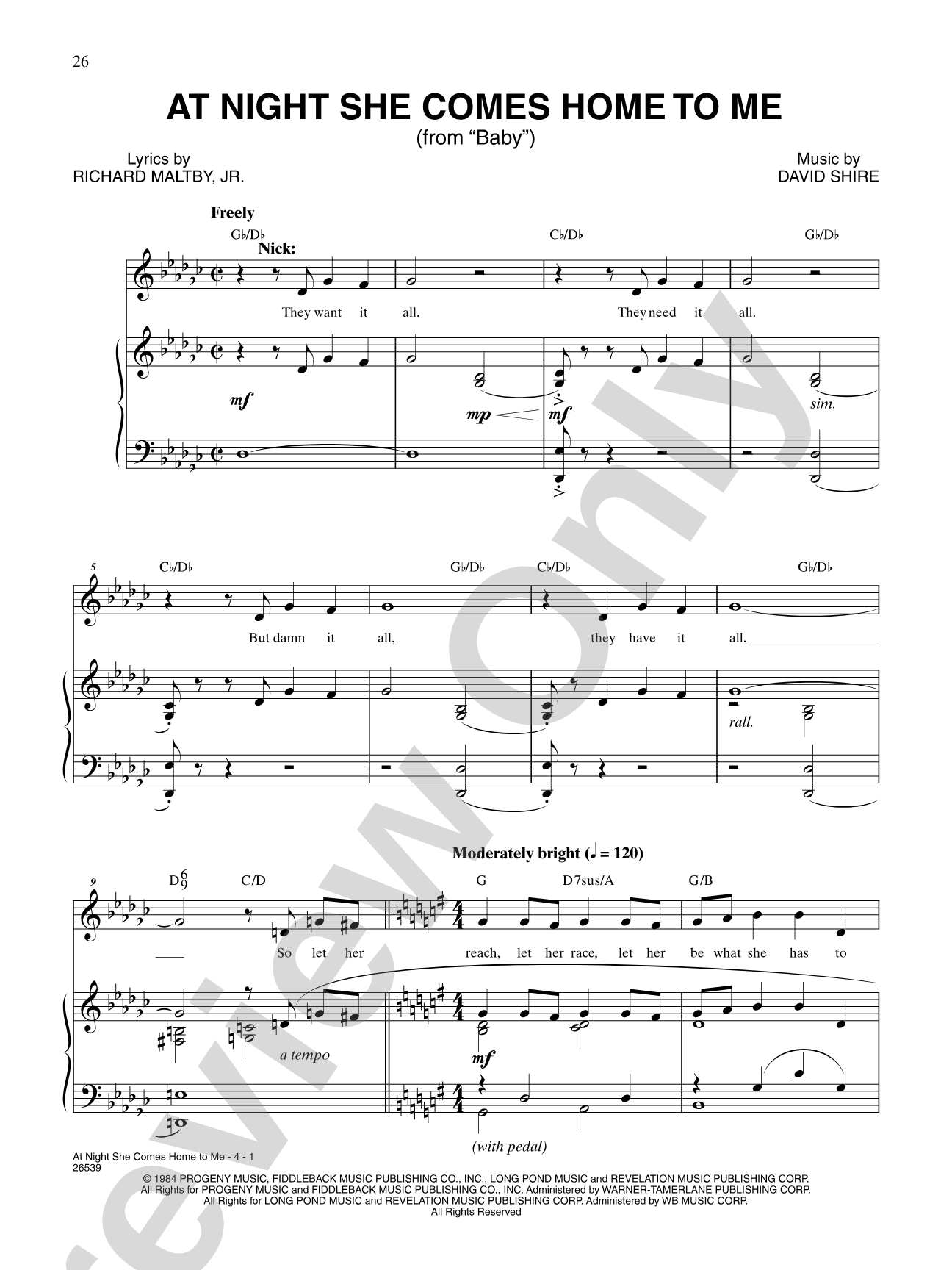

At Night She Comes Home to Me (From "Baby"): Piano/Vocal/Chords
Item: 00-PSP-000638
$4.99
One moment…
Related Items
Namely You (From "Li'l Abner"): Piano/Vocal/Chords |
$4.99
|
View | |
Look to the Rainbow (From "Finian's Rainbow"): Piano/Vocal/Chords |
$4.99
|
View | |
I Loved (J'aimais) (From "Jacques Brel Is Alive and Well and Living in Paris"): Piano/Vocal/Chords |
$4.99
|
View | |
Simple Little Things (From "110 in the Shade"): Piano/Vocal/Chords |
$4.99
|
View | |
I Loved You Once in Silence (From "Camelot"): Piano/Vocal/Chords |
$5.99
|
View | |
Is It Really Me? (From "110 in the Shade"): Piano/Vocal/Chords |
$4.99
|
View | |
Little Lamb (From "Gypsy"): Piano/Vocal/Chords |
$4.99
|
View | |
Love, Don't Turn Away (From "110 in the Shade"): Piano/Vocal/Chords |
$4.99
|
View | |
Much More (From "The Fantasticks"): Piano/Vocal/Chords |
$4.99
|
View | |
The Simple Joys of Maidenhood (From "Camelot"): Piano/Vocal/Chords |
$5.99
|
View | |
What Is a Man? (From "Pal Joey"): Piano/Vocal/Chords |
$5.99
|
View | |
The Winner Takes It All (From "Mamma Mia!"): Piano/Vocal/Chords |
$5.99
|
View | |
Mamma Mia (From "Mamma Mia!"): Piano/Vocal/Chords |
$5.99
|
View | |
Love Who You Love (From "A Man of No Importance"): Piano/Vocal/Chords |
$4.99
|
View | |
I Can't Do the Sum (From "Babes in Toyland"): Piano/Vocal/Chords |
$4.99
|
View | |
Hangin' Around with You (From "Strike Up the Band"): Piano/Vocal/Chords |
$4.99
|
View | |
The Name of the Game (From "Mamma Mia!"): Piano/Vocal/Chords |
$5.99
|
View | |
Waiting for Life (From "Once On This Island"): Piano/Vocal/Chords |
$5.99
|
View | |
The Human Heart (From "Once On This Island"): Piano/Vocal/Chords |
$5.99
|
View | |
Come to My Garden (From "The Secret Garden"): Piano/Vocal/Chords |
$4.99
|
View | |
How Could I Ever Know? (From "The Secret Garden"): Piano/Vocal/Chords |
$4.99
|
View | |
Leavin' for De' Promise Lan' (From "Porgy and Bess"): Piano/Vocal/Chords |
$5.99
|
View | |
Princess (From "A Man of No Importance"): Piano/Vocal/Chords |
$5.99
|
View | |
Hernando's Hideaway (From "The Pajama Game"): Piano/Vocal/Chords |
$4.99
|
View | |
I'm Not at All in Love (From "The Pajama Game"): Piano/Vocal/Chords |
$5.99
|
View | |
Whatever Lola Wants (Lola Gets) (From "Damn Yankees"): Piano/Vocal/Chords |
$4.99
|
View | |
And All That Jazz (From "Chicago"): Piano/Vocal/Chords |
$5.99
|
View | |
When You're Good to Mama (From "Chicago"): Piano/Vocal/Chords |
$4.99
|
View | |
Don't Rain on My Parade (From "Funny Girl"): Piano/Vocal/Chords |
$5.99
|
View | |
Everything's Coming Up Roses (From "Gypsy"): Piano/Vocal/Chords |
$5.99
|
View | |
Johnny One Note (From "Babes in Arms"): Piano/Vocal/Chords |
$5.99
|
View | |
People (From "Funny Girl"): Piano/Vocal/Chords |
$4.99
|
View | |
Rose's Turn
|
$9.99
|
View | |
Change (From "A New Brain"): Piano/Vocal/Chords |
$9.99
|
View | |
No Time at All (From "Pippin"): Piano/Vocal/Chords |
$5.99
|
View | |
The Story Goes On (From "Baby"): Piano/Vocal/Chords |
$5.99
|
View | |
With You (From "Baby"): Piano/Vocal/Chords |
$4.99
|
View | |
Another Op'nin', Another Show (From "Kiss Me, Kate"): Piano/Vocal/Chords |
$5.99
|
View | |
C'est Magnifique (From "Can-Can"): Piano/Vocal/Chords |
$4.99
|
View | |
I Just Want to Be a Star (From "Nunsense"): Piano/Vocal/Chords |
$5.99
|
View | |
Miss Byrd (From "Closer Than Ever"): Piano/Vocal/Chords |
$9.99
|
View | |
Life Story (From "Closer Than Ever"): Piano/Vocal/Chords |
$9.99
|
View | |
When I Look at You (From "The Scarlet Pimpernel"): Piano/Vocal/Chords |
$4.99
|
View | |
Goodbye, My Love (From "Ragtime"): Piano/Vocal/Chords |
$5.99
|
View | |
Back to Before (From "Ragtime"): Piano/Vocal/Chords |
$5.99
|
View | |
Hey There! (From "The Pajama Game"): Piano/Vocal/Chords |
$4.99
|
View | |
Magic to Do (From "Pippin"): Piano/Vocal/Chords |
$4.99
|
View | |
Corner of the Sky (From "Pippin"): Piano/Vocal/Chords |
$4.99
|
View | |
When I'm Not Near the Girl I Love (From "Finian's Rainbow"): Piano/Vocal/Chords |
$4.99
|
View | |
Fifty Million Years Ago (From "Celebration"): Piano/Vocal/Chords |
$5.99
|
View |
Description
For aspiring and professional singers who love Broadway, Alfred's Singer's Library of Musical Theatre presents an elegant collection of the best-loved musical theatre songs in their original keys, authentically transcribed from their original vocal scores. Perfect for study, and equally suitable for the most important auditions and performances, each volume is dedicated to a specific vocal range, and contains dozens of songs from a variety of shows that span decades of theatre history. Multiple volumes are available for each of four vocal ranges: Soprano, Mezzo-Soprano/Alto, Tenor, and Baritone/Bass. Authoritative historical and contextual commentary, audition tips, and 16-bar cut suggestions for each song make it the most useful and relevant song library of its kind.
Titles: Comedy Tonight (A Funny Thing Happened on the Way to the Forum) * Get Me to the Church on Time (My Fair Lady) * If Ever I Would Leave You (Camelot) * Make Them Hear You (Ragtime, The Musical) * They Call the Wind Maria (Paint Your Wagon) * Try to Remember (The Fantasticks) and more.


Titles: Comedy Tonight (A Funny Thing Happened on the Way to the Forum) * Get Me to the Church on Time (My Fair Lady) * If Ever I Would Leave You (Camelot) * Make Them Hear You (Ragtime, The Musical) * They Call the Wind Maria (Paint Your Wagon) * Try to Remember (The Fantasticks) and more.
At Night She Comes Home to Me (From "Baby"): Piano/Vocal/Chords isn't in MakeMusic Cloud just yet...but it could be. Let us know you'd like to see it, and you'll help shape what comes next. In the meantime, start a free trial and dive into thousands of interactive titles your students can play along with today.
Request This Title
Tell us you want it.
Start Your Free Trial
Explore everything that's ready to play right now.
Sample Audio
1
Camelot from Camelot
--:--
2
Ive Grown Accustomed To Her Face from My Fair Lady
--:--
3
Too Darn Hot from Kiss Me Kate
--:--
Camelot from Camelot
0:00
0:00
Sample Video
No sample videos found.
Additional Details
Series:
Singer's Library of Musical Theatre
Publisher:
Alfred Music
Page Count:
224
SKU:
00-PSP-000638
More about this title
About the Composer: David Shire
David Shire has been a defining voice in American musical theatre since the 1970s, composing music for Broadway productions that range from intimate character studies to sweeping ensemble pieces. His gift for melody and emotional nuance has earned him Tony nominations and a body of work that spans multiple decades and theatrical styles, from the contemporary storytelling of "Baby" to the romantic sweep of "Carmelina." Shire's compositions are prized by singers and directors alike for their singability and their capacity to reveal character through music.
Why we love this
This collection captures Shire's compositional voice across multiple styles and eras, giving singers direct access to his most performable work in authoritative transcriptions from the original vocal scores. The contextual commentary and audition cut suggestions transform this from a songbook into a genuine study tool, especially valuable for singers preparing auditions or recitals who want to explore a composer's range without scattered research. Shire's melodic gift and emotional specificity make his songs rewarding to perform at any level of experience.
What to expect
Shire's music is marked by sophisticated harmonic language that never sacrifices singability, with melodies that sit naturally in the voice while demanding expressivity and emotional specificity. His songs feel intimate even when performed in large spaces; they tend to reward careful listening and invite the audience into the interior emotional world of the character.
Who it's for
This collection serves singers preparing auditions, working on recital programs, or deepening their knowledge of contemporary musical theatre repertoire. It's equally useful for voice teachers seeking authentic scores and interpretive guidance, and for singers who want to explore a single composer's evolution across multiple theatrical styles and vocal ranges.
How to get the most out of it
- Study the historical and contextual notes provided for each song; understanding the character's dramatic situation and the show's era will inform your interpretive choices and help you find the emotional truth beneath the melody.
- Pay attention to the chord symbols and use them to explore harmonic color at the piano; Shire's harmonies often contain subtle shifts that deepen the emotional arc of a phrase.
- Use the 16-bar cut suggestions when preparing audition material, but also experiment with full verses to understand how Shire develops themes and character motivation across longer spans.
How to use it
Program Shire's work alongside composers from similar eras to create recital sets that illuminate the evolution of musical theatre songwriting from the 1970s onward. His songs also pair well with material from other contemporary Broadway composers, allowing singers to build thematic recitals around specific character types or emotional territories rather than periods or styles.
Skills your students will build
- Interpreting lyrics and dramatic subtext in relation to melodic and harmonic structure
- Reading and realizing chord symbols for improvised accompaniment and arrangement exploration
- Stylistic awareness of contemporary musical theatre vocal technique and phrasing
- Auditioning strategy and song selection within a single composer's catalog