
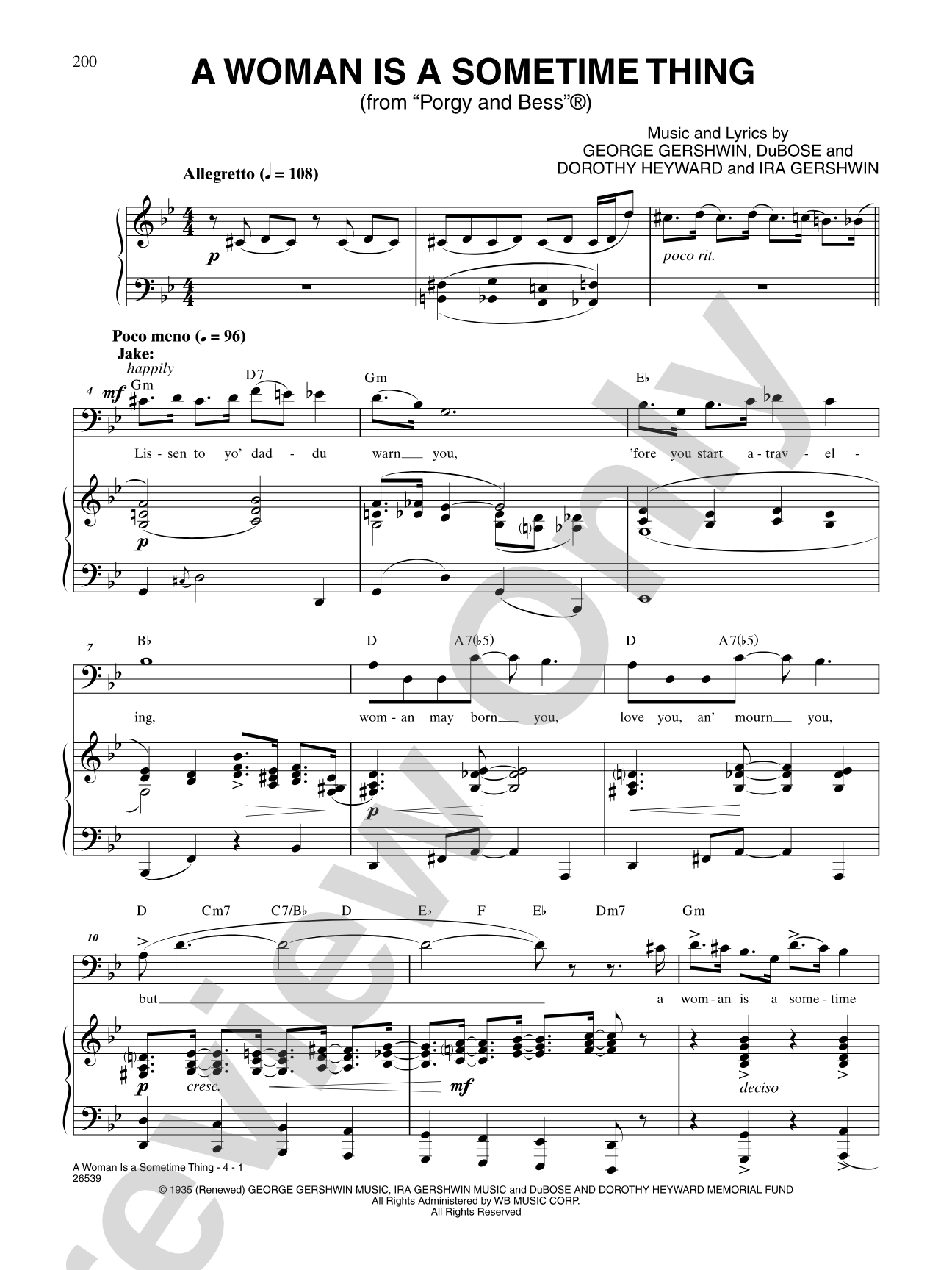

A Woman Is a Sometime Thing (From "Porgy and Bess"): Piano/Vocal/Chords
Item: 00-PSP-000601
$4.99
One moment…
Related Items
Namely You (From "Li'l Abner"): Piano/Vocal/Chords |
$4.99
|
View | |
Look to the Rainbow (From "Finian's Rainbow"): Piano/Vocal/Chords |
$4.99
|
View | |
I Loved (J'aimais) (From "Jacques Brel Is Alive and Well and Living in Paris"): Piano/Vocal/Chords |
$4.99
|
View | |
Simple Little Things (From "110 in the Shade"): Piano/Vocal/Chords |
$4.99
|
View | |
I Loved You Once in Silence (From "Camelot"): Piano/Vocal/Chords |
$5.99
|
View | |
Is It Really Me? (From "110 in the Shade"): Piano/Vocal/Chords |
$4.99
|
View | |
Little Lamb (From "Gypsy"): Piano/Vocal/Chords |
$4.99
|
View | |
Love, Don't Turn Away (From "110 in the Shade"): Piano/Vocal/Chords |
$4.99
|
View | |
Much More (From "The Fantasticks"): Piano/Vocal/Chords |
$4.99
|
View | |
The Simple Joys of Maidenhood (From "Camelot"): Piano/Vocal/Chords |
$5.99
|
View | |
What Is a Man? (From "Pal Joey"): Piano/Vocal/Chords |
$5.99
|
View | |
The Winner Takes It All (From "Mamma Mia!"): Piano/Vocal/Chords |
$5.99
|
View | |
Mamma Mia (From "Mamma Mia!"): Piano/Vocal/Chords |
$5.99
|
View | |
Love Who You Love (From "A Man of No Importance"): Piano/Vocal/Chords |
$4.99
|
View | |
I Can't Do the Sum (From "Babes in Toyland"): Piano/Vocal/Chords |
$4.99
|
View | |
Hangin' Around with You (From "Strike Up the Band"): Piano/Vocal/Chords |
$4.99
|
View | |
The Name of the Game (From "Mamma Mia!"): Piano/Vocal/Chords |
$5.99
|
View | |
Waiting for Life (From "Once On This Island"): Piano/Vocal/Chords |
$5.99
|
View | |
The Human Heart (From "Once On This Island"): Piano/Vocal/Chords |
$5.99
|
View | |
Come to My Garden (From "The Secret Garden"): Piano/Vocal/Chords |
$4.99
|
View | |
How Could I Ever Know? (From "The Secret Garden"): Piano/Vocal/Chords |
$4.99
|
View | |
Leavin' for De' Promise Lan' (From "Porgy and Bess"): Piano/Vocal/Chords |
$5.99
|
View | |
Princess (From "A Man of No Importance"): Piano/Vocal/Chords |
$5.99
|
View | |
Hernando's Hideaway (From "The Pajama Game"): Piano/Vocal/Chords |
$4.99
|
View | |
I'm Not at All in Love (From "The Pajama Game"): Piano/Vocal/Chords |
$5.99
|
View | |
Whatever Lola Wants (Lola Gets) (From "Damn Yankees"): Piano/Vocal/Chords |
$4.99
|
View | |
And All That Jazz (From "Chicago"): Piano/Vocal/Chords |
$5.99
|
View | |
When You're Good to Mama (From "Chicago"): Piano/Vocal/Chords |
$4.99
|
View | |
Don't Rain on My Parade (From "Funny Girl"): Piano/Vocal/Chords |
$5.99
|
View | |
Everything's Coming Up Roses (From "Gypsy"): Piano/Vocal/Chords |
$5.99
|
View | |
Johnny One Note (From "Babes in Arms"): Piano/Vocal/Chords |
$5.99
|
View | |
People (From "Funny Girl"): Piano/Vocal/Chords |
$4.99
|
View | |
Rose's Turn
|
$9.99
|
View | |
Change (From "A New Brain"): Piano/Vocal/Chords |
$9.99
|
View | |
No Time at All (From "Pippin"): Piano/Vocal/Chords |
$5.99
|
View | |
The Story Goes On (From "Baby"): Piano/Vocal/Chords |
$5.99
|
View | |
With You (From "Baby"): Piano/Vocal/Chords |
$4.99
|
View | |
Another Op'nin', Another Show (From "Kiss Me, Kate"): Piano/Vocal/Chords |
$5.99
|
View | |
C'est Magnifique (From "Can-Can"): Piano/Vocal/Chords |
$4.99
|
View | |
I Just Want to Be a Star (From "Nunsense"): Piano/Vocal/Chords |
$5.99
|
View | |
Miss Byrd (From "Closer Than Ever"): Piano/Vocal/Chords |
$9.99
|
View | |
Life Story (From "Closer Than Ever"): Piano/Vocal/Chords |
$9.99
|
View | |
When I Look at You (From "The Scarlet Pimpernel"): Piano/Vocal/Chords |
$4.99
|
View | |
Goodbye, My Love (From "Ragtime"): Piano/Vocal/Chords |
$5.99
|
View | |
Back to Before (From "Ragtime"): Piano/Vocal/Chords |
$5.99
|
View | |
Hey There! (From "The Pajama Game"): Piano/Vocal/Chords |
$4.99
|
View | |
Magic to Do (From "Pippin"): Piano/Vocal/Chords |
$4.99
|
View | |
Corner of the Sky (From "Pippin"): Piano/Vocal/Chords |
$4.99
|
View | |
When I'm Not Near the Girl I Love (From "Finian's Rainbow"): Piano/Vocal/Chords |
$4.99
|
View | |
Fifty Million Years Ago (From "Celebration"): Piano/Vocal/Chords |
$5.99
|
View |
Description
For aspiring and professional singers who love Broadway, Alfred's Singer's Library of Musical Theatre presents an elegant collection of the best-loved musical theatre songs in their original keys, authentically transcribed from their original vocal scores. Perfect for study, and equally suitable for the most important auditions and performances, each volume is dedicated to a specific vocal range, and contains dozens of songs from a variety of shows that span decades of theatre history. Multiple volumes are available for each of four vocal ranges: Soprano, Mezzo-Soprano/Alto, Tenor, and Baritone/Bass. Authoritative historical and contextual commentary, audition tips, and 16-bar cut suggestions for each song make it the most useful and relevant song library of its kind.
Titles: Comedy Tonight (A Funny Thing Happened on the Way to the Forum) * Get Me to the Church on Time (My Fair Lady) * If Ever I Would Leave You (Camelot) * Make Them Hear You (Ragtime, The Musical) * They Call the Wind Maria (Paint Your Wagon) * Try to Remember (The Fantasticks) and more.


Titles: Comedy Tonight (A Funny Thing Happened on the Way to the Forum) * Get Me to the Church on Time (My Fair Lady) * If Ever I Would Leave You (Camelot) * Make Them Hear You (Ragtime, The Musical) * They Call the Wind Maria (Paint Your Wagon) * Try to Remember (The Fantasticks) and more.
A Woman Is a Sometime Thing (From "Porgy and Bess"): Piano/Vocal/Chords isn't in MakeMusic Cloud just yet...but it could be. Let us know you'd like to see it, and you'll help shape what comes next. In the meantime, start a free trial and dive into thousands of interactive titles your students can play along with today.
Request This Title
Tell us you want it.
Start Your Free Trial
Explore everything that's ready to play right now.
Sample Audio
1
Camelot from Camelot
--:--
2
Ive Grown Accustomed To Her Face from My Fair Lady
--:--
3
Too Darn Hot from Kiss Me Kate
--:--
Camelot from Camelot
0:00
0:00
Sample Video
No sample videos found.
Additional Details
Series:
Singer's Library of Musical Theatre
Publisher:
Alfred Music
Page Count:
224
SKU:
00-PSP-000601
More about this title
About the Composer: George Gershwin
George Gershwin (1898-1937) was an American composer who bridged classical music and popular song with unprecedented fluency. His work for stage and concert hall earned him recognition as one of the most important musical voices of the twentieth century, and his melodies remain central to the American songbook.
Gershwin's collaboration with his brother Ira on "Porgy and Bess" (1935) produced some of musical theatre's most enduring material. The opera, co-created with DuBose and Dorothy Heyward, stands as a landmark work in American music, and its songs continue to anchor vocal repertoire across all ranges and genres.
Why we love this
This volume captures "A Woman Is a Sometime Thing" in its original key with full historical context and audition guidance, making it an invaluable tool for singers preparing this jazz-inflected aria. The song's sophisticated harmonic language and lyrical demands reward careful study, and Gershwin's orchestration notes throughout the collection deepen your understanding of how to shape the vocal line with genuine theatrical weight.
What to expect
The song settles into a melancholic, bluesy groove that speaks to romantic disappointment with dark humor. Gershwin's melody dances around the beat even as the harmony pulls downward, creating a tension between resignation and subtle defiance that demands both vocal control and emotional honesty.
Who it's for
This is essential repertoire for baritone and bass singers preparing professional auditions, callbacks, and performances, as well as intermediate and advanced singers in school and community theatre programs. The song works equally well for classroom study, voice lessons, and recital programming when you need a piece that demonstrates both vocal skill and dramatic maturity.
How to get the most out of it
- Attend to the blues inflections in the melody; this song belongs to the jazz tradition as much as the operatic one, so allow the phrasing to breathe naturally rather than forcing rigid diction.
- Use the chord symbols to anchor your sense of harmonic movement, particularly through the chromatic passages where the piano line can easily overtake the voice.
- Practice the sustained high passages with care for legit resonance while preserving the character's world-weary resignation; aim for warmth rather than brightness in these moments.
How to use it
Program this alongside other Gershwin standards or American musical theatre classics when you want to showcase jazz-influenced vocal writing. It serves as a excellent audition piece for roles requiring maturity and vocal flexibility, and it pairs naturally with other songs from "Porgy and Bess" if you're building a thematic recital or tribute program.
Skills your students will build
- Interpreting jazz-influenced phrasing and rhythmic flexibility within a notated score
- Managing sustained legit singing through chromatic and wide intervallic passages
- Understanding historical context and vocal demands of early American opera
- Applying audition cuts and building a character through song without full dramatic staging