
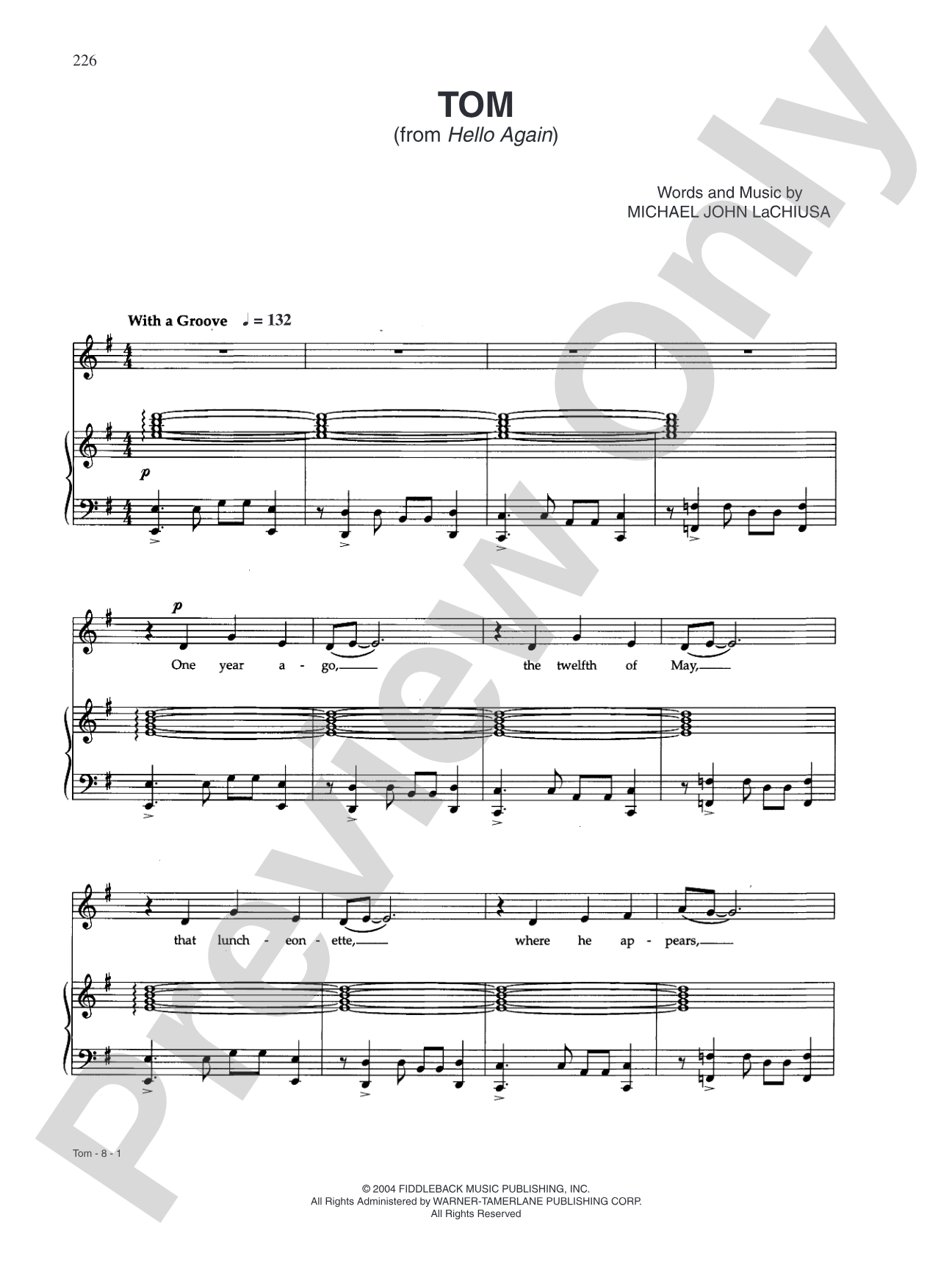
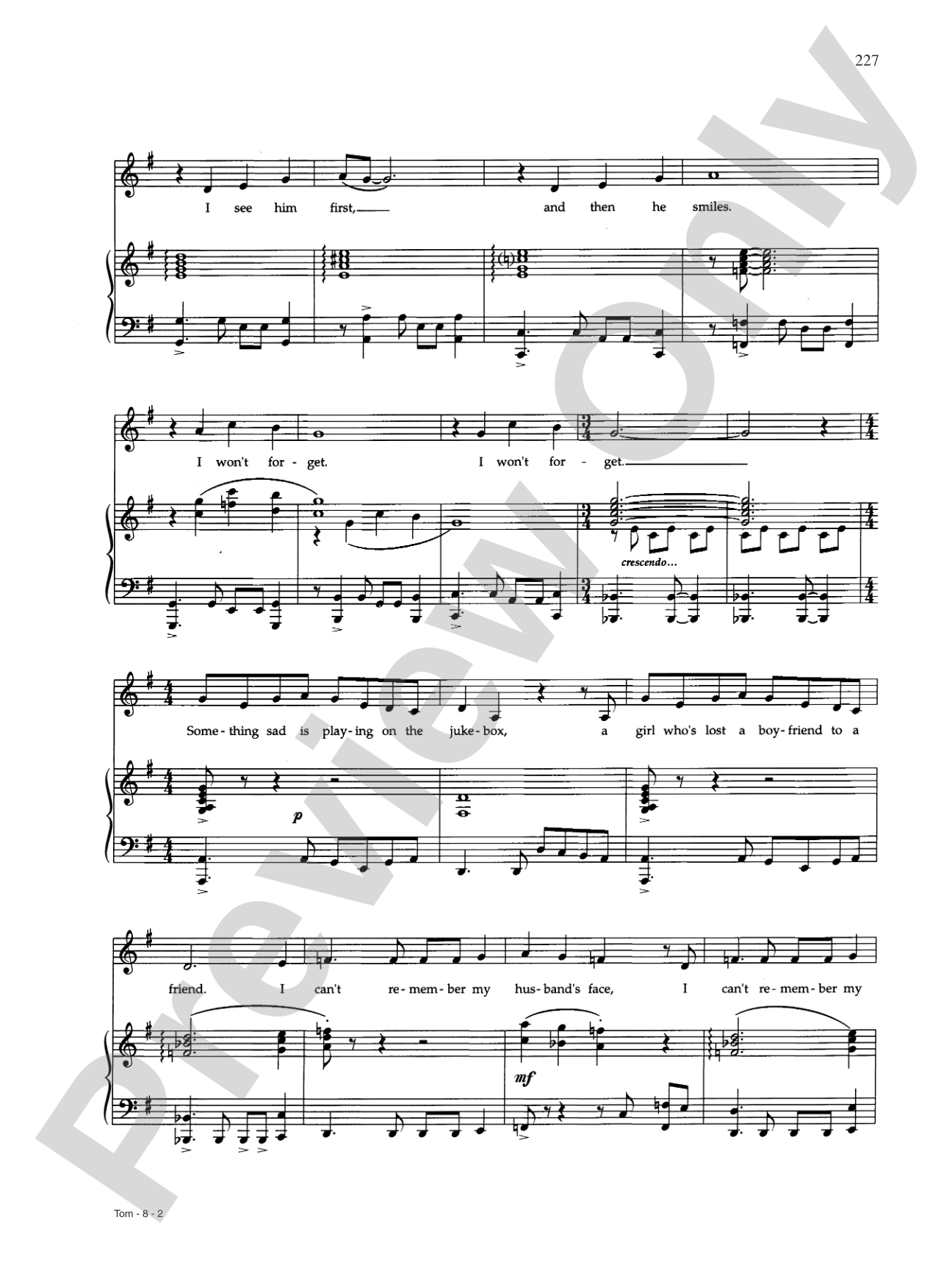

Tom (from "Hello Again"): Piano/Vocal/Chords
Michael John LaChiusa
Item: 00-PS-0013124
$5.99
One moment…
Related Items
Way Back to Paradise (from "Marie Christine"): Piano/Vocal/Chords |
$5.99
|
View | |
Beautiful (from "Marie Christine"): Piano/Vocal/Chords |
$4.99
|
View | |
I Don't Hear the Ocean (from "Marie Christine"): Piano/Vocal/Chords |
$5.99
|
View | |
See What I Wanna See (from "See What I Wanna See"): Piano/Vocal/Chords |
$5.99
|
View | |
Welcome to My Party (from "The Wild Party"): Piano/Vocal/Chords |
$5.99
|
View | |
People Like Us (from "The Wild Party"): Piano/Vocal/Chords |
$5.99
|
View | |
How Many Women In the World? (from "The Wild Party"): Piano/Vocal/Chords |
$5.99
|
View | |
When It Ends (from "The Wild Party"): Piano/Vocal/Chords |
$4.99
|
View | |
The Bed Was Not My Own (from "Hello Again"): Piano/Vocal/Chords |
$5.99
|
View | |
Hello Again (from "Hello Again"): Piano/Vocal/Chords |
$9.99
|
View | |
The One I Love (from "Hello Again"): Piano/Vocal/Chords |
$4.99
|
View | |
The Mistress of the Senator (from "Hello Again"): Piano/Vocal/Chords |
$9.99
|
View | |
Eleanor Sleeps Here (from "First Lady Suite"): Piano/Vocal/Chords |
$4.99
|
View | |
I Ran (from "Little Fish"): Piano/Vocal/Chords |
$4.99
|
View | |
By The Way (from "Little Fish"): Piano/Vocal/Chords |
$4.99
|
View | |
Remember Me (from "Little Fish"): Piano/Vocal/Chords |
$5.99
|
View | |
Little Fish (from "Little Fish"): Piano/Vocal/Chords |
$4.99
|
View | |
Simple Creature (from "Little Fish"): Piano/Vocal/Chords |
$4.99
|
View | |
The Smallest Thing (from "First Lady Suite"): Piano/Vocal/Chords |
$9.99
|
View | |
My Husband Was An Army Man (from "First Lady Suite"): Piano/Vocal/Chords |
$9.99
|
View | |
The Christian Thing To Do (from "The Seven Deadly Sins"): Piano/Vocal/Chords |
$5.99
|
View | |
The Highest Yellow (from "The Highest Yellow"): Piano/Vocal/Chords |
$5.99
|
View | |
Martirio (from "Bernarda Alba"): Piano/Vocal/Chords |
$4.99
|
View | |
Adela (from "Bernarda Alba"): Piano/Vocal/Chords |
$4.99
|
View | |
The Smallest Stream (from "Bernarda Alba"): Piano/Vocal/Chords |
$4.99
|
View | |
Coffee (from "See What I Wanna See"): Piano/Vocal/Chords |
$5.99
|
View | |
Curosity (from "See What I Wanna See"): Piano/Vocal/Chords |
$4.99
|
View | |
There Will Be A Miracle (from "See What I Wanna See"): Piano/Vocal/Chords |
$5.99
|
View | |
She Looked at Me (from "See What I Wanna See"): Piano/Vocal/Chords |
$5.99
|
View | |
Fraud (from "Broken Sleep"): Piano/Vocal/Chords |
$9.99
|
View | |
The Gift of You (from "The Nutcracker"): Piano/Vocal/Chords |
$5.99
|
View | |
He Wanted a Girl (from "Giant"): Piano/Vocal/Chords |
$5.99
|
View | |
Private Property (from "Giant"): Piano/Vocal/Chords |
$4.99
|
View | |
A Stranger (from "Giant"): Piano/Vocal/Chords |
$5.99
|
View | |
Hello, Lover, Hello (from "Send (who are you? I love you)"): Piano/Vocal/Chords |
$5.99
|
View | |
Optimistic (from "Lovers and Friends"): Piano/Vocal/Chords |
$4.99
|
View | |
Tom Sawyer (from "Romance Language"): Piano/Vocal/Chords |
$5.99
|
View |
Description
This first-ever Michael John LaChiusa sheet music collection contains 39 songs from one of the most distinctive and admired theatre composers of our time. More than 250 pages of music chronicle two decades of LaChiusa shows, from early 1990s breakouts First Lady Suite and Hello Again to celebrated favorites like The Wild Party, See What I Wanna See, and much more. The composer supplied a wealth of previously unpublished music for this collection, ensuring that even the most devoted LaChiusa fan will discover new and exciting songs among these pages. Titles: * Adela (from Bernarda Alba) * Beautiful (Marie Christine) * The Bed Was Not My Own (Hello Again) * By the Way (Little Fish) * The Christian Thing to Do (The Seven Deadly Sins) * Coffee (See What I Wanna See) * Curiosity (See What I Wanna See) * Eleanor Sleeps Here (First Lady Suite) * Fraud (Broken Sleep) * The Gift of You (The Nutcracker) * He Wanted a Girl (Giant) * Heaven (Hotel C'est l'Amour) * Hello Again (Hello Again) * Hello, Lover, Hello (Send (who are you? I love you) * The Highest Yellow (The Highest Yellow) * How Many Women in the World? (The Wild Party) * I Don't Hear the Ocean (Marie Christine) * I Ran (Little Fish) * Little Fish (Little Fish) * Martirio (Bernarda Alba) * Mistress of the Senator (Hello Again) * My Husband Was an Army Man (First Lady Suite) * The One I Love (Hello Again) * Optimistic (Lovers and Friends) * People Like Us (The Wild Party) * Private Property (Giant) * Remember Me (Little Fish) * See What I Wanna See (See What I Wanna See) * She Looked at Me (See What I Wanna See) * Simple Creature (Little Fish) * The Smallest Stream (Bernarda Alba) * The Smallest Thing (First Lady Suite) * A Stranger (Giant) * There Will Be a Miracle (See What I Wanna See) * Tom (Hello Again) * Tom Sawyer (Romance Language) * Way Back to Paradise (Marie Christine) * Welcome to My Party (The Wild Party) * When It Ends (The Wild Party).


Tom (from "Hello Again"): Piano/Vocal/Chords isn't in MakeMusic Cloud just yet...but it could be. Let us know you'd like to see it, and you'll help shape what comes next. In the meantime, start a free trial and dive into thousands of interactive titles your students can play along with today.
Request This Title
Tell us you want it.
Start Your Free Trial
Explore everything that's ready to play right now.
Sample Audio
No sample audio found.
Sample Video
No sample videos found.
Additional Details
Publisher:
Alfred Music
Page Count:
260
SKU:
00-PS-0013124
More about this title
About the Composer: Michael John LaChisua
Michael John LaChiusa is a composer and lyricist whose work has defined a particular strain of American musical theatre: intimate, character-driven, musically sophisticated, and unafraid of darkness. His output spans from early successes like First Lady Suite (1990) and Hello Again (1993) through celebrated works including The Wild Party (2000), Marie Christine (1999), and See What I Wanna See (2005). His music draws on classical forms, contemporary harmonies, and a deep understanding of vocal writing across multiple styles.
LaChiusa's compositional voice is instantly recognizable to anyone who has studied his scores. He writes for singers who can handle rhythmic complexity, harmonic ambiguity, and emotional subtlety simultaneously. His melodies often resist traditional shape; his harmonies shift beneath vocal lines in ways that reward careful listening. For music educators and serious students, his catalogue represents some of the most rewarding and challenging contemporary musical theatre material available.
Why we love this
This collection opens access to 39 LaChiusa songs across multiple shows, giving singers and pianists a comprehensive view of his evolving compositional voice without requiring individual vocal book purchases. The inclusion of previously unpublished material makes even this substantial volume a genuine discovery for devoted followers. For audition preparation, recital programming, or simply deepening your relationship with contemporary musical theatre writing, this collection is invaluable.
What to expect
These songs inhabit complex emotional territory. They may feel conversational one moment and soaring the next, witty and vulnerable in rapid succession. The harmonic language can feel unsettled or searching, reflecting LaChiusa's interest in psychological realism and emotional truth over conventional theatrical resolution.
Who it's for
Accomplished singers preparing audition material, music theatre performers seeking substantial contemporary repertoire, and pianists looking to deepen their fluency with art song and contemporary musical theatre accompaniments. This collection serves vocal students, young professional singers, and music educators building libraries of challenging, intellectually engaging material.
How to get the most out of it
- Study the harmonic movement underneath your vocal line separately from the melody itself. LaChiusa's accompaniments often shift harmonically in ways that reshape how a phrase should be sung, and mapping these changes will clarify phrasing and breath.
- Trust rhythmic specificity. His notation includes precise rhythmic values and syncopations that may feel awkward at first but become expressive once committed to fully.
- Explore the range of dynamics and tempos within individual songs. Many of these pieces contain significant shifts in mood or intensity; mark these transitions clearly and plan how you'll execute them.
- Collaborate closely with your pianist on balance and voicing. The piano writing is integral to meaning, not merely supportive; the singer and pianist are true partners in these songs.
How to use it
Individual songs work beautifully in recitals devoted to contemporary musical theatre or in mixed audition packages that pair classical and modern material. Instructors can use this collection to introduce students to LaChiusa's aesthetic, building repertoire over time rather than purchasing multiple individual vocal books. The breadth of shows represented also allows thematic programming around specific works or character types.
Skills your students will build
- Reading and interpreting complex harmonic movement in contemporary vocal writing
- Performing rhythmically precise syncopation and non-traditional meter divisions
- Sustaining emotional narrative through songs with significant harmonic or dynamic shifts
- Collaborating with accompanists on contemporary music that prioritizes textual clarity and partnership
- Understanding LaChiusa's compositional fingerprints across multiple theatrical contexts