
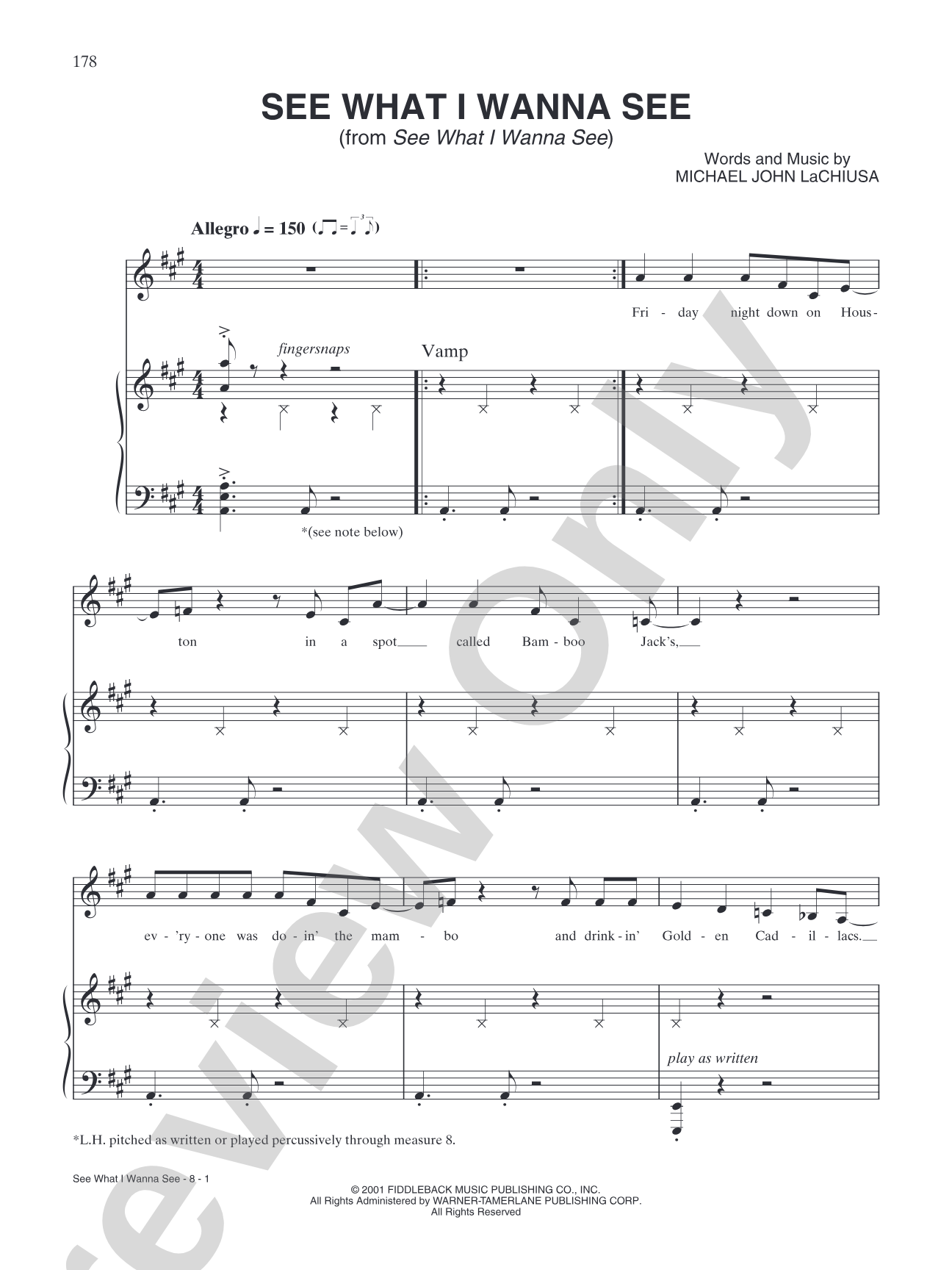
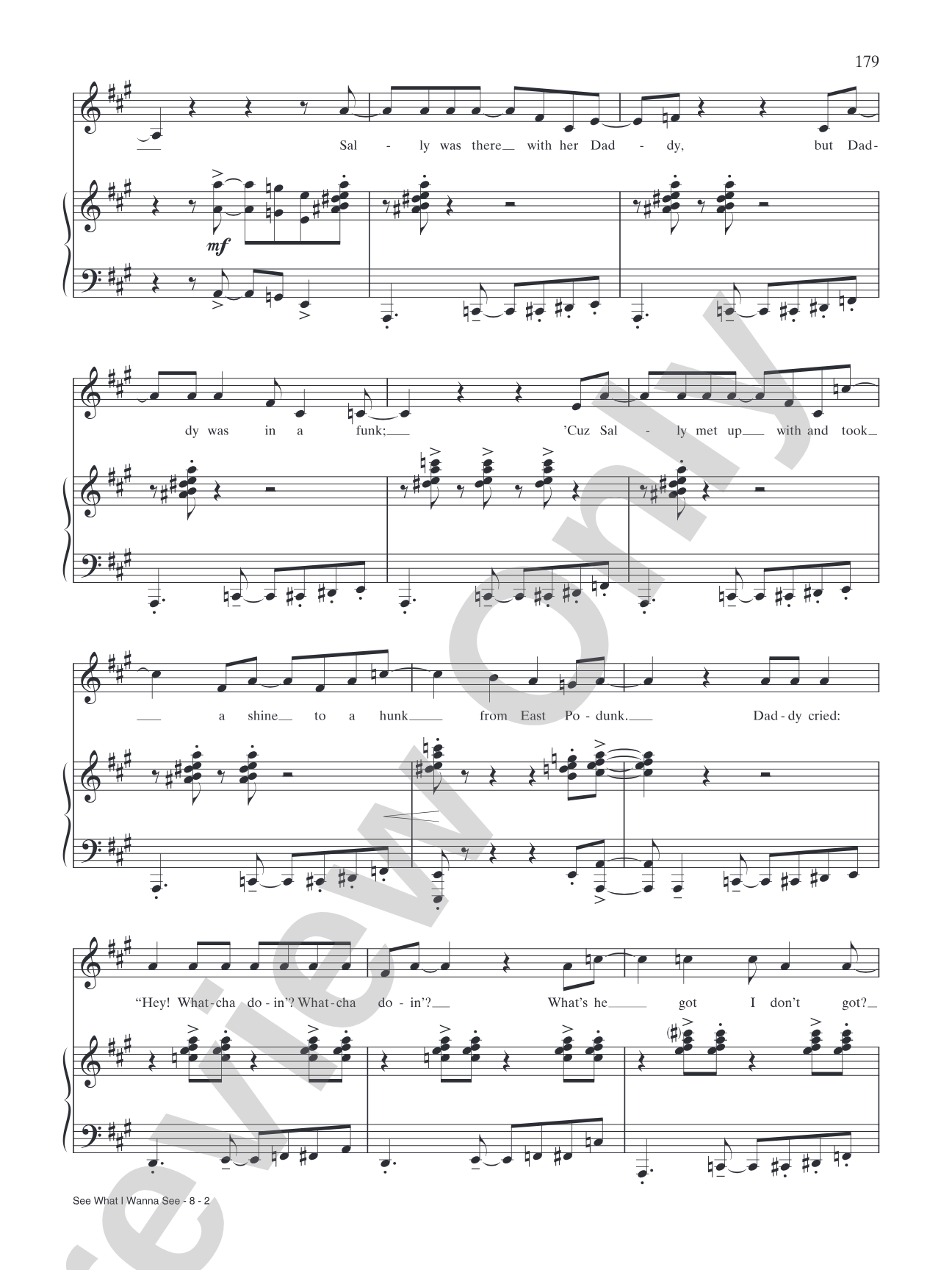

See What I Wanna See (from "See What I Wanna See"): Piano/Vocal/Chords
Michael John LaChiusa
Item: 00-XS-0000258
$5.99
One moment…
Related Items
Tom (from "Hello Again"): Piano/Vocal/Chords |
$5.99
|
View | |
Way Back to Paradise (from "Marie Christine"): Piano/Vocal/Chords |
$5.99
|
View | |
Beautiful (from "Marie Christine"): Piano/Vocal/Chords |
$4.99
|
View | |
I Don't Hear the Ocean (from "Marie Christine"): Piano/Vocal/Chords |
$5.99
|
View | |
Welcome to My Party (from "The Wild Party"): Piano/Vocal/Chords |
$5.99
|
View | |
People Like Us (from "The Wild Party"): Piano/Vocal/Chords |
$5.99
|
View | |
How Many Women In the World? (from "The Wild Party"): Piano/Vocal/Chords |
$5.99
|
View | |
When It Ends (from "The Wild Party"): Piano/Vocal/Chords |
$4.99
|
View | |
The Bed Was Not My Own (from "Hello Again"): Piano/Vocal/Chords |
$5.99
|
View | |
Hello Again (from "Hello Again"): Piano/Vocal/Chords |
$9.99
|
View | |
The One I Love (from "Hello Again"): Piano/Vocal/Chords |
$4.99
|
View | |
The Mistress of the Senator (from "Hello Again"): Piano/Vocal/Chords |
$9.99
|
View | |
Eleanor Sleeps Here (from "First Lady Suite"): Piano/Vocal/Chords |
$4.99
|
View | |
I Ran (from "Little Fish"): Piano/Vocal/Chords |
$4.99
|
View | |
By The Way (from "Little Fish"): Piano/Vocal/Chords |
$4.99
|
View | |
Remember Me (from "Little Fish"): Piano/Vocal/Chords |
$5.99
|
View | |
Little Fish (from "Little Fish"): Piano/Vocal/Chords |
$4.99
|
View | |
Simple Creature (from "Little Fish"): Piano/Vocal/Chords |
$4.99
|
View | |
The Smallest Thing (from "First Lady Suite"): Piano/Vocal/Chords |
$9.99
|
View | |
My Husband Was An Army Man (from "First Lady Suite"): Piano/Vocal/Chords |
$9.99
|
View | |
The Christian Thing To Do (from "The Seven Deadly Sins"): Piano/Vocal/Chords |
$5.99
|
View | |
The Highest Yellow (from "The Highest Yellow"): Piano/Vocal/Chords |
$5.99
|
View | |
Martirio (from "Bernarda Alba"): Piano/Vocal/Chords |
$4.99
|
View | |
Adela (from "Bernarda Alba"): Piano/Vocal/Chords |
$4.99
|
View | |
The Smallest Stream (from "Bernarda Alba"): Piano/Vocal/Chords |
$4.99
|
View | |
Coffee (from "See What I Wanna See"): Piano/Vocal/Chords |
$5.99
|
View | |
Curosity (from "See What I Wanna See"): Piano/Vocal/Chords |
$4.99
|
View | |
There Will Be A Miracle (from "See What I Wanna See"): Piano/Vocal/Chords |
$5.99
|
View | |
She Looked at Me (from "See What I Wanna See"): Piano/Vocal/Chords |
$5.99
|
View | |
Fraud (from "Broken Sleep"): Piano/Vocal/Chords |
$9.99
|
View | |
The Gift of You (from "The Nutcracker"): Piano/Vocal/Chords |
$5.99
|
View | |
He Wanted a Girl (from "Giant"): Piano/Vocal/Chords |
$5.99
|
View | |
Private Property (from "Giant"): Piano/Vocal/Chords |
$4.99
|
View | |
A Stranger (from "Giant"): Piano/Vocal/Chords |
$5.99
|
View | |
Hello, Lover, Hello (from "Send (who are you? I love you)"): Piano/Vocal/Chords |
$5.99
|
View | |
Optimistic (from "Lovers and Friends"): Piano/Vocal/Chords |
$4.99
|
View | |
Tom Sawyer (from "Romance Language"): Piano/Vocal/Chords |
$5.99
|
View |
Description
This first-ever Michael John LaChiusa sheet music collection contains 39 songs from one of the most distinctive and admired theatre composers of our time. More than 250 pages of music chronicle two decades of LaChiusa shows, from early 1990s breakouts First Lady Suite and Hello Again to celebrated favorites like The Wild Party, See What I Wanna See, and much more. The composer supplied a wealth of previously unpublished music for this collection, ensuring that even the most devoted LaChiusa fan will discover new and exciting songs among these pages. Titles: * Adela (from Bernarda Alba) * Beautiful (Marie Christine) * The Bed Was Not My Own (Hello Again) * By the Way (Little Fish) * The Christian Thing to Do (The Seven Deadly Sins) * Coffee (See What I Wanna See) * Curiosity (See What I Wanna See) * Eleanor Sleeps Here (First Lady Suite) * Fraud (Broken Sleep) * The Gift of You (The Nutcracker) * He Wanted a Girl (Giant) * Heaven (Hotel C'est l'Amour) * Hello Again (Hello Again) * Hello, Lover, Hello (Send (who are you? I love you) * The Highest Yellow (The Highest Yellow) * How Many Women in the World? (The Wild Party) * I Don't Hear the Ocean (Marie Christine) * I Ran (Little Fish) * Little Fish (Little Fish) * Martirio (Bernarda Alba) * Mistress of the Senator (Hello Again) * My Husband Was an Army Man (First Lady Suite) * The One I Love (Hello Again) * Optimistic (Lovers and Friends) * People Like Us (The Wild Party) * Private Property (Giant) * Remember Me (Little Fish) * See What I Wanna See (See What I Wanna See) * She Looked at Me (See What I Wanna See) * Simple Creature (Little Fish) * The Smallest Stream (Bernarda Alba) * The Smallest Thing (First Lady Suite) * A Stranger (Giant) * There Will Be a Miracle (See What I Wanna See) * Tom (Hello Again) * Tom Sawyer (Romance Language) * Way Back to Paradise (Marie Christine) * Welcome to My Party (The Wild Party) * When It Ends (The Wild Party).


See What I Wanna See (from "See What I Wanna See"): Piano/Vocal/Chords isn't in MakeMusic Cloud just yet...but it could be. Let us know you'd like to see it, and you'll help shape what comes next. In the meantime, start a free trial and dive into thousands of interactive titles your students can play along with today.
Request This Title
Tell us you want it.
Start Your Free Trial
Explore everything that's ready to play right now.
Sample Audio
No sample audio found.
Sample Video
No sample videos found.
Additional Details
Publisher:
Alfred Music
Page Count:
260
SKU:
00-XS-0000258
More about this title
About the Composer: Michael John LaChisua
Michael John LaChiusa is a composer whose theatrical works have defined contemporary musical theatre through their literary ambition and harmonic sophistication. His scores draw on classical forms, jazz idioms, and art song traditions, creating music that elevates the emotional and intellectual stakes of the stories he tells. Works like The Wild Party, Marie Christine, and See What I Wanna See have established him as one of the most distinctive voices writing for the stage today.
LaChiusa's compositions demand skilled musicians who can navigate complex harmonies, intricate rhythmic patterns, and deeply emotional storytelling. His influence extends beyond Broadway to concert halls and university productions, where his music continues to challenge and inspire performers seeking contemporary repertoire with real artistic substance.
Why we love this
LaChiusa's music resists easy categorization, blending classical craft with contemporary sensibility in ways that reward serious study. This collection gives singers and pianists direct access to one of the most intellectually rigorous bodies of contemporary theatrical music, with pieces that work equally well in concert recitals, audition prep, and staged contexts. The breadth of shows represented means you'll find material spanning multiple dramatic styles and vocal types.
What to expect
LaChiusa's music inhabits a space between art song sophistication and theatrical immediacy, often unsettling in its harmonic complexity while remaining deeply human in its emotional expression. These songs range from introspective and vulnerable to propulsive and theatrically present, but they share a quality of literary richness and musical substance that distinguishes them from conventional theatre music.
Who it's for
This collection serves singers preparing auditions for contemporary musical theatre roles, pianists developing their collaborative and solo repertoire, and voice teachers seeking material that challenges students beyond traditional standards. It's equally valuable for advanced high school singers, college musical theatre programs, and adult vocalists exploring contemporary art song.
How to get the most out of it
- Pay close attention to LaChiusa's harmonic language in the piano part; these harmonies often carry as much emotional weight as the vocal line and require clear articulation to land their full effect.
- Treat these songs as chamber music rather than simple accompaniment situations. The relationship between voice and piano is conversational and interdependent, not hierarchical.
- Use the song titles and show contexts as interpretive anchors. LaChiusa's music serves specific dramatic moments, and understanding that context will inform phrasing, dynamics, and emotional coloring.
How to use it
Individual songs work beautifully in recital settings, especially when paired with art song or other contemporary material that values harmonic risk and emotional authenticity. For musical theatre programs, this collection offers audition material and performance pieces that showcase vocal maturity and interpretive depth. Voice studios can use these songs to develop students' ability to navigate complex harmonies and psychologically layered character work.
Skills your students will build
- Reading and performing complex harmonic progressions and jazz-influenced chord structures
- Interpreting theatrical context to inform vocal choices and phrasing
- Collaborating with pianists on music where the accompaniment carries equal dramatic responsibility
- Sustaining emotional authenticity in sophisticated contemporary material
- Navigating contemporary rhythmic flexibility and rubato within structured harmonic frameworks