
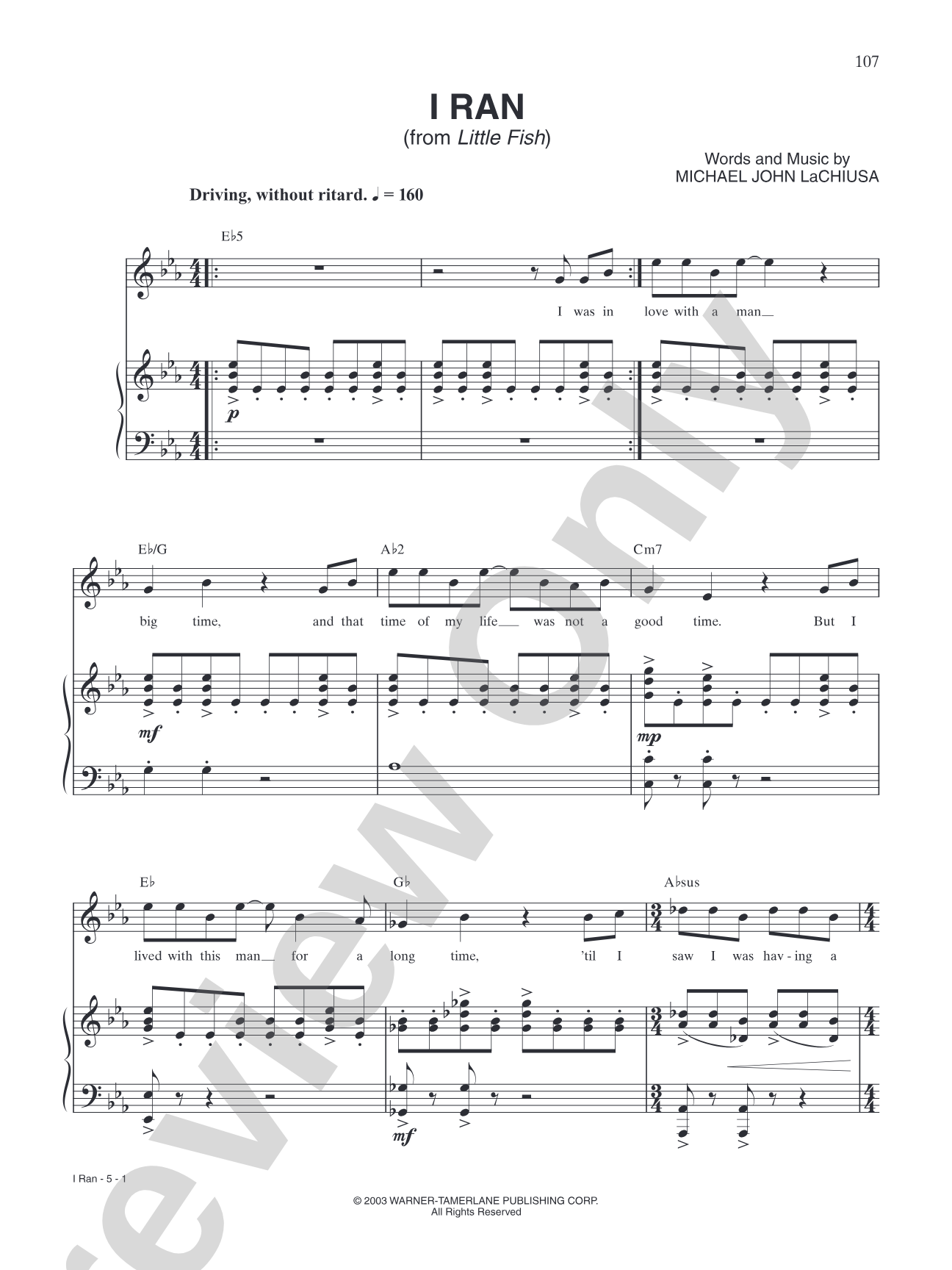

I Ran (from "Little Fish"): Piano/Vocal/Chords
Michael John LaChiusa
Item: 00-XS-0000296
$4.99
One moment…
Related Items
Tom (from "Hello Again"): Piano/Vocal/Chords |
$5.99
|
View | |
Way Back to Paradise (from "Marie Christine"): Piano/Vocal/Chords |
$5.99
|
View | |
Beautiful (from "Marie Christine"): Piano/Vocal/Chords |
$4.99
|
View | |
I Don't Hear the Ocean (from "Marie Christine"): Piano/Vocal/Chords |
$5.99
|
View | |
See What I Wanna See (from "See What I Wanna See"): Piano/Vocal/Chords |
$5.99
|
View | |
Welcome to My Party (from "The Wild Party"): Piano/Vocal/Chords |
$5.99
|
View | |
People Like Us (from "The Wild Party"): Piano/Vocal/Chords |
$5.99
|
View | |
How Many Women In the World? (from "The Wild Party"): Piano/Vocal/Chords |
$5.99
|
View | |
When It Ends (from "The Wild Party"): Piano/Vocal/Chords |
$4.99
|
View | |
The Bed Was Not My Own (from "Hello Again"): Piano/Vocal/Chords |
$5.99
|
View | |
Hello Again (from "Hello Again"): Piano/Vocal/Chords |
$9.99
|
View | |
The One I Love (from "Hello Again"): Piano/Vocal/Chords |
$4.99
|
View | |
The Mistress of the Senator (from "Hello Again"): Piano/Vocal/Chords |
$9.99
|
View | |
Eleanor Sleeps Here (from "First Lady Suite"): Piano/Vocal/Chords |
$4.99
|
View | |
By The Way (from "Little Fish"): Piano/Vocal/Chords |
$4.99
|
View | |
Remember Me (from "Little Fish"): Piano/Vocal/Chords |
$5.99
|
View | |
Little Fish (from "Little Fish"): Piano/Vocal/Chords |
$4.99
|
View | |
Simple Creature (from "Little Fish"): Piano/Vocal/Chords |
$4.99
|
View | |
The Smallest Thing (from "First Lady Suite"): Piano/Vocal/Chords |
$9.99
|
View | |
My Husband Was An Army Man (from "First Lady Suite"): Piano/Vocal/Chords |
$9.99
|
View | |
The Christian Thing To Do (from "The Seven Deadly Sins"): Piano/Vocal/Chords |
$5.99
|
View | |
The Highest Yellow (from "The Highest Yellow"): Piano/Vocal/Chords |
$5.99
|
View | |
Martirio (from "Bernarda Alba"): Piano/Vocal/Chords |
$4.99
|
View | |
Adela (from "Bernarda Alba"): Piano/Vocal/Chords |
$4.99
|
View | |
The Smallest Stream (from "Bernarda Alba"): Piano/Vocal/Chords |
$4.99
|
View | |
Coffee (from "See What I Wanna See"): Piano/Vocal/Chords |
$5.99
|
View | |
Curosity (from "See What I Wanna See"): Piano/Vocal/Chords |
$4.99
|
View | |
There Will Be A Miracle (from "See What I Wanna See"): Piano/Vocal/Chords |
$5.99
|
View | |
She Looked at Me (from "See What I Wanna See"): Piano/Vocal/Chords |
$5.99
|
View | |
Fraud (from "Broken Sleep"): Piano/Vocal/Chords |
$9.99
|
View | |
The Gift of You (from "The Nutcracker"): Piano/Vocal/Chords |
$5.99
|
View | |
He Wanted a Girl (from "Giant"): Piano/Vocal/Chords |
$5.99
|
View | |
Private Property (from "Giant"): Piano/Vocal/Chords |
$4.99
|
View | |
A Stranger (from "Giant"): Piano/Vocal/Chords |
$5.99
|
View | |
Hello, Lover, Hello (from "Send (who are you? I love you)"): Piano/Vocal/Chords |
$5.99
|
View | |
Optimistic (from "Lovers and Friends"): Piano/Vocal/Chords |
$4.99
|
View | |
Tom Sawyer (from "Romance Language"): Piano/Vocal/Chords |
$5.99
|
View |
Description
This first-ever Michael John LaChiusa sheet music collection contains 39 songs from one of the most distinctive and admired theatre composers of our time. More than 250 pages of music chronicle two decades of LaChiusa shows, from early 1990s breakouts First Lady Suite and Hello Again to celebrated favorites like The Wild Party, See What I Wanna See, and much more. The composer supplied a wealth of previously unpublished music for this collection, ensuring that even the most devoted LaChiusa fan will discover new and exciting songs among these pages. Titles: * Adela (from Bernarda Alba) * Beautiful (Marie Christine) * The Bed Was Not My Own (Hello Again) * By the Way (Little Fish) * The Christian Thing to Do (The Seven Deadly Sins) * Coffee (See What I Wanna See) * Curiosity (See What I Wanna See) * Eleanor Sleeps Here (First Lady Suite) * Fraud (Broken Sleep) * The Gift of You (The Nutcracker) * He Wanted a Girl (Giant) * Heaven (Hotel C'est l'Amour) * Hello Again (Hello Again) * Hello, Lover, Hello (Send (who are you? I love you) * The Highest Yellow (The Highest Yellow) * How Many Women in the World? (The Wild Party) * I Don't Hear the Ocean (Marie Christine) * I Ran (Little Fish) * Little Fish (Little Fish) * Martirio (Bernarda Alba) * Mistress of the Senator (Hello Again) * My Husband Was an Army Man (First Lady Suite) * The One I Love (Hello Again) * Optimistic (Lovers and Friends) * People Like Us (The Wild Party) * Private Property (Giant) * Remember Me (Little Fish) * See What I Wanna See (See What I Wanna See) * She Looked at Me (See What I Wanna See) * Simple Creature (Little Fish) * The Smallest Stream (Bernarda Alba) * The Smallest Thing (First Lady Suite) * A Stranger (Giant) * There Will Be a Miracle (See What I Wanna See) * Tom (Hello Again) * Tom Sawyer (Romance Language) * Way Back to Paradise (Marie Christine) * Welcome to My Party (The Wild Party) * When It Ends (The Wild Party).


I Ran (from "Little Fish"): Piano/Vocal/Chords isn't in MakeMusic Cloud just yet...but it could be. Let us know you'd like to see it, and you'll help shape what comes next. In the meantime, start a free trial and dive into thousands of interactive titles your students can play along with today.
Request This Title
Tell us you want it.
Start Your Free Trial
Explore everything that's ready to play right now.
Sample Audio
No sample audio found.
Sample Video
No sample videos found.
Additional Details
Publisher:
Alfred Music
Page Count:
260
SKU:
00-XS-0000296
More about this title
About the Composer: Michael John LaChisua
Michael John LaChiusa has established himself as one of Broadway's most inventive and intellectually ambitious composers. His theatrical scores are known for their harmonic sophistication, intricate orchestration, and ability to serve narratives that range from intimate psychological dramas to sweeping historical epics. His works have been performed at major theaters nationwide and internationally, earning him recognition as a composer who treats the musical theatre form with the rigor and artistry of concert music.
LaChiusa's catalogue spans from the politically charged Hello Again and The Wild Party to deeply character-driven pieces like Marie Christine and Bernarda Alba. His compositional voice resists easy categorization, incorporating elements of classical music, jazz harmony, and contemporary orchestration while remaining deeply theatrical. For music educators and serious singers, his songs offer windows into how contemporary composers build meaning through melody, harmony, and text setting.
Why we love this
This collection grants access to nearly 40 LaChiusa songs in one volume, making it possible for voice teachers, pianists, and singers to explore a major contemporary theatrical voice without hunting across individual octavos. The harmonic language and melodic writing reward careful study; these are songs that reveal new layers with repeated performance. For recitalists looking to program something contemporary with real substance, LaChiusa's music stands apart from typical pop-influenced theatre fare.
What to expect
These songs balance intellectual complexity with direct emotional expression. The melodies can feel conversational one moment and soaring the next, reflecting the theatrical contexts from which they emerge. LaChiusa's harmonic language is modern without being austere, creating accompaniments that support the voice while maintaining their own harmonic interest.
Who it's for
Voice teachers seeking contemporary art songs with theatrical depth will find substantial material here. Singers preparing cabaret or concert recitals, pianists accompanying advanced students, and music theatre performers building solo repertoire will all benefit from this first official collection. This book serves anyone looking to study how a sophisticated composer shapes language, emotion, and character through music.
How to get the most out of it
- Study the harmonic movement underneath the vocal line; LaChiusa's accompaniments are not decorative, and understanding the piano writing clarifies phrasing and breath placement
- Pay close attention to text stress and natural speech rhythm, particularly in songs with conversational or monologue-like qualities; his melodies often prioritize lyrical meaning over geometric symmetry
- Treat the chord symbols as a foundation for exploration rather than a harmonic ceiling; the collection's context suggests these are singable editions, and performers have room to shape dynamics and tempo within the emotional arc of each song
How to use it
Include individual songs in voice recitals where you want to program contemporary work with genuine dramatic substance. A song or two can anchor a set focused on American musical theatre, or several pieces could form a themed program exploring how LaChiusa approaches different dramatic situations and character types. These songs work equally well in intimate concert settings and in studio classes where students study contemporary vocal writing.
Skills your students will build
- Interpreting contemporary vocal music with complex harmonic language
- Connecting text to melodic shape and phrasing in theatrical contexts
- Collaborative piano reading with awareness of compositional intent beyond chord changes
- Understanding how contemporary composers serve dramatic character through music