
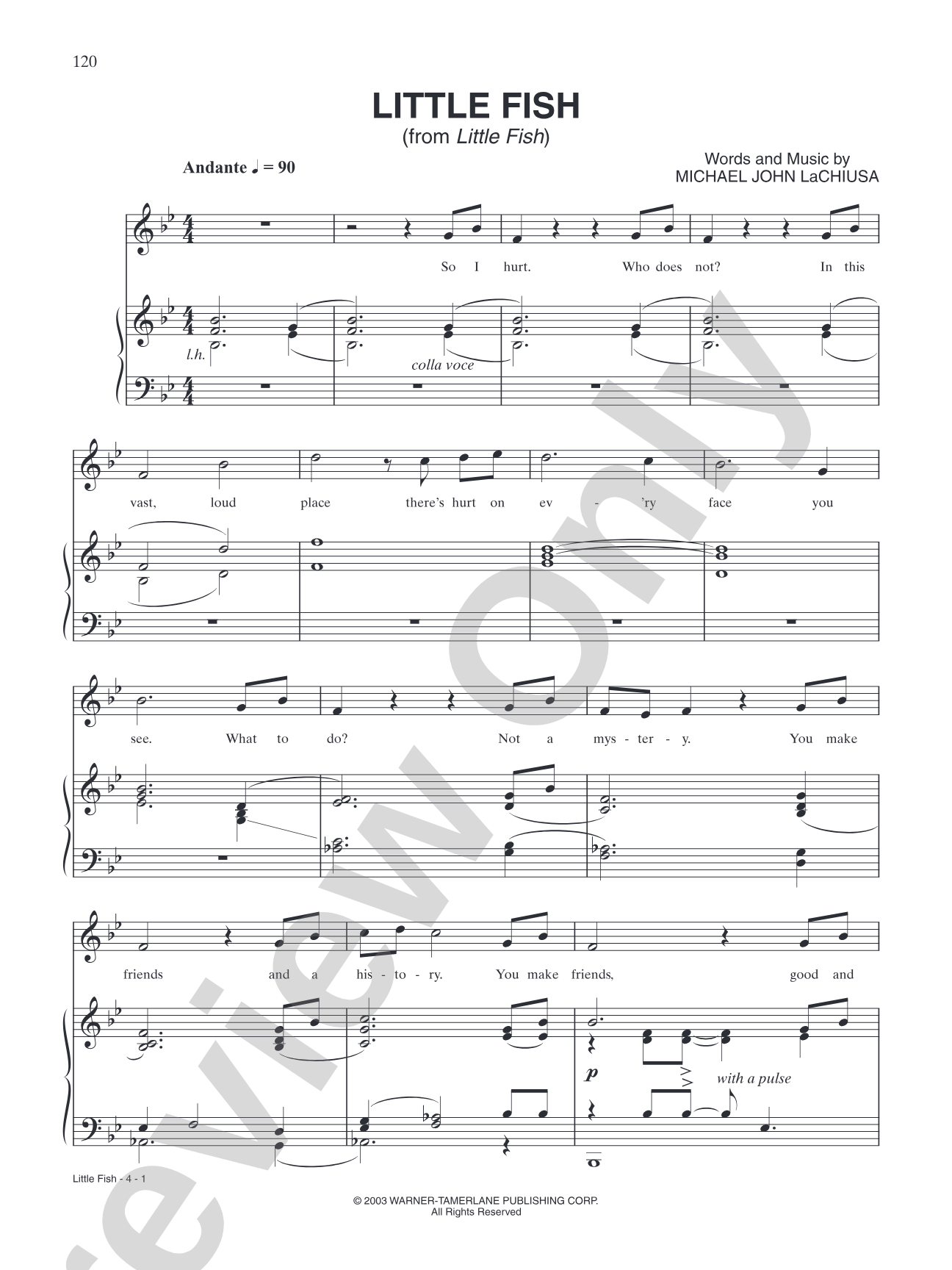

Little Fish (from "Little Fish"): Piano/Vocal/Chords
Michael John LaChiusa
Item: 00-XS-0000299
$4.99
One moment…
Related Items
Tom (from "Hello Again"): Piano/Vocal/Chords |
$5.99
|
View | |
Way Back to Paradise (from "Marie Christine"): Piano/Vocal/Chords |
$5.99
|
View | |
Beautiful (from "Marie Christine"): Piano/Vocal/Chords |
$4.99
|
View | |
I Don't Hear the Ocean (from "Marie Christine"): Piano/Vocal/Chords |
$5.99
|
View | |
See What I Wanna See (from "See What I Wanna See"): Piano/Vocal/Chords |
$5.99
|
View | |
Welcome to My Party (from "The Wild Party"): Piano/Vocal/Chords |
$5.99
|
View | |
People Like Us (from "The Wild Party"): Piano/Vocal/Chords |
$5.99
|
View | |
How Many Women In the World? (from "The Wild Party"): Piano/Vocal/Chords |
$5.99
|
View | |
When It Ends (from "The Wild Party"): Piano/Vocal/Chords |
$4.99
|
View | |
The Bed Was Not My Own (from "Hello Again"): Piano/Vocal/Chords |
$5.99
|
View | |
Hello Again (from "Hello Again"): Piano/Vocal/Chords |
$9.99
|
View | |
The One I Love (from "Hello Again"): Piano/Vocal/Chords |
$4.99
|
View | |
The Mistress of the Senator (from "Hello Again"): Piano/Vocal/Chords |
$9.99
|
View | |
Eleanor Sleeps Here (from "First Lady Suite"): Piano/Vocal/Chords |
$4.99
|
View | |
I Ran (from "Little Fish"): Piano/Vocal/Chords |
$4.99
|
View | |
By The Way (from "Little Fish"): Piano/Vocal/Chords |
$4.99
|
View | |
Remember Me (from "Little Fish"): Piano/Vocal/Chords |
$5.99
|
View | |
Simple Creature (from "Little Fish"): Piano/Vocal/Chords |
$4.99
|
View | |
The Smallest Thing (from "First Lady Suite"): Piano/Vocal/Chords |
$9.99
|
View | |
My Husband Was An Army Man (from "First Lady Suite"): Piano/Vocal/Chords |
$9.99
|
View | |
The Christian Thing To Do (from "The Seven Deadly Sins"): Piano/Vocal/Chords |
$5.99
|
View | |
The Highest Yellow (from "The Highest Yellow"): Piano/Vocal/Chords |
$5.99
|
View | |
Martirio (from "Bernarda Alba"): Piano/Vocal/Chords |
$4.99
|
View | |
Adela (from "Bernarda Alba"): Piano/Vocal/Chords |
$4.99
|
View | |
The Smallest Stream (from "Bernarda Alba"): Piano/Vocal/Chords |
$4.99
|
View | |
Coffee (from "See What I Wanna See"): Piano/Vocal/Chords |
$5.99
|
View | |
Curosity (from "See What I Wanna See"): Piano/Vocal/Chords |
$4.99
|
View | |
There Will Be A Miracle (from "See What I Wanna See"): Piano/Vocal/Chords |
$5.99
|
View | |
She Looked at Me (from "See What I Wanna See"): Piano/Vocal/Chords |
$5.99
|
View | |
Fraud (from "Broken Sleep"): Piano/Vocal/Chords |
$9.99
|
View | |
The Gift of You (from "The Nutcracker"): Piano/Vocal/Chords |
$5.99
|
View | |
He Wanted a Girl (from "Giant"): Piano/Vocal/Chords |
$5.99
|
View | |
Private Property (from "Giant"): Piano/Vocal/Chords |
$4.99
|
View | |
A Stranger (from "Giant"): Piano/Vocal/Chords |
$5.99
|
View | |
Hello, Lover, Hello (from "Send (who are you? I love you)"): Piano/Vocal/Chords |
$5.99
|
View | |
Optimistic (from "Lovers and Friends"): Piano/Vocal/Chords |
$4.99
|
View | |
Tom Sawyer (from "Romance Language"): Piano/Vocal/Chords |
$5.99
|
View |
Description
This first-ever Michael John LaChiusa sheet music collection contains 39 songs from one of the most distinctive and admired theatre composers of our time. More than 250 pages of music chronicle two decades of LaChiusa shows, from early 1990s breakouts First Lady Suite and Hello Again to celebrated favorites like The Wild Party, See What I Wanna See, and much more. The composer supplied a wealth of previously unpublished music for this collection, ensuring that even the most devoted LaChiusa fan will discover new and exciting songs among these pages. Titles: * Adela (from Bernarda Alba) * Beautiful (Marie Christine) * The Bed Was Not My Own (Hello Again) * By the Way (Little Fish) * The Christian Thing to Do (The Seven Deadly Sins) * Coffee (See What I Wanna See) * Curiosity (See What I Wanna See) * Eleanor Sleeps Here (First Lady Suite) * Fraud (Broken Sleep) * The Gift of You (The Nutcracker) * He Wanted a Girl (Giant) * Heaven (Hotel C'est l'Amour) * Hello Again (Hello Again) * Hello, Lover, Hello (Send (who are you? I love you) * The Highest Yellow (The Highest Yellow) * How Many Women in the World? (The Wild Party) * I Don't Hear the Ocean (Marie Christine) * I Ran (Little Fish) * Little Fish (Little Fish) * Martirio (Bernarda Alba) * Mistress of the Senator (Hello Again) * My Husband Was an Army Man (First Lady Suite) * The One I Love (Hello Again) * Optimistic (Lovers and Friends) * People Like Us (The Wild Party) * Private Property (Giant) * Remember Me (Little Fish) * See What I Wanna See (See What I Wanna See) * She Looked at Me (See What I Wanna See) * Simple Creature (Little Fish) * The Smallest Stream (Bernarda Alba) * The Smallest Thing (First Lady Suite) * A Stranger (Giant) * There Will Be a Miracle (See What I Wanna See) * Tom (Hello Again) * Tom Sawyer (Romance Language) * Way Back to Paradise (Marie Christine) * Welcome to My Party (The Wild Party) * When It Ends (The Wild Party).


Little Fish (from "Little Fish"): Piano/Vocal/Chords isn't in MakeMusic Cloud just yet...but it could be. Let us know you'd like to see it, and you'll help shape what comes next. In the meantime, start a free trial and dive into thousands of interactive titles your students can play along with today.
Request This Title
Tell us you want it.
Start Your Free Trial
Explore everything that's ready to play right now.
Sample Audio
No sample audio found.
Sample Video
No sample videos found.
Additional Details
Publisher:
Alfred Music
Page Count:
260
SKU:
00-XS-0000299
More about this title
About the Composer: Michael John LaChisua
Michael John LaChisua stands among Broadway's most inventive contemporary composers, known for music that defies easy categorization. His work spans intimate chamber musicals and large-scale productions, each marked by harmonic sophistication, theatrical storytelling, and a refusal to settle into conventional song structures. Over three decades, he has created scores for productions ranging from the chamber elegance of Hello Again to the raw energy of The Wild Party, earning recognition from peers and audiences alike for his commitment to advancing the musical theatre form.
LaChisua's compositional voice emerges from deep listening to character and narrative. Rather than imposing a stylistic template onto every show, he allows each piece to demand its own musical language. This approach has made him an essential figure for singers, musicians, and theatre artists seeking material that challenges conventional expectations while remaining deeply human and performable.
Why we love this
LaChisua's music rewards careful listening and repeated performance. These songs demand vocal flexibility, harmonic awareness, and interpretive maturity from pianists and singers, making the collection valuable for advanced students and professional performers alike. The sheer range of theatrical contexts represented here gives teachers and coaches an exceptional resource for pairing singers with material that fits their voice type, emotional range, and artistic development.
What to expect
LaChisua's music inhabits a sophisticated emotional landscape where sophistication and intimacy coexist. Songs shift between introspection and theatrical declaration, often within a single piece; harmonies surprise and comfort in equal measure, and the relationship between piano and voice feels like a genuine conversation rather than accompaniment to a solo line. There is always an intelligence to the writing, a sense that the composer trusts the performer to meet the music's demands.
Who it's for
This collection serves advanced classical singers exploring art song and contemporary theatre music, as well as pianists seeking imaginative and demanding repertoire beyond the standard recital canon. Musical theatre performers and coaches building audition books will find substantial material for discovering songs that fit specific voice types and dramatic needs. Voice teachers preparing students for college auditions or advanced solo performance will appreciate the musical literacy and interpretive challenge LaChisua's songs provide.
How to get the most out of it
- Study the original cast recordings alongside the sheet music to hear how rhythm, phrasing, and dynamic shape support the lyrical content. LaChisua's written notation captures intent, but the recorded performances illuminate interpretive choices that aren't always obvious on the page.
- Pay attention to harmonic movement beneath the vocal line rather than treating it as accompaniment. These songs often use chords and progressions that mirror or complicate the emotional journey, and pianists who listen to the harmony gain insight into where the voice should breathe and how phrases should arc.
- Honor the specificity of each song's style and orchestration. A piano reduction of material originally written for larger ensembles requires thoughtfulness about registration, voicing, and balance to honor the composer's intentions without the full orchestral color.
How to use it
Integrate individual songs into recital programs alongside classical and contemporary art song to demonstrate the breadth of vocal literature available to trained singers. Use selections in masterclasses focused on musical theatre song interpretation, particularly for students transitioning between classical and contemporary styles. Assign these pieces in voice studio when students are ready for material that demands both vocal control and dramatic specificity.
Skills your students will build
- Reading and performing contemporary harmonic language with altered chords and unexpected progressions
- Sustaining musical communication through complex lyrical and melodic rhythms
- Interpreting character and dramatic intention through vocal placement and phrasing
- Balancing technical vocal demands with theatrical authenticity
- Collaborative listening and adaptation between pianist and singer