
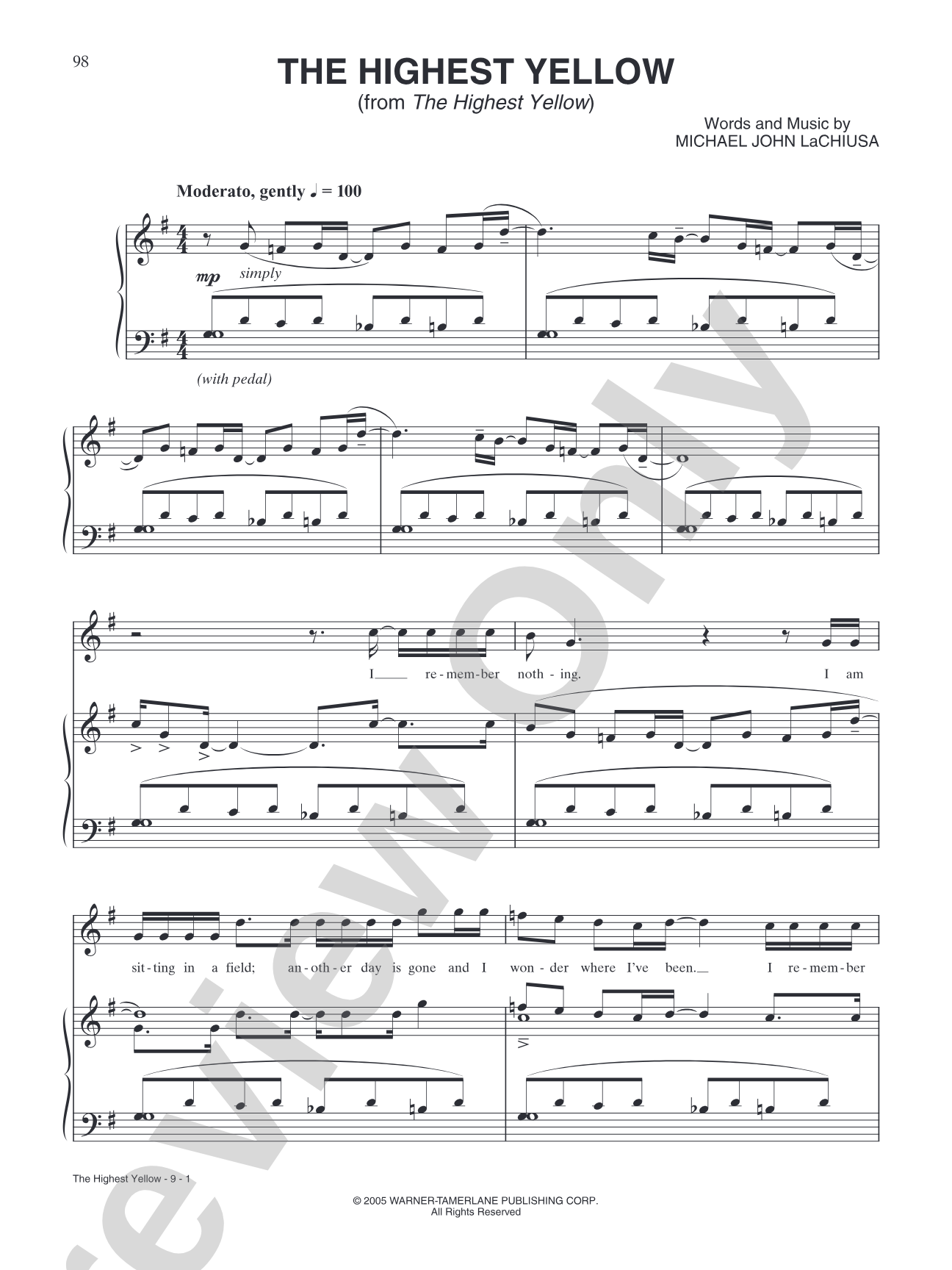
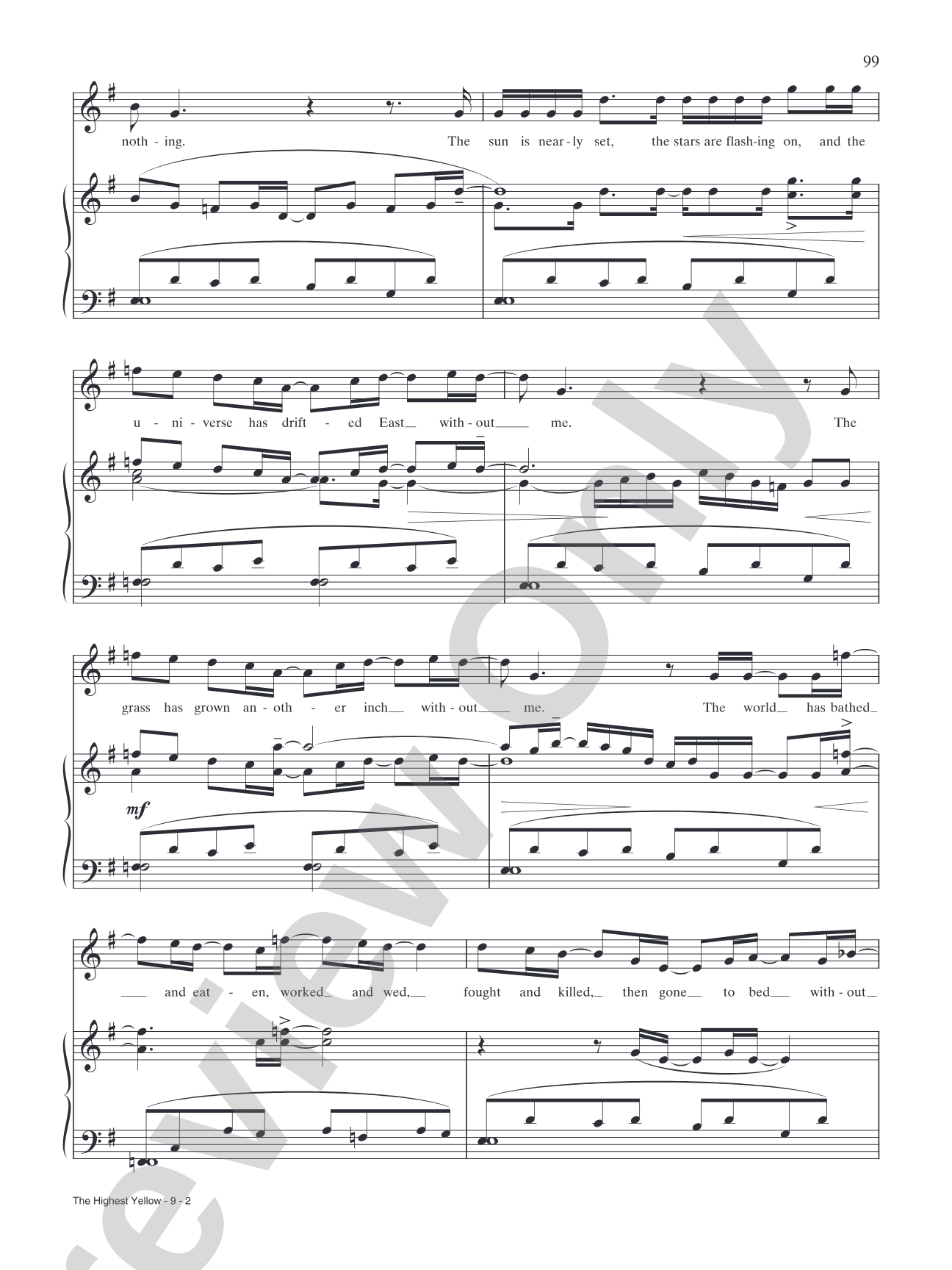

The Highest Yellow (from "The Highest Yellow"): Piano/Vocal/Chords
Michael John LaChiusa
Item: 00-XS-0000304
$5.99
One moment…
Related Items
Tom (from "Hello Again"): Piano/Vocal/Chords |
$5.99
|
View | |
Way Back to Paradise (from "Marie Christine"): Piano/Vocal/Chords |
$5.99
|
View | |
Beautiful (from "Marie Christine"): Piano/Vocal/Chords |
$4.99
|
View | |
I Don't Hear the Ocean (from "Marie Christine"): Piano/Vocal/Chords |
$5.99
|
View | |
See What I Wanna See (from "See What I Wanna See"): Piano/Vocal/Chords |
$5.99
|
View | |
Welcome to My Party (from "The Wild Party"): Piano/Vocal/Chords |
$5.99
|
View | |
People Like Us (from "The Wild Party"): Piano/Vocal/Chords |
$5.99
|
View | |
How Many Women In the World? (from "The Wild Party"): Piano/Vocal/Chords |
$5.99
|
View | |
When It Ends (from "The Wild Party"): Piano/Vocal/Chords |
$4.99
|
View | |
The Bed Was Not My Own (from "Hello Again"): Piano/Vocal/Chords |
$5.99
|
View | |
Hello Again (from "Hello Again"): Piano/Vocal/Chords |
$9.99
|
View | |
The One I Love (from "Hello Again"): Piano/Vocal/Chords |
$4.99
|
View | |
The Mistress of the Senator (from "Hello Again"): Piano/Vocal/Chords |
$9.99
|
View | |
Eleanor Sleeps Here (from "First Lady Suite"): Piano/Vocal/Chords |
$4.99
|
View | |
I Ran (from "Little Fish"): Piano/Vocal/Chords |
$4.99
|
View | |
By The Way (from "Little Fish"): Piano/Vocal/Chords |
$4.99
|
View | |
Remember Me (from "Little Fish"): Piano/Vocal/Chords |
$5.99
|
View | |
Little Fish (from "Little Fish"): Piano/Vocal/Chords |
$4.99
|
View | |
Simple Creature (from "Little Fish"): Piano/Vocal/Chords |
$4.99
|
View | |
The Smallest Thing (from "First Lady Suite"): Piano/Vocal/Chords |
$9.99
|
View | |
My Husband Was An Army Man (from "First Lady Suite"): Piano/Vocal/Chords |
$9.99
|
View | |
The Christian Thing To Do (from "The Seven Deadly Sins"): Piano/Vocal/Chords |
$5.99
|
View | |
Martirio (from "Bernarda Alba"): Piano/Vocal/Chords |
$4.99
|
View | |
Adela (from "Bernarda Alba"): Piano/Vocal/Chords |
$4.99
|
View | |
The Smallest Stream (from "Bernarda Alba"): Piano/Vocal/Chords |
$4.99
|
View | |
Coffee (from "See What I Wanna See"): Piano/Vocal/Chords |
$5.99
|
View | |
Curosity (from "See What I Wanna See"): Piano/Vocal/Chords |
$4.99
|
View | |
There Will Be A Miracle (from "See What I Wanna See"): Piano/Vocal/Chords |
$5.99
|
View | |
She Looked at Me (from "See What I Wanna See"): Piano/Vocal/Chords |
$5.99
|
View | |
Fraud (from "Broken Sleep"): Piano/Vocal/Chords |
$9.99
|
View | |
The Gift of You (from "The Nutcracker"): Piano/Vocal/Chords |
$5.99
|
View | |
He Wanted a Girl (from "Giant"): Piano/Vocal/Chords |
$5.99
|
View | |
Private Property (from "Giant"): Piano/Vocal/Chords |
$4.99
|
View | |
A Stranger (from "Giant"): Piano/Vocal/Chords |
$5.99
|
View | |
Hello, Lover, Hello (from "Send (who are you? I love you)"): Piano/Vocal/Chords |
$5.99
|
View | |
Optimistic (from "Lovers and Friends"): Piano/Vocal/Chords |
$4.99
|
View | |
Tom Sawyer (from "Romance Language"): Piano/Vocal/Chords |
$5.99
|
View |
Description
This first-ever Michael John LaChiusa sheet music collection contains 39 songs from one of the most distinctive and admired theatre composers of our time. More than 250 pages of music chronicle two decades of LaChiusa shows, from early 1990s breakouts First Lady Suite and Hello Again to celebrated favorites like The Wild Party, See What I Wanna See, and much more. The composer supplied a wealth of previously unpublished music for this collection, ensuring that even the most devoted LaChiusa fan will discover new and exciting songs among these pages. Titles: * Adela (from Bernarda Alba) * Beautiful (Marie Christine) * The Bed Was Not My Own (Hello Again) * By the Way (Little Fish) * The Christian Thing to Do (The Seven Deadly Sins) * Coffee (See What I Wanna See) * Curiosity (See What I Wanna See) * Eleanor Sleeps Here (First Lady Suite) * Fraud (Broken Sleep) * The Gift of You (The Nutcracker) * He Wanted a Girl (Giant) * Heaven (Hotel C'est l'Amour) * Hello Again (Hello Again) * Hello, Lover, Hello (Send (who are you? I love you) * The Highest Yellow (The Highest Yellow) * How Many Women in the World? (The Wild Party) * I Don't Hear the Ocean (Marie Christine) * I Ran (Little Fish) * Little Fish (Little Fish) * Martirio (Bernarda Alba) * Mistress of the Senator (Hello Again) * My Husband Was an Army Man (First Lady Suite) * The One I Love (Hello Again) * Optimistic (Lovers and Friends) * People Like Us (The Wild Party) * Private Property (Giant) * Remember Me (Little Fish) * See What I Wanna See (See What I Wanna See) * She Looked at Me (See What I Wanna See) * Simple Creature (Little Fish) * The Smallest Stream (Bernarda Alba) * The Smallest Thing (First Lady Suite) * A Stranger (Giant) * There Will Be a Miracle (See What I Wanna See) * Tom (Hello Again) * Tom Sawyer (Romance Language) * Way Back to Paradise (Marie Christine) * Welcome to My Party (The Wild Party) * When It Ends (The Wild Party).


The Highest Yellow (from "The Highest Yellow"): Piano/Vocal/Chords isn't in MakeMusic Cloud just yet...but it could be. Let us know you'd like to see it, and you'll help shape what comes next. In the meantime, start a free trial and dive into thousands of interactive titles your students can play along with today.
Request This Title
Tell us you want it.
Start Your Free Trial
Explore everything that's ready to play right now.
Sample Audio
No sample audio found.
Sample Video
No sample videos found.
Additional Details
Publisher:
Alfred Music
Page Count:
260
SKU:
00-XS-0000304
More about this title
About the Composer: Michael John LaChisua
Michael John LaChiusa stands among Broadway's most inventive and fearless composers. His work spans intimate chamber musicals and large-scale productions, all marked by sophisticated harmonies, conversational lyricism, and an unflinching willingness to explore complex emotional terrain. Over three decades, he has created music for stages ranging from off-Broadway to Lincoln Center, earning widespread recognition for his ability to match musical sophistication with theatrical storytelling.
LaChiusa's catalog reflects a composer deeply engaged with character and narrative. Whether writing for a single voice or full ensemble, he crafts music that serves the text while standing on its own musical merit. His influence on contemporary musical theatre extends beyond his own works to shape how emerging composers think about melody, harmony, and the integration of music with dramatic action.
Why we love this
This collection gives singers and pianists direct access to LaChiusa's distinctive voice across multiple shows and decades. The range within these 39 songs means you'll find pieces suited to auditions, recitals, and teaching across multiple voice types and skill levels, all grounded in the kind of theatrical sophistication that elevates student singers' understanding of how music serves character and story.
What to expect
These songs breathe with the intimacy of conversation. LaChiusa's melodies often feel speech-like, yet always musical; his harmonies surprise without feeling arbitrary. Whether tender, ironic, defiant, or vulnerable, the music meets emotional specificity with craft that rewards careful listening and repeated discovery.
Who it's for
This collection serves singers preparing auditions for musical theatre programs, performers building recital repertoire with contemporary theatrical material, and voice teachers seeking songs that challenge students to engage with sophisticated harmony and character-driven lyrics. Pianists studying contemporary song accompaniment will also find valuable material that demands both technical skill and interpretive sensitivity.
How to get the most out of it
- Study the harmonic language closely before rehearsing. LaChiusa's chords often move in unexpected directions; understanding the underlying structure helps singers stay grounded when the harmony doesn't follow predictable patterns.
- Pay attention to the relationship between the melody and the lyrical content. These songs reward detailed text analysis; the music frequently emphasizes emotional subtext rather than surface meaning.
- Use the piano part as a conversation partner, not simply accompaniment. Many of these pieces feature dialogue between voice and piano that shapes phrasing and dramatic timing.
- Experiment with tempo flexibility within marked tempos. LaChiusa's music often benefits from small rhythmic adjustments that serve the storytelling without sacrificing structural integrity.
How to use it
Weave individual songs into a recital that spans theatrical styles, using LaChiusa's work to demonstrate contemporary songwriting craft. Select pieces that connect thematically across multiple shows (love, loss, identity) to create a cohesive program, or feature a single song as a bridge between classical and contemporary material in a mixed vocal recital.
Skills your students will build
- Reading and interpreting complex harmonic progressions outside traditional tonal patterns
- Shaping phrases based on character intent and subtext rather than melodic contour alone
- Balancing lyrical clarity with musical line in speech-like melodies
- Understanding how contemporary theatre songs approach song structure differently from standard Broadway conventions