
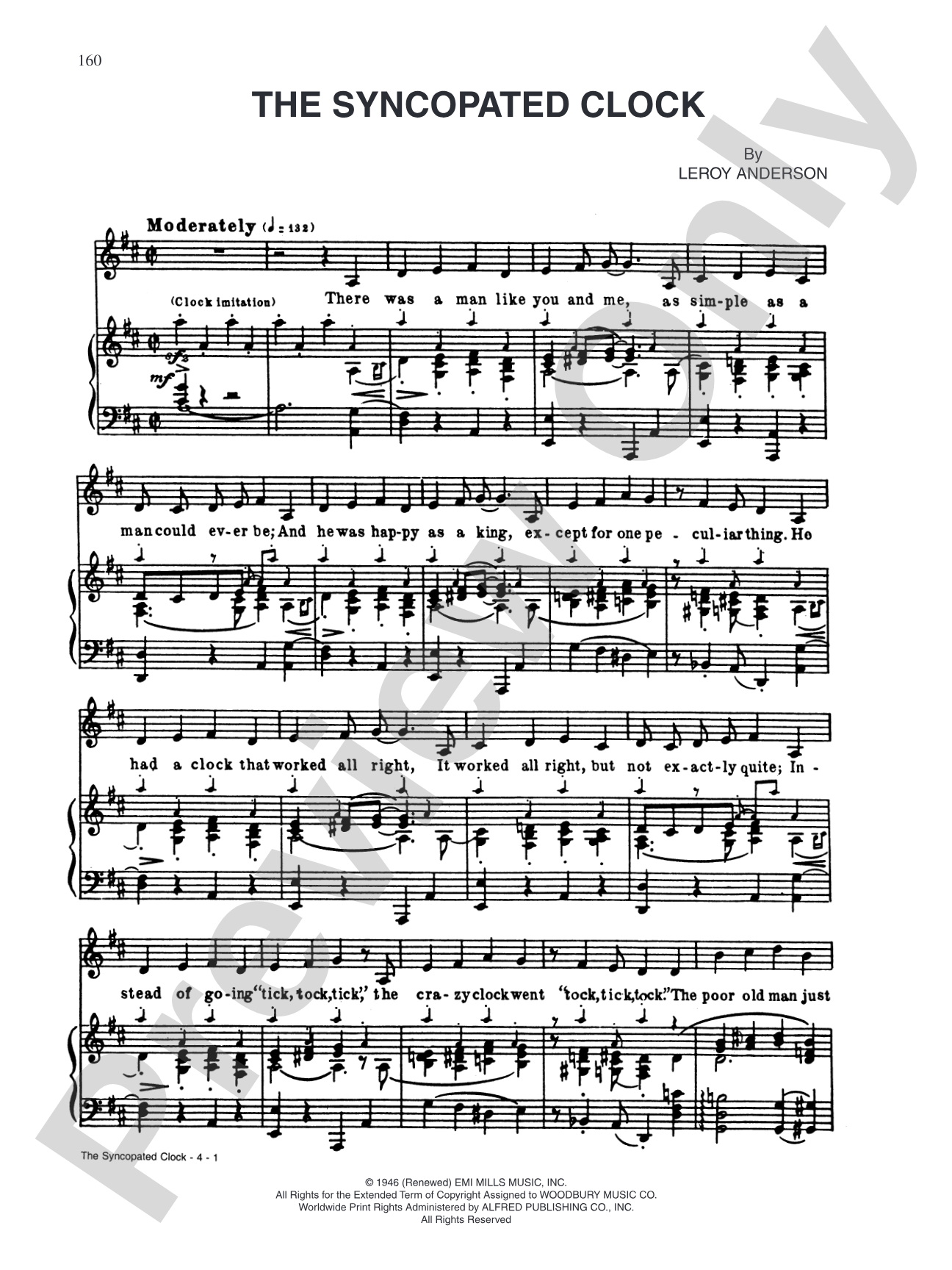

The Syncopated Clock (Vocal): Piano/Vocal/Chords
Item: 00-PSP-000516
$4.99
Pickup currently not available
Related Items
(Meet) The Flintstones: Piano/Vocal/Chords |
$4.99
|
View | |
Anywhere the Heart Goes (From "The Thorn Birds"): Piano/Vocal/Chords |
$4.99
|
View | |
As Long As We Got Each Other (From "Growing Pains"): Piano/Vocal/Chords |
$4.99
|
View | |
Best Friend (From "The Courtship of Eddie's Father"): Piano/Vocal/Chords |
$4.99
|
View | |
California: Piano/Vocal/Chords |
$4.99
|
View | |
Charlie's Angels (Main Theme): Piano/Vocal/Chords |
$4.99
|
View | |
Dallas (Main Title): Piano/Vocal/Chords |
$4.99
|
View | |
Daniel Boone (Main Theme): Piano/Vocal/Chords |
$4.99
|
View | |
E.R. (Main Theme): Piano/Vocal/Chords |
$4.99
|
View | |
Free Willy (Main Title): Piano/Vocal/Chords |
$4.99
|
View | |
Go Go Power Rangers: Piano/Vocal/Chords |
$5.99
|
View | |
Hardcastle & McCormick (Cues): Piano/Vocal/Chords |
$4.99
|
View | |
Huckleberry Hound: Piano/Vocal/Chords |
$4.99
|
View | |
In the Heat of the Night: Piano/Vocal/Chords |
$4.99
|
View | |
It's A Jungle Out There (From "Monk"): Piano/Vocal/Chords |
$4.99
|
View | |
Josie (from "Josie and the Pussycats"): Piano/Vocal/Chords |
$4.99
|
View | |
L.A. Law (Main Title): Piano/Vocal/Chords |
$4.99
|
View | |
Late Show Theme: Piano/Vocal/Chords |
$4.99
|
View | |
Moon Over Parma (From "The Drew Carey Show"): Piano/Vocal/Chords |
$4.99
|
View | |
Road Runner Theme: Piano/Vocal/Chords |
$4.99
|
View | |
Scooby Doo, Where Are You?: Piano/Vocal/Chords |
$4.99
|
View | |
Thank God for a Friend Like You (From "Hope & Gloria"): Piano/Vocal/Chords |
$4.99
|
View | |
The A-Team (Main Theme): Piano/Vocal/Chords |
$4.99
|
View | |
The Ballad of Gilligan's Isle: Piano/Vocal/Chords |
$4.99
|
View | |
The Greatest American Hero (Theme): Piano/Vocal/Chords |
$4.99
|
View | |
The Green Hornet Theme: Piano/Vocal/Chords |
$4.99
|
View | |
The Jetsons (Main Theme): Piano/Vocal/Chords |
$4.99
|
View | |
The Rosie O'Donnell Show (Opening Theme): Piano/Vocal/Chords |
$4.99
|
View | |
Fantasy Island Theme: Piano/Vocal/Chords |
$4.99
|
View | |
F-Troop Theme: Piano/Vocal/Chords |
$4.99
|
View | |
Hunter Theme: Piano/Vocal/Chords |
$4.99
|
View | |
Peyton Place Theme: Piano/Vocal/Chords |
$4.99
|
View | |
Time for You (From "Jesse"): Piano/Vocal/Chords |
$4.99
|
View | |
Yogi Bear Song: Piano/Vocal/Chords |
$4.99
|
View |
Description
Each songbook in the Big Book series provides musicians of all ability levels with a big list---usually 40 or more titles per book---of the very best songs from a favorite musical genre.
Songs include As Long as We Got Each Other (Growing Pains) * Bad Boys (Cops) * Batman Theme (Batman) * California (The O.C.) * (Meet) The Flintstones (The Flintstones) * Good Ol' Boys (The Dukes of Hazzard) * I'll Be There for You (Friends) * Movin' On Up (The Jeffersons) * The Pink Panther (The Pink Panther) * Scooby-Doo (Main Title) (Scooby-Doo) * Song from M*A*S*H (M*A*S*H) * This Is It! (The Bugs Bunny Show) * Yogi Bear Song (Yogi Bear) * and many more.


Songs include As Long as We Got Each Other (Growing Pains) * Bad Boys (Cops) * Batman Theme (Batman) * California (The O.C.) * (Meet) The Flintstones (The Flintstones) * Good Ol' Boys (The Dukes of Hazzard) * I'll Be There for You (Friends) * Movin' On Up (The Jeffersons) * The Pink Panther (The Pink Panther) * Scooby-Doo (Main Title) (Scooby-Doo) * Song from M*A*S*H (M*A*S*H) * This Is It! (The Bugs Bunny Show) * Yogi Bear Song (Yogi Bear) * and many more.
The Syncopated Clock (Vocal): Piano/Vocal/Chords isn't in MakeMusic Cloud just yet...but it could be. Let us know you'd like to see it, and you'll help shape what comes next. In the meantime, start a free trial and dive into thousands of interactive titles your students can play along with today.
Request This Title
Tell us you want it.
Start Your Free Trial
Explore everything that's ready to play right now.
Sample Audio
No sample audio found.
Sample Video
No sample videos found.
Additional Details
Series:
The Big Book Series
Publisher:
Alfred Music
Page Count:
256
SKU:
00-PSP-000516
More about this title
About the Composer: Leroy Anderson
Leroy Anderson (1908–1975) was an American composer and conductor whose gift for orchestration and infectious melodies made him a dominant force in mid-century light music. Trained at Harvard and influenced by both classical and jazz traditions, Anderson composed hundreds of works for orchestra, band, and film that became standards in concert and educational settings. His skillful yet accessible writing spans from concert pieces to television and film scores, earning him respect among both professional musicians and students learning the craft of composition.
Why we love this
This collection captures the wit and craftsmanship that defined Anderson's approach to melody and arrangement. Whether you're building a cabaret program, planning a nostalgia-themed concert, or looking for standards that singers genuinely enjoy performing, these vocal settings deliver polished, singable arrangements backed by straightforward piano accompaniment. The sheer breadth of familiar titles means you'll find something that resonates with your ensemble and audience every time.
What to expect
These songs evoke the golden age of American popular music and television, with melodies that lodge in your memory immediately. The writing carries Anderson's signature blend of sophistication and directness: clever harmonies and orchestral touches adapted for voice and piano, yet never obscuring the warmth and humor of the original material. Performing these pieces feels like stepping into a well-loved classic.
Who it's for
Vocalists preparing recital or audition material will find reliable, well-crafted settings of beloved standards. Music teachers and directors looking to add accessible yet musically substantive repertoire to student recitals or ensemble concerts benefit from the variety and proven appeal of this collection. Pianists accompanying singers will appreciate accompaniments that are clear to read and supportive without requiring advanced technique.
How to get the most out of it
- Balance the vocal line clearly against the piano accompaniment; these arrangements sit well for voices when the accompaniment provides support rather than competition.
- Pay attention to Anderson's rhythmic precision, especially in syncopated moments. Anchor the rhythm section to create the crisp, energetic feel these pieces deserve.
- Approach the lyrical passages with genuine phrasing rather than metronomic accuracy. These melodies reward singers who find the natural breath and shape within the bar lines.
- Use the chord symbols as a springboard for interpretation if you're working with jazz or contemporary singers; the harmonic language invites subtle reharmonization.
How to use it
Feature selections from this collection in a recital devoted to television and film standards, pairing different vocalists with pieces that suit their range and style. A single song works equally well as a encore or a bridge between more serious art song and musical theater programming. The iconic recognition of these titles also makes them crowd-pleasers for casual concerts and community performances where audience connection matters.
Skills your students will build
- Interpretation of lead sheet notation and chord symbols
- Phrasing and legato singing in a popular-song style
- Collaboration between vocalist and pianist using chord changes as a guide
- Recognition of harmonic language in American popular music