
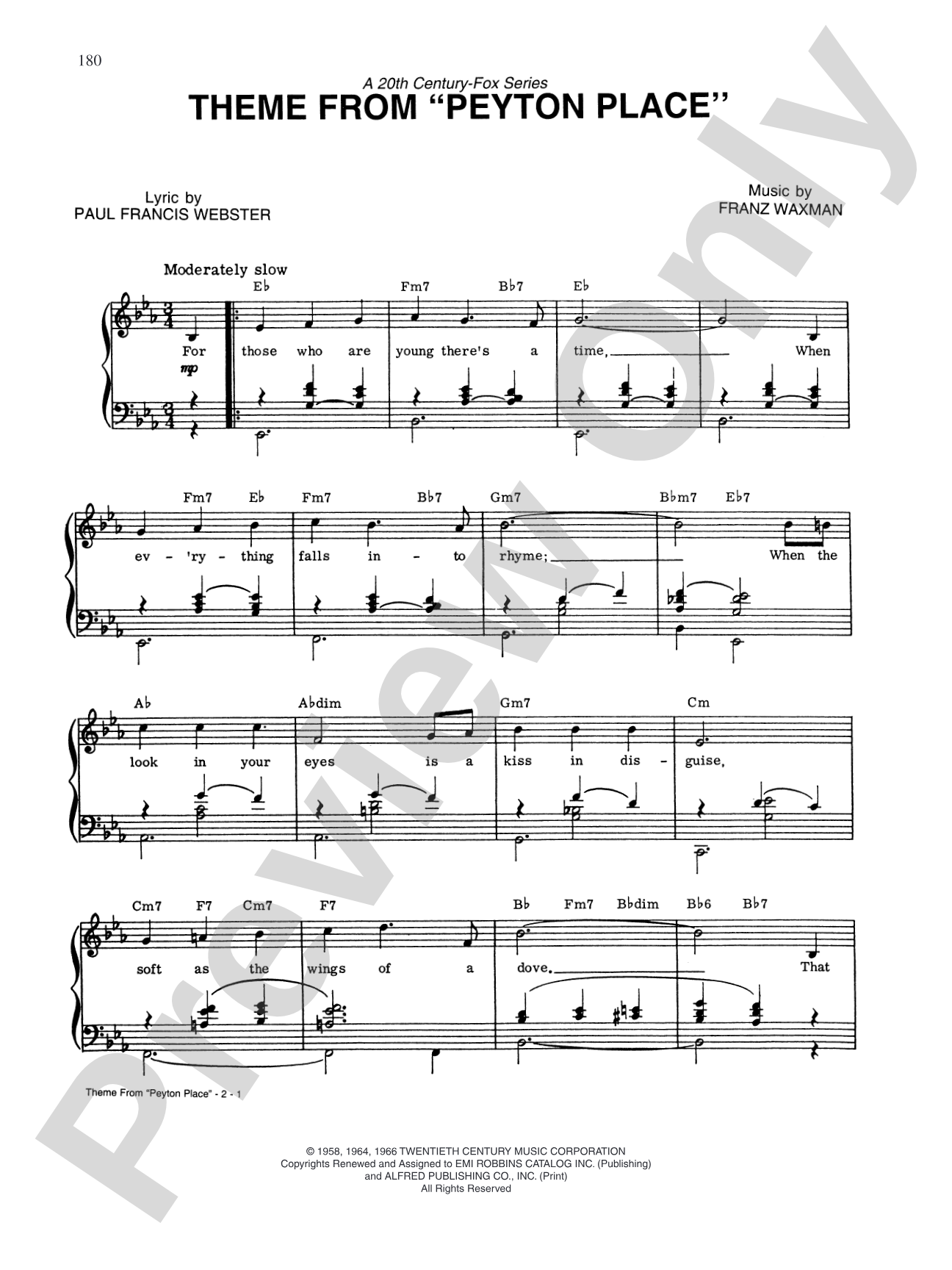

Peyton Place Theme: Piano/Vocal/Chords
Item: 00-PSP-000522
$4.99
One moment…
Related Items
(Meet) The Flintstones: Piano/Vocal/Chords |
$4.99
|
View | |
Anywhere the Heart Goes (From "The Thorn Birds"): Piano/Vocal/Chords |
$4.99
|
View | |
As Long As We Got Each Other (From "Growing Pains"): Piano/Vocal/Chords |
$4.99
|
View | |
Best Friend (From "The Courtship of Eddie's Father"): Piano/Vocal/Chords |
$4.99
|
View | |
California: Piano/Vocal/Chords |
$4.99
|
View | |
Charlie's Angels (Main Theme): Piano/Vocal/Chords |
$4.99
|
View | |
Dallas (Main Title): Piano/Vocal/Chords |
$4.99
|
View | |
Daniel Boone (Main Theme): Piano/Vocal/Chords |
$4.99
|
View | |
E.R. (Main Theme): Piano/Vocal/Chords |
$4.99
|
View | |
Free Willy (Main Title): Piano/Vocal/Chords |
$4.99
|
View | |
Go Go Power Rangers: Piano/Vocal/Chords |
$5.99
|
View | |
Hardcastle & McCormick (Cues): Piano/Vocal/Chords |
$4.99
|
View | |
Huckleberry Hound: Piano/Vocal/Chords |
$4.99
|
View | |
In the Heat of the Night: Piano/Vocal/Chords |
$4.99
|
View | |
It's A Jungle Out There (From "Monk"): Piano/Vocal/Chords |
$4.99
|
View | |
Josie (from "Josie and the Pussycats"): Piano/Vocal/Chords |
$4.99
|
View | |
L.A. Law (Main Title): Piano/Vocal/Chords |
$4.99
|
View | |
Late Show Theme: Piano/Vocal/Chords |
$4.99
|
View | |
Moon Over Parma (From "The Drew Carey Show"): Piano/Vocal/Chords |
$4.99
|
View | |
Road Runner Theme: Piano/Vocal/Chords |
$4.99
|
View | |
Scooby Doo, Where Are You?: Piano/Vocal/Chords |
$4.99
|
View | |
Thank God for a Friend Like You (From "Hope & Gloria"): Piano/Vocal/Chords |
$4.99
|
View | |
The A-Team (Main Theme): Piano/Vocal/Chords |
$4.99
|
View | |
The Ballad of Gilligan's Isle: Piano/Vocal/Chords |
$4.99
|
View | |
The Greatest American Hero (Theme): Piano/Vocal/Chords |
$4.99
|
View | |
The Green Hornet Theme: Piano/Vocal/Chords |
$4.99
|
View | |
The Jetsons (Main Theme): Piano/Vocal/Chords |
$4.99
|
View | |
The Rosie O'Donnell Show (Opening Theme): Piano/Vocal/Chords |
$4.99
|
View | |
The Syncopated Clock (Vocal): Piano/Vocal/Chords |
$4.99
|
View | |
Fantasy Island Theme: Piano/Vocal/Chords |
$4.99
|
View | |
F-Troop Theme: Piano/Vocal/Chords |
$4.99
|
View | |
Hunter Theme: Piano/Vocal/Chords |
$4.99
|
View | |
Time for You (From "Jesse"): Piano/Vocal/Chords |
$4.99
|
View | |
Yogi Bear Song: Piano/Vocal/Chords |
$4.99
|
View |
Description
Each songbook in the Big Book series provides musicians of all ability levels with a big list---usually 40 or more titles per book---of the very best songs from a favorite musical genre.
Songs include As Long as We Got Each Other (Growing Pains) * Bad Boys (Cops) * Batman Theme (Batman) * California (The O.C.) * (Meet) The Flintstones (The Flintstones) * Good Ol' Boys (The Dukes of Hazzard) * I'll Be There for You (Friends) * Movin' On Up (The Jeffersons) * The Pink Panther (The Pink Panther) * Scooby-Doo (Main Title) (Scooby-Doo) * Song from M*A*S*H (M*A*S*H) * This Is It! (The Bugs Bunny Show) * Yogi Bear Song (Yogi Bear) * and many more.


Songs include As Long as We Got Each Other (Growing Pains) * Bad Boys (Cops) * Batman Theme (Batman) * California (The O.C.) * (Meet) The Flintstones (The Flintstones) * Good Ol' Boys (The Dukes of Hazzard) * I'll Be There for You (Friends) * Movin' On Up (The Jeffersons) * The Pink Panther (The Pink Panther) * Scooby-Doo (Main Title) (Scooby-Doo) * Song from M*A*S*H (M*A*S*H) * This Is It! (The Bugs Bunny Show) * Yogi Bear Song (Yogi Bear) * and many more.
Peyton Place Theme: Piano/Vocal/Chords isn't in MakeMusic Cloud just yet...but it could be. Let us know you'd like to see it, and you'll help shape what comes next. In the meantime, start a free trial and dive into thousands of interactive titles your students can play along with today.
Request This Title
Tell us you want it.
Start Your Free Trial
Explore everything that's ready to play right now.
Sample Audio
No sample audio found.
Sample Video
No sample videos found.
Additional Details
Series:
The Big Book Series
Publisher:
Alfred Music
Page Count:
256
SKU:
00-PSP-000522
More about this title
About the Composer: Franz Waxman
Franz Waxman (1906-1967) was a German-American composer who became one of Hollywood's most prolific and versatile film score composers. Working across drama, comedy, suspense, and animation, he earned four Academy Award nominations and created some of the most recognizable theme music in television and film history. His gift for melodic invention and orchestral color made his themes instantly memorable while remaining sophisticated enough to sustain repeated listening.
Waxman's work in television during the 1950s and 1960s helped define the medium's sonic identity. He understood how to craft themes that communicated character and premise within seconds, a skill that made his music essential to shows that became cultural touchstones. His approach to composition prioritized clarity and emotional directness, qualities that make his work accessible to pianists and vocalists across ability levels.
Why we love this
This collection captures Waxman's genius for writing themes that lodge themselves instantly in the ear. For piano and voice, these arrangements let you experience music that shaped American popular culture while building comfort with mid-century harmonic language and melodic phrasing. The variety across TV genres means your students encounter everything from uptempo comedy cues to dramatic underscores without leaving one book.
What to expect
Stepping through these pages feels like walking through the golden age of American television. The melodies are immediate and charming, from the playful bounce of a sitcom opener to the dramatic sweep of a dramatic theme, all delivered with the sophistication and orchestral sensibility that marks Waxman's craft. You'll notice how much personality each theme carries in just a few measures; these are melodies designed to work hard and stick with you.
Who it's for
This book serves pianists and singer-pianists who want to explore mid-century popular song and film/TV theme arranging, as well as music students learning to play from lead sheets with chord symbols. Teachers can use these pieces in recitals, casual performance settings, or to teach students how composers write for different moods and genres within a single stylistic framework.
How to get the most out of it
- Balance the melody with accompaniment so the theme remains distinct; these melodies deserve to sing even when the piano part is active
- Pay attention to tempo markings and style indications specific to each theme, as Waxman's music often depends on rhythmic clarity to convey its character
- Use the chord symbols to experiment with voicing options on piano, especially for uptempo comedic themes where lighter touch and crisp articulation work well
- When singing these themes, maintain conversational phrasing rather than operatic production; Waxman's TV themes work best when they sound natural and direct
How to use it
Use individual themes as recital openers or encores, especially in themed concerts or variety programs where students perform music from film and television. These arrangements work beautifully in informal settings, masterclasses, or as supplementary repertoire for students learning to sight-read and play from lead sheets with piano accompaniment.
Skills your students will build
- Reading and performing from lead sheets with chord symbols and melody line
- Interpreting style indications and tempo markings specific to different TV genres
- Coordinating melody and accompaniment in solo piano and voice-with-piano contexts
- Understanding mid-century harmonic language and common progressions in popular music
- Sustaining melodic phrases and controlling phrasing in shorter thematic forms