
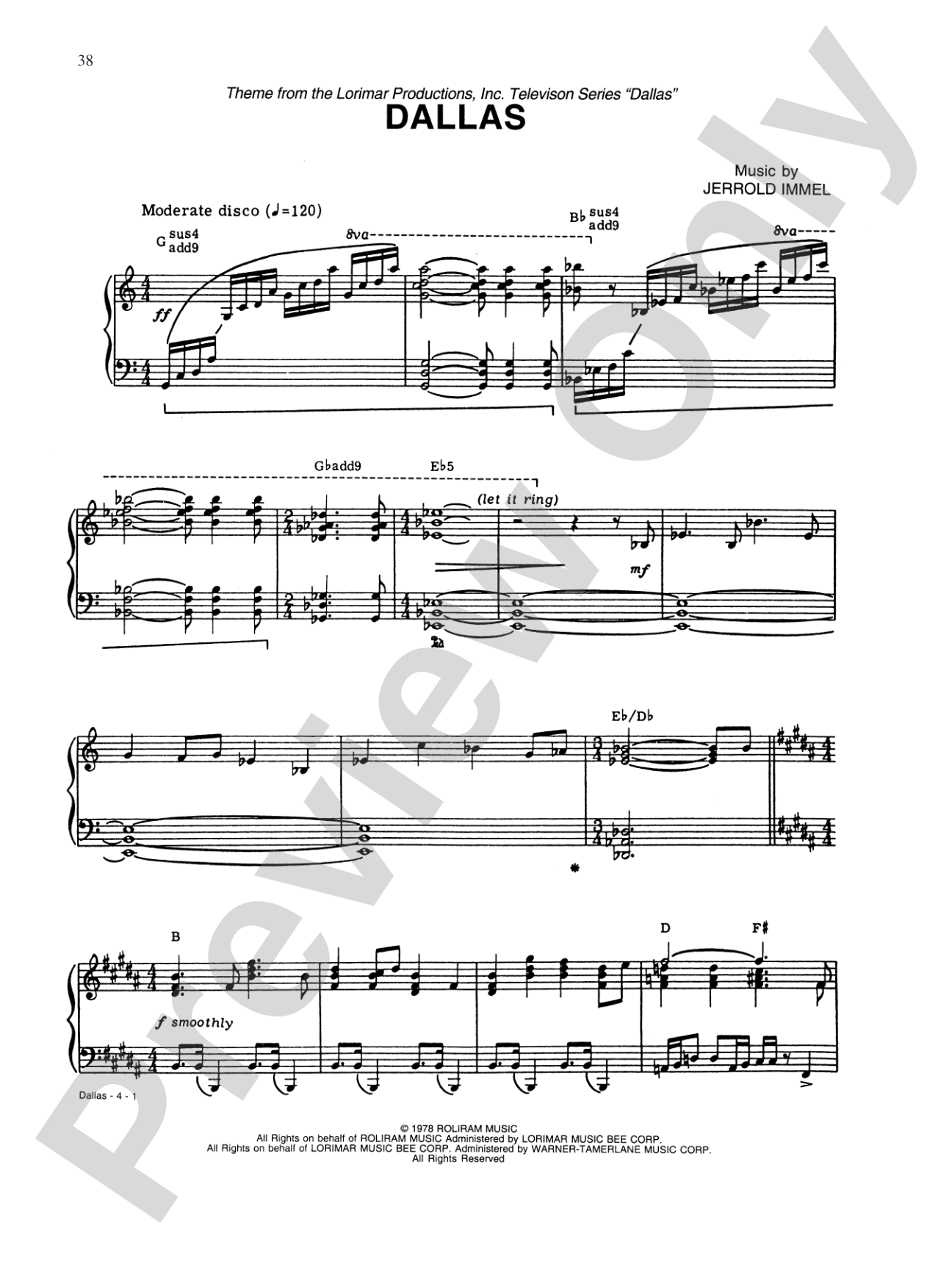

Dallas (Main Title): Piano/Vocal/Chords
Item: 00-PSP-000400
$4.99
Pickup currently not available
Related Items
(Meet) The Flintstones: Piano/Vocal/Chords |
$4.99
|
View | |
Anywhere the Heart Goes (From "The Thorn Birds"): Piano/Vocal/Chords |
$4.99
|
View | |
As Long As We Got Each Other (From "Growing Pains"): Piano/Vocal/Chords |
$4.99
|
View | |
Best Friend (From "The Courtship of Eddie's Father"): Piano/Vocal/Chords |
$4.99
|
View | |
California: Piano/Vocal/Chords |
$4.99
|
View | |
Charlie's Angels (Main Theme): Piano/Vocal/Chords |
$4.99
|
View | |
Daniel Boone (Main Theme): Piano/Vocal/Chords |
$4.99
|
View | |
E.R. (Main Theme): Piano/Vocal/Chords |
$4.99
|
View | |
Free Willy (Main Title): Piano/Vocal/Chords |
$4.99
|
View | |
Go Go Power Rangers: Piano/Vocal/Chords |
$5.99
|
View | |
Hardcastle & McCormick (Cues): Piano/Vocal/Chords |
$4.99
|
View | |
Huckleberry Hound: Piano/Vocal/Chords |
$4.99
|
View | |
In the Heat of the Night: Piano/Vocal/Chords |
$4.99
|
View | |
It's A Jungle Out There (From "Monk"): Piano/Vocal/Chords |
$4.99
|
View | |
Josie (from "Josie and the Pussycats"): Piano/Vocal/Chords |
$4.99
|
View | |
L.A. Law (Main Title): Piano/Vocal/Chords |
$4.99
|
View | |
Late Show Theme: Piano/Vocal/Chords |
$4.99
|
View | |
Moon Over Parma (From "The Drew Carey Show"): Piano/Vocal/Chords |
$4.99
|
View | |
Road Runner Theme: Piano/Vocal/Chords |
$4.99
|
View | |
Scooby Doo, Where Are You?: Piano/Vocal/Chords |
$4.99
|
View | |
Thank God for a Friend Like You (From "Hope & Gloria"): Piano/Vocal/Chords |
$4.99
|
View | |
The A-Team (Main Theme): Piano/Vocal/Chords |
$4.99
|
View | |
The Ballad of Gilligan's Isle: Piano/Vocal/Chords |
$4.99
|
View | |
The Greatest American Hero (Theme): Piano/Vocal/Chords |
$4.99
|
View | |
The Green Hornet Theme: Piano/Vocal/Chords |
$4.99
|
View | |
The Jetsons (Main Theme): Piano/Vocal/Chords |
$4.99
|
View | |
The Rosie O'Donnell Show (Opening Theme): Piano/Vocal/Chords |
$4.99
|
View | |
The Syncopated Clock (Vocal): Piano/Vocal/Chords |
$4.99
|
View | |
Fantasy Island Theme: Piano/Vocal/Chords |
$4.99
|
View | |
F-Troop Theme: Piano/Vocal/Chords |
$4.99
|
View | |
Hunter Theme: Piano/Vocal/Chords |
$4.99
|
View | |
Peyton Place Theme: Piano/Vocal/Chords |
$4.99
|
View | |
Time for You (From "Jesse"): Piano/Vocal/Chords |
$4.99
|
View | |
Yogi Bear Song: Piano/Vocal/Chords |
$4.99
|
View |
Description
Each songbook in the Big Book series provides musicians of all ability levels with a big list---usually 40 or more titles per book---of the very best songs from a favorite musical genre.
Songs include As Long as We Got Each Other (Growing Pains) * Bad Boys (Cops) * Batman Theme (Batman) * California (The O.C.) * (Meet) The Flintstones (The Flintstones) * Good Ol' Boys (The Dukes of Hazzard) * I'll Be There for You (Friends) * Movin' On Up (The Jeffersons) * The Pink Panther (The Pink Panther) * Scooby-Doo (Main Title) (Scooby-Doo) * Song from M*A*S*H (M*A*S*H) * This Is It! (The Bugs Bunny Show) * Yogi Bear Song (Yogi Bear) * and many more.


Songs include As Long as We Got Each Other (Growing Pains) * Bad Boys (Cops) * Batman Theme (Batman) * California (The O.C.) * (Meet) The Flintstones (The Flintstones) * Good Ol' Boys (The Dukes of Hazzard) * I'll Be There for You (Friends) * Movin' On Up (The Jeffersons) * The Pink Panther (The Pink Panther) * Scooby-Doo (Main Title) (Scooby-Doo) * Song from M*A*S*H (M*A*S*H) * This Is It! (The Bugs Bunny Show) * Yogi Bear Song (Yogi Bear) * and many more.
Dallas (Main Title): Piano/Vocal/Chords isn't in MakeMusic Cloud just yet...but it could be. Let us know you'd like to see it, and you'll help shape what comes next. In the meantime, start a free trial and dive into thousands of interactive titles your students can play along with today.
Request This Title
Tell us you want it.
Start Your Free Trial
Explore everything that's ready to play right now.
Sample Audio
No sample audio found.
Sample Video
No sample videos found.
Additional Details
Series:
The Big Book Series
Publisher:
Alfred Music
Page Count:
256
SKU:
00-PSP-000400
More about this title
About the Composer: Jerrold Immel
Jerrold Immel composed music for television throughout a career spanning multiple decades, with particular recognition for his work on series that became cultural touchstones. His ability to craft memorable, singable themes that captured the essence of their shows made him a sought-after composer in the industry. Immel's melodies have remained instantly recognizable to generations of viewers, demonstrating the lasting power of well-crafted television composition.
Why we love this
This collection captures television themes at their most iconic, spanning decades and genres from sitcoms to action shows. The material works equally well as accessible sing-alongs for non-auditioned groups or as jumping-off points for arrangement projects and contemporary concert programming. Singers and pianists get to inhabit music that genuinely moves people because they've heard it in their living rooms.
What to expect
Stepping into the opening credits of shows that defined childhoods and shaped pop culture. These melodies sit comfortably in the voice, pair naturally with piano accompaniment, and carry the warmth of nostalgia without requiring heavy instrumental pyrotechnics.
Who it's for
Pianists and singers at any level who want to connect immediately with an audience through beloved material. This collection appeals to school groups, community choirs, and studio students building repertoire that feels contemporary and fun while remaining musically substantial.
How to get the most out of it
- Study the original TV recordings to absorb the rhythmic swagger and groove of each theme. These melodies were written to hook listeners in seconds, and that same energy translates directly to live performance.
- Treat the chord symbols as a blueprint, not a cage. Pianists can reharmonize, comp dynamically, or stay sparse depending on the arrangement context and what the vocalist needs.
- Shape phrases to mirror the pacing of the original opening credits. Many of these themes were designed to cover specific time slots, which means clear sectional breathing and strategic emphasis matter more than legit opera phrasing.
- Balance familiarity with ownership. Audiences arrive with expectations, but a fresh tempo or subtle reharmonization can make the performance feel like a discovery rather than a reproduction.
How to use it
Feature individual themes in pop-style or variety concerts where contemporary television music fits naturally alongside other accessible material. Solo pianists can draw from this collection for recital openers or light-hearted encore selections that allow audiences to laugh and sing along. School ensembles often find success programming 2-3 contrasting themes as a medley or as palate-cleansers between more formal classical works.
Skills your students will build
- Interpreting lead sheet notation and chord symbols
- Sight-reading and accompanying from piano/vocal/chord charts
- Vocal phrasing and microphone technique in contemporary music contexts
- Improvisation and reharmonization from a harmonic framework
- Communication and ensemble listening across melody, harmony, and rhythm