
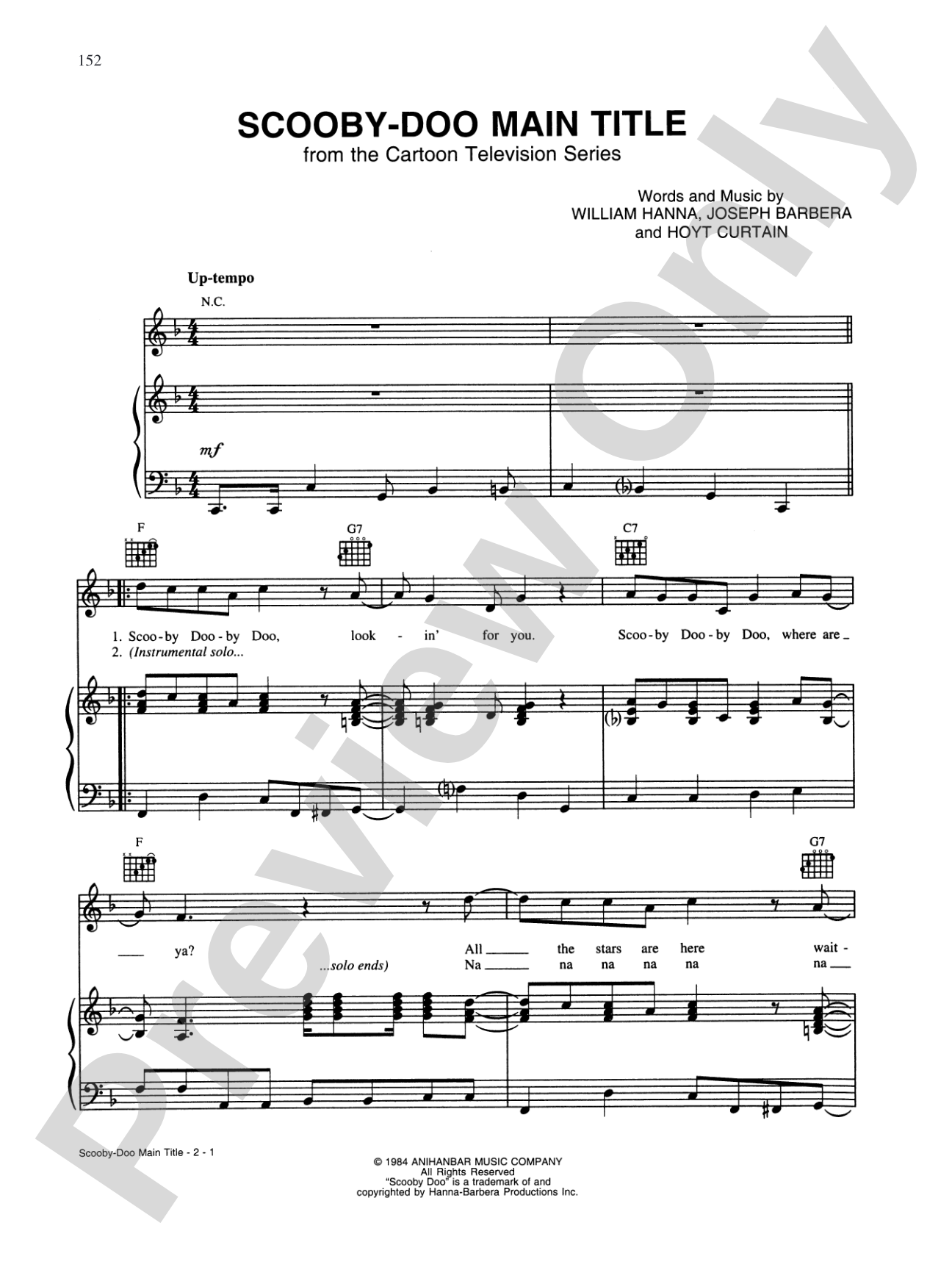

Scooby Doo, Where Are You?: Piano/Vocal/Chords
Item: 00-PSP-000491
$4.99
One moment…
Related Items
(Meet) The Flintstones: Piano/Vocal/Chords |
$4.99
|
View | |
Anywhere the Heart Goes (From "The Thorn Birds"): Piano/Vocal/Chords |
$4.99
|
View | |
As Long As We Got Each Other (From "Growing Pains"): Piano/Vocal/Chords |
$4.99
|
View | |
Best Friend (From "The Courtship of Eddie's Father"): Piano/Vocal/Chords |
$4.99
|
View | |
California: Piano/Vocal/Chords |
$4.99
|
View | |
Charlie's Angels (Main Theme): Piano/Vocal/Chords |
$4.99
|
View | |
Dallas (Main Title): Piano/Vocal/Chords |
$4.99
|
View | |
Daniel Boone (Main Theme): Piano/Vocal/Chords |
$4.99
|
View | |
E.R. (Main Theme): Piano/Vocal/Chords |
$4.99
|
View | |
Free Willy (Main Title): Piano/Vocal/Chords |
$4.99
|
View | |
Go Go Power Rangers: Piano/Vocal/Chords |
$5.99
|
View | |
Hardcastle & McCormick (Cues): Piano/Vocal/Chords |
$4.99
|
View | |
Huckleberry Hound: Piano/Vocal/Chords |
$4.99
|
View | |
In the Heat of the Night: Piano/Vocal/Chords |
$4.99
|
View | |
It's A Jungle Out There (From "Monk"): Piano/Vocal/Chords |
$4.99
|
View | |
Josie (from "Josie and the Pussycats"): Piano/Vocal/Chords |
$4.99
|
View | |
L.A. Law (Main Title): Piano/Vocal/Chords |
$4.99
|
View | |
Late Show Theme: Piano/Vocal/Chords |
$4.99
|
View | |
Moon Over Parma (From "The Drew Carey Show"): Piano/Vocal/Chords |
$4.99
|
View | |
Road Runner Theme: Piano/Vocal/Chords |
$4.99
|
View | |
Thank God for a Friend Like You (From "Hope & Gloria"): Piano/Vocal/Chords |
$4.99
|
View | |
The A-Team (Main Theme): Piano/Vocal/Chords |
$4.99
|
View | |
The Ballad of Gilligan's Isle: Piano/Vocal/Chords |
$4.99
|
View | |
The Greatest American Hero (Theme): Piano/Vocal/Chords |
$4.99
|
View | |
The Green Hornet Theme: Piano/Vocal/Chords |
$4.99
|
View | |
The Jetsons (Main Theme): Piano/Vocal/Chords |
$4.99
|
View | |
The Rosie O'Donnell Show (Opening Theme): Piano/Vocal/Chords |
$4.99
|
View | |
The Syncopated Clock (Vocal): Piano/Vocal/Chords |
$4.99
|
View | |
Fantasy Island Theme: Piano/Vocal/Chords |
$4.99
|
View | |
F-Troop Theme: Piano/Vocal/Chords |
$4.99
|
View | |
Hunter Theme: Piano/Vocal/Chords |
$4.99
|
View | |
Peyton Place Theme: Piano/Vocal/Chords |
$4.99
|
View | |
Time for You (From "Jesse"): Piano/Vocal/Chords |
$4.99
|
View | |
Yogi Bear Song: Piano/Vocal/Chords |
$4.99
|
View |
Description
Each songbook in the Big Book series provides musicians of all ability levels with a big list---usually 40 or more titles per book---of the very best songs from a favorite musical genre.
Songs include As Long as We Got Each Other (Growing Pains) * Bad Boys (Cops) * Batman Theme (Batman) * California (The O.C.) * (Meet) The Flintstones (The Flintstones) * Good Ol' Boys (The Dukes of Hazzard) * I'll Be There for You (Friends) * Movin' On Up (The Jeffersons) * The Pink Panther (The Pink Panther) * Scooby-Doo (Main Title) (Scooby-Doo) * Song from M*A*S*H (M*A*S*H) * This Is It! (The Bugs Bunny Show) * Yogi Bear Song (Yogi Bear) * and many more.


Songs include As Long as We Got Each Other (Growing Pains) * Bad Boys (Cops) * Batman Theme (Batman) * California (The O.C.) * (Meet) The Flintstones (The Flintstones) * Good Ol' Boys (The Dukes of Hazzard) * I'll Be There for You (Friends) * Movin' On Up (The Jeffersons) * The Pink Panther (The Pink Panther) * Scooby-Doo (Main Title) (Scooby-Doo) * Song from M*A*S*H (M*A*S*H) * This Is It! (The Bugs Bunny Show) * Yogi Bear Song (Yogi Bear) * and many more.
Scooby Doo, Where Are You?: Piano/Vocal/Chords isn't in MakeMusic Cloud just yet...but it could be. Let us know you'd like to see it, and you'll help shape what comes next. In the meantime, start a free trial and dive into thousands of interactive titles your students can play along with today.
Request This Title
Tell us you want it.
Start Your Free Trial
Explore everything that's ready to play right now.
Sample Audio
No sample audio found.
Sample Video
No sample videos found.
Additional Details
Series:
The Big Book Series
Publisher:
Alfred Music
Page Count:
256
SKU:
00-PSP-000491
More about this title
About the Composer: William Hanna
William Hanna co-founded Hanna-Barbera Productions with Joseph Barbera, revolutionizing television animation in the 1950s and beyond. His work as a composer and producer shaped the sound of American animated television, creating instantly recognizable themes that defined entire generations of viewers. Hanna's gift for writing memorable, singable melodies that could anchor a show's identity made him a pioneer in connecting music to visual storytelling on screen.
Why we love this
This collection captures the golden age of animated television through its most iconic themes. The arrangements preserve the charm and immediate recognizability of these songs while remaining accessible for pianists and singers at various levels, making them perfect for recitals, educational settings, or informal performances that resonate across age groups.
What to expect
Nostalgic yet playful, these melodies carry the warmth of Saturday morning cartoons and prime-time classics. The music feels deliberately uncomplicated but never unsophisticated; each theme stands complete and memorable on its own, inviting performers to inhabit the personality of the show it represents.
Who it's for
Pianists and singers preparing repertoire for recitals, variety shows, or casual performance contexts where audience recognition matters. Music students exploring arrangement styles and performance practice across television music; teachers seeking contemporary material that engages students across age ranges.
How to get the most out of it
- Pay attention to the rhythmic snap in these themes; they're built for clarity and punch, so lock into the steady beat even when the melody line feels conversational.
- Use the chord symbols to explore comping underneath the vocal line rather than doubling it note-for-note; this opens space for the singer's interpretation.
- Study the original recordings to catch the orchestral color these themes carry, then translate that energy into your keyboard voicings and pedal choices.
- Consider the comedic timing built into many of these melodies; slight rubato and well-placed breath points enhance the humor and personality of each song.
How to use it
Build a themed recital around television history, pairing these classics with other media music or contemporary songs to frame how music shapes our relationship with visual storytelling. Include selections as lighter moments in recitals that otherwise feature standard repertoire, or explore the full collection as a semester-long resource for performance and interpretation study.
Skills your students will build
- Reading and interpreting chord symbols in context
- Balancing accompaniment texture with vocal melody
- Understanding how melody and rhythm create immediate memorability
- Stylistic interpretation of mid-century popular music idioms
- Collaborative listening between pianist and vocalist