
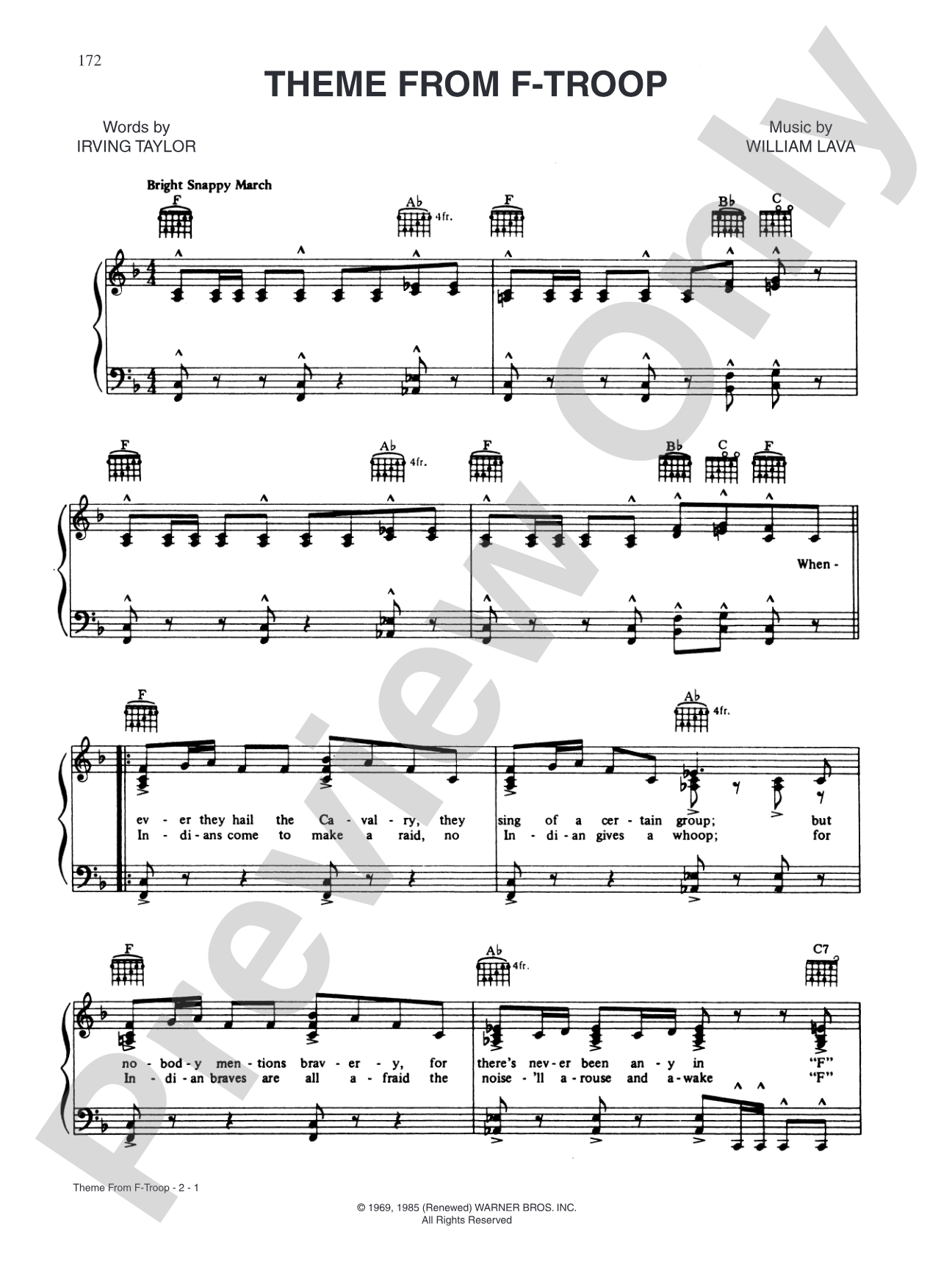

F-Troop Theme: Piano/Vocal/Chords
Item: 00-PSP-000519
$4.99
One moment…
Related Items
(Meet) The Flintstones: Piano/Vocal/Chords |
$4.99
|
View | |
Anywhere the Heart Goes (From "The Thorn Birds"): Piano/Vocal/Chords |
$4.99
|
View | |
As Long As We Got Each Other (From "Growing Pains"): Piano/Vocal/Chords |
$4.99
|
View | |
Best Friend (From "The Courtship of Eddie's Father"): Piano/Vocal/Chords |
$4.99
|
View | |
California: Piano/Vocal/Chords |
$4.99
|
View | |
Charlie's Angels (Main Theme): Piano/Vocal/Chords |
$4.99
|
View | |
Dallas (Main Title): Piano/Vocal/Chords |
$4.99
|
View | |
Daniel Boone (Main Theme): Piano/Vocal/Chords |
$4.99
|
View | |
E.R. (Main Theme): Piano/Vocal/Chords |
$4.99
|
View | |
Free Willy (Main Title): Piano/Vocal/Chords |
$4.99
|
View | |
Go Go Power Rangers: Piano/Vocal/Chords |
$5.99
|
View | |
Hardcastle & McCormick (Cues): Piano/Vocal/Chords |
$4.99
|
View | |
Huckleberry Hound: Piano/Vocal/Chords |
$4.99
|
View | |
In the Heat of the Night: Piano/Vocal/Chords |
$4.99
|
View | |
It's A Jungle Out There (From "Monk"): Piano/Vocal/Chords |
$4.99
|
View | |
Josie (from "Josie and the Pussycats"): Piano/Vocal/Chords |
$4.99
|
View | |
L.A. Law (Main Title): Piano/Vocal/Chords |
$4.99
|
View | |
Late Show Theme: Piano/Vocal/Chords |
$4.99
|
View | |
Moon Over Parma (From "The Drew Carey Show"): Piano/Vocal/Chords |
$4.99
|
View | |
Road Runner Theme: Piano/Vocal/Chords |
$4.99
|
View | |
Scooby Doo, Where Are You?: Piano/Vocal/Chords |
$4.99
|
View | |
Thank God for a Friend Like You (From "Hope & Gloria"): Piano/Vocal/Chords |
$4.99
|
View | |
The A-Team (Main Theme): Piano/Vocal/Chords |
$4.99
|
View | |
The Ballad of Gilligan's Isle: Piano/Vocal/Chords |
$4.99
|
View | |
The Greatest American Hero (Theme): Piano/Vocal/Chords |
$4.99
|
View | |
The Green Hornet Theme: Piano/Vocal/Chords |
$4.99
|
View | |
The Jetsons (Main Theme): Piano/Vocal/Chords |
$4.99
|
View | |
The Rosie O'Donnell Show (Opening Theme): Piano/Vocal/Chords |
$4.99
|
View | |
The Syncopated Clock (Vocal): Piano/Vocal/Chords |
$4.99
|
View | |
Fantasy Island Theme: Piano/Vocal/Chords |
$4.99
|
View | |
Hunter Theme: Piano/Vocal/Chords |
$4.99
|
View | |
Peyton Place Theme: Piano/Vocal/Chords |
$4.99
|
View | |
Time for You (From "Jesse"): Piano/Vocal/Chords |
$4.99
|
View | |
Yogi Bear Song: Piano/Vocal/Chords |
$4.99
|
View |
Description
Each songbook in the Big Book series provides musicians of all ability levels with a big list---usually 40 or more titles per book---of the very best songs from a favorite musical genre.
Songs include As Long as We Got Each Other (Growing Pains) * Bad Boys (Cops) * Batman Theme (Batman) * California (The O.C.) * (Meet) The Flintstones (The Flintstones) * Good Ol' Boys (The Dukes of Hazzard) * I'll Be There for You (Friends) * Movin' On Up (The Jeffersons) * The Pink Panther (The Pink Panther) * Scooby-Doo (Main Title) (Scooby-Doo) * Song from M*A*S*H (M*A*S*H) * This Is It! (The Bugs Bunny Show) * Yogi Bear Song (Yogi Bear) * and many more.


Songs include As Long as We Got Each Other (Growing Pains) * Bad Boys (Cops) * Batman Theme (Batman) * California (The O.C.) * (Meet) The Flintstones (The Flintstones) * Good Ol' Boys (The Dukes of Hazzard) * I'll Be There for You (Friends) * Movin' On Up (The Jeffersons) * The Pink Panther (The Pink Panther) * Scooby-Doo (Main Title) (Scooby-Doo) * Song from M*A*S*H (M*A*S*H) * This Is It! (The Bugs Bunny Show) * Yogi Bear Song (Yogi Bear) * and many more.
F-Troop Theme: Piano/Vocal/Chords isn't in MakeMusic Cloud just yet...but it could be. Let us know you'd like to see it, and you'll help shape what comes next. In the meantime, start a free trial and dive into thousands of interactive titles your students can play along with today.
Request This Title
Tell us you want it.
Start Your Free Trial
Explore everything that's ready to play right now.
Sample Audio
No sample audio found.
Sample Video
No sample videos found.
Additional Details
Series:
The Big Book Series
Publisher:
Alfred Music
Page Count:
256
SKU:
00-PSP-000519
More about this title
About the Composer: William Lava
William Lava (1911-1996) was a prolific composer and arranger whose career spanned radio, television, and film. He scored hundreds of hours of television music from the 1950s through the 1980s, creating instantly recognizable themes that became part of American popular culture. His gift for writing catchy, memorable melodies and his ability to capture a show's character in a few bars made him one of the most recorded composers of the television age.
Why we love this
This collection captures the iconic melodies that defined television's golden age, giving pianists and singers access to genuinely fun material that connects with audiences across generations. The variety spans decades and genres, so you'll find something for every rehearsal mood and performance context. The arrangements are straightforward enough for students building sight-reading skills, yet engaging enough that serious musicians won't feel bored.
What to expect
Opening this book is like stepping into a time machine set to the best moments of American television. The melodies are immediate and joyful; many will get stuck in your head before you finish the first phrase. There's a lightness and directness to this music that feels refreshing, paired with the warmth of classic arranging.
Who it's for
Pianists and vocalists at all levels will find material here, from beginners building repertoire to experienced musicians looking for accessible songs that audiences genuinely love. Teachers can use these arrangements in studio lessons, ensembles, or community performances. This collection works especially well for musicians who want to develop musicality through songs that are already familiar to listeners.
How to get the most out of it
- Let the melody breathe. These themes were written to hook listeners in seconds, so honor the shape and phrasing of each tune rather than rushing through it.
- Pay attention to dynamics and articulation markings. TV themes rely on personality and punch to create their effect; clean execution of these details makes the difference between a flat performance and one that sparkles.
- When playing from the chords, treat them as a harmonic foundation rather than a strict grid. This gives you flexibility to add color and interpret the accompaniment in a way that suits your arrangement.
How to use it
Use individual selections as concert openers or closers, especially for community audiences who will recognize and enjoy the cultural references. This folio is ideal for pairing with other pop music in a casual recital or variety show format. A medley of two or three selections works beautifully as a 'throwback' moment in a program, and the variety means you can tailor choices to match your venue and audience.
Skills your students will build
- Reading lead sheets with melody, chord symbols, and lyrics
- Voice leading and harmonic awareness through chord symbol interpretation
- Stylistic awareness of mid-20th century popular song structure
- Coordination between melody and accompaniment when singing and playing
- Sight-reading fluency across a broad range of straightforward arrangements