
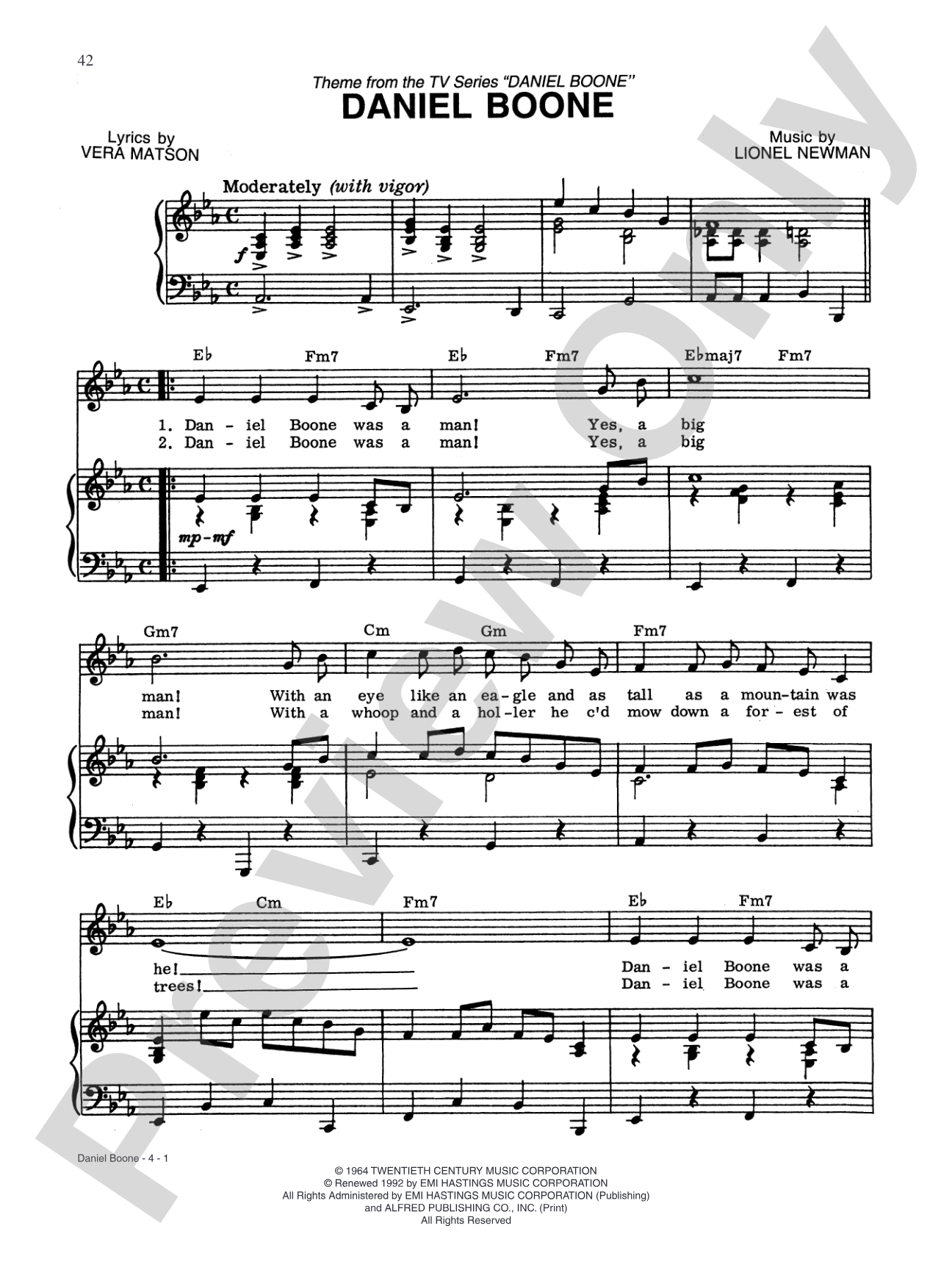

Daniel Boone (Main Theme): Piano/Vocal/Chords
Item: 00-PSP-000402
$4.99
One moment…
Related Items
(Meet) The Flintstones: Piano/Vocal/Chords |
$4.99
|
View | |
Anywhere the Heart Goes (From "The Thorn Birds"): Piano/Vocal/Chords |
$4.99
|
View | |
As Long As We Got Each Other (From "Growing Pains"): Piano/Vocal/Chords |
$4.99
|
View | |
Best Friend (From "The Courtship of Eddie's Father"): Piano/Vocal/Chords |
$4.99
|
View | |
California: Piano/Vocal/Chords |
$4.99
|
View | |
Charlie's Angels (Main Theme): Piano/Vocal/Chords |
$4.99
|
View | |
Dallas (Main Title): Piano/Vocal/Chords |
$4.99
|
View | |
E.R. (Main Theme): Piano/Vocal/Chords |
$4.99
|
View | |
Free Willy (Main Title): Piano/Vocal/Chords |
$4.99
|
View | |
Go Go Power Rangers: Piano/Vocal/Chords |
$5.99
|
View | |
Hardcastle & McCormick (Cues): Piano/Vocal/Chords |
$4.99
|
View | |
Huckleberry Hound: Piano/Vocal/Chords |
$4.99
|
View | |
In the Heat of the Night: Piano/Vocal/Chords |
$4.99
|
View | |
It's A Jungle Out There (From "Monk"): Piano/Vocal/Chords |
$4.99
|
View | |
Josie (from "Josie and the Pussycats"): Piano/Vocal/Chords |
$4.99
|
View | |
L.A. Law (Main Title): Piano/Vocal/Chords |
$4.99
|
View | |
Late Show Theme: Piano/Vocal/Chords |
$4.99
|
View | |
Moon Over Parma (From "The Drew Carey Show"): Piano/Vocal/Chords |
$4.99
|
View | |
Road Runner Theme: Piano/Vocal/Chords |
$4.99
|
View | |
Scooby Doo, Where Are You?: Piano/Vocal/Chords |
$4.99
|
View | |
Thank God for a Friend Like You (From "Hope & Gloria"): Piano/Vocal/Chords |
$4.99
|
View | |
The A-Team (Main Theme): Piano/Vocal/Chords |
$4.99
|
View | |
The Ballad of Gilligan's Isle: Piano/Vocal/Chords |
$4.99
|
View | |
The Greatest American Hero (Theme): Piano/Vocal/Chords |
$4.99
|
View | |
The Green Hornet Theme: Piano/Vocal/Chords |
$4.99
|
View | |
The Jetsons (Main Theme): Piano/Vocal/Chords |
$4.99
|
View | |
The Rosie O'Donnell Show (Opening Theme): Piano/Vocal/Chords |
$4.99
|
View | |
The Syncopated Clock (Vocal): Piano/Vocal/Chords |
$4.99
|
View | |
Fantasy Island Theme: Piano/Vocal/Chords |
$4.99
|
View | |
F-Troop Theme: Piano/Vocal/Chords |
$4.99
|
View | |
Hunter Theme: Piano/Vocal/Chords |
$4.99
|
View | |
Peyton Place Theme: Piano/Vocal/Chords |
$4.99
|
View | |
Time for You (From "Jesse"): Piano/Vocal/Chords |
$4.99
|
View | |
Yogi Bear Song: Piano/Vocal/Chords |
$4.99
|
View |
Description
Each songbook in the Big Book series provides musicians of all ability levels with a big list---usually 40 or more titles per book---of the very best songs from a favorite musical genre.
Songs include As Long as We Got Each Other (Growing Pains) * Bad Boys (Cops) * Batman Theme (Batman) * California (The O.C.) * (Meet) The Flintstones (The Flintstones) * Good Ol' Boys (The Dukes of Hazzard) * I'll Be There for You (Friends) * Movin' On Up (The Jeffersons) * The Pink Panther (The Pink Panther) * Scooby-Doo (Main Title) (Scooby-Doo) * Song from M*A*S*H (M*A*S*H) * This Is It! (The Bugs Bunny Show) * Yogi Bear Song (Yogi Bear) * and many more.


Songs include As Long as We Got Each Other (Growing Pains) * Bad Boys (Cops) * Batman Theme (Batman) * California (The O.C.) * (Meet) The Flintstones (The Flintstones) * Good Ol' Boys (The Dukes of Hazzard) * I'll Be There for You (Friends) * Movin' On Up (The Jeffersons) * The Pink Panther (The Pink Panther) * Scooby-Doo (Main Title) (Scooby-Doo) * Song from M*A*S*H (M*A*S*H) * This Is It! (The Bugs Bunny Show) * Yogi Bear Song (Yogi Bear) * and many more.
Daniel Boone (Main Theme): Piano/Vocal/Chords isn't in MakeMusic Cloud just yet...but it could be. Let us know you'd like to see it, and you'll help shape what comes next. In the meantime, start a free trial and dive into thousands of interactive titles your students can play along with today.
Request This Title
Tell us you want it.
Start Your Free Trial
Explore everything that's ready to play right now.
Sample Audio
No sample audio found.
Sample Video
No sample videos found.
Additional Details
Series:
The Big Book Series
Publisher:
Alfred Music
Page Count:
256
SKU:
00-PSP-000402
More about this title
About the Composer: Lionel Newman
Lionel Newman composed film and television scores throughout the mid-to-late 20th century, establishing himself as a versatile voice in underscore and theme music. His gift for writing memorable, accessible melodies made him a fixture in television production, where his themes became instantly recognizable to millions of viewers.
Why we love this
This collection captures some of the most culturally embedded TV themes of American popular entertainment. Singers and pianists immediately connect with the material because these melodies are already living in people's ears, which builds confidence and engagement faster than unfamiliar repertoire. The folio's breadth means you can program something nostalgic alongside contemporary performance contexts without feeling out of place.
What to expect
Stepping into a cultural time machine. These themes carry the warmth and wit of their television contexts, from quirky comedy shows to action series. The arrangements feel both familiar and fresh, grounded enough for intimate performance but energetic enough to fill a space.
Who it's for
Pianists and singers working in community theater, educational theater productions, or recital settings who want accessible, recognizable material with immediate appeal. This folio also works for piano students exploring the intersection of classical technique and popular arranging styles, or for amateur vocalists building a setlist of songs they already know and love.
How to get the most out of it
- Study the original television recordings to internalize the orchestral arrangement and pacing; the piano/vocal score will land with more intention when you understand what the full orchestration is doing underneath.
- Treat the chord symbols as a guide rather than a prescription. If you're accompanying a vocalist, you have room to voice and voice-lead these chords expressively rather than playing them literally.
- Lock in the rhythmic profile of the theme early in rehearsal. TV themes often sit on a knife's edge between folk simplicity and sophisticated harmonic movement; nailing the groove makes everything else easier.
How to use it
Use individual selections as audition pieces, recital openers, or encore material in a concert that mixes classical and popular repertoire. A pianist might program one or two themes as a palate-cleansing bridge between heavier classical works, or a vocalist could build an entire cabaret-style recital around thematically linked selections from the collection.
Skills your students will build
- Reading and interpreting lead sheet notation (melody, lyrics, chord symbols)
- Vocal phrasing and text interpretation within a familiar melodic context
- Piano accompaniment voicing and reharmonization techniques
- Managing the relationship between melody and harmonic support in mixed instrumental and vocal writing
- Sight-reading across multiple clefs and staff systems in a piano/vocal score