
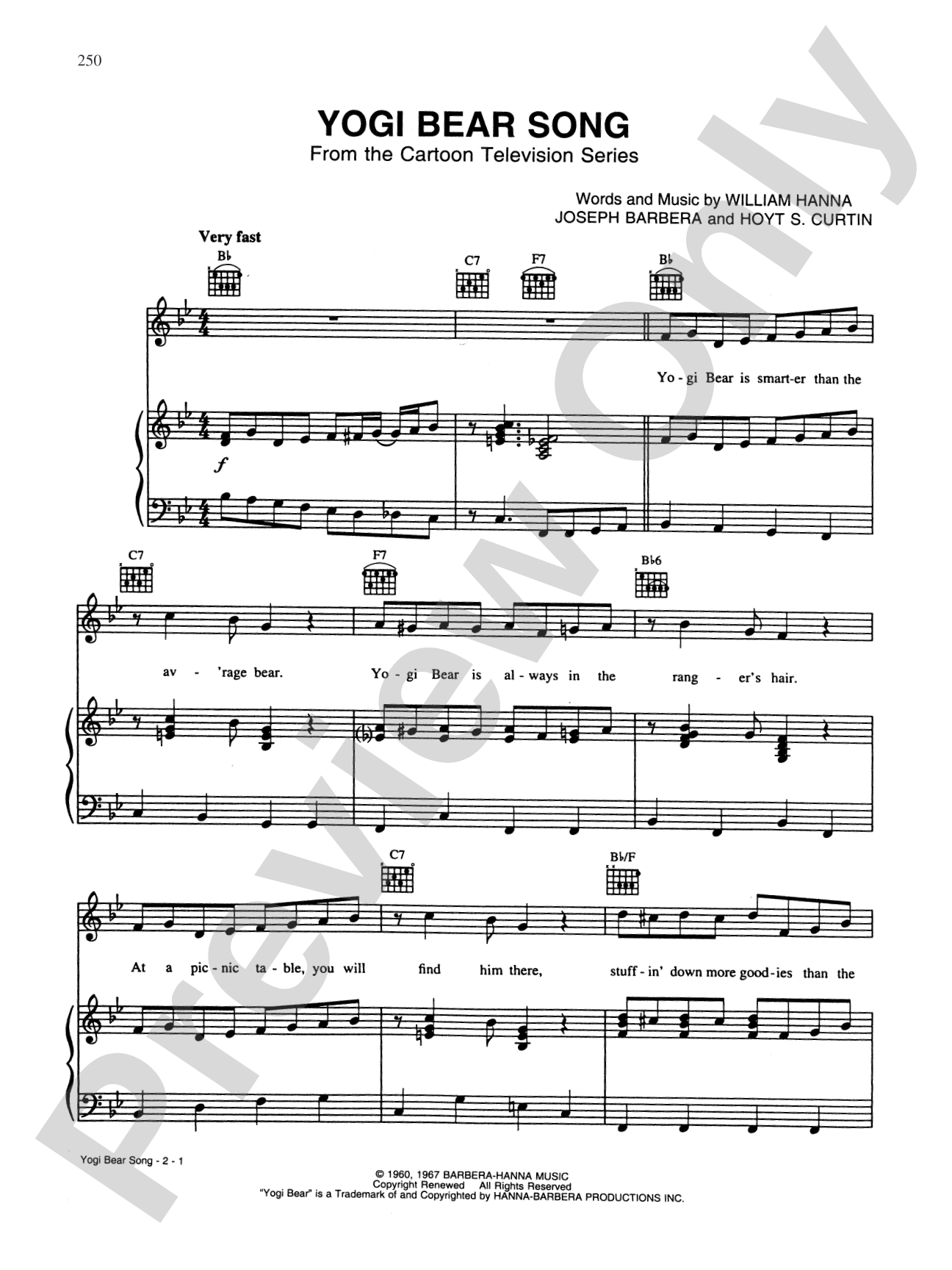

Yogi Bear Song: Piano/Vocal/Chords
Item: 00-PSP-000541
$4.99
One moment…
Related Items
(Meet) The Flintstones: Piano/Vocal/Chords |
$4.99
|
View | |
Anywhere the Heart Goes (From "The Thorn Birds"): Piano/Vocal/Chords |
$4.99
|
View | |
As Long As We Got Each Other (From "Growing Pains"): Piano/Vocal/Chords |
$4.99
|
View | |
Best Friend (From "The Courtship of Eddie's Father"): Piano/Vocal/Chords |
$4.99
|
View | |
California: Piano/Vocal/Chords |
$4.99
|
View | |
Charlie's Angels (Main Theme): Piano/Vocal/Chords |
$4.99
|
View | |
Dallas (Main Title): Piano/Vocal/Chords |
$4.99
|
View | |
Daniel Boone (Main Theme): Piano/Vocal/Chords |
$4.99
|
View | |
E.R. (Main Theme): Piano/Vocal/Chords |
$4.99
|
View | |
Free Willy (Main Title): Piano/Vocal/Chords |
$4.99
|
View | |
Go Go Power Rangers: Piano/Vocal/Chords |
$5.99
|
View | |
Hardcastle & McCormick (Cues): Piano/Vocal/Chords |
$4.99
|
View | |
Huckleberry Hound: Piano/Vocal/Chords |
$4.99
|
View | |
In the Heat of the Night: Piano/Vocal/Chords |
$4.99
|
View | |
It's A Jungle Out There (From "Monk"): Piano/Vocal/Chords |
$4.99
|
View | |
Josie (from "Josie and the Pussycats"): Piano/Vocal/Chords |
$4.99
|
View | |
L.A. Law (Main Title): Piano/Vocal/Chords |
$4.99
|
View | |
Late Show Theme: Piano/Vocal/Chords |
$4.99
|
View | |
Moon Over Parma (From "The Drew Carey Show"): Piano/Vocal/Chords |
$4.99
|
View | |
Road Runner Theme: Piano/Vocal/Chords |
$4.99
|
View | |
Scooby Doo, Where Are You?: Piano/Vocal/Chords |
$4.99
|
View | |
Thank God for a Friend Like You (From "Hope & Gloria"): Piano/Vocal/Chords |
$4.99
|
View | |
The A-Team (Main Theme): Piano/Vocal/Chords |
$4.99
|
View | |
The Ballad of Gilligan's Isle: Piano/Vocal/Chords |
$4.99
|
View | |
The Greatest American Hero (Theme): Piano/Vocal/Chords |
$4.99
|
View | |
The Green Hornet Theme: Piano/Vocal/Chords |
$4.99
|
View | |
The Jetsons (Main Theme): Piano/Vocal/Chords |
$4.99
|
View | |
The Rosie O'Donnell Show (Opening Theme): Piano/Vocal/Chords |
$4.99
|
View | |
The Syncopated Clock (Vocal): Piano/Vocal/Chords |
$4.99
|
View | |
Fantasy Island Theme: Piano/Vocal/Chords |
$4.99
|
View | |
F-Troop Theme: Piano/Vocal/Chords |
$4.99
|
View | |
Hunter Theme: Piano/Vocal/Chords |
$4.99
|
View | |
Peyton Place Theme: Piano/Vocal/Chords |
$4.99
|
View | |
Time for You (From "Jesse"): Piano/Vocal/Chords |
$4.99
|
View |
Description
Each songbook in the Big Book series provides musicians of all ability levels with a big list---usually 40 or more titles per book---of the very best songs from a favorite musical genre.
Songs include As Long as We Got Each Other (Growing Pains) * Bad Boys (Cops) * Batman Theme (Batman) * California (The O.C.) * (Meet) The Flintstones (The Flintstones) * Good Ol' Boys (The Dukes of Hazzard) * I'll Be There for You (Friends) * Movin' On Up (The Jeffersons) * The Pink Panther (The Pink Panther) * Scooby-Doo (Main Title) (Scooby-Doo) * Song from M*A*S*H (M*A*S*H) * This Is It! (The Bugs Bunny Show) * Yogi Bear Song (Yogi Bear) * and many more.


Songs include As Long as We Got Each Other (Growing Pains) * Bad Boys (Cops) * Batman Theme (Batman) * California (The O.C.) * (Meet) The Flintstones (The Flintstones) * Good Ol' Boys (The Dukes of Hazzard) * I'll Be There for You (Friends) * Movin' On Up (The Jeffersons) * The Pink Panther (The Pink Panther) * Scooby-Doo (Main Title) (Scooby-Doo) * Song from M*A*S*H (M*A*S*H) * This Is It! (The Bugs Bunny Show) * Yogi Bear Song (Yogi Bear) * and many more.
Yogi Bear Song: Piano/Vocal/Chords isn't in MakeMusic Cloud just yet...but it could be. Let us know you'd like to see it, and you'll help shape what comes next. In the meantime, start a free trial and dive into thousands of interactive titles your students can play along with today.
Request This Title
Tell us you want it.
Start Your Free Trial
Explore everything that's ready to play right now.
Sample Audio
No sample audio found.
Sample Video
No sample videos found.
Additional Details
Series:
The Big Book Series
Publisher:
Alfred Music
Page Count:
256
SKU:
00-PSP-000541
More about this title
About the Composer: William Hanna
William Hanna (1910-2001) was a pioneering animator and composer whose work defined Saturday morning television for generations. Along with his creative partner Joseph Barbera and composer Hoyt Curtin, Hanna created some of the most recognizable animated characters and themes in entertainment history, with Yogi Bear among the most iconic.
For music educators, Hanna's legacy matters because his themes represent a unique moment when popular television music was composed with genuine craft and melodic strength. These songs remain instantly memorable and emotionally engaging for students across age groups, making them powerful tools for building enthusiasm around music literacy and performance.
Why we love this
This collection captures TV themes that your students will actually recognize and want to play. The Yogi Bear Song sits alongside Friends, Batman, and Scooby-Doo in a carefully curated mix that bridges generations, making it ideal for recital programs, ensemble showcases, or lessons where you need repertoire that connects immediately with learners.
What to expect
Opening this book feels like stepping into the living rooms and Saturday mornings of American pop culture. Each tune carries nostalgia and warmth, from the swinging optimism of The Jeffersons to the playful adventure of Yogi Bear, with melodies so direct and winning that they play themselves.
Who it's for
This book works for adult piano students exploring familiar popular music, vocalists building a recital repertoire, and pianists accompanying singers in lessons or performances. Teachers can also draw from it for community events, variety shows, or programs celebrating television history and popular culture.
How to get the most out of it
- Pay attention to the iconic tag or signature phrase of each theme. These melodies were written to stick with viewers instantly, so highlighting the most memorable moments will bring audiences in immediately.
- Use the chord symbols to experiment with different voicings on the keyboard. TV themes often benefit from fuller, richer harmonic textures than the lead line alone.
- Balance the vocal melody with piano accompaniment so the lyrics remain clear. These songs are as much about the words as the tune.
- Consider the original tempo and feel from the broadcast. Most of these themes have a specific groove or energy that made them work on screen.
How to use it
Feature a single theme as a fun palate-cleanse in a recital, or group several themes together for a "Television Classics" concert segment that engages audiences who might not attend traditional classical programs. This book also works wonderfully for theme-based lesson sequences where you pair a well-known song with technique or theory work.
Skills your students will build
- Reading lead-line melody with piano accompaniment and chord symbols
- Interpreting performance directions from a combined vocal-instrumental score
- Coordinating vocal phrasing with keyboard accompaniment
- Working with standard song forms (verse, chorus, bridge) common to popular music
- Playing from chord symbols and understanding functional harmony in accessible contexts