
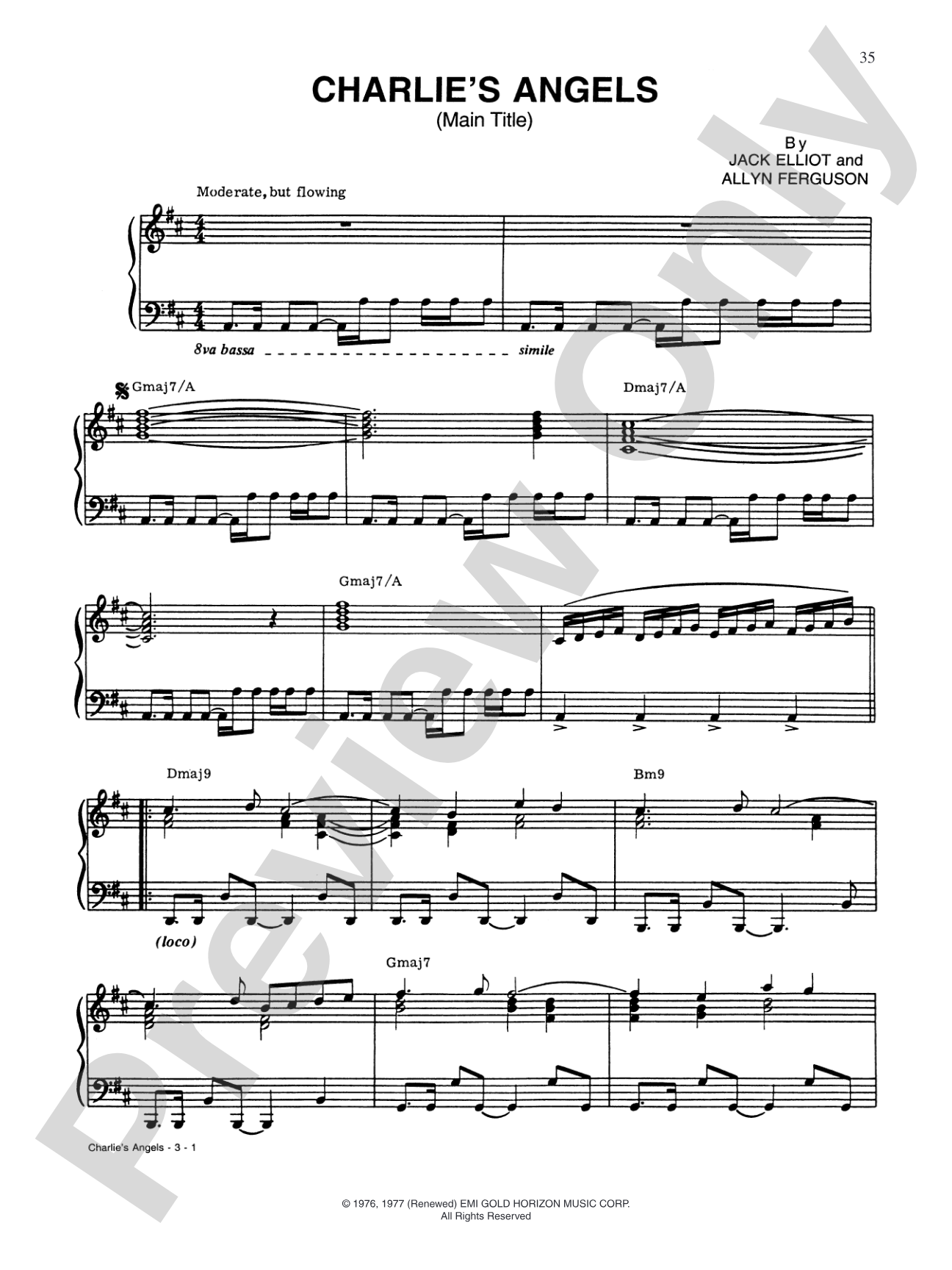

Charlie's Angels (Main Theme): Piano/Vocal/Chords
Item: 00-PSP-000387
$4.99
Pickup currently not available
Related Items
(Meet) The Flintstones: Piano/Vocal/Chords |
$4.99
|
View | |
Anywhere the Heart Goes (From "The Thorn Birds"): Piano/Vocal/Chords |
$4.99
|
View | |
As Long As We Got Each Other (From "Growing Pains"): Piano/Vocal/Chords |
$4.99
|
View | |
Best Friend (From "The Courtship of Eddie's Father"): Piano/Vocal/Chords |
$4.99
|
View | |
California: Piano/Vocal/Chords |
$4.99
|
View | |
Dallas (Main Title): Piano/Vocal/Chords |
$4.99
|
View | |
Daniel Boone (Main Theme): Piano/Vocal/Chords |
$4.99
|
View | |
E.R. (Main Theme): Piano/Vocal/Chords |
$4.99
|
View | |
Free Willy (Main Title): Piano/Vocal/Chords |
$4.99
|
View | |
Go Go Power Rangers: Piano/Vocal/Chords |
$5.99
|
View | |
Hardcastle & McCormick (Cues): Piano/Vocal/Chords |
$4.99
|
View | |
Huckleberry Hound: Piano/Vocal/Chords |
$4.99
|
View | |
In the Heat of the Night: Piano/Vocal/Chords |
$4.99
|
View | |
It's A Jungle Out There (From "Monk"): Piano/Vocal/Chords |
$4.99
|
View | |
Josie (from "Josie and the Pussycats"): Piano/Vocal/Chords |
$4.99
|
View | |
L.A. Law (Main Title): Piano/Vocal/Chords |
$4.99
|
View | |
Late Show Theme: Piano/Vocal/Chords |
$4.99
|
View | |
Moon Over Parma (From "The Drew Carey Show"): Piano/Vocal/Chords |
$4.99
|
View | |
Road Runner Theme: Piano/Vocal/Chords |
$4.99
|
View | |
Scooby Doo, Where Are You?: Piano/Vocal/Chords |
$4.99
|
View | |
Thank God for a Friend Like You (From "Hope & Gloria"): Piano/Vocal/Chords |
$4.99
|
View | |
The A-Team (Main Theme): Piano/Vocal/Chords |
$4.99
|
View | |
The Ballad of Gilligan's Isle: Piano/Vocal/Chords |
$4.99
|
View | |
The Greatest American Hero (Theme): Piano/Vocal/Chords |
$4.99
|
View | |
The Green Hornet Theme: Piano/Vocal/Chords |
$4.99
|
View | |
The Jetsons (Main Theme): Piano/Vocal/Chords |
$4.99
|
View | |
The Rosie O'Donnell Show (Opening Theme): Piano/Vocal/Chords |
$4.99
|
View | |
The Syncopated Clock (Vocal): Piano/Vocal/Chords |
$4.99
|
View | |
Fantasy Island Theme: Piano/Vocal/Chords |
$4.99
|
View | |
F-Troop Theme: Piano/Vocal/Chords |
$4.99
|
View | |
Hunter Theme: Piano/Vocal/Chords |
$4.99
|
View | |
Peyton Place Theme: Piano/Vocal/Chords |
$4.99
|
View | |
Time for You (From "Jesse"): Piano/Vocal/Chords |
$4.99
|
View | |
Yogi Bear Song: Piano/Vocal/Chords |
$4.99
|
View |
Description
Each songbook in the Big Book series provides musicians of all ability levels with a big list---usually 40 or more titles per book---of the very best songs from a favorite musical genre.
Songs include As Long as We Got Each Other (Growing Pains) * Bad Boys (Cops) * Batman Theme (Batman) * California (The O.C.) * (Meet) The Flintstones (The Flintstones) * Good Ol' Boys (The Dukes of Hazzard) * I'll Be There for You (Friends) * Movin' On Up (The Jeffersons) * The Pink Panther (The Pink Panther) * Scooby-Doo (Main Title) (Scooby-Doo) * Song from M*A*S*H (M*A*S*H) * This Is It! (The Bugs Bunny Show) * Yogi Bear Song (Yogi Bear) * and many more.


Songs include As Long as We Got Each Other (Growing Pains) * Bad Boys (Cops) * Batman Theme (Batman) * California (The O.C.) * (Meet) The Flintstones (The Flintstones) * Good Ol' Boys (The Dukes of Hazzard) * I'll Be There for You (Friends) * Movin' On Up (The Jeffersons) * The Pink Panther (The Pink Panther) * Scooby-Doo (Main Title) (Scooby-Doo) * Song from M*A*S*H (M*A*S*H) * This Is It! (The Bugs Bunny Show) * Yogi Bear Song (Yogi Bear) * and many more.
Charlie's Angels (Main Theme): Piano/Vocal/Chords isn't in MakeMusic Cloud just yet...but it could be. Let us know you'd like to see it, and you'll help shape what comes next. In the meantime, start a free trial and dive into thousands of interactive titles your students can play along with today.
Request This Title
Tell us you want it.
Start Your Free Trial
Explore everything that's ready to play right now.
Sample Audio
No sample audio found.
Sample Video
No sample videos found.
Additional Details
Series:
The Big Book Series
Publisher:
Alfred Music
Page Count:
256
SKU:
00-PSP-000387
More about this title
About the Composer: Jack Elliot
Jack Elliot is a composer and musician whose work shaped the sound of American television from the 1960s through the 1980s. His gift for crafting memorable, instantly recognizable themes made him a fixture in TV scoring, where brevity and melodic clarity were essential to capturing audience attention in those opening seconds.
Why we love this
This collection captures the cultural DNA of television's golden age. For pianists and singers working with pop-influenced repertoire, these themes offer genuine musical substance beneath their accessibility: strong melodic hooks, clear harmonic frameworks, and the challenge of nailing character and style in just a few bars. Programming a theme night or building a "music from film and TV" recital becomes instantly engaging.
What to expect
Opening these pages is stepping into a time machine: bright, confident, and unapologetically melodic. Each theme carries the DNA of its era, from the jazzy swagger of detective shows to the playful bounce of cartoons. There's joy in the straightforwardness of these melodies and genuine craftsmanship in their construction.
Who it's for
Pianists and singers seeking repertoire that's both musically satisfying and immediately recognizable. This folio works equally well for students building sight-reading fluency with engaging material, performers assembling variety-show or novelty recitals, and jazz or pop-influenced musicians looking to expand beyond contemporary sources.
How to get the most out of it
- Identify the iconic rhythmic or melodic signature of each theme and commit to it completely. These melodies live in the ear already; your job is to honor what listeners expect while bringing your own personality to the arrangement.
- Shape phrases as if they're opening a scene. Think cinematically about where the melody should breathe, build, and land for maximum impact.
- Use the chord changes as a guide to harmonic color. Many of these themes rely on simple progressions, so lean into voice leading and voicing choices to create richness without overcomplicating the line.
How to use it
Build a standalone recital or concert segment around TV's greatest hits, inviting audiences to sing along on the chorus of a favorite theme. Mix themes with other pop-influenced piano or vocal repertoire for a program that celebrates American popular music across decades. Students can tackle one or two themes as palate-cleansers between more classical fare, or use them as sight-reading assignments that happen to be fun.
Skills your students will build
- Identifying and executing melodic hooks under time pressure
- Reading piano/vocal/chords notation with fluency
- Balancing melodic clarity with harmonic accompaniment
- Stylistic interpretation of mid-20th-century popular song writing
- Quick preparation of short, self-contained pieces