
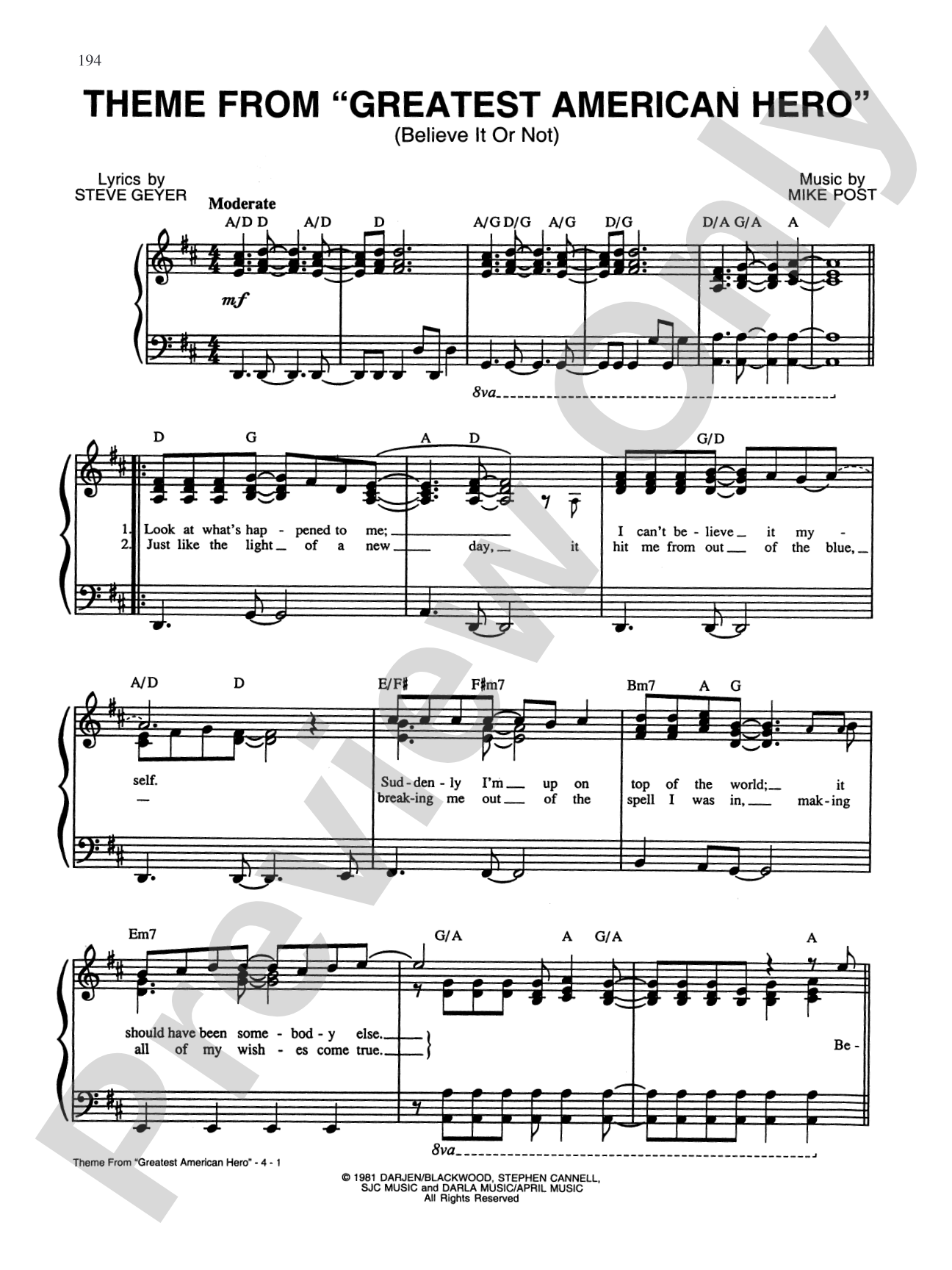

The Greatest American Hero (Theme): Piano/Vocal/Chords
Item: 00-PSP-000502
$4.99
One moment…
Related Items
(Meet) The Flintstones: Piano/Vocal/Chords |
$4.99
|
View | |
Anywhere the Heart Goes (From "The Thorn Birds"): Piano/Vocal/Chords |
$4.99
|
View | |
As Long As We Got Each Other (From "Growing Pains"): Piano/Vocal/Chords |
$4.99
|
View | |
Best Friend (From "The Courtship of Eddie's Father"): Piano/Vocal/Chords |
$4.99
|
View | |
California: Piano/Vocal/Chords |
$4.99
|
View | |
Charlie's Angels (Main Theme): Piano/Vocal/Chords |
$4.99
|
View | |
Dallas (Main Title): Piano/Vocal/Chords |
$4.99
|
View | |
Daniel Boone (Main Theme): Piano/Vocal/Chords |
$4.99
|
View | |
E.R. (Main Theme): Piano/Vocal/Chords |
$4.99
|
View | |
Free Willy (Main Title): Piano/Vocal/Chords |
$4.99
|
View | |
Go Go Power Rangers: Piano/Vocal/Chords |
$5.99
|
View | |
Hardcastle & McCormick (Cues): Piano/Vocal/Chords |
$4.99
|
View | |
Huckleberry Hound: Piano/Vocal/Chords |
$4.99
|
View | |
In the Heat of the Night: Piano/Vocal/Chords |
$4.99
|
View | |
It's A Jungle Out There (From "Monk"): Piano/Vocal/Chords |
$4.99
|
View | |
Josie (from "Josie and the Pussycats"): Piano/Vocal/Chords |
$4.99
|
View | |
L.A. Law (Main Title): Piano/Vocal/Chords |
$4.99
|
View | |
Late Show Theme: Piano/Vocal/Chords |
$4.99
|
View | |
Moon Over Parma (From "The Drew Carey Show"): Piano/Vocal/Chords |
$4.99
|
View | |
Road Runner Theme: Piano/Vocal/Chords |
$4.99
|
View | |
Scooby Doo, Where Are You?: Piano/Vocal/Chords |
$4.99
|
View | |
Thank God for a Friend Like You (From "Hope & Gloria"): Piano/Vocal/Chords |
$4.99
|
View | |
The A-Team (Main Theme): Piano/Vocal/Chords |
$4.99
|
View | |
The Ballad of Gilligan's Isle: Piano/Vocal/Chords |
$4.99
|
View | |
The Green Hornet Theme: Piano/Vocal/Chords |
$4.99
|
View | |
The Jetsons (Main Theme): Piano/Vocal/Chords |
$4.99
|
View | |
The Rosie O'Donnell Show (Opening Theme): Piano/Vocal/Chords |
$4.99
|
View | |
The Syncopated Clock (Vocal): Piano/Vocal/Chords |
$4.99
|
View | |
Fantasy Island Theme: Piano/Vocal/Chords |
$4.99
|
View | |
F-Troop Theme: Piano/Vocal/Chords |
$4.99
|
View | |
Hunter Theme: Piano/Vocal/Chords |
$4.99
|
View | |
Peyton Place Theme: Piano/Vocal/Chords |
$4.99
|
View | |
Time for You (From "Jesse"): Piano/Vocal/Chords |
$4.99
|
View | |
Yogi Bear Song: Piano/Vocal/Chords |
$4.99
|
View |
Description
Each songbook in the Big Book series provides musicians of all ability levels with a big list---usually 40 or more titles per book---of the very best songs from a favorite musical genre.
Songs include As Long as We Got Each Other (Growing Pains) * Bad Boys (Cops) * Batman Theme (Batman) * California (The O.C.) * (Meet) The Flintstones (The Flintstones) * Good Ol' Boys (The Dukes of Hazzard) * I'll Be There for You (Friends) * Movin' On Up (The Jeffersons) * The Pink Panther (The Pink Panther) * Scooby-Doo (Main Title) (Scooby-Doo) * Song from M*A*S*H (M*A*S*H) * This Is It! (The Bugs Bunny Show) * Yogi Bear Song (Yogi Bear) * and many more.


Songs include As Long as We Got Each Other (Growing Pains) * Bad Boys (Cops) * Batman Theme (Batman) * California (The O.C.) * (Meet) The Flintstones (The Flintstones) * Good Ol' Boys (The Dukes of Hazzard) * I'll Be There for You (Friends) * Movin' On Up (The Jeffersons) * The Pink Panther (The Pink Panther) * Scooby-Doo (Main Title) (Scooby-Doo) * Song from M*A*S*H (M*A*S*H) * This Is It! (The Bugs Bunny Show) * Yogi Bear Song (Yogi Bear) * and many more.
The Greatest American Hero (Theme): Piano/Vocal/Chords isn't in MakeMusic Cloud just yet...but it could be. Let us know you'd like to see it, and you'll help shape what comes next. In the meantime, start a free trial and dive into thousands of interactive titles your students can play along with today.
Request This Title
Tell us you want it.
Start Your Free Trial
Explore everything that's ready to play right now.
Sample Audio
No sample audio found.
Sample Video
No sample videos found.
Additional Details
Series:
The Big Book Series
Publisher:
Alfred Music
Page Count:
256
SKU:
00-PSP-000502
More about this title
About the Composer: Mike Post
Mike Post is a prolific composer and television music specialist whose work has defined the sound of American television for over five decades. His gift for creating instantly recognizable themes and underscores has made him one of the most performed composers in broadcast history, with credits spanning Law & Order, The Greatest American Hero, Magnum P.I., and dozens of other series that shaped popular culture.
Post's approach to television composition combines accessibility with sophistication, crafting melodies that are memorable enough to hum yet structurally rich enough to sustain repeated listening. His influence on how musicians understand functional, character-driven composition makes his work valuable in any educational setting where students engage with media music.
Why we love this
This collection captures a generation's worth of TV themes in one volume, giving singers and pianists immediate access to material that genuinely excites audiences. The genre variety means you can teach melodic writing, harmonic function, and arrangement choices across wildly different musical styles without leaving the folio. Songs like The Greatest American Hero theme sit comfortably alongside The Pink Panther and The Flintstones, offering real teaching moments about how different compositional approaches solve the problem of creating a memorable identity for visual media.
What to expect
Opening this collection feels like stepping into a time capsule of American pop culture from the 1960s onward. Each theme carries the distinctive personality of its show: the smooth sophistication of Mission: Impossible, the playful energy of Scooby-Doo, the dramatic flair of Batman. Together, they create a landscape where nostalgia meets genuine musicianship, and where seemingly simple melodies reveal thoughtful harmonic and orchestrational choices when you dig deeper.
Who it's for
Singers preparing cabaret or recital programs built around TV themes will find material that audiences recognize instantly and that sits well for different voice types. Piano students and accompanists benefit from the chord-based format, which builds fluency with jazz and pop harmonic language alongside classical training. Community musicians and small ensemble players can pull individual songs to arrange, perform, or teach from without needing multiple specialized sources.
How to get the most out of it
- Study the chord symbols as a harmonic roadmap before diving into the melody; many of these themes use jazz and pop conventions (ii-V progressions, unexpected chromatic moves) that reward careful harmonic awareness.
- Sing or play the main theme a few times without the page to lock the melody into your ear, then let the chord chart guide accompaniment choices and fills.
- Layer accompaniment textures gradually: start with simple root-position chords, then add rhythmic grooves and passing tones once the basic progression feels secure.
- Pay attention to the original theme's rhythmic character in the source material; these transcriptions preserve those details, and nailing the groove makes the melody land authentically.
How to use it
Program themed concerts around specific decades of television (1970s sitcoms, 1980s action shows, 1990s drama) and let audiences engage with music they already love. Use individual themes as optional recital or practice material for singers and pianists building confidence with contemporary repertoire that rewards both accuracy and interpretation. Extract themes for small ensemble arrangement projects, where students can study how Post crafted these melodies to work across different instrumental and vocal configurations.
Skills your students will build
- Reading and interpreting chord symbols in jazz and pop contexts
- Accompanying singers with rhythmic accuracy and harmonic understanding
- Recognizing and performing different groove patterns (swing, shuffle, straight feel) as indicated by notation
- Balancing melody and accompaniment texture in arrangements
- Transposing themes to accommodate different voice types and instrument ranges