
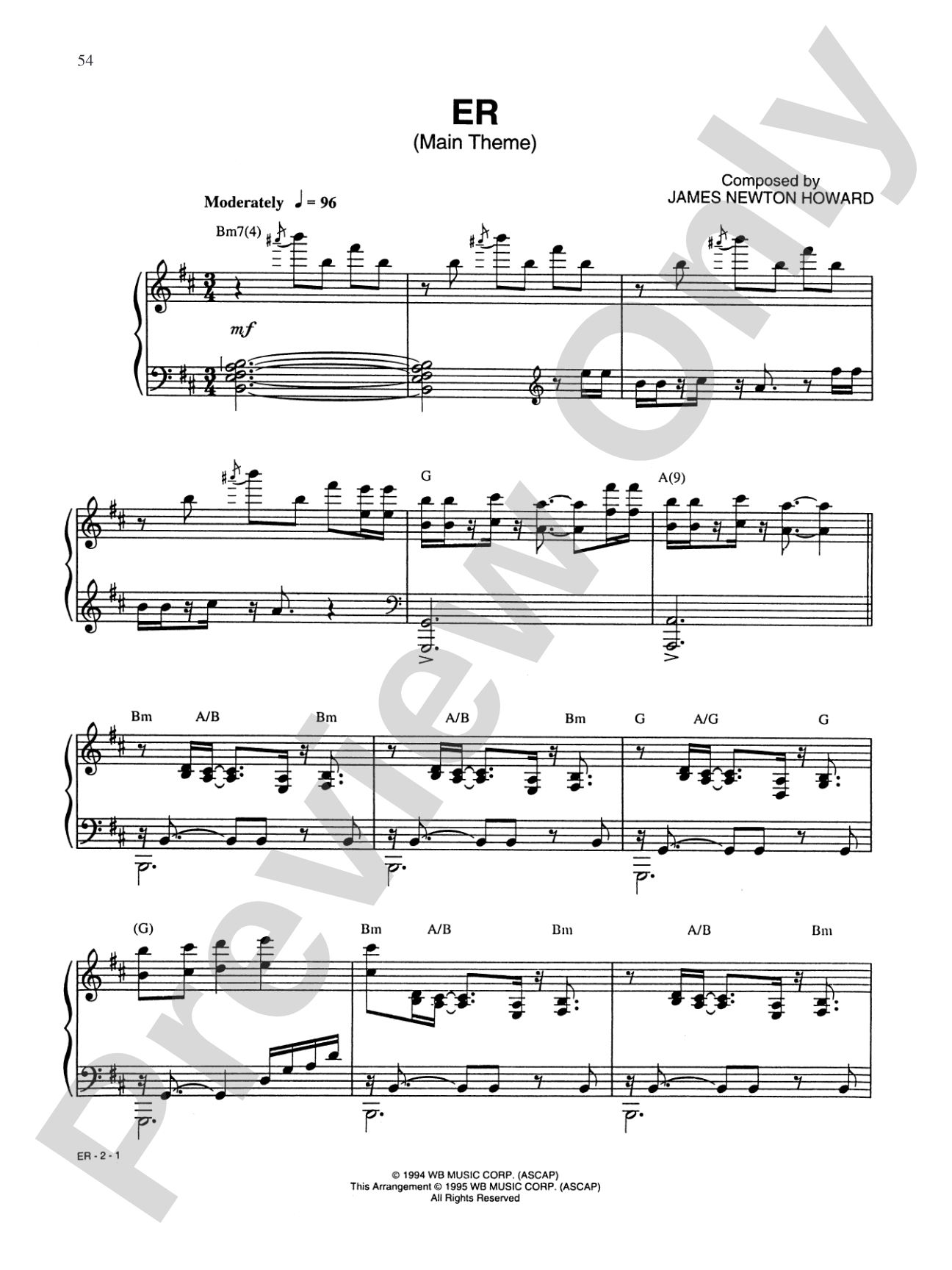

E.R. (Main Theme): Piano/Vocal/Chords
Item: 00-PSP-000410
$4.99
Pickup currently not available
Related Items
(Meet) The Flintstones: Piano/Vocal/Chords |
$4.99
|
View | |
Anywhere the Heart Goes (From "The Thorn Birds"): Piano/Vocal/Chords |
$4.99
|
View | |
As Long As We Got Each Other (From "Growing Pains"): Piano/Vocal/Chords |
$4.99
|
View | |
Best Friend (From "The Courtship of Eddie's Father"): Piano/Vocal/Chords |
$4.99
|
View | |
California: Piano/Vocal/Chords |
$4.99
|
View | |
Charlie's Angels (Main Theme): Piano/Vocal/Chords |
$4.99
|
View | |
Dallas (Main Title): Piano/Vocal/Chords |
$4.99
|
View | |
Daniel Boone (Main Theme): Piano/Vocal/Chords |
$4.99
|
View | |
Free Willy (Main Title): Piano/Vocal/Chords |
$4.99
|
View | |
Go Go Power Rangers: Piano/Vocal/Chords |
$5.99
|
View | |
Hardcastle & McCormick (Cues): Piano/Vocal/Chords |
$4.99
|
View | |
Huckleberry Hound: Piano/Vocal/Chords |
$4.99
|
View | |
In the Heat of the Night: Piano/Vocal/Chords |
$4.99
|
View | |
It's A Jungle Out There (From "Monk"): Piano/Vocal/Chords |
$4.99
|
View | |
Josie (from "Josie and the Pussycats"): Piano/Vocal/Chords |
$4.99
|
View | |
L.A. Law (Main Title): Piano/Vocal/Chords |
$4.99
|
View | |
Late Show Theme: Piano/Vocal/Chords |
$4.99
|
View | |
Moon Over Parma (From "The Drew Carey Show"): Piano/Vocal/Chords |
$4.99
|
View | |
Road Runner Theme: Piano/Vocal/Chords |
$4.99
|
View | |
Scooby Doo, Where Are You?: Piano/Vocal/Chords |
$4.99
|
View | |
Thank God for a Friend Like You (From "Hope & Gloria"): Piano/Vocal/Chords |
$4.99
|
View | |
The A-Team (Main Theme): Piano/Vocal/Chords |
$4.99
|
View | |
The Ballad of Gilligan's Isle: Piano/Vocal/Chords |
$4.99
|
View | |
The Greatest American Hero (Theme): Piano/Vocal/Chords |
$4.99
|
View | |
The Green Hornet Theme: Piano/Vocal/Chords |
$4.99
|
View | |
The Jetsons (Main Theme): Piano/Vocal/Chords |
$4.99
|
View | |
The Rosie O'Donnell Show (Opening Theme): Piano/Vocal/Chords |
$4.99
|
View | |
The Syncopated Clock (Vocal): Piano/Vocal/Chords |
$4.99
|
View | |
Fantasy Island Theme: Piano/Vocal/Chords |
$4.99
|
View | |
F-Troop Theme: Piano/Vocal/Chords |
$4.99
|
View | |
Hunter Theme: Piano/Vocal/Chords |
$4.99
|
View | |
Peyton Place Theme: Piano/Vocal/Chords |
$4.99
|
View | |
Time for You (From "Jesse"): Piano/Vocal/Chords |
$4.99
|
View | |
Yogi Bear Song: Piano/Vocal/Chords |
$4.99
|
View |
Description
Each songbook in the Big Book series provides musicians of all ability levels with a big list---usually 40 or more titles per book---of the very best songs from a favorite musical genre.
Songs include As Long as We Got Each Other (Growing Pains) * Bad Boys (Cops) * Batman Theme (Batman) * California (The O.C.) * (Meet) The Flintstones (The Flintstones) * Good Ol' Boys (The Dukes of Hazzard) * I'll Be There for You (Friends) * Movin' On Up (The Jeffersons) * The Pink Panther (The Pink Panther) * Scooby-Doo (Main Title) (Scooby-Doo) * Song from M*A*S*H (M*A*S*H) * This Is It! (The Bugs Bunny Show) * Yogi Bear Song (Yogi Bear) * and many more.


Songs include As Long as We Got Each Other (Growing Pains) * Bad Boys (Cops) * Batman Theme (Batman) * California (The O.C.) * (Meet) The Flintstones (The Flintstones) * Good Ol' Boys (The Dukes of Hazzard) * I'll Be There for You (Friends) * Movin' On Up (The Jeffersons) * The Pink Panther (The Pink Panther) * Scooby-Doo (Main Title) (Scooby-Doo) * Song from M*A*S*H (M*A*S*H) * This Is It! (The Bugs Bunny Show) * Yogi Bear Song (Yogi Bear) * and many more.
E.R. (Main Theme): Piano/Vocal/Chords isn't in MakeMusic Cloud just yet...but it could be. Let us know you'd like to see it, and you'll help shape what comes next. In the meantime, start a free trial and dive into thousands of interactive titles your students can play along with today.
Request This Title
Tell us you want it.
Start Your Free Trial
Explore everything that's ready to play right now.
Sample Audio
No sample audio found.
Sample Video
No sample videos found.
Additional Details
Series:
The Big Book Series
Publisher:
Alfred Music
Page Count:
256
SKU:
00-PSP-000410
More about this title
About the Composer: James Newton Howard
James Newton Howard is a composer whose work spans film, television, and concert music. His sophisticated harmonic language and memorable melodic writing have made him one of the most prolific composers for visual media, with scores for dozens of television series and feature films that reach millions of viewers annually.
Howard's approach to composition balances accessibility with musical substance, a quality that makes his work particularly valuable in educational settings. His television themes are instantly recognizable yet constructed with enough harmonic and rhythmic interest to sustain repeated listening and serious musical study.
Why we love this
This collection lets you teach iconic television themes through the lens of a single major composer. Howard's melodies are singable and memorable, his harmonic progressions are clear enough for students to understand chord function, and the piano/vocal format makes these themes accessible to singers, pianists, and anyone learning to read lead sheets. Rather than scattering theme songs across multiple books, you can build a unit around how one composer shapes the sound of television.
What to expect
These themes carry the emotional weight of their source material: some are bright and comedic, others dramatic and urgent. As written piano/vocal arrangements, they retain their signature hooks while inviting personal interpretation through accompaniment choices and vocal inflection.
Who it's for
Pianists and vocalists preparing material for recitals, auditions, or casual performance will find solid, recognizable repertoire here. Music students studying composition, arranging, or television music can use these scores as models for how themes are constructed and harmonized.
How to get the most out of it
- Study the chord symbols before playing to understand the harmonic movement; Howard often uses unexpected substitutions that reward close reading.
- Sing the melody while playing the chord progression to internalize how melody and harmony interact in theme writing.
- Record yourself playing the accompaniment, then sing the melody over it to develop independence between hands or between voice and keyboard.
How to use it
Select a few Howard themes to create a "Television Themes" segment in a recital or showcase, pairing them with non-soundtrack material to demonstrate genre range. For piano students, theme songs offer shorter, highly motivating pieces alongside more traditional classical repertoire.
Skills your students will build
- Reading and interpreting chord symbols (both basic triads and extended chords)
- Connecting melody to harmonic function in popular music contexts
- Sight-reading lead sheets with professional chord notation
- Singing or playing in a style that balances pop/television idiom with musical intention